
As an affiliate, we may earn a commission from qualifying purchases. We get commissions for purchases made through links on this website from Amazon and other third parties.
Best Overall
Best 1-Inch Heavy-Duty Housing
Best Standard 10-Inch Housing
A filter housing is only the shell around the cartridge, but it can become one of the highest-consequence parts of a rainwater plumbing system. A cracked sump, damaged thread insert, pinched O-ring, or weak bracket can leak far more water than a clogged cartridge ever will.
Choose the housing before choosing a cartridge only when you already know the cartridge format, pipe size, pressure, flow, and service space the system needs. The housing does not define the filtration result by itself. A 10-inch or 20-inch body can hold sediment, carbon, or other compatible cartridges with very different treatment roles.
The four housings here use common large-diameter cartridge formats. For rainwater, they make the most sense after coarse tank sediment has already been reduced. Keeping grit out of the housing extends cartridge life and makes each filter change less messy.
Filter Housings at a Glance
| Product | Best For | Main Strength | Main Tradeoff |
|---|---|---|---|
| SimPure DB10P | Flexible 10 x 4.5 in systems | Big Blue cartridge format with several threaded port options and mounting hardware | Plastic housing can crack over time |
| Culligan WH-HD200-C | 1-inch main lines | 1-inch ports, clear sump, bypass and pressure-relief features | Housing and bypass leaks appear in long-term use |
| Geekpure 10-Inch Housing | Basic 4.5 x 10 in filter stages | Standard cartridge format and 1-inch port product claim | Not universal across housing-cap brands; bottom cracking has occurred |
| MewMore WHT20 | 20 x 4.5 in cartridges | Larger cartridge format and 1-inch inlet product claim | Multiple housing, O-ring, bracket, and pressure failures lower confidence |
Cartridge Size Changes Flow and Service Space
A 4.5-by-10-inch cartridge housing is easier to fit into a small pump room. A 4.5-by-20-inch housing provides more cartridge area but needs roughly twice the vertical service clearance and becomes heavier when full of water.
Do not mount a long housing where the cartridge cannot drop out from below. Leave room for the wrench, your hands, and a catch pan. A filter installed neatly against the floor can become impossible to service without cutting plumbing later.
Pipe size matters too. Reducing a one-inch main to a smaller filter connection may add pressure loss. At the same time, a one-inch housing does not guarantee one-inch flow if the cartridge itself is restrictive or clogged.
A Flexible 10-Inch Big Blue Housing
1 / 4
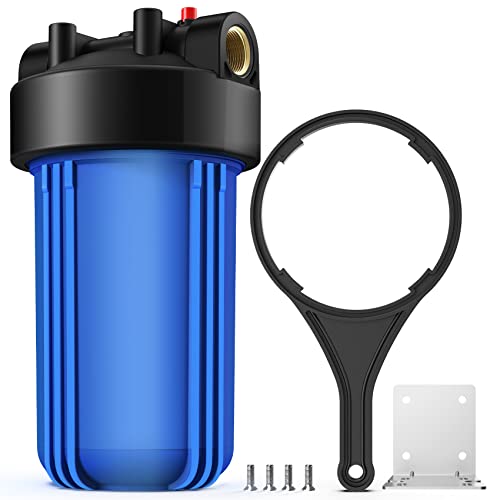
SimPure DB10P 10-Inch Big Blue Filter Housing
Cartridge Format
10 x 4.5 in
Ports
1 in MNPT, 3/4 in FNPT and 3/4 in MNPT product claim
Mounting
Steel bracket
Service
Housing wrench included
The SimPure DB10P is the most versatile housing here for a compact rainwater filter stage. It accepts standard 10-by-4.5-inch cartridges and provides several documented thread options around one-inch and 3/4-inch plumbing, making it easier to adapt to different pump and treatment layouts without reducing everything to one connection size.
A steel mounting bracket, wrench, and installation hardware are included. Product-specific use supports simple installation and useful sediment capture once a suitable cartridge is installed. This makes it a practical first housing for a sediment or carbon stage where floor-to-ceiling clearance is limited.
Long-term housing integrity is the main caution. A sump crack developed in one installation after months of service. The prepared material, dimension, and capacity fields also conflict, so those values are not used here. Install the housing where leaks can be noticed, isolate it with valves, and inspect the sump during every cartridge change.
Why It Works
- Standard 10-by-4.5-inch cartridge format gives many filter-media choices.
- Multiple threaded port options improve plumbing flexibility.
- Mounting bracket and wrench simplify a fixed installation.
- Compact cartridge length needs less service clearance than a 20-inch housing.
What To Keep In Mind
- Plastic sump cracking has occurred over time.
- Do not overuse thread tape around brass inserts.
- Filter cartridge is sold separately and determines treatment performance.
A 1-Inch Housing With Built-In Bypass Features
2 / 4
Culligan WH-HD200-C Heavy-Duty Filter Housing

Ports
1 in inlet/outlet
Sump
Clear
Service
Pressure relief
Valve
Built-in shutoff/bypass
Cartridge
Sold separately
The Culligan WH-HD200-C is useful when the rainwater plumbing already uses a one-inch main line and you want to avoid necking down just to add a filter housing. Its clear sump lets you see cartridge discoloration and sediment buildup, while the built-in shutoff/bypass and pressure-relief features are intended to make servicing easier.
The housing accepts compatible heavy-duty whole-house cartridges, so the installed media can be selected for sediment or another supported function. The cartridge is sold separately, which is actually helpful when the water-quality problem is already known and you do not want to be locked into one media type.
Long-term leak history keeps it out of the top spot. Product-specific use includes several years of reliable service followed by leaks from the housing or valve assembly. Treat the bypass as a convenience, not as a reason to omit proper isolation valves if the installation would be difficult to repair during a failure.
Why It Works
- One-inch ports suit larger pump-fed residential lines.
- Clear sump makes cartridge condition visible.
- Pressure-relief feature helps before opening the housing.
- Compatible cartridge choice lets the housing serve different filter stages.
What To Keep In Mind
- Long-term housing and bypass leaks have occurred.
- Inspect the clear sump and valve at every service interval.
- Do not assume the housing's presence defines micron rating or contaminant removal.
A Standard 10-Inch Housing With 1-Inch Ports
3 / 4
Geekpure 10-Inch Whole-House Filter Housing

Cartridge Format
4.5 x 10 in
Port
1 in product claim
Documented Working Pressure
10-60 psi
Documented Flow
5-15 GPM depending on inlet pressure
The Geekpure housing is another straightforward choice for standard 4.5-by-10-inch cartridges. Its product documentation gives a one-inch port, a working-pressure range of 10–60 psi, and flow of roughly 5–15 GPM depending on inlet pressure. Those numbers make it easier to evaluate against a rainwater pump than a housing sold only by cartridge size.
Product-specific use includes installations that remained leak-free for a year or more, but also a sump that cracked around the bottom. The O-ring must sit correctly in its groove, and the product specifically warns against excessive thread tape.
One compatibility detail matters: the housing cap and sump are not presented as interchangeable with other brands even though the cartridge format is standard. Standard cartridge size does not mean standard housing threads.
Why It Works
- Uses common 4.5-by-10-inch cartridges.
- One-inch port product claim suits many pump-fed lines.
- Documented pressure and flow ranges help with system sizing.
- Compact height is easier to service than a 20-inch housing.
What To Keep In Mind
- Housing cap and sump are not universal across brands.
- Bottom cracking has occurred in product-specific use.
- Seat and lubricate the O-ring as directed during filter changes.
A 20-Inch Housing for Larger Cartridges
4 / 4
MewMore WHT20 Whole-House Filter Housing

Cartridge Format
20 x 4.5 in
Port
1 in product claim
Pressure Relief
Included
Documented Pressure Range
20-90 psi
The MewMore WHT20 has a clear role for systems that specifically need a 20-by-4.5-inch cartridge. The longer format provides more cartridge area, and the product includes a mounting bracket, wrench, pressure-relief button, and one-inch inlet claim.
That larger format would normally be attractive for whole-house flow, but the product-specific durability record is poor. Hairline cracking at a thread insert, O-ring failures, a bottom seam failure, and a weak bracket all appear in the prepared customer material. Those are serious weaknesses for a housing that may sit under continuous pump pressure.
The prepared material and dimension fields conflict, so the article does not rely on those values. It stays in the roundup because it is the only clear 20-inch option, but it ranks last and should be installed only with close attention to pressure, support, isolation, and leak consequences.
Why It Works
- Accepts large 20-by-4.5-inch cartridges.
- One-inch port product claim suits higher-flow plumbing layouts.
- Pressure-relief button helps before housing removal.
- Larger cartridge format can reduce replacement frequency when the media and sediment load are appropriate.
What To Keep In Mind
- Multiple housing and seal failures reduce confidence.
- Long housing needs substantial vertical service clearance and strong mounting.
- Protect sensitive indoor areas from possible filter-housing leaks.
Clear or Opaque Filter Housing?
A clear sump makes sediment loading easy to see. That can be useful during the first months of a rainwater installation while you learn how quickly the cartridges become dirty.
An opaque housing removes that visual check but may be preferable in locations exposed to light, because light can encourage biological growth in water-filled transparent components. Follow the housing and cartridge manufacturer's installation conditions rather than leaving any whole-house filter in direct sun.
Build Serviceability Into the Plumbing
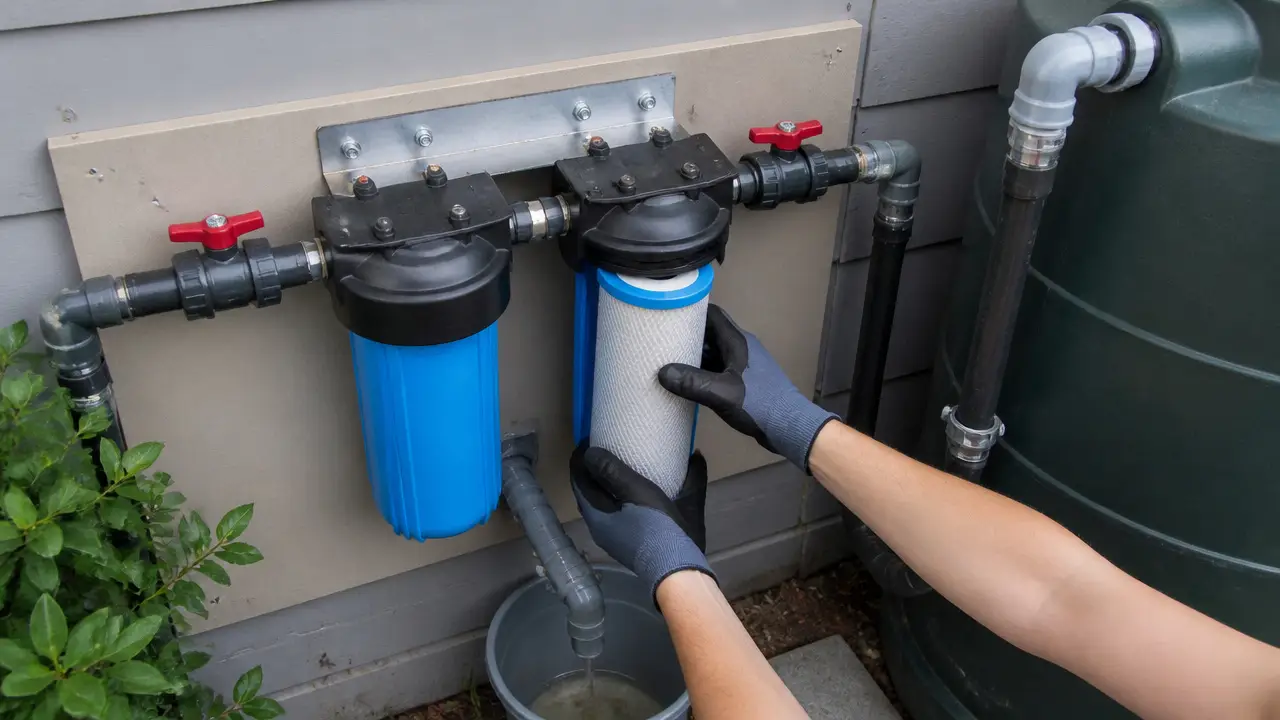
Use isolation valves so the filter can be opened without draining the entire system. A bypass can keep appropriate non-treatment water service available during maintenance where the plumbing design permits it.
Mount the housing to a strong surface. A water-filled 20-inch housing and cartridge are much heavier than the empty assembly. Support the pipes independently instead of asking plastic filter ports to carry the plumbing load.
Place a drain pan or leak detector where a housing failure could damage a building. Housings are replaceable pressure vessels and should be inspected rather than treated as permanent plumbing.
Common Filter-Housing Problems
The Sump Will Not Seal After a Cartridge Change
Remove pressure, reopen the housing, inspect the O-ring for twists or damage, clean the sealing surfaces, and reinstall according to the manufacturer's instructions.
Threaded Ports Leak
Use the specified thread-sealing method and avoid excessive tape that can stress an insert. Support connected pipe so it does not lever against the housing head.
Flow Drops Even With a Large Housing
The cartridge may be clogged or too restrictive for the system. Housing size alone does not determine flow.
The Housing Cracks
Shut the system down immediately. Replace a cracked pressure housing rather than attempting a patch on a component designed to contain water under pressure.
Cartridge Changes Are Difficult
More service clearance, proper isolation valves, a pressure-relief step, and the correct housing wrench usually matter more than brute force.
Frequently Asked Questions
What size filter housing is best for a rainwater system?
Use the cartridge format, flow demand, pump pressure, pipe size, and available service space to choose. Ten-inch Big Blue housings are compact; 20-inch housings offer more cartridge area but need more clearance.
Does a filter housing come with a filter cartridge?
Not always. Several housings here are sold without the cartridge, allowing you to choose sediment, carbon, or another compatible media separately.
Is a one-inch filter housing better than 3/4 inch?
It may reduce connection bottlenecks on a one-inch main line, but the cartridge and housing internals still affect actual flow and pressure loss.
How often should a filter housing be replaced?
There is no universal interval. Inspect the sump, threads, O-ring, bracket, and valve during every cartridge change and replace any housing showing cracks, deformation, or damage.
Can a clear filter housing be installed outdoors?
Only if the product is rated for the installation conditions. Sunlight, freezing, heat, and weather exposure can shorten housing life or encourage growth in clear water-filled components.
Does the filter housing make rainwater safe to drink?
No. The housing only holds treatment media. Potable use depends on the entire treatment system, suitable components, local requirements, and current water testing.
For complete cartridge systems rather than empty housings, whole-house filters for rainwater compares multi-stage assemblies. If coarse tank sediment is the main problem, rainwater filters includes reusable spin-down stages that can protect disposable cartridges. Before storage, rainwater pre-filters can reduce the debris entering the tank. And rainwater test kits can help identify which water-quality questions need further testing or treatment rather than choosing cartridge media blindly.