As an affiliate, we may earn a commission from qualifying purchases. We get commissions for purchases made through links on this website from Amazon and other third parties.
Rainwater filtration usually works best as a series of stages, not as one filter. Each stage handles a different job. The early stages keep leaves and dirt out. Later stages remove smaller particles or specific contaminants. If the water will be used for drinking, treatment may also need to address harmful germs and chemicals.
The right number of stages depends on how you plan to use the water. Water for a garden hose may need only basic debris control. Water used inside a home needs much more careful treatment and testing.
Current CDC guidance says collected rainwater is not automatically safe to drink. Roof runoff can contain germs and chemicals even when the water looks clear. CDC recommends regular testing when rainwater is used for drinking, cooking, or bathing.
The Main Rainwater Filtration Stages
A complete rainwater system can include these stages:
- Keep contamination away from the collection surface.
- Screen out leaves and large debris.
- Divert the first dirty roof runoff.
- Let heavier material settle in the storage tank.
- Filter sediment and smaller particles.
- Treat specific dissolved contaminants when needed.
- Disinfect the water when the intended use requires microbial control.
- Protect the treated water until it reaches the point of use.
Not every system needs every stage.
A rain barrel feeding ornamental plants may stop after the first few stages. A system supplying showers, sinks, or drinking water needs a treatment plan based on the source water, intended use, testing, local requirements, and ongoing maintenance.
Stage 1: Keep Contamination Out Before Filtration
The easiest material to filter is material that never enters the system.
Rainwater can collect contaminants as it passes through:
- The air
- Roofing materials
- Gutters
- Downspouts
- Bird and animal waste
- Dust
- Leaves
- Pollen
- Storage tanks
- Pipes and fittings
CDC notes that roof runoff can pick up germs as well as chemicals such as lead or copper from roofing, gutters, piping, or other collection materials.
This makes source control the first treatment stage.
Keep gutters reasonably clean. Remove accumulated leaves and organic matter. Make sure roof materials, coatings, flashing, pipes, tanks, and fittings are suitable for the intended water use.
For drinking-water systems, material suitability deserves extra attention. A filter installed downstream cannot be assumed to correct every chemical problem introduced by the roof or collection system.
Stage 2: Leaf Screens and Inlet Screens
Screens remove larger material before it reaches your tank.
They may be installed at:
- Gutters
- Downspouts
- Rain heads
- Tank inlets
- Rain barrel openings
A coarse screen can catch leaves, twigs, insects, and larger debris.
This protects later parts of the system. Without a screen, large debris can collect in pipes and tanks or clog finer filters quickly.
Screening is not fine filtration
A screen does not make rainwater clean enough for drinking.
The openings are much larger than most microorganisms and many fine particles. Its main job is to reduce the amount of physical debris entering the system.
Screens also need cleaning. A badly clogged screen can slow water entering the tank and may cause valuable runoff to spill away during heavy rain.
Stage 3: First-Flush Diversion
The beginning of a rainstorm often carries a heavy load of dirt from the roof.
A first-flush diverter sends some of this initial runoff away from the storage tank.
After a dry period, a roof may hold:
- Dust
- Bird droppings
- Pollen
- Insects
- Small leaves
- Airborne particles
The first water flowing across the roof washes much of this material toward the downspout.
CDC recommends considering first-flush diversion as one way to improve collected rainwater quality. The appropriate amount to divert depends in part on the roof area feeding the collection system.
A first flush is pretreatment
A first-flush diverter reduces the amount of contamination entering storage. It does not guarantee that later rainwater is free from germs or chemicals.
It also needs maintenance. Depending on the design, the chamber or drain may need to empty between storms and periodically be cleaned.
Stage 4: Settling Inside the Storage Tank
Once rainwater enters a barrel, IBC tote, or cistern, gravity can provide another treatment step.
Heavier particles gradually settle toward the bottom.
This process is called sedimentation.
It is one reason water taken from slightly above the tank floor may contain less settled material than water pulled directly from the lowest point.
Settling can reduce the workload placed on downstream filters, but it does not remove everything. Fine particles may stay suspended, and dissolved chemicals will not simply settle out.
Tank design and maintenance still matter.
Sediment that builds up for years can become difficult to remove and may affect water quality. Tanks should be inspected and cleaned when needed rather than treated as maintenance-free storage.
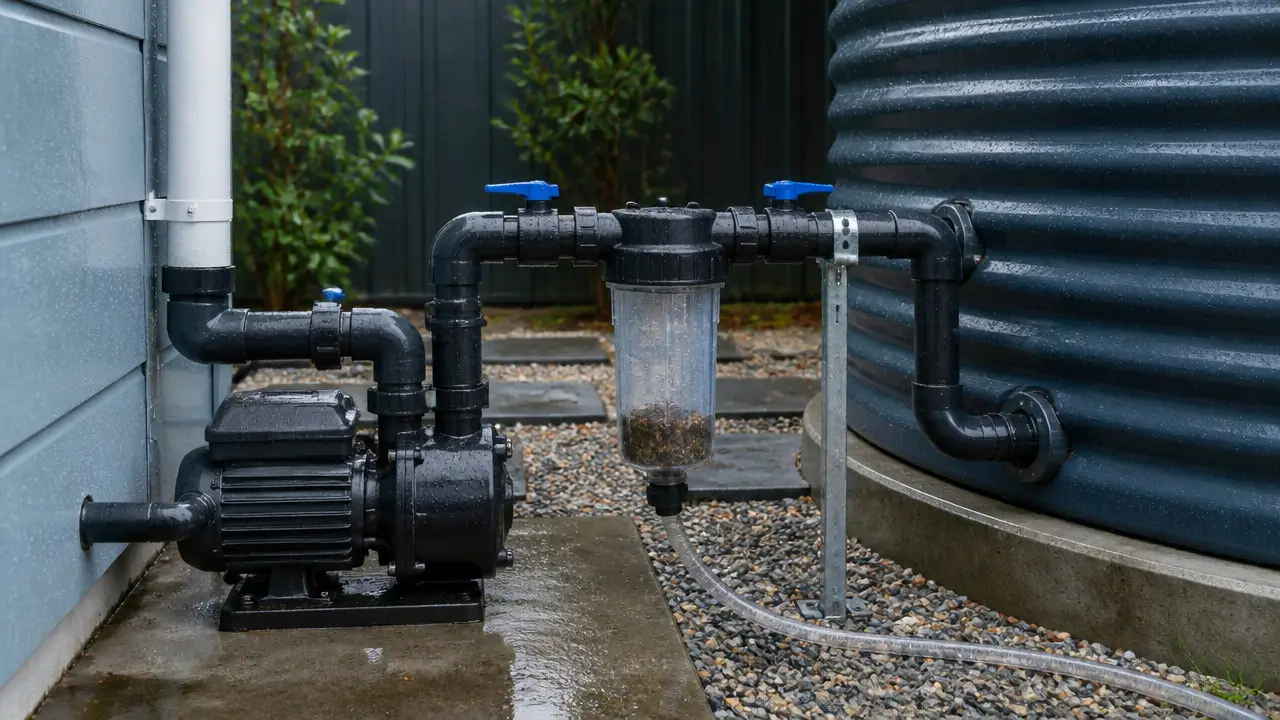
Stage 5: Sediment Filtration
After storage, many systems use a physical filter to catch smaller suspended particles.
This is often called a sediment filter.
Sediment filtration may remove material such as:
- Fine dirt
- Rust particles
- Small organic particles
- Sand
- Tank sediment
Filters are commonly described by their micron rating.
A micron is one-thousandth of a millimeter. Smaller micron ratings generally indicate smaller openings or finer particle removal, although filter construction and rating methods also matter.
For example, a coarse filter placed before a fine filter can keep larger particles from plugging the finer element too quickly.
Why filters are often installed in stages
Putting an extremely fine filter first may seem better, but it can create problems.
A fine filter exposed to dirty tank water can clog rapidly. That causes:
- Lower flow
- Greater pressure loss
- More frequent filter changes
- Extra load on a pump
A staged system lets the coarser filter handle larger particles before water reaches the finer element.
The exact filter sizes should be chosen for the system rather than copied from an unrelated setup.
Understanding Nominal and Absolute Micron Ratings
Two filters with the same micron number may not perform exactly the same way.
A nominal rating generally means the filter removes a stated portion of particles around that size.
An absolute rating is based on a more defined maximum particle size under specified testing conditions.
The terms are important when a treatment system depends on a filter reaching a particular level of performance.
Do not choose a filter for pathogen control based only on a micron number printed on a product page. Verify what the filter has actually been designed and tested to remove.
CDC notes that different filtration technologies have very different abilities to remove parasites, bacteria, viruses, and chemicals.
Stage 6: Activated Carbon Treatment
Activated carbon is often added after sediment filtration.
Carbon works differently from a simple screen or sediment cartridge. Instead of merely trapping large particles, activated carbon can adsorb certain substances onto its large internal surface area.
Depending on the carbon and system design, it may help with certain:
- Tastes
- Odors
- Organic compounds
- Chemicals
EPA describes granular activated carbon as a porous treatment medium with a very large internal surface area.
What carbon does not mean
A carbon filter is not a universal rainwater purifier.
It should not be assumed to remove every:
- Bacterium
- Virus
- Parasite
- Metal
- Dissolved mineral
- Industrial chemical
Its effectiveness depends on what contaminant is present, the type and amount of carbon, water chemistry, flow rate, contact time, and how long the media has been in service.
Carbon also needs replacement. Once its useful capacity is reached, continuing to run water through it does not restore its treatment ability.
Stage 7: Targeted Treatment for Dissolved Contaminants
Ordinary sediment filters are mainly useful for particles.
Some water-quality problems involve substances dissolved in the water. These may require a different treatment method.
Depending on verified water-test results, treatment might involve technologies such as:
- Reverse osmosis
- Nanofiltration
- Ion exchange
- Specialized adsorption media
- Other contaminant-specific treatment
For example, reverse osmosis forces water through a semi-permeable membrane and can remove many dissolved substances. EPA notes that RO can address a broad range of dissolved contaminants, but treatment selection still depends on the contaminants present and the water conditions.
More treatment is not automatically better
Adding random treatment stages can waste water, reduce flow, increase maintenance, or create new problems.
A treatment method should have a reason for being there.
For drinking-water systems, test the source water and select treatment based on what needs to be controlled rather than building a long filter chain based only on cartridge size.
Stage 8: Disinfection
Filtration and disinfection are not the same thing.
Filtration physically removes or captures certain contaminants.
Disinfection is intended to inactivate harmful microorganisms.
Possible disinfection methods in properly designed systems can include:
- Ultraviolet light
- Chlorination
- Other validated treatment methods
The right method depends on the system and intended use.
UV treatment
A UV system exposes flowing water to ultraviolet light.
UV can be useful for microbial treatment, but the water reaching the UV chamber generally needs to be sufficiently clear for the system to work as intended. Particles and poor water clarity can interfere with UV transmission.
That is one reason sediment filtration normally comes before UV rather than after it.
For methods for purifying rainwater, first understand upkeep actions that credible water-quality results support.
UV systems also require:
- Electricity
- Correct flow conditions
- Lamp replacement
- Quartz-sleeve cleaning
- Monitoring according to the equipment design
A glowing UV lamp alone does not prove that the water received adequate treatment.
Chemical disinfection
Chemical treatment can provide microbial control and, depending on the method, may leave a disinfectant residual that continues working in storage or distribution piping.
However, chemical treatment involves concentration, contact time, water chemistry, equipment, and safety considerations.
It should not be treated as a casual "add some bleach" stage in a permanent household rainwater system.
Complex drinking-water treatment and chemical dosing are good points to involve a qualified water-treatment professional or local health authority.
Stage 9: Protect the Water After Treatment
Treatment does little good if the water becomes contaminated again afterward.
The clean side of the system needs protection too.
Potential problems include:
- Dirty treated-water tanks
- Open vents
- Insect entry
- Contaminated hoses
- Stagnant plumbing
- Cross-connections with household drinking-water pipes
Rainwater and treated public water should not be allowed to connect in a way that could let untreated rainwater enter potable plumbing. CDC specifically advises keeping rainwater separate from piped drinking water.
A potable system is one intended to provide water suitable for drinking.
A non-potable system supplies water for uses that do not require drinking-water quality.
Keeping those systems clearly separated is an important part of safe design.
How Many Filtration Stages Does a Rain Barrel Need?
A simple garden rain barrel does not usually need the same treatment train as household water.
For watering ornamental plants, a practical arrangement may be:
Roof → gutter → debris screen → rain barrel → outlet screen or basic sediment control
The main goals are usually to keep debris out, limit mosquitoes, prevent clogs, and keep irrigation equipment working.
Fine drinking-water filtration usually adds unnecessary restriction for a basic gravity-fed rain barrel.
Remember that every filter creates some resistance to flow. A rain barrel already has low pressure, so adding several small cartridges can leave very little usable flow at the hose.
Filtration for Drip Irrigation
Drip irrigation often needs better particle control than a basic garden hose.
Small emitters have narrow passages that can clog with debris.
A typical layout might be:
Tank → pump if needed → sediment filter → pressure regulation if required → irrigation line
The exact filter needs depend on the irrigation equipment.
Check the emitter or irrigation-system requirements rather than choosing a filter only because it is labeled for rainwater.
The filter must also be sized for the required flow rate, meaning how much water needs to move through the system during a given time.
Filtration for Pumps and Household Non-Potable Use
A rainwater system supplying toilets, laundry, cleaning, or other household uses can place greater demands on filtration.
You need to consider:
- Required flow
- Pump capacity
- Pressure
- Filter pressure loss
- Pipe size
- Tank condition
- Intended fixtures
- Local plumbing requirements
A filter that works well at a slow garden flow may cause unacceptable pressure loss when several indoor fixtures operate.
Filter housings also have operating limits. The housing, connections, valves, and cartridges must all be suitable for the pressure produced by the pump.
Filtration for Drinking Rainwater
Drinking-water treatment should be approached differently from ordinary rainwater filtration.
A row of sediment and carbon cartridges should not be assumed to make roof runoff potable.
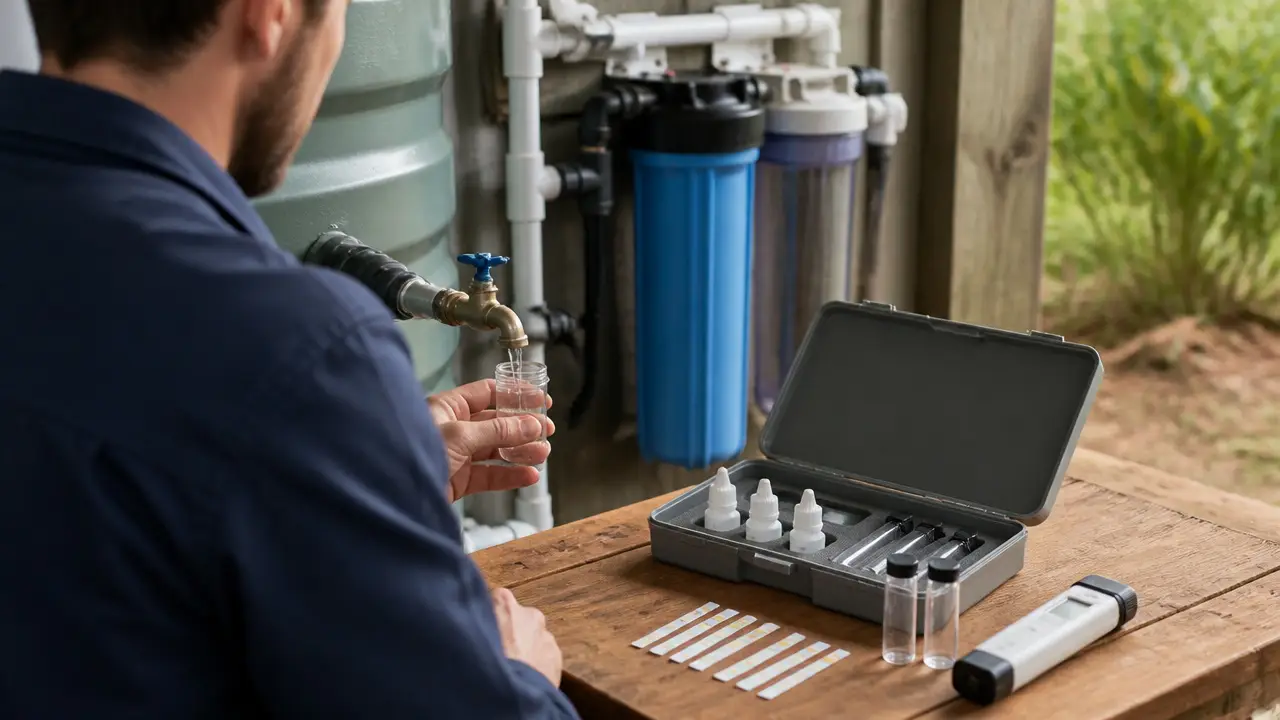
CDC recommends that rainwater used for drinking be regularly tested for harmful germs and chemicals. Treatment should then be selected to address the contaminants of concern.
A drinking-water system may involve:
- Suitable collection surfaces
- Debris exclusion
- First-flush control
- Protected storage
- Sediment filtration
- Contaminant-specific treatment
- Validated disinfection
- Protected treated-water plumbing
- Regular maintenance
- Current laboratory testing
EPA likewise notes that treatment technology should be selected according to the contaminants and water conditions being addressed rather than assuming one treatment method handles every problem.
Use a certified drinking-water laboratory and follow local health and plumbing requirements. A qualified water-treatment professional can also help design and verify more complex household systems.
Where Should Filters Go: Before or After the Tank?
Most rainwater systems benefit from doing the roughest treatment before storage and finer treatment after storage.
Before the tank, focus on:
- Leaves
- Large debris
- First-flush runoff
- Insects
After the tank, filtration can handle smaller particles before the water reaches pumps, fixtures, irrigation equipment, or later treatment stages.
Trying to put a very fine cartridge directly in a downspout can restrict collection during heavy rainfall and cause water to bypass the system.
The tank itself also provides useful settling time.
Should the Pump Go Before or After the Filter?
There is no single answer for every filter.
Some coarse screens can be located on the pump's intake side. Many pressurized cartridge filters are installed after the pump.
Putting a restrictive fine filter before a pump can starve the pump of water and contribute to poor performance or damage.
The correct arrangement depends on:
- Pump type
- Filter design
- Maximum pressure
- Required flow
- Pipe size
- Suction conditions
Follow the pump and filter manufacturers' installation requirements.
If the system involves a pressurized household supply, pressure tank, electrical controls, or complex pump protection, professional installation may be appropriate.
Filter Maintenance Is Part of the Treatment System
A filter only works properly when it is maintained.
Common maintenance tasks include:
- Cleaning leaf screens
- Emptying or cleaning first-flush devices
- Inspecting the tank
- Removing accumulated sediment
- Cleaning reusable filters
- Replacing cartridges
- Replacing carbon media
- Cleaning UV sleeves
- Replacing UV lamps as required
- Checking seals and O-rings
- Inspecting for leaks
- Checking vents and insect screens
Do not assume a filter needs replacement only when the water looks dirty.
Some treatment media can lose effectiveness without a visible change in the water.
CDC also warns that poorly maintained filters and treatment equipment can support microbial growth.
A Simple Way to Plan Your Filtration Stages
Start with the final use of the water and work backward.
For garden watering
Concentrate on debris and clog prevention.
For drip irrigation
Add filtration fine enough to protect the emitters while maintaining enough flow.
For toilets and other household non-potable uses
Consider finer sediment control, pump performance, pressure, plumbing separation, and local rules.
For drinking, cooking, or other potable uses
Treat the entire collection and treatment system as a water-safety system rather than a set of filters.
Test the water, identify contaminants, choose verified treatment methods, disinfect when required, protect treated water from recontamination, maintain the system, and confirm performance through appropriate laboratory testing.
The goal is not to install the greatest possible number of stages. It is to use the right stages in the right order for the water you actually need.
Frequently Asked Questions
What is the first stage of rainwater filtration?
The first stage is keeping contamination out of the collection system. Clean gutters, suitable collection materials, leaf screens, and other debris controls reduce the amount of material that later filters must handle.
Does a first-flush diverter count as a filter?
Not technically. A first-flush diverter sends away some of the initial roof runoff instead of passing water through filter media. It is still an important pretreatment stage because the beginning of a storm can carry a high concentration of roof debris.
What micron filter should I use for rainwater?
There is no single correct micron rating. The right size depends on the intended use, water quality, flow requirements, and later treatment stages. Coarser filters are often placed before finer ones to reduce clogging. Do not assume a particular micron rating alone makes water safe to drink.
Do I need activated carbon in a rainwater system?
Not always. Basic garden systems often do not need it. Carbon may be useful when treatment is needed for certain tastes, odors, organic compounds, or other specific contaminants. Its suitability should be based on the water problem being treated.
Can sediment and carbon filters make rainwater drinkable?
Not by themselves. They may remove certain particles or chemicals, but they do not provide a complete drinking-water safety assessment. Potable rainwater requires suitable collection, appropriate treatment for identified contaminants, microbial control where needed, maintenance, laboratory testing, and compliance with applicable local requirements.
Is UV another type of rainwater filter?
No. UV is a disinfection technology rather than a particle filter. Water passes through a UV chamber where microorganisms can be exposed to germicidal ultraviolet light. Proper pretreatment, flow, lamp condition, equipment sizing, and maintenance are important for reliable operation.
Should rainwater be filtered before going into the storage tank?
Large debris should normally be controlled before storage with screens and other pretreatment. First-flush diversion may also reduce the dirt entering the tank. Fine pressurized filtration is more commonly performed after storage, where flow can be controlled.
Why does my rainwater flow drop after I add filters?
Every filter adds resistance. A clogged cartridge, filter that is too fine, undersized housing, low tank pressure, small pipe, or insufficient pump capacity can reduce flow. Check the filter condition and make sure the filtration system is sized for the flow and pressure your application requires.