As an affiliate, we may earn a commission from qualifying purchases. We get commissions for purchases made through links on this website from Amazon and other third parties.
Inline water filters can be very useful, but only when the filter matches the water problem and the job you need it to do. They work well for catching sediment, protecting irrigation parts, improving taste or odor in appropriate water supplies, and serving as one stage in a larger treatment system.
What they do not do is automatically make questionable water safe to drink. This matters with rainwater. Roof runoff can pick up dirt, animal waste, metals, chemicals, and microorganisms before it reaches the tank. A small inline filter should not be treated as a complete drinking-water system.
What Is an Inline Water Filter?
An inline water filter is installed directly in a water line. Water enters one side, passes through the filter media, and leaves through the other side.
You might find one:
- Between a rain barrel and a garden hose
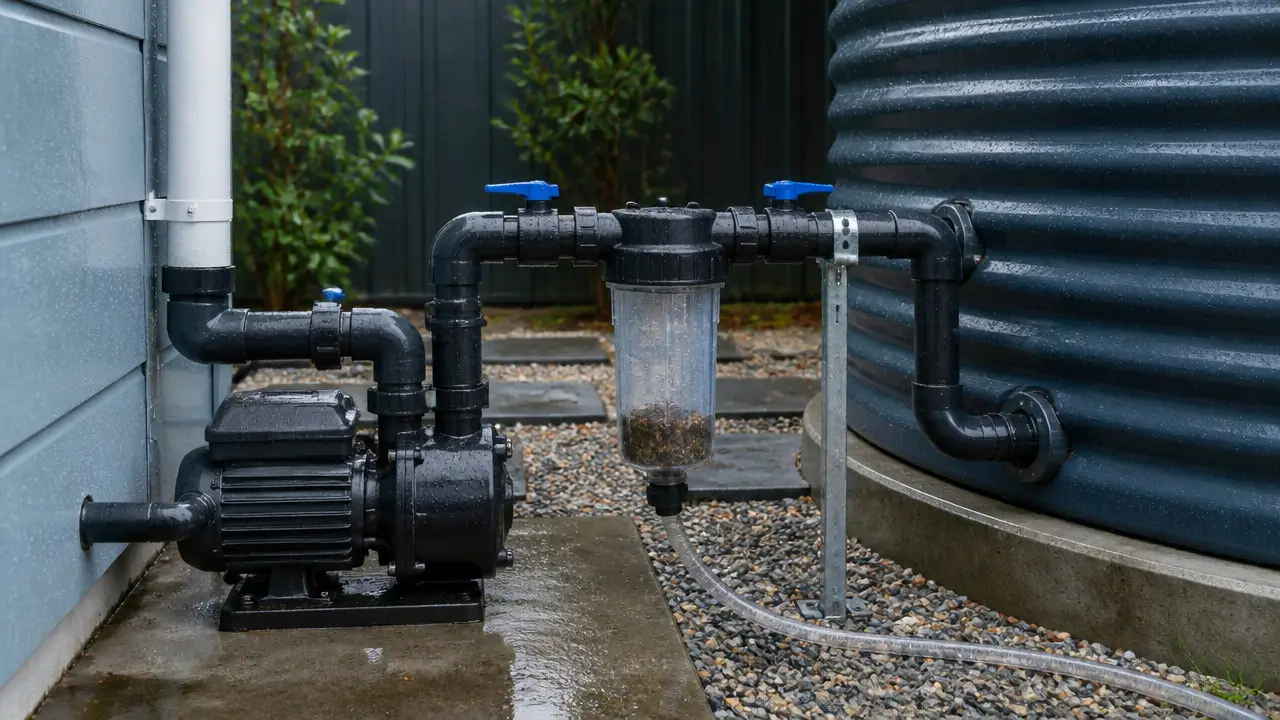
- After a rainwater pump
- Before a drip irrigation system
- Under a sink
- In an RV or cabin water line
- Before another treatment stage, such as UV
- On a refrigerator or drinking-water line
Some inline filters are disposable sealed cartridges. Others use a housing that opens so you can replace or clean the filter inside.
The important point is that "inline" describes where the filter goes, not what it removes. Two filters that look similar may perform completely different jobs.
Are Inline Water Filters Any Good?
Yes, for the right purpose.
A good inline filter can solve a specific problem without requiring a large whole-house treatment setup. The problem starts when a filter is expected to do something it was not designed or certified to do.
For example, a sediment filter may be excellent at keeping grit out of drip emitters. That does not mean it removes dissolved chemicals or dangerous microorganisms.
An activated carbon filter may improve certain tastes and odors. That does not mean it disinfects untreated rainwater.
The CDC recommends choosing a water filter based on the specific germs or chemicals you need to address. Many common household filters are not designed to remove germs.
So the better question is not simply whether inline filters are good. It is:
Good at what?
Where Inline Filters Work Well in Rainwater Systems
Catching sediment before irrigation
This is one of the simplest and most useful applications.
Even a covered rainwater tank can collect small amounts of:
- Roof grit
- Dust
- Insect debris
- Organic matter
- Small particles from the tank
These particles can clog small irrigation passages.
An inline sediment filter installed before drip tubing, emitters, or small spray nozzles can reduce that problem. The filter should still be easy to inspect and clean because rainwater systems can carry more suspended material than treated municipal water.
Protecting downstream equipment
Filters can also protect parts that have small passages.
Depending on the system, that may include:
- Irrigation valves
- Solenoid valves
- Pumps or pump controls
- Pressure regulators
- UV treatment equipment
- Fine treatment cartridges
A coarse filter placed earlier in the system can keep a finer and more expensive treatment stage from loading with dirt as quickly.
This staged approach often works better than asking one very fine filter to handle everything.
Improving water appearance
Sediment filtration can make stored rainwater look clearer by removing suspended particles.
That can be useful for some non-potable uses.
Non-potable means water that is not intended or approved for drinking.
Clearer water should not be confused with safer water, however. Many microorganisms and dissolved contaminants cannot be seen.
Improving taste or odor in suitable water
Activated carbon is commonly used to reduce certain tastes, odors, and chemicals. NSF/ANSI 42, for example, covers aesthetic claims such as chlorine taste and odor, while NSF/ANSI 53 covers specific health-related contaminant reduction claims. The exact claim matters; certification to a standard does not mean a filter removes every contaminant covered by that standard.
Carbon is therefore useful when it has a defined job.
It should not be used as a substitute for proper treatment of microbiologically questionable rainwater.
What Inline Filters Do Not Automatically Remove
One of the biggest mistakes is assuming that anything called a "water filter" cleans up every possible water problem.
Different technologies work in different ways.
| Filter or treatment type | Typical role | Important limitation |
|---|---|---|
| Sediment filter | Catches suspended particles | Does not remove most dissolved contaminants |
| Activated carbon | Can reduce certain tastes, odors, and chemicals | Usually not a complete treatment for harmful microorganisms |
| Microfiltration | Removes particles and some microorganisms depending on pore size | Does not remove all microorganisms or dissolved chemicals |
| Ultrafiltration | Can remove parasites and bacteria | Generally not intended to remove dissolved chemicals |
| Reverse osmosis | Can remove many microorganisms and certain dissolved contaminants | Requires suitable pretreatment, pressure, maintenance, and specific performance claims |
| UV treatment | Inactivates microorganisms when properly designed and operated | Does not physically remove sediment or most chemicals |
The CDC specifically notes that different filters remove different contaminants. Some filters that address germs do not address chemicals, and the reverse can also be true.
That is why drinking-water treatment often uses several stages.
Understanding Micron Ratings
A micron is one-millionth of a meter.
A filter's micron rating describes the size of particles its openings are intended to control. A smaller number generally means finer filtration.
But there is another detail that matters: nominal versus absolute ratings.
A nominal rating describes an approximate level of filtration. Some openings may be larger than the stated size.
An absolute rating means the filter's pores are at or below the stated size according to the manufacturer's rating method.
That difference is especially important when filtration is being relied upon for microorganisms.
The CDC notes, for example, that an absolute pore size of 1 micron or smaller can capture parasites such as Cryptosporidium, while a nominal 1-micron filter should not automatically be assumed to provide the same result.
For ordinary rainwater irrigation, however, choosing the smallest possible micron rating is usually not the goal. Very fine filtration can create unnecessary flow restriction and frequent clogging.
Fine Filters Can Reduce Flow
Every filter creates some resistance.
As the cartridge fills with material, that resistance normally increases.
This can matter a lot in gravity-fed rain barrels.
A barrel sitting only slightly above the garden has limited water pressure. Adding a restrictive fine filter can reduce an already modest flow to an inconvenient trickle.
Pump-fed systems have more available pressure, but the same basic rule applies. The filter must be sized for the required flow and stay within the pressure limits of the housing and fittings.
Before choosing an inline filter, check:
- Required water flow
- Available pressure
- Filter connection size
- Maximum operating pressure
- Recommended flow range
- Cartridge capacity or cleaning requirements
- Expected amount of sediment
A filter with small ports can also become a bottleneck even when the filter media itself is relatively open.
Connection Size Matters
Inline filters have to physically fit the rest of the system.
Check both the connection type and connection size.
Common systems may use:
- Garden hose threads
- Pipe threads
- Barbed hose fittings
- Compression fittings
- Push-to-connect tubing
- Irrigation fittings
Do not assume two fittings are compatible just because their measured diameters look similar.
Adapters can solve many connection problems, but stacking several adapters adds more potential leak points and can create unnecessary flow restriction.
With the role of carbon filters in rainwater treatment, you can compare a treatment train sized for the actual domestic demand.
For a rainwater setup, it is usually easier to choose the filter around the pipe, hose, or tubing already being used.
Where Should an Inline Filter Go?
Placement depends on what you want the filter to protect.
A basic rainwater irrigation path might look like:
Roof → debris screening → storage tank → pump or outlet → inline filter → irrigation system
A more involved system could use several filtration stages.
For example:
Tank → coarse sediment stage → pump → finer filtration → treatment equipment → intended point of use
There is no single correct order for every system. Pumps and treatment devices can have their own requirements.
Some pumps need water screened before it reaches them. Other equipment may require a specific filtration level before water enters it.
Follow the equipment manufacturer's installation requirements rather than automatically placing every filter in the same location.
Do You Still Need Gutter Screens and a First Flush?
Usually, yes.
An inline filter should not be expected to replace good collection practices.
Roof screening keeps larger material from entering the system in the first place.
A first-flush device diverts some of the initial roof runoff at the start of a rain event. That first runoff can carry a higher amount of material that settled on the roof between rains.
Keeping debris out before storage has several advantages. It can reduce tank sediment, reduce filter loading, and make the entire system easier to maintain.
It is generally better to prevent large amounts of contamination from reaching storage than to rely entirely on a small downstream cartridge.
Are Carbon Inline Filters Good for Rainwater?
They can be useful as one treatment stage, but they need careful use.
Activated carbon has a large internal surface area that can adsorb certain substances from water. It is widely used for taste, odor, chlorine, and specific contaminant reduction applications.
However, carbon does not provide universal contaminant removal. The EPA notes, for example, that activated carbon does not remove nitrate.
Carbon filters also need regular replacement. Filters that are not properly maintained can support microbial growth, and the CDC warns that germs can grow in water filters when they are not maintained and replaced correctly.
For untreated rainwater, a carbon cartridge should therefore be chosen as part of a planned treatment train rather than installed with the assumption that carbon makes the water safe.
Can an Inline Filter Make Rainwater Drinkable?
Do not assume so.
Rainwater intended for drinking needs to be considered as a complete system, starting at the catchment surface and continuing all the way to the tap.
That can involve:
- A suitable roof and collection system
- Good debris exclusion
- Appropriate storage
- Sediment control
- Treatment selected for the actual contaminants
- Properly designed disinfection when needed
- Clean plumbing and storage after treatment
- Regular maintenance
- Current laboratory testing
- Compliance with applicable local requirements
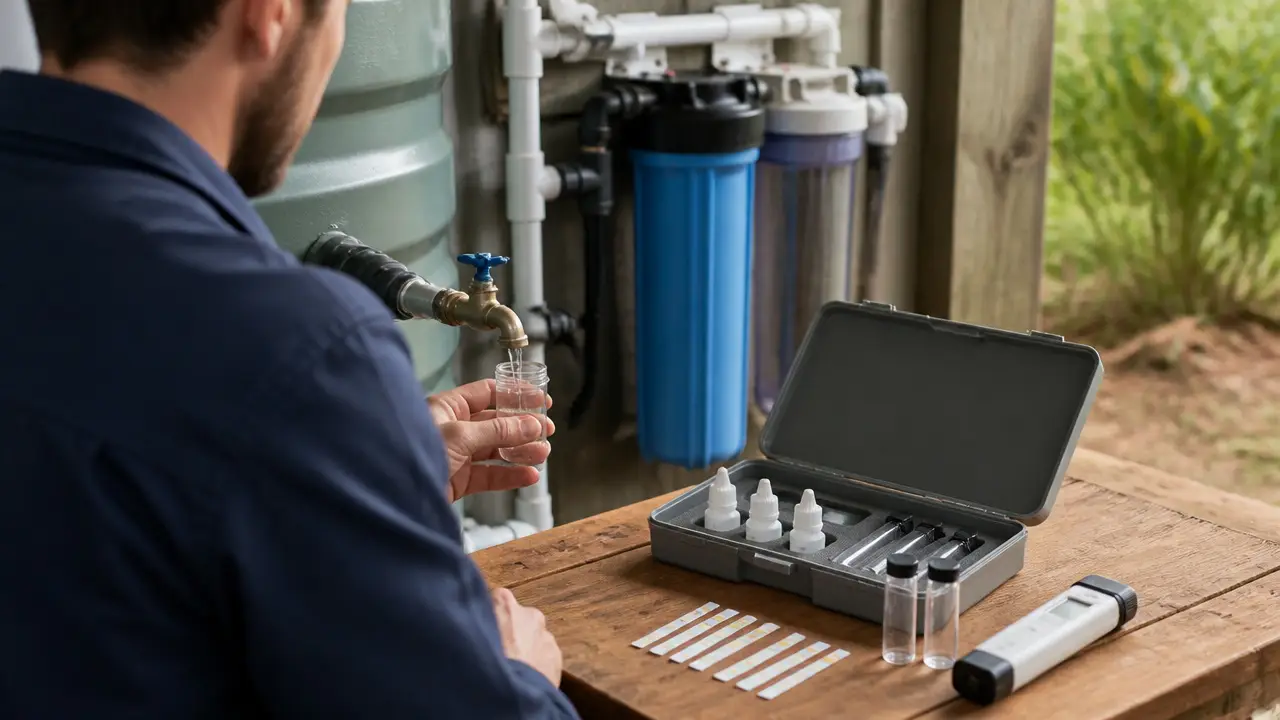
The CDC recommends that people using a rainwater collection system test the water at least once each year for harmful germs and chemicals and consider additional testing when its color, taste, or smell changes.
Even that testing schedule is not a guarantee that water remains safe between samples. System design, maintenance, contamination events, and local health guidance still matter.
If the goal is drinking water, cooking, brushing teeth, or another use where water will be swallowed, do not base the treatment plan solely on the presence of an inline cartridge. A qualified water-treatment professional or local health authority can help determine suitable treatment and laboratory testing.
Look at the Specific Certification Claim
For drinking-water equipment, a certification mark can be useful, but the number alone does not tell the whole story.
NSF explains that manufacturers certify products for specific contaminant-reduction claims. A product certified under NSF/ANSI 53, for example, is not automatically certified to remove every contaminant covered by that standard. You need to check the actual claim for the specific model.
Common standards you may encounter include:
- NSF/ANSI 42: primarily aesthetic effects such as certain taste, odor, and particulate claims
- NSF/ANSI 53: specific contaminants associated with health effects
- NSF/ANSI 55: ultraviolet treatment systems
- NSF/ANSI 58: reverse osmosis systems
Certification is most useful when you first know what needs to be reduced.
How Often Do Inline Filters Need Changing?
There is no useful universal replacement interval.
Filter life depends on:
- Amount of water passing through it
- Sediment load
- Filter type
- Cartridge size
- Water quality
- Flow conditions
- Manufacturer requirements
Rainwater can make replacement intervals especially variable. One system may collect relatively little sediment, while another receives large amounts of fine roof debris.
Watch for symptoms such as a noticeable loss of flow, but do not use flow alone as the replacement rule. Some treatment media can reach the end of their useful capacity without producing an obvious pressure change.
Follow the filter manufacturer's replacement or cleaning schedule.
If a reusable housing is opened, keep the housing, seals, and surrounding plumbing clean during servicing. Replace damaged seals and make sure the housing is properly closed before repressurizing the system.
When an Inline Filter Is Probably Worth Using
An inline filter makes sense when you can clearly state its job.
For example:
- "I need to keep sediment out of my drip emitters."
- "I need to protect a downstream treatment stage."
- "I want a certified filter that reduces a specific contaminant in already suitable source water."
- "I need particulate filtration before my irrigation valves."
- "My equipment manufacturer requires a certain level of prefiltration."
Those are defined problems that can be matched to filter specifications.
An inline filter is a poor solution when the plan is simply:
"The water looks dirty, so I'll add a filter and assume it is safe."
Start with the intended use and the actual water problem. Then choose the filter.
Frequently Asked Questions
Are inline water filters worth it for rain barrels?
They often are if sediment is clogging hoses, irrigation valves, sprayers, or drip emitters. For a simple garden system, a cleanable sediment filter may be more useful than very fine filtration. Make sure the filter does not restrict the limited pressure available from a gravity-fed barrel.
Does a smaller micron rating mean a better filter?
Not necessarily. A smaller rating means finer filtration, but finer filters can clog faster and restrict more flow. The right micron rating depends on what must be removed and what the equipment downstream requires.
Can I put an inline filter before a rainwater pump?
Sometimes, but pump requirements vary. A coarse screen or strainer may be required to protect certain pumps, while an overly restrictive filter on the suction side can cause operating problems. Follow the pump manufacturer's installation instructions.
Will a carbon inline filter remove bacteria?
Do not assume that it will. Most common carbon filters are not intended to act as complete microbial treatment. Check the filter's specific certification and contaminant-reduction claims.
Can an inline filter remove chemicals from roof runoff?
Some filter media can reduce specific chemicals, but no generic inline filter removes every possible chemical contaminant. Laboratory testing and the filter's verified contaminant claims are important when chemical contamination is a concern.
Can I drink rainwater after putting it through a 1-micron filter?
A 1-micron filter alone should not be treated as a complete rainwater drinking-water system. Although certain absolute 1-micron filters can remove some parasites, other microorganisms and dissolved contaminants may remain. Drinking-water use requires appropriate collection, treatment, testing, maintenance, and local requirements to be considered together.
Should I filter rainwater before storing it or after the tank?
Both locations can serve different purposes. Screens and other pre-storage controls keep larger debris out of the tank. A downstream inline filter can then protect pumps, irrigation equipment, or later treatment stages. Using several appropriate stages is often more practical than relying on one very fine filter.