
As an affiliate, we may earn a commission from qualifying purchases. We get commissions for purchases made through links on this website from Amazon and other third parties.
Best Overall
Best Heavy-Duty 2-Way
Best for Four Outlets
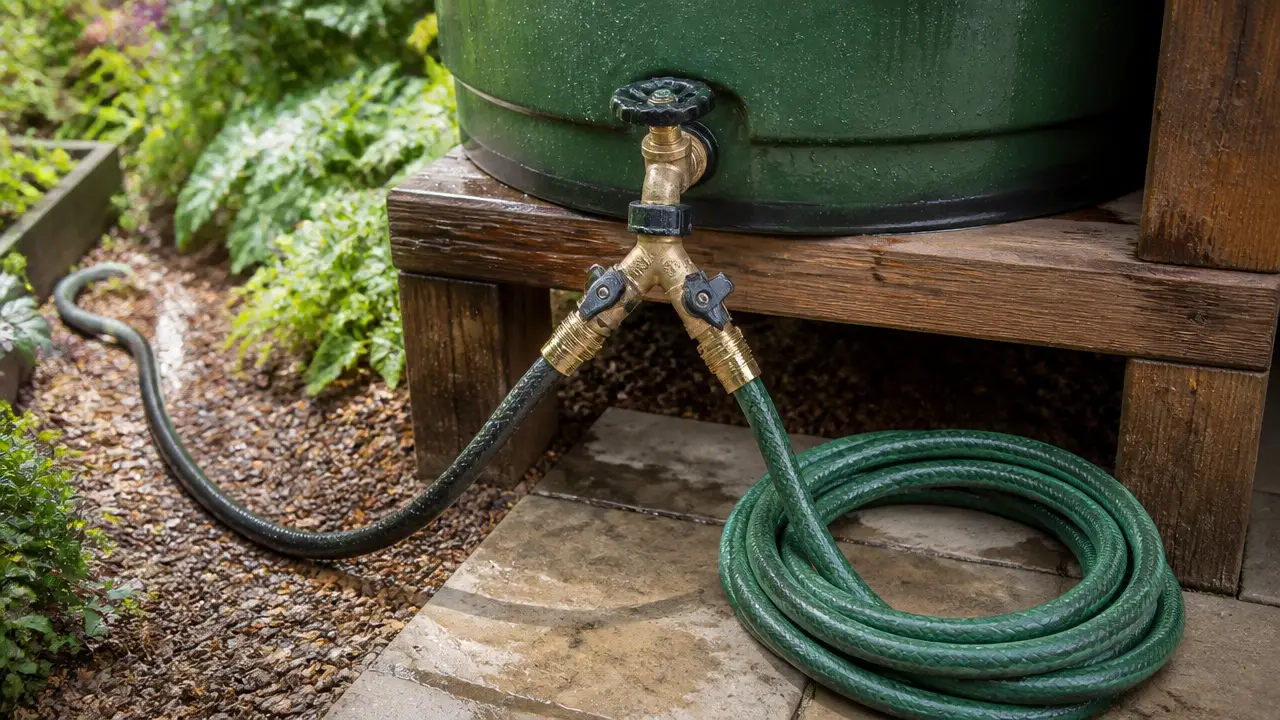
A hose splitter is useful when one rain barrel needs to feed more than one garden job. You might want one outlet for a drip line and another for filling a watering can, or separate branches for two beds.
The important part is not simply getting more outlets. A splitter adds valves, seals, and smaller internal passages to a system that may already have very little pressure. The wrong thread type can leak, and a narrow valve can reduce gravity flow even when the connection fits.
For a rain barrel, start by confirming a 3/4-inch garden-hose-thread connection at the spigot. Then choose only as many outlets as you need. Two well-sized branches are usually easier to manage than four partially open lines competing for the same gravity-fed flow.
Hose Splitters at a Glance
| Product | Best For | Main Strength | Main Tradeoff |
|---|---|---|---|
| Biswing 2-Way Brass Splitter | Most two-branch barrel setups | Brass body, two shutoff valves, GHT connection | Small internal openings can restrict already-low flow |
| RAINPOINT 2-Way Splitter | Heavier-duty two-outlet use | Metal body, 3/4-inch GHT, large valve hardware | Stiffer controls and more hardware than a basic splitter |
| Twinkle Star 4-Way Splitter | Four separate garden branches | Four individually controlled outlets | More flow splitting and thread-fit uncertainty |
| Morvat 2-Way Brass Splitter | Compact brass option | 3/4-inch NH/GHT-style connection and lighter body | Some leak and valve-aging complaints |
| 2WAYZ All-Metal Y Splitter | Easy-to-grip manual control | Large handles and 3/4-inch GHT | Mixed long-term durability reports |
Match the Splitter to the Barrel, Not Just the Hose
Most garden accessories are designed around pressurized outdoor faucets. A rain barrel is different. It may have only a few feet of water head, so every elbow, valve, filter, timer, and splitter can noticeably change flow.
Keep the plumbing simple. If one branch needs steady drip irrigation and the other is used only occasionally, leave the unused branch fully closed. Opening several branches at once can make each one too weak to be useful.
Thread type also matters. Garden hose thread, usually shortened to GHT, is not the same as common pipe thread. Do not force an NPT fitting onto a garden-hose outlet just because both carry a 3/4-inch label.
Best Overall: A Simple Brass Two-Way Splitter
1 / 5
Biswing 2-Way Brass Hose Splitter

Outlets
2
Thread
GHT
Material
Brass and rubber
Controls
Independent ball valves
The Biswing is the strongest all-around fit for a basic rain-barrel setup because it stays simple: one inlet, two independently controlled outlets, GHT connections, and brass valve hardware. That is enough for a drip line plus a hose or two separate watering zones without turning the barrel outlet into a bulky manifold.
Its main limitation is flow. The two outlet openings are fairly small. That matters more on a gravity-fed barrel than on a pressurized faucet. If your barrel already produces a slow stream, do not expect the splitter to improve it.
Leak performance depends heavily on washers and hand-tight connections. The supplied evidence includes both leak-free use and cases where washer compression or fitting tightness caused trouble. Check the rubber seal first rather than overtightening the body.
Why It Works
- Two branches are enough for most rain-barrel watering layouts.
- GHT connections match common garden-hose hardware.
- Brass construction is preferable to a fully plastic splitter for repeated outdoor use.
- Independent valves let you isolate one branch and preserve flow for the other.
What To Keep In Mind
- Internal passages may reduce already-low gravity flow.
- Replace worn washers if a connection starts dripping.
- The product information says it is not for drinking-water systems.
- Remove and drain outdoor fittings before freezing conditions.
Best Heavy-Duty 2-Way: RAINPOINT Metal Splitter
2 / 5
RAINPOINT 2-Way Garden Hose Splitter

Outlets
2
Thread
3/4 in GHT
Body
Metal
Connector
Wye
The RAINPOINT is the better choice when you want a substantial two-way body with clearly documented 3/4-inch GHT connections. Its metal construction and larger valve hardware make it a good match for a permanent garden branch where the splitter stays installed for much of the season.
The useful advantage for a rain barrel is straightforward control rather than its high-pressure marketing claims. Connections can install easily and remain leak-free, while the two separate valves let you dedicate one side to a timer or drip line and leave the second available for manual watering.
Some users report stiff levers when new, and any quick-connect fitting added downstream creates another possible leak point. Keep the layout short and support the hose so its weight does not twist the barrel spigot.
Why It Works
- Documented 3/4-inch GHT thread fit suits common rain-barrel outlets.
- Two valves allow one automatic and one manual branch.
- Metal body feels more substantial than light plastic splitters.
- Connections can remain leak-free when installed with the correct washer.
What To Keep In Mind
- Controls may be stiff at first.
- Extra quick-connect hardware can introduce leaks.
- High-pressure ratings do not mean a rain barrel will deliver high flow.
Best for Four Outlets: Twinkle Star 4-Way Splitter
3 / 5
Twinkle Star 4-Way Heavy Duty Brass Garden Hose Splitter
Outlets
4
Connection
3/4 in product claim
Material
Metal
Controls
4 independent valves
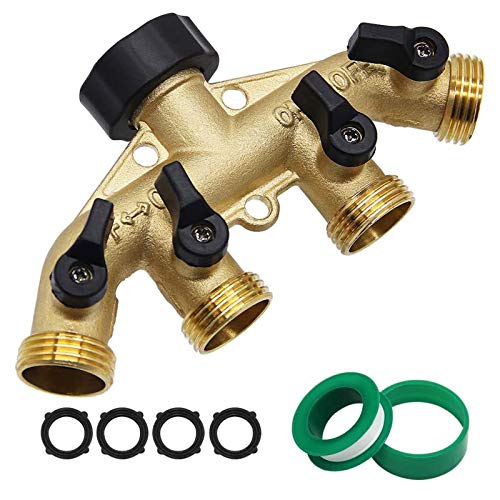
The Twinkle Star is useful when one tank or barrel must serve several separate zones and you want each branch to have its own shutoff. Four outlets can simplify a garden layout with multiple beds, but the benefit comes from branch control rather than running all four at once.
On a low-pressure barrel, four open outlets can divide flow until none of them works well. Use this as a small manifold and operate one or two branches at a time unless your tank height and downstream tubing provide enough flow for more.
This splitter needs extra thread attention. A standard 3/4-inch label does not resolve confusion about the feed thread. Match the actual unit inlet to your barrel spigot before building the rest of the system around it.
Why It Works
- Four individually controlled branches suit larger garden layouts.
- Metal construction is better suited to a semi-permanent outdoor manifold.
- Separate valves make it easy to shut unused zones completely.
What To Keep In Mind
- Four open branches can sharply reduce gravity-fed flow.
- Match the inlet thread before installation; 3/4-inch size alone does not prove GHT compatibility.
- Long-term reports include eventual cracking or valve-body failure.
Best Compact Brass Option: Morvat 2-Way Splitter
4 / 5
Morvat Brass Heavy-Duty 2-Way Splitter
Outlets
2
Connection
3/4 in NH product claim
Material
Brass
Item Weight
8 oz
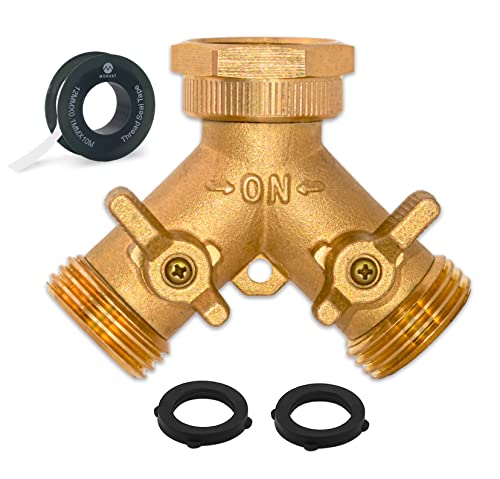
The Morvat is a compact brass two-way splitter for readers who want separate shutoffs without the weight of a larger manifold. Its product information specifies a 3/4-inch U.S. hose-style connection and a swiveling inlet, which can make alignment easier when the barrel spigot sits close to a wall.
It is lighter than the other metal splitters in this group and has large valve grips. That makes it convenient for seasonal systems that are removed and stored rather than left outdoors year-round.
Leak history is mixed. Some installations remained tight with the supplied washers, while others developed leaks or valve problems over time. Check seals regularly, especially if the inlet stays continuously wet or one branch feeds an automatic timer.
Why It Works
- Compact two-way layout suits small barrel installations.
- Brass body avoids an all-plastic load-bearing connection.
- Swiveling inlet can simplify alignment at the spigot.
What To Keep In Mind
- Long-term valve and leak reports are mixed.
- Do not use extra wrench force to compensate for a bad washer or mismatched thread.
- Shut off the source when the system will be unattended for long periods.
Best Easy-Grip Option: 2WAYZ All-Metal Y Splitter
5 / 5
2WAYZ All-Metal Y Splitter

Outlets
2
Thread
3/4 in GHT
Body
Metal with rubberized grip
Controls
Extended handles
The 2WAYZ splitter stands out for its larger valve handles and rubberized body. Those controls are useful when the splitter sits low beside a barrel where small metal tabs can be awkward to turn.
The 3/4-inch GHT connection is appropriate for common garden-hose plumbing, and installation can be easy and leak-free. However, durability is less consistent than with the higher-ranked choices, with failures at valves and outlet connections after months of use.
Use it when grip and easy manual operation matter more than keeping the manifold as small as possible. As with the other splitters, support attached hoses so their weight is not hanging from the barrel wall or spigot fitting.
Why It Works
- Large handles are easy to operate by hand.
- 3/4-inch GHT connection matches common garden accessories.
- Two branches keep the layout simpler than a four-way manifold.
What To Keep In Mind
- Long-term durability reports are inconsistent.
- Keep hose weight off the splitter and barrel fitting.
- Inspect the valve stems and seals before leaving an automatic branch unattended.
How to Set Up a Splitter on a Rain Barrel
Start with a stable barrel and a sound outlet fitting. Thread the splitter onto the spigot by hand with the correct washer in place. The connection should become snug without forcing the threads.
Connect the highest-priority branch first. If that is a drip line, add the appropriate screen or filter before small emitters. Open the barrel and test the branch by itself. Then add the second branch and compare flow with one and both valves open.
If flow drops too far, the answer is usually not a larger splitter. Raise the water source when the barrel and stand are designed for it, shorten unnecessary hose runs, reduce the number of simultaneous branches, or use equipment designed for low-pressure irrigation.
What Usually Goes Wrong
The Splitter Leaks at the Inlet
Check the flat hose washer first. A damaged, missing, or displaced washer causes many leaks that people try to solve by overtightening the metal connection.
A Branch Barely Flows
Close the other outlet and test again. If flow improves, the barrel does not have enough available head and flow for both branches at once. A splitter divides available flow; it does not create pressure.
The Thread Starts but Binds
Stop. A fitting that becomes tight after only a partial turn may have the wrong thread pattern. Identify GHT versus NPT instead of forcing it.
The Barrel Spigot Twists
Support the splitter while connecting hoses. A heavy brass manifold plus two long hoses can place leverage on a plastic barrel wall or bulkhead fitting.
Frequently Asked Questions
Can I run two hoses from one rain barrel?
Yes, if the barrel outlet and splitter use compatible threads. Available flow will be divided when both outlets are open, so gravity-fed performance may be better when you use one branch at a time.
Does a hose splitter increase water pressure?
No. A splitter only divides the available water path. It can actually reduce flow because water passes through additional valves and smaller passages.
Is GHT the same as NPT?
No. Garden hose thread and tapered pipe thread use different thread forms. A 3/4-inch label does not make them interchangeable.
Should I choose a two-way or four-way splitter?
Choose the fewest outlets that solve the job. A two-way splitter is simpler for most barrels. A four-way manifold makes sense when several garden zones need separate shutoff control, even if they are not used simultaneously.
Can I leave a splitter connected all winter?
In freezing climates, remove, drain, and store exposed hose hardware unless the manufacturer specifically provides another winter procedure. Trapped water can damage valves, seals, and connected barrel fittings.
Where should a filter go when a splitter feeds drip irrigation?
Place filtration where it protects the small drip passages from debris. The exact position depends on the system layout, but keep it accessible for cleaning and make sure its connection and pressure range suit gravity-fed water.
For automatic watering, compare these splitters with the best hose timers for rain barrels so the valve can open at low pressure. If one branch feeds emitters, the best drip irrigation kits for rain barrels are built around reservoir-fed layouts. For systems designed specifically around low head, see the best gravity-fed drip irrigation kits.