
As an affiliate, we may earn a commission from qualifying purchases. We get commissions for purchases made through links on this website from Amazon and other third parties.
Best Overall
Best Rotary Pump
Best Lever Pump
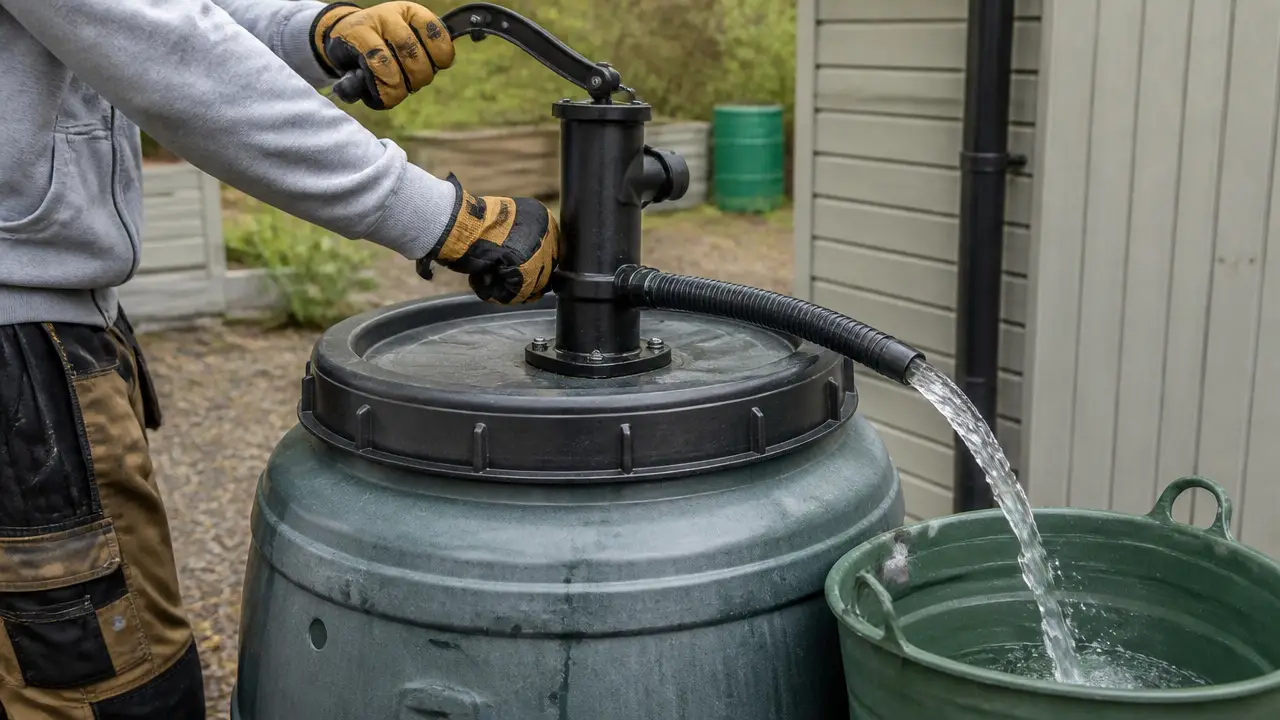
A hand pump is a simple way to move rainwater out of a barrel when gravity is not enough or the container has no low-mounted spigot. It can fill watering cans, transfer water to another container, or empty part of a drum without electricity.
The most important buying question is fit. Many drum pumps are built around a 2-inch bung and a suction tube sized for 15- to 55-gallon drums. A pump that works well in one barrel can be useless in another if the opening, thread, or tube length does not match.
After fit, choose the pumping action you prefer. Piston and lever pumps move water with repeated strokes. Rotary pumps use a crank and can feel smoother during longer transfers. None of these replaces a powered pump when you need sustained pressure for sprinklers or household plumbing.
Hand Pumps for Water Barrels at a Glance
| Product | Best For | Key Strength | Tradeoff |
|---|---|---|---|
| TERA PUMP Emergency Drum Pump | Everyday 55-gallon rain barrels | Simple piston action and up to 5.5 GPM documented flow | Bung fit must match the barrel |
| TERA PUMP TRDRUM40 | Adjustable 15- to 55-gallon drums | Segmented suction tube and familiar lever action | Discharge hose durability is mixed |
| VEVOR Lever-Action Drum Pump | High-volume per-stroke transfer | Moves 9.5 ounces per stroke and fits 5-55 gallon drums | Seal life and build consistency are mixed |
| VEVOR Rotary Drum Pump | Longer hand-crank transfers | Documented 6.5 GPM flow and rotary action | Larger pump body and hose sealing need attention |
| SMART JERRY Drum Pump | Lever-style barrel transfer | Moves 9–14 ounces per stroke with a 36-inch suction reach | Drum-thread fit is inconsistent across containers |
Check the Barrel Opening Before You Buy
A 55-gallon drum is not one universal standard at the opening. Some barrels have different thread patterns on the two bungs, and some rain barrels use lids or openings that are not designed for a threaded drum pump at all.
Measure the opening and identify the thread before ordering. If the pump uses a 2-inch NPS adapter, make sure your drum has the matching bung. Also check whether the suction tube reaches near the bottom without pressing hard against it.
If your rain barrel has a wide open top, a pump that only needs a tube dropped through the opening may be easier than a threaded model. If the barrel is sealed, the bung adapter becomes much more important because it keeps the pump stable while you work the handle.
A Straightforward Pump for a 55-Gallon Rain Barrel
1 / 5
TERA PUMP Emergency 55-Gallon Drum Pump

Action
Manual piston
Flow
Up to 5.5 GPM
Suction Tube
33.4 in
The TERA PUMP emergency drum pump is a practical match for a standard 55-gallon water drum with the right bung. It uses manual piston action, a 33.4-inch suction tube, and a flexible 47.2-inch discharge hose. The built-in 2-inch NPS bung adapter is meant to hold the pump at the drum opening.
Its documented flow is up to 5.5 gallons per minute, which is enough for filling watering cans and moving useful amounts of water without turning the job into an all-day exercise. The long hose also lets you direct water into a bucket without balancing the bucket directly beside the drum.
Fit is the main caution. It works well when the barrel opening matches, but it does not fit every blue drum or greenhouse tank. Measure first. For a basic rain barrel that does match, the simple manual action and useful hose length make this the easiest recommendation here.
Why It Works
- Manual operation needs no outlet, battery, or charger.
- Up to 5.5 GPM is practical for watering cans and container transfer.
- A 33.4-inch suction tube reaches deep into a standard drum.
- The discharge hose gives more placement freedom than a short rigid spout.
What To Keep In Mind
- The 2-inch NPS bung must fit your specific barrel.
- A drum opening that is too small or uses a different thread can make the pump unusable.
- This is a transfer pump, not a pressure pump for sprinklers or household fixtures.
An Adjustable TERA PUMP for Different Drum Depths
2 / 5
TERA PUMP TRDRUM40 Manual Drum Pump

Drum Range
15-55 gal
Suction Tube
3-piece, to about 34.4 in
Adapter
2 in NPS
The TRDRUM40 uses a three-piece segmented suction tube that adjusts to about 34.4 inches. That makes it useful when you want one pump for several drums between roughly 15 and 55 gallons rather than a tube built around one container depth.
It also uses lever-style manual pumping and a flexible 47.2-inch discharge hose. The documented delivery is in the same general class as the other TERA PUMP model, with about one pint for every three strokes and up to 5.5 gallons per minute under suitable conditions.
The discharge hose is the weak point. Product-specific use includes hoses developing cracks after months of service and pumps losing siphon when air enters the system. For rainwater, keep the hose protected from unnecessary sun exposure and inspect the connections when pumping becomes harder or flow drops.
Why It Works
- Segmented tube adapts to a range of drum depths.
- Designed around 15- to 55-gallon drums.
- Manual lever action works without electricity.
- Long discharge hose is convenient for bucket filling.
What To Keep In Mind
- Hose durability is mixed over longer use.
- Air leaks can reduce pumping performance.
- The drum bung still has to match the supplied adapter.
A Lever Pump With High Volume Per Stroke
3 / 5
VEVOR Lever-Action Drum Pump

Action
Lever
Delivery
9.5 oz per stroke
Drum Range
5-55 gal
The VEVOR lever-action pump is built for 5- to 55-gallon drums and moves a documented 9.5 ounces with each stroke. That is a useful way to think about its output because actual gallons per minute depend on how quickly and continuously you operate the handle.
A three-section suction tube lets the pump reach different drum depths. The pump is hand operated, so it remains useful at a garden barrel or remote tank where running power is inconvenient. The handle is also easier to understand than a powered pump with switches, wiring, and dry-run concerns.
Manual pumping can be compared with getting water from a rain barrel without a pump when gravity and elevation are sufficient.
Build consistency is the tradeoff. Product-specific use includes pumps lasting through substantial transfer work, but also seal deterioration and contamination concerns in non-water liquids. For a rainwater barrel, inspect the pump before use and keep the application limited to water rather than assuming broad chemical claims apply to your system.
Why It Works
- Moves 9.5 ounces per lever stroke.
- Fits a broad 5- to 55-gallon drum range.
- Three-section suction tube adapts to different container depths.
- Manual operation suits sheds, gardens, and off-grid storage areas.
What To Keep In Mind
- Seal life is inconsistent over long use.
- Pump condition matters if the stored water has a sensitive intended use.
- Do not treat a drum pump as a water-treatment component.
A Rotary Hand Pump for Longer Transfers
4 / 5
VEVOR 6.5 GPM Rotary Drum Pump

Action
Hand crank rotary
Flow
Up to 6.5 GPM
Drum Range
5-55 gal
The VEVOR rotary pump uses a hand crank instead of repeated vertical lever strokes. For moving several gallons at a time, that motion can feel more continuous because the pump cycles as you turn the handle.
Its documented flow is up to 6.5 gallons per minute, and it is built around 5- to 55-gallon drums with a three-section suction tube. The pump body is larger than the compact piston models, so it works best when the drum has enough clear space around the bung for the crank to turn freely.
A secure mechanical fit matters most with this pump. Product-specific use includes hose leaks and a pump assembly that can wiggle when the bung connection is not tightened securely. Make sure the drum opening matches and keep the pump upright while turning the crank.
Why It Works
- Rotary hand-crank action suits longer transfer sessions.
- Up to 6.5 GPM gives useful flow without electrical power.
- Three-section suction tube covers a broad drum range.
- Good match for garden water transfer where pressure is not required.
What To Keep In Mind
- Leave enough room around the drum for the crank handle.
- Hose and bung connections may need periodic inspection.
- A loose drum connection makes the pump harder to operate smoothly.
A Lever Pump With Strong Documented Flow
5 / 5
SMART JERRY 55-Gallon Drum Pump

Action
Lever
Delivery
9–14 oz per stroke
Suction Tube Reach
36 in
The SMART JERRY drum pump is another lever-style option, with documented delivery of 9–14 ounces per stroke and a three-section suction tube that reaches up to 36 inches. Its tall form is intended to work with drum-style containers rather than small buckets.
High flow only matters when the pump actually fits the barrel. Product-specific use is split: some users get strong transfer performance from 50- and 55-gallon drums, while others find that the bung threads do not match any of their containers. Different thread sizes on the same drum can also cause confusion.
That fit uncertainty moves it to the bottom of the ranking despite its useful per-stroke delivery. It can be a useful pump when the barrel interface matches, but this is the product here where measuring the bung before ordering matters most.
Why It Works
- Moves a documented 9–14 ounces per lever stroke.
- Lever operation needs no external power.
- A suction-tube reach of up to 36 inches suits drum transfer.
- Tall pump layout is built around barrel use.
What To Keep In Mind
- Bung-thread compatibility is inconsistent across drums.
- Hardware can loosen if the pump is not mounted firmly.
- Do not buy by the words "55 gallon" alone; measure the opening and thread.
Piston, Lever, or Rotary: Which Is Better?
Piston and lever pumps are simple and easy to control when you only need a bucket or watering can. You pump exactly as much as you want, then stop. They also have fewer reasons to keep turning once the receiving container is nearly full.
A rotary pump is more comfortable when you plan to move a larger amount continuously. The crank gives a steady rhythm and can feel smoother than repeated long lever strokes.
Neither style creates useful household water pressure by itself. If your goal is running a hose nozzle, sprinkler, or pressure-dependent filter, a powered pump sized for flow, lift, and pressure is a different category.
How to Set Up a Hand Pump on a Rain Barrel
Make Sure the Barrel Is Stable
A full 55-gallon drum is heavy. Keep it on a level, supported base and do not pull sideways on the pump while operating the handle.
Fit the Suction Tube
Assemble or adjust the tube so it reaches low into the barrel without jamming hard against the bottom. A tube pressed into the floor of the drum can restrict the inlet.
Secure the Bung Adapter
Thread or clamp the pump into the opening as intended. The pump should not rotate or wobble significantly when you move the handle.
Route the Discharge Hose
Place the hose securely in the receiving bucket or container before pumping. Do not rely on a loose hose to stay put once water starts moving.
Start Slowly
Use a few controlled strokes to prime the pump. Once flow is steady, increase your pace only as needed.
Common Hand-Pump Problems
The Pump Will Not Prime
Check for air entering around the bung, tube joints, hose, or pump seals. Make sure the suction tube reaches the water and any vent control is positioned correctly.
The Pump Fits the Drum but Wobbles
The bung connection may not be fully seated or the adapter may not match the opening correctly. Do not hold a poorly fitted pump in place by hand while forcing the lever.
Flow Drops After a Few Months
Inspect the hose, seals, and tube joints for cracks or air leaks. Manual pumps depend on an intact suction path.
The Pump Leaves Water in the Bottom
Most drum pumps cannot remove every last drop. Suction-tube length and inlet position decide how much remains.
The Water Is for Drinking
A hand pump only moves water. Roof-collected rainwater intended for drinking needs a suitable whole-system treatment plan and current water testing. Pump material and cleanliness also have to fit that intended use.
Frequently Asked Questions
Can I use a hand pump on a rain barrel?
Yes, when the suction tube reaches the water and the pump fits the barrel opening. Drum-style pumps are especially convenient on sealed barrels with compatible bungs.
Do hand barrel pumps need electricity?
No. The pumps here use piston, lever, or hand-crank operation, so they can move water without an outlet or battery.
How fast can a manual drum pump move water?
It varies by design and how quickly you operate it. Documented maximum figures among these pumps range from roughly 5.5 GPM upward, while lever models may also specify volume per stroke.
Will a 55-gallon drum pump fit every 55-gallon barrel?
No. Drum capacity does not guarantee the bung thread or opening is the same. Measure the barrel interface before buying.
Can a hand pump run a garden hose sprinkler?
Usually not in the way a powered pressure pump can. A hand pump is best for transferring water into a bucket, watering can, or another container.
How do I keep a manual drum pump working well?
Keep the suction path clean, protect hoses from unnecessary weather exposure, inspect seals for air leaks, and avoid forcing the handle when the pump is not primed.
If you want an even simpler gravity-assisted transfer, siphon pumps for water barrels are worth comparing. For faster portable transfer without hand pumping, battery-powered water transfer pumps use a motor and portable power source. A drill can also supply the motor for drill pumps for water transfer when a compatible tool is already nearby. For a permanent powered setup, rain barrel pumps are better suited to repeated hose and irrigation use.