As an affiliate, we may earn a commission from qualifying purchases. We get commissions for purchases made through links on this website from Amazon and other third parties.
Best Overall
Best Automatic Flush
Best Fine Cartridge
Sediment filtration works best as a sequence, not one magic filter. Coarse screens and spin-down filters catch sand, rust, grit, and larger particles early. Finer cartridges catch smaller suspended sediment later. Using the stages in that order can protect pumps, valves, filter housings, UV equipment, and other downstream parts from unnecessary loading.
For rainwater, the right micron rating depends on what reaches the filter. Water from a well-screened tank may work well with a 50-micron reusable prefilter before a finer cartridge. Water carrying heavy roof grit can clog a fine cartridge quickly unless larger material is removed first.
The seven options here include manual and automatic spin-down filters plus disposable cartridge filters. They do not all belong in the same position. Pick the filter from its stage in the system, required flow, connection size, and maintenance routine rather than treating a smaller micron number as automatically better.
Sediment Filters at a Glance
| Product | Best For | Key Strength | Main Tradeoff |
|---|---|---|---|
| iSpring WSP-50 | General reusable prefiltration | 50-micron stainless screen, manual flush, dual-thread connections | Fine screen can clog quickly in heavy sediment |
| iSpring WSP50ARJ | Automatic high-debris prefiltration | Jumbo screen area and timed automatic flush | Large unit, powered flush module, high drain flow |
| Pentek DGD-5005-20 | Fine cartridge stage | Nominal 5-micron dual-gradient depth filtration | Disposable cartridge adds replacement cost and pressure loss as it loads |
| Waterdrop RPFK15 | Adjustable coarse prefilter | 100- and 500-micron mesh options with multiple connection choices | Finer sediment still needs a later stage |
| Waterdrop PF01 | Compact 50-micron prefilter | Small body, dual threads, flushable stainless mesh | Drain valve and union sealing have caused leaks on some units |
| PUREPLUS Pleated Filter | Washable-style 20-micron cartridge use | Pleated surface area and coarser 20-micron stage | Prepared material and dimension fields conflict |
| Culligan R50-BBSA | Coarse cartridge stage | 50-micron heavy-duty sediment reduction | Housing fit is not truly universal despite broad compatibility claims |
Best Overall: iSpring WSP-50 Spin-Down Sediment Filter
1 / 7
iSpring WSP-50 Spin-Down Sediment Filter

Micron Rating
50 micron
Connections
1 in MNPT / 3/4 in FNPT
Operating Pressure
15-115 PSI
The iSpring WSP-50 is the most balanced first sediment stage for a typical pumped rainwater system. Its 50-micron stainless screen is fine enough to catch visible grit while remaining reusable, and the housing uses 1-inch male NPT plus 3/4-inch female NPT connection options. A hose-barb flush outlet lets collected sediment be purged without replacing a cartridge.
Its documented operating range is 15 to 115 PSI and 40°F to 100°F, with indoor installation specified. Those limits matter in rainwater systems because filter housings often end up beside outdoor tanks. If the pump equipment is outside, the filter needs a protected location rather than assuming a clear bowl can tolerate sun and freezing exposure.
Rainwater-specific use shows this filter working between storage tanks and a 12-volt pump, with sediment visible in the bowl and cleaning straightforward. The weak point appears when source water carries a lot of fine sediment. A 50-micron screen can load quickly and may need manual removal for a deeper cleaning beyond a quick flush.
Why It Works
- A reusable 50-micron screen is a practical first stage after tank storage.
- Dual-thread connections suit common 1-inch and 3/4-inch plumbing layouts.
- The clear bowl makes sediment buildup easy to see.
- Manual flushing reduces disposable-cartridge use at the coarse stage.
What To Keep In Mind
- Heavy sediment can clog a 50-micron screen quickly.
- The unit is specified for indoor use and above-freezing conditions.
- Do not over-tighten or use improper tools on the clear housing.
- Sediment removal is only one treatment stage and does not establish drinking-water safety.
Best Automatic Flush: iSpring WSP50ARJ Jumbo
2 / 7
iSpring WSP50ARJ Jumbo Spin-Down Sediment Filter

Micron Rating
50 micron
Connections
1 in MNPT / 3/4 in FNPT
Flush Control
Programmable automatic
The WSP50ARJ is the better fit when sediment loading is high enough that a small spin-down filter becomes a constant maintenance job. It uses a much larger housing and a 316L stainless mesh with a 50-micron rating, giving debris more collection area before flow becomes restricted.
Its automatic module can open the flush path on a programmed schedule. The default is presented as a 15-second flush every 15 days, though the schedule can be adjusted for the water source. That is useful for installations where the filter sees regular sand or rust and manual flushing would otherwise be forgotten.
Automatic cleaning adds complexity. The drain can move a large amount of water very quickly, so it needs a proper discharge path. Product-specific use also includes drain-valve leakage and automatic-module problems. Some owners ultimately preferred manual flushing. The prepared capacity and body-dimension fields conflict, so those exact values are not used here.
Why It Works
- A large 50-micron screen area handles heavier sediment loads than a compact spin-down.
- Programmable flushing can reduce routine hands-on maintenance.
- The clear housing makes sediment accumulation visible.
- Dual 1-inch male and 3/4-inch female NPT connections suit common whole-system plumbing.
What To Keep In Mind
- The powered auto-flush module creates another part that can fail.
- Drain flow is high enough to require a planned discharge line.
- Exact capacity and housing dimensions are omitted because the prepared fields conflict.
- Keep access around the housing in case manual disassembly is still needed.
Best Fine Cartridge: Pentair Pentek DGD-5005-20
3 / 7
Pentair Pentek DGD-5005-20 Sediment Cartridge

Micron Rating
5 micron nominal
Design
Dual-gradient depth
Certification
NSF/ANSI 42 material requirements
The Pentek DGD-5005-20 belongs later in the treatment train than a spin-down filter. Its nominal 5-micron rating targets much finer suspended sediment, and its dual-gradient construction becomes denser toward the core. That depth structure lets larger particles load the outer layers while smaller material is caught deeper inside.
The cartridge is designed for heavy-duty 20-inch Big Blue-style housings and carries NSF/ANSI Standard 42 material certification. It is a disposable cartridge, so there is no flush valve to maintain. As sediment loads the media, pressure drop increases until the cartridge needs replacement.
The prepared material, dimension, and capacity fields contain conflicts, so this guide does not use those disputed numbers beyond the supported nominal 5-micron role and Big Blue housing application. Product-specific use also shows replacement intervals varying widely with source water—from a few months in silty water to much longer when sediment loading is lighter.
Why It Works
- A nominal 5-micron rating catches much finer sediment than the reusable prefilters above.
- Dual-gradient depth media spreads dirt loading through the cartridge.
- It is designed as a downstream protective stage after coarser sediment removal.
- Material certification provides a defined standard for the cartridge materials.
What To Keep In Mind
- Fine cartridges can clog quickly if roof grit and sand reach them directly.
- Replacement timing depends on pressure drop and actual source-water load.
- Housing fit should be based on the exact filter housing model, not a generic size assumption.
- A 5-micron sediment cartridge does not remove every microbial or dissolved contaminant.
Best Adjustable Coarse Prefilter: Waterdrop RPFK15
4 / 7
Waterdrop RPFK15 Spin-Down Sediment Filter

Mesh Options
100 and 500 micron
Flow Claim
20 GPM
Connections
1 in MNPT / 3/4 in FNPT / 3/4 in MNPT
The RPFK15 is useful when the incoming sediment load changes with the season. It includes 100- and 500-micron mesh options, so a system can start coarse when roof or tank sediment is heavy and move to the finer screen when the source is cleaner.
Its compact body measures about 3.78 x 2.6 x 7.9 inches, and the connection package supports 1-inch male NPT, 3/4-inch female NPT, and 3/4-inch male NPT layouts. A 3/4-inch push-fit fitting is also included. The filter is driven by water pressure and does not need a powered flush module.
The 20 GPM flow claim makes it suitable for higher-demand prefiltration when the available pump and pipework can supply that flow. With only one usable product-specific customer note, there is less field history here than with the iSpring models. Its strongest reason to choose it is the interchangeable coarse screens and compact connection flexibility.
Why It Works
- Two mesh sizes let the prefilter adapt to changing sediment loads.
- Multiple thread options reduce adapter work.
- The compact housing fits tight pump-room layouts.
- Coarser mesh can protect finer filters without creating as much early pressure loss.
What To Keep In Mind
- A 100- or 500-micron screen is a coarse stage, not fine treatment.
- The product specifies protected installation above 4°C rather than exposed outdoor use.
- Flow depends on pump pressure, sediment loading, and the rest of the plumbing.
- Later filtration is still needed when smaller particles or higher-risk water uses matter.
Best Compact 50-Micron Prefilter: Waterdrop PF01
5 / 7
Waterdrop PF01 Spin-Down Sediment Filter
Primary Mesh
50 micron
Connections
1 in MNPT / 3/4 in FNPT
Flow Claim
20 GPM
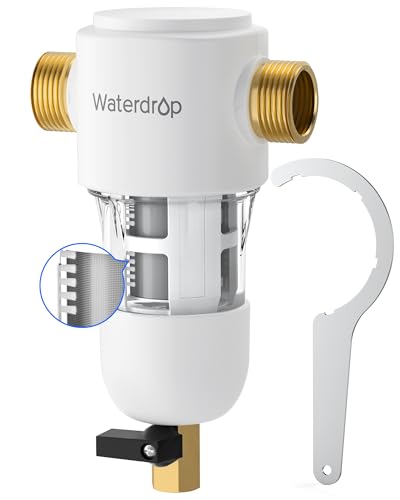
The PF01 is a compact alternative when you want a 50-micron reusable stage but do not have room for the jumbo iSpring. Its body is about 6.5 x 2.9 x 7.7 inches, and dual 1-inch male NPT and 3/4-inch female NPT connections support common whole-house plumbing arrangements.
A 316L stainless mesh catches sediment, rust, dirt, sand, and silt above its screen size. The clear lower chamber collects debris for flushing. Product-specific use shows it reducing sand and rust before sprinklers and downstream disposable filters.
Leakage around the purge valve and union seals is the main caution. There is also a product-specific report that replacement parts and screens became difficult to source. That makes serviceability worth considering before choosing it for a permanent rainwater installation.
Why It Works
- A reusable 50-micron screen fits the common coarse-prefilter role.
- Compact dimensions help in tight plumbing spaces.
- Dual thread sizes reduce adapter count.
- Flushing can extend the life of finer disposable filters downstream.
What To Keep In Mind
- Inspect the purge valve and union seals during the first pressure cycles.
- Replacement-part availability matters for long-term service.
- The filter is specified for protected, above-freezing installation.
- Fine sediment can still pass a 50-micron screen.
Best Pleated 20-Micron Cartridge: PUREPLUS
6 / 7
PUREPLUS 20-Micron Pleated Sediment Filter

Micron Rating
20 micron
Design
Pleated sediment cartridge
Pack
2
The PUREPLUS cartridge fills the gap between a coarse spin-down filter and a fine 5-micron depth cartridge. Its 20-micron pleated media provides more surface area than a flat sheet of the same footprint, which can help maintain flow while catching smaller sediment.
A 20-micron stage can make sense after a 50- or 100-micron reusable prefilter when you want to keep visible fine sediment out of later carbon, UV, or other treatment equipment. Product-specific use also suggests the coarser 20-micron format can last longer than 5-micron cartridges in sediment-heavy water.
The prepared material and dimension fields conflict, so this guide does not use exact cartridge-size measurements as a fit promise. The product identifies compatibility with several heavy-duty housing families, but fit should still be matched to the exact housing model before purchase.
Why It Works
- The 20-micron rating bridges coarse prefiltration and fine polishing.
- Pleated media provides a large exposed filtration area.
- A two-pack keeps a replacement ready for the next change.
- The coarser rating can last longer than a 5-micron cartridge when sediment load is high.
What To Keep In Mind
- Exact dimensions are omitted because the prepared fields conflict.
- Product-specific use includes a report of blue color washing from plastic components after installation.
- Replace the cartridge when pressure drop becomes excessive or according to the housing/filter maintenance plan.
- It is a sediment stage, not complete purification.
Best Coarse Cartridge: Culligan R50-BBSA
7 / 7
Culligan R50-BBSA Sediment Cartridge

Micron Rating
50 micron
Flow Claim
10 GPM
Dimensions
4.5 x 4.5 x 10 in
The Culligan R50-BBSA is a good option when you prefer a replaceable cartridge rather than a flushable spin-down but still want a coarse 50-micron first stage. It is designed to reduce sediment, rust, scale, dirt, silt, and coarse sand before that material reaches later treatment equipment.
The cartridge measures about 4.5 inches in diameter and 10 inches long, with a stated 10 GPM flow at its intended operating conditions. It carries IAPMO testing against NSF/ANSI Standard 42 for material requirements. That certification describes the material standard, not a guarantee that the cartridge removes all contaminants from rainwater.
Housing fit is the main issue. Despite broad compatibility language, product-specific use includes a GE housing where the cartridge was too long to seal correctly. Treat the exact housing model as the fit authority and do not force a housing closed around an over-length cartridge.
Why It Works
- A 50-micron rating makes it a coarse disposable sediment stage.
- Cartridge replacement avoids cleaning a reusable mesh.
- It can protect softer, finer, or more expensive downstream media.
- Material certification provides a defined standard for the cartridge itself.
What To Keep In Mind
- “Universal” compatibility does not mean every heavy-duty housing is identical.
- A cartridge that is too long can keep the housing from sealing and cause leaks.
- It does not address sulfur odor or dissolved contaminants simply because water looks clearer.
- Replacement interval depends heavily on actual sediment load.
How to Build a Sediment Filtration Sequence
Start Coarse
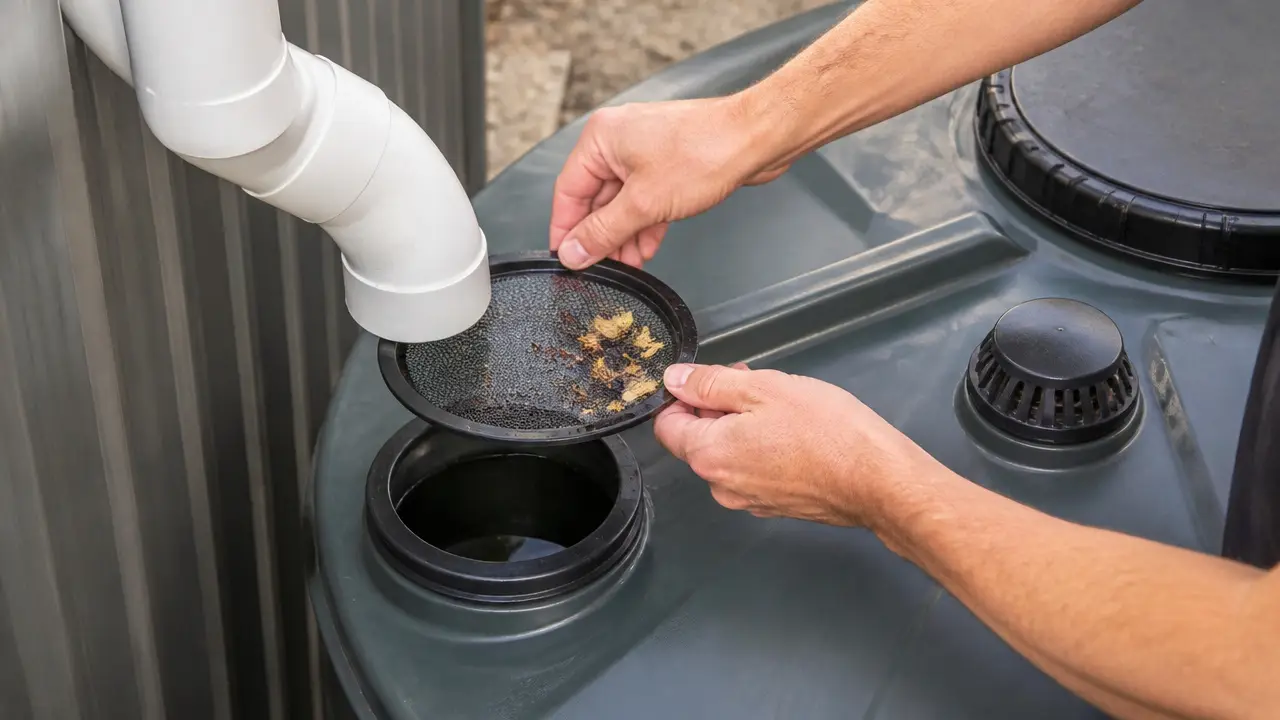
Use roof screens, downspout filters, tank inlet screens, and a coarse reusable prefilter to remove the largest material first. This protects pumps and prevents expensive fine cartridges from filling with grit they were not meant to handle alone.
A 500-, 100-, or 50-micron reusable stage can be appropriate depending on how dirty the stored water is. More sediment usually favors a coarser first screen.
Go Finer Only When the System Needs It
A 20- or 5-micron cartridge can reduce smaller suspended particles, but finer media creates more pressure drop as it loads. Do not install the smallest micron rating simply because it sounds cleaner.
The intended water use and downstream treatment determine how fine sediment filtration needs to go.
Watch Pressure Before and After the Filter
Pressure gauges on both sides of a filter make maintenance easier. As the screen or cartridge loads with sediment, the difference between inlet and outlet pressure grows.
That pressure drop is often a better maintenance signal than a calendar date because rainwater sediment load changes with roof conditions and storms.
Give Flush Water Somewhere to Go
Spin-down filters need a drain line or container that can handle the purge flow. Automatic jumbo filters can discharge water much faster than expected.
Route flush water to a safe location where sediment will not clog a floor drain or wash back toward the foundation.
Protect Clear Housings From Sun and Freezing
Many transparent filter bowls are meant for protected indoor use. Sun exposure can age plastic, while freezing water can crack a bowl or drain valve.
Outdoor rainwater systems should place filtration in an enclosure or other location consistent with each filter's environmental limits.
Frequently Asked Questions
What micron sediment filter is best for rainwater?
There is no single best rating. Heavy sediment often starts with 100 to 500 microns, followed by 50 microns and then a finer cartridge when needed. The best sequence depends on the source water and intended use.
Is 5 microns better than 50 microns?
It catches smaller particles, but it also clogs faster. A 5-micron cartridge works better after coarse sediment has already been removed.
Should a sediment filter go before or after the pump?
Coarse screening may be used before a pump when the pump design allows it, while pressurized spin-down and cartridge filters are often installed after the pump. Follow the pump's suction requirements and avoid creating excessive suction restriction.
How often should I flush a spin-down filter?
Flush it often enough that sediment does not build up and restrict flow. The interval may range from after dirty storms to weeks between flushes, depending on the source and screen size.
How do I know when a cartridge needs replacement?
A growing pressure drop, reduced flow, visible loading, or the cartridge maker's service limit can signal replacement. Sediment-heavy rainwater may shorten the interval substantially.
Does a sediment filter make rainwater safe to drink?
No. Sediment filtration removes physical particles only. Drinking-water use requires suitable treatment for microbial and chemical risks, current laboratory testing, maintenance, and applicable local requirements.
If you want to stop larger material before it reaches the tank, downspout filters handle an earlier debris stage. Rainwater tank inlet screens protect the storage opening itself. After filtration changes, rainwater test kits can help with limited screening tasks, but they do not replace a certified laboratory assessment for drinking-water safety.