As an affiliate, we may earn a commission from qualifying purchases. We get commissions for purchases made through links on this website from Amazon and other third parties.
A gravity-fed water system makes pressure from the vertical height of the water above the outlet. The higher the tank or water level, the more pressure you get.
For water, a useful rule is:
1 foot of vertical water height produces about 0.43 psi.
That means a tank with its water surface 10 feet above a faucet can provide about 4.3 psi before pipe and fitting losses.
Gravity systems often have much less pressure than a typical pumped household water system, so height, pipe size, and flow demand matter.
Gravity-Fed Water Pressure Formula
You can estimate pressure with this formula:
Pressure in psi = vertical height in feet × 0.433
For example:
- 5 feet of height = about 2.2 psi
- 10 feet = about 4.3 psi
- 20 feet = about 8.7 psi
- 30 feet = about 13 psi
- 40 feet = about 17.3 psi
- 50 feet = about 21.7 psi
If you use metric measurements, about 1 meter of water height produces 9.8 kPa, or roughly 0.1 bar.
These numbers describe the pressure available when water is not flowing. Actual pressure at a faucet, hose, filter, or irrigation line will usually be lower.
Measure Height From the Water Surface
The important measurement is not simply how high the bottom of the tank sits.
Measure the vertical distance from the water surface inside the tank to the outlet where you want pressure.
For example, imagine a rainwater tank sitting on a 6-foot platform. The water surface is another 4 feet above the bottom outlet. A garden faucet is at ground level.
The total vertical difference may be about 10 feet.
The estimated pressure would be:
10 × 0.433 = 4.33 psi
As the tank empties, the water surface drops. Pressure drops with it.
This is one reason gravity-fed systems do not provide perfectly steady pressure.
What Is Head Height?
Head height is the vertical distance between the water surface and the point where the water is being used.
It is one of the most important measurements in a gravity-fed system.
More head height means more pressure.
A tank that is farther away horizontally does not automatically create more pressure. A 100-foot-long pipe running across level ground does not add pressure. Only vertical height creates the gravity pressure.
The long pipe can actually reduce the pressure available while water is flowing because of friction.
Static Pressure vs. Flowing Pressure
There are two useful ways to think about pressure.
Static pressure
Static pressure is the pressure in the pipe when no water is moving.
This is the pressure you estimate from head height.
If you have 20 feet of vertical height:
20 × 0.433 = about 8.7 psi static pressure
Dynamic pressure
Dynamic pressure is the pressure available while water is flowing.
It is normally lower because water loses energy as it moves through:
- Pipe
- Hose
- Valves
- Elbows
- Tees
- Filters
- Screens
- Check valves
- Small fittings
The faster you try to move the water, the larger these losses can become.
A system that measures 8 psi with the valve closed might provide noticeably less pressure once a high-flow sprinkler is running.
Pipe Size Has a Big Effect on Gravity Systems
Low-pressure systems are especially sensitive to small pipes.
A narrow hose or pipe may work for filling a watering can but struggle to supply several irrigation lines at once.
Larger pipe usually reduces friction loss.
For example, if a rainwater tank supplies a garden located some distance away, using a larger main pipe can help preserve the limited pressure produced by gravity. You can then reduce the pipe size closer to individual outlets when appropriate.
Do not assume that increasing pipe size creates additional static pressure. It does not.
Instead, larger pipe helps you lose less pressure while water is flowing.
Flow Rate and Pressure Are Not the Same Thing
Flow rate tells you how much water moves during a period of time. It may be measured in gallons per minute or liters per minute.
Pressure tells you how strongly the water is being pushed.
A gravity-fed tank can sometimes provide a useful flow rate even when pressure is low, especially through a large pipe with few restrictions.
But equipment that requires a specific minimum pressure may still not work.
This distinction matters for:
- Drip irrigation
- Sprinklers
- Filters
- Water heaters
- Toilets
- Washing machines
- Shower fixtures
- Automatic irrigation valves
Check the operating requirements of anything connected to the system.
How Much Height Do You Need for Common Pressures?
You can also rearrange the pressure formula:
Required height in feet = desired psi ÷ 0.433
Approximate examples are:
| Desired Static Pressure | Vertical Water Height Needed |
|---|---|
| 2 psi | 4.6 ft |
| 5 psi | 11.5 ft |
| 10 psi | 23 ft |
| 15 psi | 34.6 ft |
| 20 psi | 46.2 ft |
| 30 psi | 69.3 ft |
These are theoretical static-pressure values.
Real systems need additional head if you must overcome long pipe runs, filters, fittings, elevation changes, or high flow rates.
How Much Pressure Does a Rain Barrel Produce?
A typical rain barrel sitting near ground level produces very little pressure.
Suppose the water surface is 3 feet above the hose outlet.
The pressure is approximately:
3 × 0.433 = 1.3 psi
That may be enough for:
- Filling a bucket
- Slowly watering nearby plants
- Supplying some low-pressure drip arrangements
It may not be enough for equipment designed around normal household water pressure.
Putting the barrel on a stand can increase pressure, but the stand must safely support the full weight.
Water is heavy. One US gallon weighs about 8.34 pounds. A large container can place thousands of pounds on its base or platform.
Do not raise tanks on makeshift structures just to gain pressure. Use a structure designed for the filled tank load and local site conditions.
What About IBC Totes and Cisterns?
Evaluating estimating water pressure from gravity helps verify required pump lift with suitable operating safeguards.
The same pressure rule applies to an IBC tote, rain tank, or cistern.
What matters is the water level relative to the outlet.
An IBC tote placed directly on the ground usually offers only a few feet of head when full. Pressure drops as the tote empties.
A cistern located uphill from a garden or building may have much more useful gravity pressure because the land itself provides elevation.
This can be more practical than building a very tall tank stand.
Elevation Changes After the Tank Matter
The final outlet may be above or below the tank.
If water travels downhill, the available head increases.
If it travels uphill, the available head decreases.
For example, assume the tank water surface is 20 feet above the starting point of the pipe.
If the final faucet is 5 feet uphill from that starting point, the effective head may be about:
20 – 5 = 15 feet
Static pressure would be approximately:
15 × 0.433 = 6.5 psi
Always compare the tank's water surface with the elevation of the actual point of use.
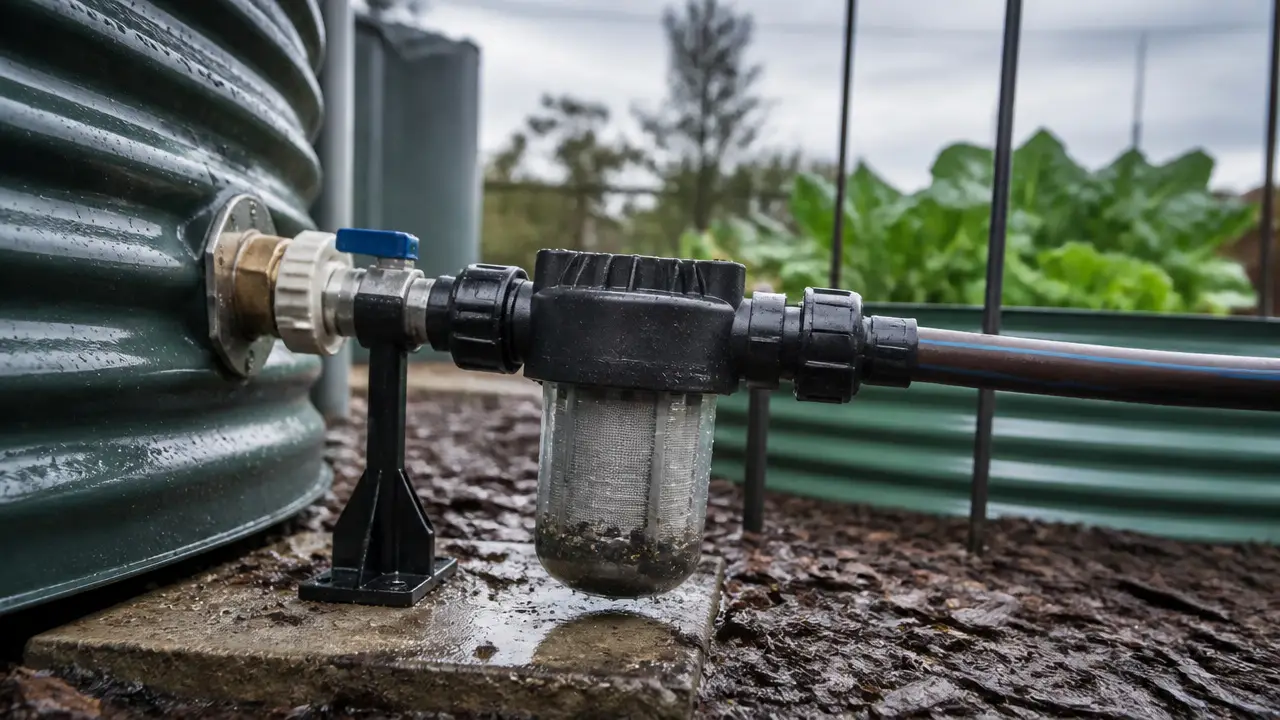
Filters Can Reduce Available Pressure
Filters add resistance to water flow.
This can be important in gravity systems because there may not be much pressure available to begin with.
A filter that works well on a pumped water line may restrict a low-pressure gravity system too much.
The effect can become worse as the filter gets dirty.
If filtration is needed, consider:
- Required flow rate
- Available pressure
- Filter connection size
- Pressure loss through the filter
- Maintenance needs
- How dirty the incoming water may be
For drinking-water applications, do not assume that good pressure or one filter makes rainwater safe to drink. Potable water means water suitable for drinking. Drinking-water use requires a suitable collection and treatment system, maintenance, current laboratory testing, and compliance with applicable local requirements.
Can You Increase Gravity-Fed Pressure?
There are two basic ways to get more useful pressure.
Increase the vertical height
Raising the water surface increases static pressure.
Every additional foot provides about 0.43 psi.
However, large tanks are very heavy. Raising a storage tank can create serious structural and stability risks. A properly engineered location or an existing higher elevation is often safer than building a tall improvised platform.
Add a pump
A pump can provide higher and more consistent pressure when gravity alone is not enough.
A pump may be useful when supplying:
- Sprinklers
- Household fixtures
- Longer irrigation runs
- Equipment with minimum pressure requirements
- Several outlets at the same time
Pump selection depends on required flow, pressure, vertical lift, pipe layout, power supply, and controls.
Dry-run protection may also be important so the pump does not continue running after the storage tank empties.
How to Check Your Actual Gravity-Fed Pressure
The height formula gives a good estimate, but a pressure gauge can show what your real system is doing.
Test pressure at the point where performance matters.
It can be useful to compare:
- Pressure with all outlets closed.
- Pressure while the expected amount of water is flowing.
A large difference between those readings can point to flow restrictions.
Possible causes include undersized pipe, clogged screens, dirty filters, partly closed valves, narrow fittings, or a long pipe run.
Plan for the Lowest Water Level
A gravity system should not be sized only around a completely full tank.
Pressure decreases as the water level falls.
Suppose a tall tank gives you 12 feet of head when full but only 6 feet when nearly empty.
At 12 feet:
12 × 0.433 = about 5.2 psi
At 6 feet:
6 × 0.433 = about 2.6 psi
If your irrigation system needs more than 2.6 psi to work properly, it may stop performing as expected before the tank is actually empty.
For reliable operation, design around the lowest water level you expect to use.
The Main Rule to Remember
Gravity pressure depends mainly on vertical water height.
For water:
1 foot of head = about 0.43 psi
or:
10 feet of head = about 4.3 psi
The pressure available while water is flowing will usually be lower because of pipes, fittings, filters, valves, and other restrictions.
For a simple rain barrel feeding a nearby garden, low pressure may be perfectly useful. For sprinklers, household fixtures, long pipe runs, or equipment with minimum pressure requirements, calculate the available head and expected losses before deciding whether gravity alone will work.
Frequently Asked Questions
How much pressure does 10 feet of water create?
Ten feet of vertical water head creates about 4.3 psi of static pressure. Pressure while water is flowing will normally be somewhat lower.
How high does a water tank need to be for 10 psi?
You need about 23 feet of vertical distance between the water surface and the outlet to produce 10 psi before flow losses.
Does a bigger tank create more water pressure?
Not necessarily. A wider tank holds more water, but pressure depends on the vertical height of the water surface above the outlet. A taller water column can create more pressure.
Does a larger pipe increase gravity pressure?
A larger pipe does not increase static pressure. It can reduce friction loss, which may leave more pressure available at the outlet while water is flowing.
Why does my gravity-fed system lose pressure as the tank empties?
The water surface becomes lower as the tank empties. This reduces head height, so gravity pressure decreases.
Can a gravity-fed rain barrel run a sprinkler?
Some sprinklers require more pressure or flow than a low rain barrel can provide. Check the sprinkler's operating requirements and compare them with the pressure available from your head height.
Can a gravity-fed system supply a house?
It can in some layouts, especially when storage is located well above the building. However, household fixtures and appliances may need more pressure than gravity can provide. Water intended for household use also requires planning for plumbing, treatment, water quality, maintenance, and applicable local requirements.