As an affiliate, we may earn a commission from qualifying purchases. We get commissions for purchases made through links on this website from Amazon and other third parties.
For most garden-hose watering jobs, a battery-powered digital hose timer is the best all-around choice. It can turn the water on and off automatically, lets you choose watering days and run times, and does not need an electrical outlet.
But the best timer depends on what is feeding the hose. A timer connected to a pressurized outdoor faucet has different needs from one connected to a gravity-fed rain barrel.
The Main Types of Garden Hose Water Timers
There are four useful types to consider.
Mechanical Shutoff Timers
A mechanical timer is the simplest option. You turn a dial to choose how long the water should run. The timer shuts the water off when that time ends.
These work well for:
- Occasional garden watering
- Soaker hoses
- Sprinklers you start manually
- Preventing a forgotten hose from running for hours
They usually do not start watering automatically. You must turn the timer each time.
Choose this type when you mainly want automatic shutoff rather than a watering schedule.
Single-Outlet Digital Timers
A single-outlet digital timer fits between the outdoor faucet and one garden hose.
You can usually program a watering schedule based on time, frequency, or specific days. Colorado State University Extension describes these battery-powered single-zone controllers as a simple way to automatically turn garden watering on and off.
This is a good choice for:
- One vegetable garden
- A drip irrigation line
- A soaker hose
- One sprinkler
- Raised beds connected to one hose
For most homeowners, this is the best place to start.
Multi-Outlet Hose Timers
A multi-outlet timer splits one faucet into two or more independently controlled watering lines.
For example, you might use:
- Outlet 1 for raised beds
- Outlet 2 for containers
- Outlet 3 for a lawn sprinkler
Separate outlets are useful because different areas often need different watering schedules. Putting vegetables and lawn sprinklers on the same watering zone can make it difficult to give each area the right amount of water.
Check whether the timer can run the outlets independently. Some models have more outlets but fewer independent programs than you might expect.
Smart Hose Timers
Smart timers add Bluetooth, Wi-Fi, or both. They may let you change schedules from a phone, check timer status, or delay watering without walking outside.
Some systems also use weather information to help adjust watering.
A smart timer makes the most sense when:
- You travel often
- The faucet is inconvenient to reach
- You change watering schedules frequently
- You have several watering areas
- Remote control is genuinely useful
For a small garden with a fixed schedule, a normal digital timer is usually simpler.
What Makes a Good Garden Hose Timer?
Do not choose based only on the number of programs it offers. Several practical details matter more.
Easy Manual Watering
Look for a manual watering function.
It should let you turn the water on temporarily without deleting or changing your normal schedule. This is useful when you want to fill a watering can, rinse tools, or give plants extra water.
Manual operation and temporary rain-delay functions are common features on current programmable hose timers.
Flexible Watering Frequency
Your timer should match the way you actually water.
Useful scheduling choices may include:
- Certain days of the week
- Every day
- Every few days
- More than one watering period per day
Do not assume every digital timer provides every option. Check the programming limits before buying.
Rain Delay
A rain-delay button temporarily skips scheduled watering without erasing the program.
That is much easier than turning the timer off and rebuilding the schedule later.
It does not mean the timer actually knows how much rain your garden received unless it has a compatible weather or moisture system.
A Clear Display
Hose timers live in awkward places. They may be below a faucet, behind plants, or close to the ground.
A large display and simple controls can be more valuable than an extra set of advanced features you rarely use.
Replaceable Batteries
Most basic digital hose timers run on batteries.
Check:
- Battery type
- How the battery compartment seals
- Whether the timer warns you when batteries are low
- What the valve does if the batteries die
Replace batteries as part of normal garden maintenance rather than waiting for the timer to stop operating.
Check Water Pressure Before Using a Timer
This is especially important for rainwater systems.
Many normal hose timers are designed for a pressurized faucet. Their internal valve may not open or close properly when connected directly to a gravity-fed rain barrel.
Minimum operating pressure varies greatly by model. For example, one current programmable hose timer specifies a 25 psi minimum operating pressure. That does not mean all hose timers require 25 psi. It shows why checking the actual specification matters.
A rain barrel sitting a few feet above the garden produces only a small amount of pressure.
Head height means the vertical distance between the water surface and the outlet. About 2.31 feet of water height produces roughly 1 psi of static pressure.
So raising a barrel a couple of feet does not turn it into a normal household-pressure water source.
Better Timers for Gravity-Fed Rain Barrels
For rain-barrel timers for dependable scheduling, first evaluate lift, suction, and safeguard requirements for the setup.
If your hose comes directly from a rain barrel or elevated tank, look specifically for a timer designed for:
- Zero pressure
- Very low pressure
- Gravity-fed systems
These timers often use a motor-driven valve rather than a valve that depends on normal household water pressure.
Still check the manufacturer's minimum pressure requirement. "Low pressure" can mean different things on different products.
Also remember that a timer cannot fix poor gravity flow. Flow may still be limited by:
- Small tank outlets
- Long hoses
- Narrow tubing
- Filters
- Elevation changes
- Drip emitters that require more pressure
A timer can control when water moves. It cannot create pressure.
Using a Hose Timer With a Rainwater Pump
A pump-fed cistern or storage tank is a different situation.
If the pump provides normal hose pressure, a standard timer may work well. However, the entire system must be designed so the pump can safely start and stop as the timer opens and closes.
A typical arrangement might be:
Tank → filter or strainer → pump → pressure control → hose timer → irrigation line
The pump needs appropriate automatic controls and dry-run protection where needed. Do not assume that simply installing a timer on the discharge side makes any pump suitable for automatic irrigation.
Watch the Connection Sizes
Most hose-end timers are intended for standard garden-hose connections, but do not assume every part of your system uses the same threads.
Check the:
- Faucet connection
- Timer inlet
- Timer outlet
- Hose
- Splitter
- Drip adapter
- Rain-barrel fitting
Rain barrels and IBC totes often use larger plumbing fittings rather than normal garden-hose threads.
You may need an adapter between the tank valve and timer.
Avoid stacking several heavy fittings directly from a plastic barrel wall. The extra leverage can put stress on the bulkhead fitting.
A bulkhead fitting is the sealed fitting that passes through the tank wall and provides a connection for a valve or pipe.
Think About Flow Rate Too
A timer creates some resistance to water flow.
That may not matter when running a short hose from a normal household faucet. It can matter much more in a low-pressure rainwater system.
If you are supplying several sprinklers or a large drip system, make sure the water source can provide enough flow rate.
Flow rate is simply how much water moves through the system over time, such as gallons per minute.
A large timer outlet does not guarantee high flow if the faucet, pump, tank fitting, hose, or filter is restricting the system upstream.
Use a Filter With Collected Rainwater
Roof runoff can carry leaves, grit, insects, roofing debris, and other particles into a storage tank.
Small debris can interfere with timer valves and irrigation emitters.
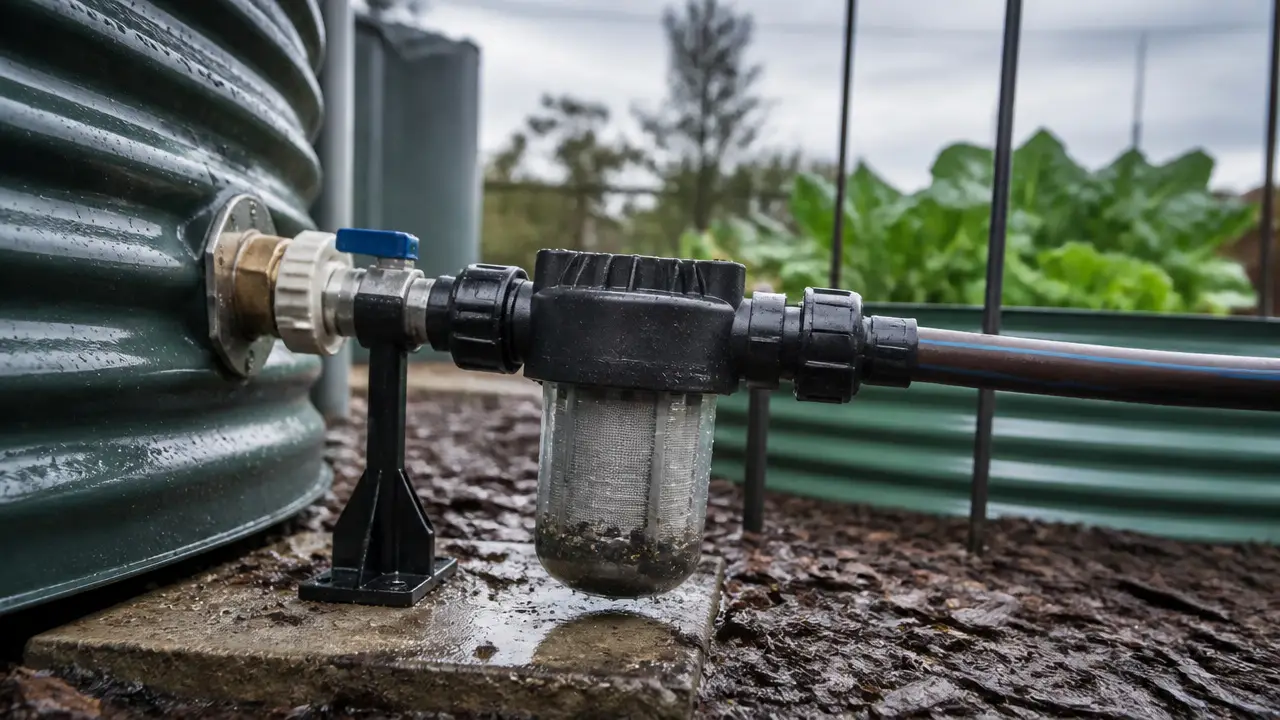
A simple irrigation strainer or suitable filter upstream of the timer can reduce clogging. The appropriate filtration depends on the irrigation equipment downstream.
Keep the filter accessible. A filter that is never cleaned eventually becomes another flow restriction.
Filtration for irrigation does not make collected roof runoff safe to drink.
Protect the Timer From Freezing
Hose timers normally contain small internal passages and valves. Water trapped inside them can freeze and damage the housing or valve.
Before freezing weather:
- Shut off the water source.
- Disconnect the timer.
- Allow trapped water to drain.
- Store the timer according to its manufacturer's instructions.
Do the same for vulnerable hoses, filters, and exposed fittings in the watering system.
Do not assume that selecting "off" on a digital timer removes the water trapped inside it.
Which Type Should You Choose?
A simple way to decide is:
| Watering setup | Good timer type |
|---|---|
| Occasionally running a hose or sprinkler | Mechanical shutoff timer |
| One garden, drip line, or soaker hose | Single-outlet digital timer |
| Several separate garden areas | Multi-outlet digital timer |
| Remote control is useful | Smart hose timer |
| Gravity-fed rain barrel | Timer specifically rated for zero or very low pressure |
| Pump-fed rainwater system | Standard timer only if pressure and pump controls are compatible |
For most gardens supplied by a normal outdoor faucet, a single-outlet battery-powered digital timer with manual watering and rain delay is a practical choice.
For a rain barrel, pressure compatibility should be the first thing you check. A good timer designed for household water pressure can be a poor choice for a gravity-fed system.
Frequently Asked Questions
Can I put a water timer on any garden hose?
Usually, if the timer and hose use compatible garden-hose connections. You also need to check the timer's water-pressure requirements. Standard timers may not work properly with low-pressure sources such as gravity-fed rain barrels.
Do garden hose timers reduce water pressure?
A timer creates some restriction, so some pressure and flow loss is possible. The effect may be minor on a normal household faucet but more noticeable in a low-pressure rainwater system.
Can I use a normal hose timer on a rain barrel?
Only if the timer is rated for the pressure your rain barrel can provide. Many standard timers need more pressure than a gravity-fed barrel produces. Look for a zero-pressure or low-pressure model when using gravity flow.
Are digital hose timers better than mechanical timers?
Digital timers are better for automatic schedules. Mechanical timers are simpler when you only want the water to shut off after a set period. Neither type is automatically better for every garden.
Should I use a single-outlet or multi-outlet timer?
Use a single outlet when one watering schedule serves the whole area. Choose multiple independently controlled outlets when different garden areas need different watering times or frequencies.
Can a hose timer control drip irrigation?
Yes, provided the timer, water pressure, flow rate, pressure regulator, filter, and drip system are compatible. A timer controls watering time but does not replace the other parts needed by the drip system.
Should I leave a hose timer outside during winter?
Not where it can freeze with water trapped inside. Disconnect and drain the timer before freezing conditions, then follow the manufacturer's storage instructions.