As an affiliate, we may earn a commission from qualifying purchases. We get commissions for purchases made through links on this website from Amazon and other third parties.
For most homeowners using a normal pressurized outdoor faucet, Rain Bird is the best all-around hose-end timer brand. Its current hose-end range is focused on irrigation, and its Premium Hose End Timer uses brass inlet and outlet connections, flexible weekly programming, manual watering, and rain-delay controls.
That does not make Rain Bird the best choice for every setup. Orbit is a better fit if you want Bluetooth, Wi-Fi, weather-based controls, or several hose outlets. Melnor is strong for simple garden watering and multi-zone timers, while GARDENA is worth considering where its tap fittings and irrigation system are common.
Best Hose-End Timer Brands by Use
| Brand | Best fit | Main advantage | Main thing to check |
|---|---|---|---|
| Rain Bird | Simple, dependable automatic watering | Strong irrigation-focused design and programming | Available water pressure |
| Orbit | Smart watering and more complex setups | Broad range of digital, Bluetooth, Wi-Fi, and multi-outlet timers | App, hub, and pressure requirements |
| Melnor | Basic garden and multi-zone watering | Simple controls and many timer formats | Features vary quite a bit by model |
| GARDENA | GARDENA irrigation systems and many non-U.S. installations | Good integration with its watering system | Tap thread and regional compatibility |
The brand should come after the system requirements. A timer that cannot operate at your available pressure will not become a good timer just because it comes from a well-known irrigation company.
Why Rain Bird Is the Best General Choice
Rain Bird is a good starting point when you simply want a faucet to turn watering on and off on a schedule.
Its current Premium Hose End Timer is made for sprinklers, drip irrigation, and soaker hoses. It provides multiple start times, weekly scheduling, manual watering, and a rain-delay function. The inlet and outlet use brass garden-hose connections rather than relying entirely on plastic threads.
That combination works well for common jobs such as:
- Watering a vegetable garden with drip tubing
- Running a soaker hose around landscape beds
- Operating one lawn sprinkler automatically
- Watering while you are away
- Running short watering cycles several times during the day
Rain Bird also maintains manuals and troubleshooting information for its hose-end timers, including current and older models.
For a basic one-zone system, this is often more useful than paying for smart features you may never use.
When Orbit Is the Better Brand
Choose Orbit when you want more control from a phone or expect your watering system to grow.
Orbit currently offers basic mechanical timers, single-outlet digital timers, multi-outlet timers, Bluetooth timers, and B-hyve smart hose timers.
Some B-hyve models can work through Bluetooth without Wi-Fi. Adding a compatible hub can provide remote control, weather-based watering adjustments, notifications, and watering history. Saved schedules can continue running at the timer if the internet connection goes down.
Orbit therefore makes more sense when you want to control several watering areas or manage irrigation remotely.
The tradeoff is complexity. A simple digital timer has fewer things to configure than a timer that depends on an app, Bluetooth connection, Wi-Fi hub, weather service, and batteries.
If all you need is "water this bed every morning," simpler equipment is usually easier to live with.
Where Melnor Fits
Melnor is another good garden-watering brand, especially when you want straightforward controls.
Its current single-zone timer, for example, can handle several scheduled watering cycles and also provides manual operation. Melnor also offers two-zone and larger multi-zone timer designs.
Melnor is also worth looking at when you do not need a true automatic schedule. Its mechanical timer works more like a kitchen timer: you manually start the water and set how long it should run. It then shuts the water off automatically. Melnor states that this type can be used with low-pressure drip and soaker hoses.
That can be useful when you mainly want protection against forgetting to shut off a hose.
Remember that a mechanical countdown timer and a programmable timer do different jobs. A countdown timer normally does not start tomorrow's watering by itself.
When GARDENA Makes More Sense
GARDENA is particularly useful if the rest of your watering system already uses GARDENA fittings, sprinklers, drip parts, or controls.
The company has simple electronic water controls as well as Bluetooth and smart versions. Current GARDENA water controls commonly specify minimum operating pressures around 0.5 bar, depending on the model. They also use tap connections such as G3/4 and G1 on many international models.
That makes connection type especially important.
Do not assume a timer sold for one country will screw directly onto a faucet in another country. U.S. garden hose thread and the threaded tap fittings commonly used elsewhere are not automatically interchangeable.
Buy the version intended for your local plumbing and hose system.
Water Pressure Matters More Than Brand for Rainwater Systems
This is especially important if the timer will be connected to a rain barrel, IBC tote, or cistern.
Most electronic hose timers need some water pressure to operate their internal valve correctly.
For example, Rain Bird lists a 15 psi minimum operating pressure for its Premium Hose End Timer. Orbit lists some B-hyve XD hose timers for operation down to about 5 psi. Current GARDENA controls may specify about 0.5 bar, which is roughly 7 psi, depending on the model.
A rain barrel sitting beside a house usually provides far less pressure than a household faucet.
Water pressure from gravity depends mainly on head height. Head height is the vertical distance between the water surface in the tank and the point where the water is being used.
As a useful rule, one foot of water height creates only about 0.43 psi.
That means simply putting a barrel on a short stand does not turn it into a normal pressurized water supply.
An electronic timer may appear to work when tested but fail to open fully, close reliably, or provide enough flow once drip tubing and filters are connected.
For a Gravity-Fed Rain Barrel
Look specifically for a timer designed for low-pressure or gravity-fed watering. Do not assume that any standard hose timer will work.
Also check the rest of the system:
- Tank outlet size
- Filter restriction
- Hose diameter
- Timer minimum pressure
- Drip-line pressure requirements
- Elevation difference
- Required flow rate
Flow rate is how much water passes through the system during a set time, usually measured in gallons per minute or liters per minute.
A large tank can hold plenty of water while still having poor flow because the outlet, filter, timer, or tubing is too restrictive.
For a Pumped Rainwater System
A standard timer may work well if a pump provides suitable pressure and flow.
But the timer must be considered together with the pump.
Opening the timer may need to start the pump through a pressure switch, flow controller, or suitable pump-control system. Closing the timer must also allow the pump to shut down safely.
Do not assume the hose timer itself protects a pump from dry running or other operating problems.
Choose the Number of Outlets Before Choosing the Brand
A one-outlet timer controls one watering line.
That is fine for one garden bed, one sprinkler, or one drip system.
Review choosing a timer for gravity-fed watering to evaluate duty-cycle limits for prolonged water delivery.
If you have several areas with different watering needs, consider separate outlets. For example:
- Lawn sprinkler: longer watering
- Vegetable beds: regular drip irrigation
- Containers: shorter, more frequent watering
- Newly planted area: temporary extra watering
A two- or four-outlet timer can give each line its own schedule.
However, multiple outlets do not increase the amount of water your faucet or pump can supply. If several zones operate at once, available flow and pressure may fall.
Running zones one at a time is often easier on a small water supply.
Digital or Smart Timer?
A standard digital timer is usually enough for a small irrigation system.
You set the current time, watering days, start time, and run duration. The timer handles the rest.
Smart control makes more sense when you want:
- Remote watering control
- Automatic weather delays
- Watering notifications
- Several remotely managed areas
- Access while traveling
- Watering history
Orbit is especially strong in this category because its current hose-timer line includes Bluetooth and hub-connected B-hyve models.
Smart watering still needs sensible setup. Weather data cannot detect every condition in your yard. A shaded bed, covered planter, clogged emitter, broken hose, or unusual soil condition may need manual attention.
Check the Connections
A hose timer normally sits directly below the outdoor faucet.
The basic arrangement is:
Faucet → timer → hose or irrigation system
Check both the inlet and outlet before buying.
For a typical U.S. system, look for standard garden hose thread compatibility. Rain Bird's Premium timer, for example, uses garden hose thread connections.
Do not force mismatched threads together. Cross-threading can damage the faucet or timer and cause leaks.
Also inspect the rubber washer inside the female connection. Many apparent timer leaks are actually caused by a missing, dirty, damaged, or poorly seated washer.
Do Not Ignore Freezing Weather
Hose-end timers contain valves and small internal water passages. Water trapped inside can freeze, expand, and damage them.
Rain Bird specifies keeping its Premium timer from freezing, and Orbit likewise instructs users to protect hose-timer equipment from freezing conditions.
Before freezing weather:
- Shut off the water.
- Remove the timer.
- Disconnect attached hoses where needed.
- Drain trapped water.
- Store the timer somewhere protected from freezing.
Do not depend on draining alone if the manufacturer calls for indoor winter storage.
A Good Timer Still Needs Maintenance
Even a quality hose-end timer is not maintenance-free.
At the start of the watering season, inspect:
- Threaded connections
- Rubber washers
- Inlet screen
- Battery condition
- Hose condition
- Drip filters
- Emitters and sprinklers
Many timers have a small screen at the inlet. It keeps grit from entering the valve.
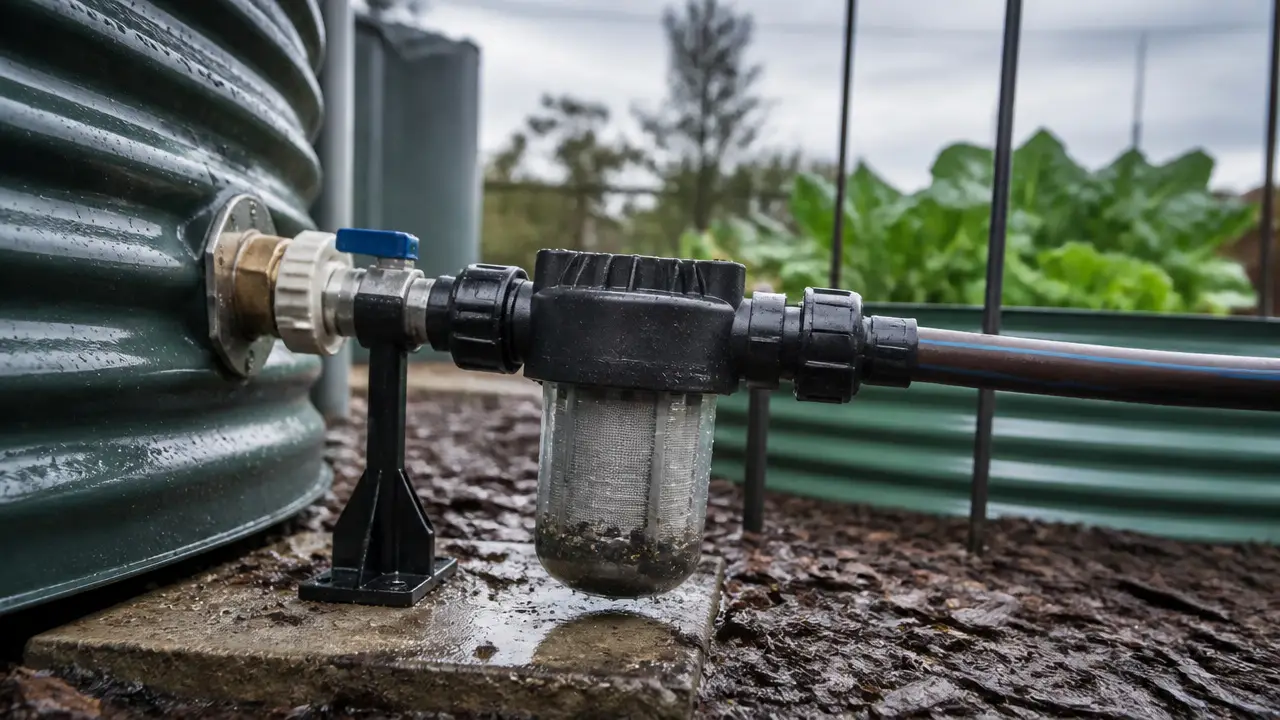
That screen matters even more with collected rainwater. Small roof particles, tank sediment, insects, and organic material can enter irrigation plumbing if filtration is poor.
Clean the upstream filter and timer screen as needed rather than waiting until watering flow drops.
Run each automatic schedule while you are present before trusting the system unattended. Confirm that the valve opens, water reaches the intended area, and the timer closes completely afterward.
Which Brand Should You Choose?
For a normal household faucet and a basic one-zone automatic watering system, start with Rain Bird.
Choose Orbit when smart controls, Bluetooth, Wi-Fi, or several watering outlets are more important.
Choose Melnor when you want straightforward garden timers, including simple multi-zone or mechanical options.
Choose GARDENA when you already use the GARDENA watering system or need the tap connections commonly supplied with its regional products.
For a gravity-fed rain barrel, do not choose by brand first. Check the timer's minimum pressure. Many standard electronic hose timers are designed around pressurized water and may be a poor match for a barrel sitting only a few feet above the garden.
Frequently Asked Questions
What is the best hose-end timer brand?
Rain Bird is a strong all-around choice for a simple automatic hose-end timer on a pressurized outdoor faucet. Orbit is usually the better choice when you want smart controls, Bluetooth, Wi-Fi, or several outlets.
Will a hose-end timer work on a rain barrel?
Sometimes, but many standard electronic timers require more pressure than a gravity-fed rain barrel provides. Check the timer's stated minimum operating pressure before buying. A timer designed for low-pressure or gravity-fed irrigation may be necessary.
Is a digital hose timer better than a mechanical timer?
They serve different purposes. A digital timer can start and stop watering automatically according to a schedule. A mechanical timer is simpler and usually requires you to start the watering manually, after which it shuts the water off after the selected time.
Do hose timers reduce water pressure?
Every valve and fitting adds some resistance to water flow. A hose timer can therefore cause some pressure loss, especially when flow is high. Filters, long hoses, small tubing, splitters, and other fittings can add more restriction.
Should the faucet stay open when using an automatic hose timer?
Yes. The supply faucet normally stays open so the timer can control water automatically. Check all connections for leaks first, keep the system within the timer's operating limits, and inspect it regularly.
Can a hose timer stay outside during winter?
Do not leave a water-filled hose timer exposed to freezing conditions unless its manufacturer specifically allows it. Remove, drain, and store the timer as directed before freezing weather.
Do I need a filter before a hose timer when using rainwater?
A suitable upstream screen or filter is a good idea because collected rainwater can carry sediment and debris into the timer valve. The amount of filtration needed depends on the water source, timer, and irrigation equipment downstream.