As an affiliate, we may earn a commission from qualifying purchases. We get commissions for purchases made through links on this website from Amazon and other third parties.
The most accurate pH meter is usually a laboratory-grade digital meter with a high-quality glass electrode that is calibrated correctly before use. For rainwater, the electrode matters as much as the meter itself because rainwater can have very low mineral content. That can make some pH meters slow, unstable, or misleading.
For most homeowners, you do not need a laboratory benchtop meter. A good handheld meter with a replaceable electrode, published accuracy specification, two- or three-point calibration, and temperature compensation can give very useful results when it is maintained correctly.
What Type of pH Meter Is Most Accurate?
There are three common ways to measure pH:
| Method | Typical Use | Accuracy Potential |
|---|---|---|
| Laboratory benchtop meter | Labs and detailed water testing | Highest |
| Quality handheld digital meter | Rainwater systems, pools, hydroponics, field work | Very good |
| Test strips or liquid color tests | Quick checks | Lower |
A laboratory meter normally provides the best measurement conditions. It uses a sensitive electrode, controlled calibration, and stable sample handling.
But meter quality alone does not guarantee an accurate reading. The U.S. Geological Survey treats electrode selection, calibration, maintenance, measurement procedure, and troubleshooting as important parts of pH measurement.
For a rainwater system, a properly maintained handheld meter may be more practical than a laboratory meter.
Look at Accuracy, Not Just Display Resolution
A common mistake is buying a meter because its screen shows two decimal places.
For example, a meter might display:
6.47 pH
That does not automatically mean the true pH is within 0.01 of that number.
There are two different specifications.
Resolution
Resolution tells you the smallest change the meter can display.
A meter with 0.01 pH resolution can display values such as 6.46, 6.47, and 6.48.
Accuracy
Accuracy tells you how close the measurement should be to the actual value under the manufacturer's specified conditions.
Accuracy is normally the more important specification.
When comparing meters, look for a clearly published pH accuracy specification, not just a long digital display.
The Electrode Is Especially Important for Rainwater
A pH meter measures an electrical response through its electrode.
That becomes important with collected rainwater because rainwater often contains fewer dissolved minerals and salts than tap water or groundwater.
Water with very low conductivity can be harder to measure accurately. The reading may:
- drift slowly
- take a long time to stabilize
- change when the sample is stirred
- differ between repeated measurements
- respond poorly with an unsuitable electrode
USGS guidance has specifically noted that pH measurements become more difficult in low-conductivity water and that electrode choice can be a critical part of the measurement system.
For serious rainwater testing, look for a meter whose electrode is suitable for low-conductivity or low-ionic-strength water.
This can matter more than choosing a meter simply because it has more decimal places.
Features That Matter Most
If accuracy is your main goal, focus on these features.
A Replaceable Glass Electrode
The electrode is the sensing part that touches the water.
Electrodes age. They can also become contaminated, damaged, or dehydrated.
A replaceable electrode means you can replace the sensing part without replacing the whole meter.
Disposable pocket meters may be fine for simple checks, but a replaceable electrode is usually a better choice for long-term use.
Two- or Three-Point Calibration
A pH meter does not stay perfectly calibrated forever.
Calibration means checking and adjusting the meter with liquids called buffer solutions. These solutions have known pH values.
Common calibration buffers include:
- pH 4
- pH 7
- pH 10
USGS field procedures use known buffer solutions for pH calibration, with calibration covering the range that will be measured.
If you expect mildly acidic rainwater, calibration around pH 4 and pH 7 is generally more useful than calibrating only at pH 7.
Follow the meter manufacturer's calibration instructions.
Automatic Temperature Compensation
Electrode response changes with temperature.
Automatic temperature compensation, often called ATC, allows the instrument to account for the temperature effect on the electrode's response.
It is useful, but ATC does not magically make every sample perfectly comparable. The actual chemistry of water can also change with temperature.
For better repeatability, avoid comparing one sample that is very cold with another that is very warm whenever practical.
Stable Calibration
A good meter should hold calibration reasonably well between checks.
More importantly, it should tell you when calibration has failed or when the electrode response is poor, if the instrument includes those features.
A meter that repeatedly fails calibration may have:
- an old electrode
- contaminated glass
- incorrect storage
- contaminated buffer
- damaged electronics
Do not simply continue using it because the screen still produces a number.
Why Calibration Can Matter More Than Meter Price
Even an excellent pH meter can give poor results when it is not calibrated.
Suppose two meters are used on the same rainwater sample.
One is an expensive meter that has not been calibrated for months.
The other is a simpler meter that was recently calibrated with fresh buffers and has a healthy electrode.
The second meter may give the more useful measurement.
For important testing, use fresh calibration solution and avoid pouring used buffer back into the original bottle. USGS measurement procedures likewise call for calibration using known buffers and careful handling of those solutions.
Store the Electrode Correctly
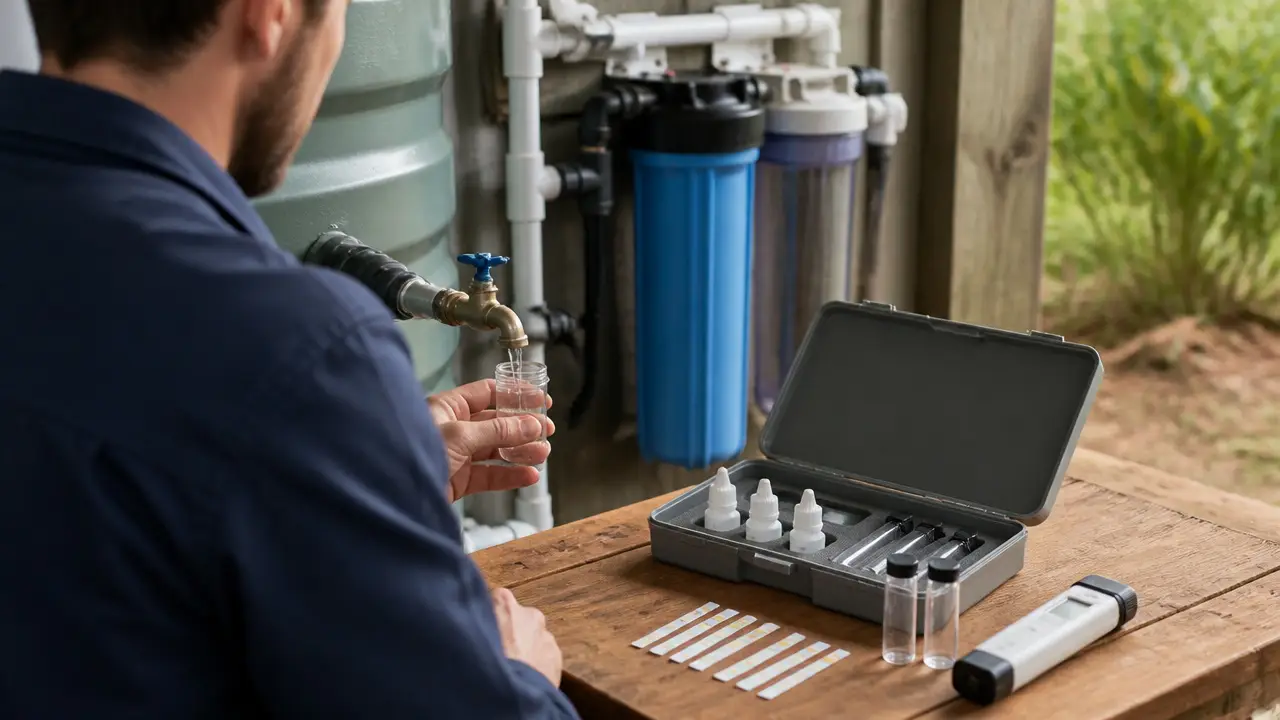
Factor in recommended pH meters for rainwater testing and trend checks to compare a treatment train sized for the actual domestic demand.
Improper storage is one of the easiest ways to ruin pH meter performance.
Many glass pH electrodes should remain hydrated in the storage solution specified by their manufacturer.
Do not assume that storing an electrode dry is acceptable.
USGS guidance has specifically warned against storing pH electrodes dry and recommends following the manufacturer's storage instructions.
Also avoid storing an electrode in a random liquid just because it is available. Follow the instructions for that particular electrode.
How to Get a More Accurate Rainwater Reading
Good sample handling can improve repeatability as much as buying a better meter.
A practical approach is:
- Use a clean sample container. Residue from cleaners, fertilizer, soil, or other water can change pH.
- Calibrate the meter. Use the buffer solutions recommended by the manufacturer.
- Rinse the electrode properly. Follow the meter instructions so you do not carry calibration solution into the sample.
- Place the electrode in enough water to cover the required sensing area.
- Allow the reading to stabilize. Low-mineral rainwater may respond more slowly than tap water.
- Avoid unnecessary aeration. Leaving low-alkalinity water exposed or stirring it aggressively can change its chemistry.
- Record the reading promptly.
- Rinse and store the electrode correctly afterward.
Do not wipe or scrub a delicate glass sensing surface unless the manufacturer's cleaning instructions specifically call for it.
Benchtop Meter or Handheld Meter?
A benchtop meter makes sense when you need the best repeatability you can reasonably obtain.
It is most useful when:
- you test many samples
- you need careful comparison between treatments
- you keep calibration records
- you work in a controlled area
- small pH differences matter
A quality handheld meter is usually better for a homeowner checking:
- rain barrel water
- cistern water
- irrigation water
- garden water
- treatment-system performance
For those uses, good calibration and electrode care often matter more than moving from a good handheld meter to an expensive laboratory instrument.
Are Cheap Pocket pH Meters Accurate?
Some can provide useful general readings.
Their weakness is often consistency rather than their ability to display a number.
Low-cost meters may have:
- limited calibration options
- non-replaceable electrodes
- unclear accuracy specifications
- slower stabilization
- poor performance in low-conductivity water
- limited electrode diagnostics
A cheap meter can still be useful if you only need to know whether water is roughly acidic, neutral, or alkaline.
If a decision depends on a difference of only a few hundredths of a pH unit, use better equipment and tighter measurement procedures.
Are pH Test Strips Accurate Enough?
Test strips are useful for quick checks but are not the most accurate option.
You must match a color against a printed scale. Lighting, water color, and human color perception can all affect the result.
Strips are helpful for questions such as:
- Is this water clearly acidic?
- Has the pH changed a lot?
- Is the water roughly within the expected range?
A calibrated digital meter is better when you want a numerical measurement you can track over time.
Does Temperature Compensation Guarantee Accuracy?
No.
Automatic temperature compensation corrects part of the measurement process. It does not correct every source of error.
You can still get inaccurate readings from:
- bad calibration
- old buffer
- dirty electrodes
- dried-out electrodes
- low-conductivity water
- cross-contamination
- a damaged probe
- poor sample handling
Treat ATC as a useful feature, not as a replacement for calibration and maintenance.
What Is the Best Choice for a Rainwater System?
For most rainwater users, the best balance is a quality handheld pH meter with a replaceable glass electrode, published accuracy specification, at least two-point calibration, temperature measurement or compensation, and an electrode suitable for low-conductivity water.
A benchtop laboratory meter can be more accurate, but it is unnecessary for many garden, irrigation, and storage-system checks.
If you only need rough pH information, a simpler meter may be enough.
If pH will guide chemical treatment, corrosion control, drinking-water treatment, or another important decision, use better measurement equipment and consider professional laboratory testing where appropriate.
A pH Meter Does Not Tell You Whether Rainwater Is Safe to Drink
This point is important.
A pH meter measures pH only.
It cannot tell you whether rainwater contains:
- harmful bacteria
- parasites
- viruses
- lead
- other metals
- pesticides
- chemicals from roofing materials
- animal contamination
- other unsafe substances
In the United States, EPA lists pH 6.5 to 8.5 as a secondary drinking-water guideline related mainly to issues such as taste, deposits, and corrosion. It is not a primary health-based standard and does not prove water is safe to drink.
Roof-collected rainwater intended for drinking should be treated as a whole-system water-quality issue. Collection surfaces, debris removal, first-flush control, storage, treatment, current laboratory testing, maintenance, and applicable local requirements all matter.
A pH reading of 7.0 does not make untreated rainwater potable.
Potable means suitable for drinking.
Frequently Asked Questions
What is the most accurate type of pH meter?
A laboratory-grade benchtop meter with a good glass electrode and proper calibration generally offers the highest accuracy. For home rainwater systems, a quality calibrated handheld meter is usually accurate enough.
Is 0.01 pH accuracy necessary?
Not always. Many rainwater-system decisions do not require measurements to the hundredth of a pH unit. Also remember that 0.01 display resolution does not necessarily mean the meter has 0.01 accuracy.
How often should I calibrate a pH meter?
Calibrate according to the manufacturer's instructions. For important measurements, checking calibration before testing is a good practice. Frequent use, electrode age, storage conditions, and the accuracy you need all affect calibration frequency.
Why does my pH reading keep drifting?
Low-conductivity rainwater can cause slow or unstable electrode response. A dirty, aging, damaged, or poorly stored electrode can also cause drifting. Check calibration and confirm that the electrode is suitable for low-conductivity water.
Is a pH pen better than test strips?
A properly calibrated pH pen can provide a more precise numerical reading than color strips. Test strips remain useful for fast, approximate checks.
Can a pH meter tell whether rainwater is drinkable?
No. A pH meter measures acidity or alkalinity only. It cannot detect pathogens, metals, pesticides, or many other contaminants. Drinking-water decisions require appropriate treatment, maintenance, laboratory testing, and compliance with applicable requirements.
Does a more expensive pH meter always give a more accurate reading?
No. Electrode condition, calibration, sample handling, temperature, and suitability for low-conductivity water can matter as much as meter cost. A well-maintained meter can outperform a more advanced meter that is poorly calibrated or has a bad electrode.