As an affiliate, we may earn a commission from qualifying purchases. We get commissions for purchases made through links on this website from Amazon and other third parties.
A gutter downspout extension does not have to be a plain plastic tube lying across the yard. You can route roof runoff through gravel channels, rain chains, dry creek beds, buried drain pipe, rain barrels, garden beds, decorative basins, or removable extensions.
The best idea is the one that moves water far enough from the house without creating a trip hazard, erosion problem, mosquito area, or foundation issue.
Start With the Main Job: Move Water Away From the House
A creative downspout extension still needs to do one basic job well.
It should carry water away from the foundation and release it where the ground can handle the flow.
Before choosing a design, look at:
- Where the downspout ends
- Which way the yard slopes
- How much roof drains into that downspout
- Whether the soil absorbs water well
- Where people walk or mow
- Whether the area freezes
- Whether you want to collect the water
- Where the water will go during a heavy storm
Do not send runoff toward a neighboring property, septic area, basement window well, retaining wall, driveway icing area, or another part of your foundation.
1. Build a Decorative Dry Creek Bed
A dry creek bed can make a downspout extension look like part of the landscape.
Water leaves the downspout and travels through a shallow channel lined with stone. Larger rocks can help slow the flow, while smaller gravel fills gaps.
This works well when you have enough natural slope to move water away from the house.
A simple setup may include:
- An outlet below the downspout
- A shallow sloped channel
- Landscape fabric if appropriate for the site
- River rock or gravel
- A safe discharge area at the lower end
Make the channel wide enough to handle storm flow. A narrow decorative groove can overflow quickly if a large roof section drains into it.
Also make sure water cannot slip under the stones and erode soil beside the foundation.
2. Hide the Extension Under a Stone Path
You can route water beneath a walkway instead of running a downspout extension across it.
A solid drain pipe can pass under stepping stones, gravel, or a garden path and continue to a lower discharge point.
This can reduce trip hazards and make mowing easier.
Use pipe that is suitable for buried drainage. Thin flexible extensions can flatten, clog, or become difficult to clean when buried.
Plan for access too. Buried drainage lines may eventually collect leaves, grit, roof debris, or roots.
3. Use a Pop-Up Drainage Emitter
A pop-up emitter lets you hide much of the downspout extension underground.
The downspout connects to buried pipe. Water travels through the pipe and reaches an emitter at the end. The emitter opens when water pressure builds and closes afterward.
This can create a cleaner yard than a long surface extension.
It works best when:
- The buried pipe has a workable slope
- The outlet is lower than the starting point
- The line can be cleaned
- Standing water will not remain in a freezing area
Pop-up emitters are not magic pressure devices. They still depend largely on gravity and proper drainage layout.
4. Feed a Rain Garden
A rain garden is a planted low area that temporarily accepts runoff and lets some of it soak into the ground.
Instead of ending the downspout beside the house, you can extend it toward a properly located rain garden.
Plants can make the drainage area look intentional while helping manage runoff.
However, placement matters. A rain garden should not simply be a deep hole next to the foundation.
Soil type, slope, drainage speed, groundwater conditions, nearby structures, and local requirements can all affect whether a rain garden is suitable.
If water stays in the area for long periods, the design needs attention.
5. Run the Downspout Into a Rain Barrel
A rain barrel turns the extension into a collection system.
The downspout can be shortened or redirected into the top of the barrel. Some systems use a downspout diverter that sends water into the container and redirects excess water when it fills.
The overflow is just as important as the barrel.
Once the barrel is full, every additional gallon still needs somewhere safe to go.
A good layout may be:
Downspout → diverter → rain barrel → overflow hose or pipe → safe drainage area
Stored roof runoff is generally best treated as non-potable water unless a complete system has been designed and managed for drinking-water use. Non-potable means water that is not intended for drinking.
6. Connect the Downspout to a Larger Storage Tank
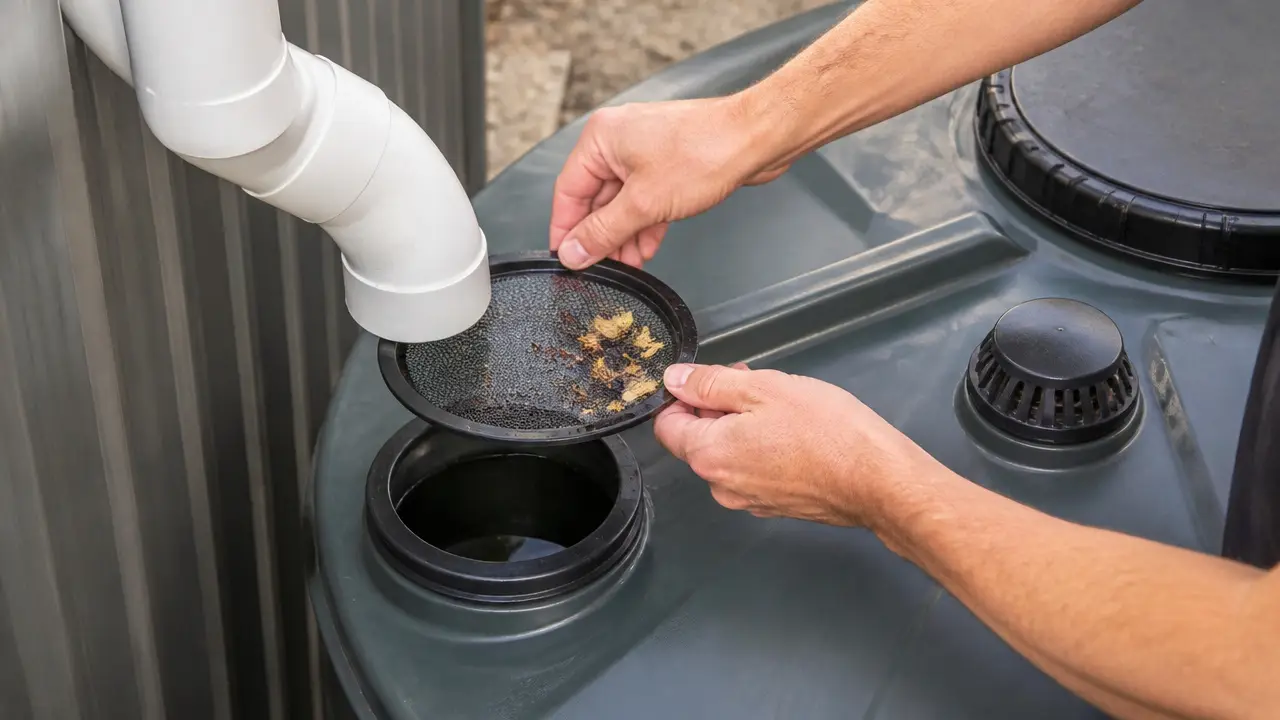
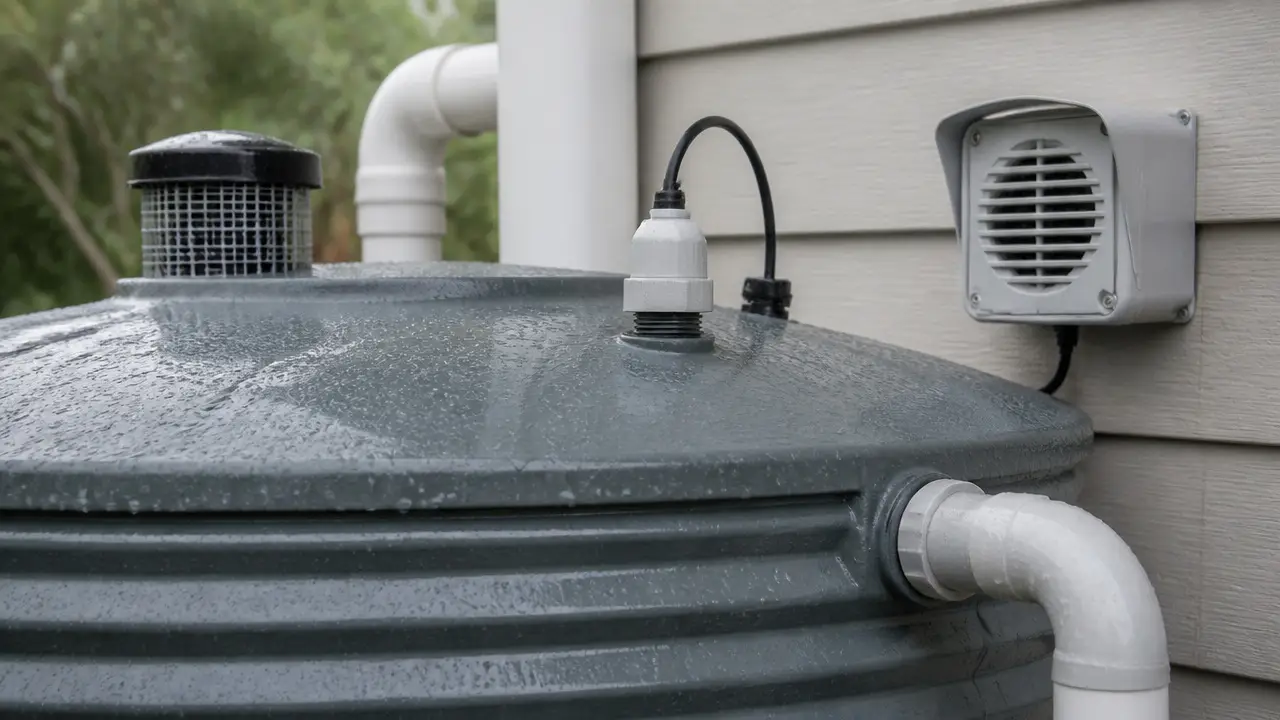
If a rain barrel fills too quickly, the downspout can feed an IBC tote, above-ground tank, or cistern instead.
Larger storage creates more options for garden watering or other allowed non-potable uses.
The main challenge is not simply getting water into the tank. You also need to plan:
- Leaf and debris screening
- Inlet size
- Overflow capacity
- Tank support
- Tank venting
- Mosquito protection
- Cleaning access
- Freeze protection where needed
A full water tank is extremely heavy. Water weighs roughly 8.3 pounds per U.S. gallon, so large containers require a stable base.
7. Create a Gravel Splash Basin
For a short and simple extension, build a decorative gravel basin under the outlet.
Instead of using a basic splash block, place the downspout above a shallow area filled with stone.
The stones help reduce soil erosion where the water lands.
This idea works best where the ground already slopes safely away from the building.
A splash basin is not a substitute for a longer drainage route if water naturally flows back toward the foundation.
8. Use a Rain Chain With an Extension Channel
A rain chain can replace the visible lower part of a downspout in some locations.
Water travels down cups or links into a basin below. From there, a hidden channel, drain pipe, or stone creek bed can move the water farther away.
This creates a more decorative transition than a conventional elbow and extension.
Rain chains can splash in heavy rain or wind, so they are not ideal for every roof location.
The basin below the chain still needs a drainage plan.
9. Build a Small Water Rill
A rill is a narrow, constructed water channel.
You can route the downspout into a stone, concrete, or lined channel that carries rainwater across a landscaped area.
Unlike a dry creek bed, a rill usually has cleaner edges and a more deliberate shape.
It may work well beside:
- Patios
- Garden paths
- Courtyards
- Raised beds
- Landscape borders
Keep the channel sloped enough to drain after the storm. Standing water can collect sediment and become a mosquito problem.
10. Route Water Along a Garden Border
A downspout extension can follow the edge of a planting bed instead of crossing open lawn.
For example, a solid pipe or shallow lined channel can run behind shrubs before reaching a safe outlet.
This can hide much of the drainage system.
Be careful about releasing concentrated roof runoff directly onto plants. Heavy flows can wash away mulch, expose roots, or keep soil too wet.
It is usually better to spread or slow the water before it reaches delicate plants.
11. Make a Removable Mowing Extension
A long extension across the lawn can be annoying every time you mow.
One solution is to make the final section removable.
A short fixed elbow stays attached to the downspout, while a longer section can be slipped on before storms or lifted out of the way for lawn work.
Another option is a hinged extension that flips upward.
Whichever method you use, make sure it does not accidentally remain folded up during heavy rain.
12. Use a Roll-Out Downspout Extension
Some flexible extensions stay rolled up when dry and unroll as water enters them.
These can be useful where you want a low-profile extension without leaving rigid pipe across a walkway or lawn.
They work best in locations where debris is limited and the outlet can drain freely.
Check them often. Leaves, grit, folds, or damage can reduce flow.
They may also be less suitable where freezing water can remain trapped inside.
13. Create a Stepping-Stone Drainage Channel
If runoff needs to cross a walking area, you can combine drainage and landscaping.
Place stepping stones slightly above a shallow gravel channel so water passes between or beneath the stones.
This keeps the drainage route visible while still allowing people to cross.
Avoid designs where rushing water makes the stones slippery or washes away the supporting soil.
14. Send Water Through a Rock-Lined Swale
Account for installing a DIY rain chain without gutters to compare roof discharge relative to available drainage capacity.
A swale is a broad, shallow channel that guides water across the land.
Unlike a narrow pipe, a swale spreads the flow over a wider area.
Adding stone at the downspout end can help handle the concentrated water before it enters the wider channel.
Swales are useful when the property has enough room and a suitable slope.
They require more planning than attaching a plastic extension because changing surface drainage can affect other parts of the yard.
15. Route the Downspout Behind a Raised Garden Bed
A raised bed can sometimes hide a downspout extension running along its outer edge.
The pipe can continue past the bed to a safe discharge area.
Do not simply dump the entire roof flow into the raised bed unless it was designed for that amount of water.
A short storm can send far more water through a downspout than a small garden bed can absorb.
16. Use Decorative Downspout Boots
A decorative downspout boot fits at the bottom of the vertical downspout and redirects water horizontally.
Boots may be made to look like stonework, architectural trim, or other landscape features.
The boot itself is mainly an outlet fitting. You may still need a channel, pipe, splash area, or extension after it.
Think of it as a decorative connection rather than a complete drainage system.
17. Hide Drainage Inside a Landscape Berm
A berm is a raised area of soil used in landscaping.
In some yards, drainage pipe can run along or through a landscaped berm before reaching a lower outlet.
This can conceal a long drainage route.
Do not create a berm that traps water against the house. The land immediately around the building should continue to direct water away from the foundation.
18. Split the Flow Between Two Areas
A large downspout may discharge more water than one small landscape area can handle.
A properly designed junction can sometimes divide the flow between two drainage paths.
For example:
Downspout → solid pipe → split → two stable discharge areas
This requires more care than simply attaching two hoses.
Water does not always divide evenly. Pipe slope, outlet height, restrictions, and fittings affect where the water goes.
For large drainage areas, it may be better to have the layout sized by someone familiar with site drainage.
19. Combine Storage With a Decorative Overflow
A rain barrel or tank does not need to hide every part of the system.
One attractive approach is to collect the first portion of runoff in storage and send the overflow into a visible stone creek, garden channel, or planted basin.
The system might look like:
Roof → gutter → downspout → storage tank → overflow → dry creek bed
This keeps excess water moving even when storage is full.
The overflow should be large enough to handle incoming stormwater without backing water into the tank inlet.
20. Use a Flexible Extension Where the Route Changes
Rigid drainage pipe is usually cleaner and more predictable for permanent runs, but short flexible sections can help around awkward obstacles.
They may be useful near:
- Porch posts
- Air-conditioning equipment
- Garden borders
- Steps
- Existing landscaping
Try not to build a long route with many tight bends. Every bend can collect debris and make cleaning harder.
Surface Extensions vs. Buried Extensions
Both approaches can work.
| Surface extension | Buried extension |
|---|---|
| Easy to inspect | Cleaner appearance |
| Easy to clean | Fewer trip hazards |
| Easier to change | Easier to mow over |
| May look cluttered | Harder to inspect |
| Can interfere with mowing | More work to install |
| Easy to disconnect | Needs good slope and access |
If clogs are common because of roof debris, an accessible surface system may be easier to maintain.
Solid Pipe or Perforated Pipe?
For carrying concentrated downspout water away from the house, solid pipe is usually the safer starting point.
Solid pipe keeps the water contained until it reaches the intended outlet.
Perforated pipe has holes that allow water to enter or leave the pipe. It is useful in some drainage systems, but placing perforated pipe immediately beside a foundation can release roof water exactly where you are trying to avoid it.
The correct choice depends on the full drainage design.
Do Not Forget Downspout Flow
A downspout can carry a large amount of water during a heavy storm.
The amount depends mainly on:
- Roof area draining to that downspout
- Rainfall intensity
- Gutter and downspout capacity
- Number of downspouts
- Roof shape
This is why a tiny decorative tube may work during light rain but overflow badly during a storm.
Any extension, pipe, channel, or basin should provide a reasonably open path for water.
Keep Connections Simple
Creative designs work better when the plumbing remains simple.
Common connection points include:
- Downspout elbows
- Flexible adapters
- Drain pipe adapters
- Diverters
- Tank inlets
- Overflow fittings
Avoid reducing a large downspout into a very small tube unless the system was intentionally designed around the lower flow capacity.
A restriction can make water back up at the connection.
Plan for Debris
Roof runoff can carry:
- Leaves
- Seeds
- Shingle grit
- Twigs
- Insects
- Dirt
- Bird droppings
- Other roof debris
Long underground lines and narrow decorative channels can clog if debris enters them.
Gutter guards, inlet screens, accessible cleanouts, and regular cleaning may reduce problems, but none make a system maintenance-free.
Think About Freezing Weather
Downspout extensions need special attention in freezing climates.
Water trapped in:
- Sagging hose
- Flat underground pipe
- Closed containers
- Valves
- Narrow channels
can freeze and block drainage.
Whenever possible, drainage extensions should empty completely after the storm.
Rainwater tanks, pumps, valves, and irrigation connections may need additional winter protection.
Avoid Creating a Mosquito Area
A creative drainage feature should drain instead of holding shallow stagnant water for long periods.
Check decorative basins, low sections of hose, clogged emitters, and uneven channels after rain.
If water remains trapped, correct the drainage rather than treating the standing water as a normal part of the design.
When a Simple Extension Is Not Enough
A DIY extension may be reasonable when you are moving surface runoff a short distance across a clearly sloped yard.
Get qualified drainage help when you have:
- Basement water problems
- Repeated foundation wetting
- Significant erosion
- Standing water that lasts after storms
- A steep hillside
- Retaining walls near the discharge
- Several downspouts connected together
- Long underground drain runs
- Unknown underground utilities
- A discharge point near neighboring property
- Major excavation
The goal is not just to move water away from one downspout. It is to make sure the new drainage route does not create another problem somewhere else.
Frequently Asked Questions
How far should a downspout extension run from the house?
There is no single distance that works for every property. The important point is to carry water to ground that slopes away and can safely absorb or drain the flow. Soil, grading, roof area, foundation type, and local drainage conditions all matter.
Can I bury a flexible downspout extension?
It is usually better to use pipe intended for buried drainage. Thin flexible extensions can crush, sag, hold water, or become difficult to clean underground.
Can a downspout empty into a flower bed?
It can sometimes discharge toward a suitable planted area, but concentrated roof runoff can cause erosion or waterlogged soil. Large roof areas may produce far more water than a small bed can handle.
Can I connect a downspout directly to a rain barrel?
Yes, if the barrel has a suitable inlet and a reliable overflow route. The overflow is essential because the barrel may fill quickly during heavy rain.
Is a dry creek bed better than a plastic extension?
Neither is always better. A plastic extension is simple and easy to inspect. A dry creek bed may look better and help spread flow, but it needs enough slope and capacity to avoid erosion or overflow.
Can I connect several downspouts to one buried drain?
It is possible, but the shared drain must be able to handle the combined flow. Long runs, pipe size, slope, fittings, and outlet capacity all matter. Large systems may need professional drainage design.
Why does water stay inside my downspout extension?
The extension may have a low spot, poor slope, clogged outlet, crushed section, or an outlet that sits too high. Adjust the route so water can drain freely rather than remaining trapped.