As an affiliate, we may earn a commission from qualifying purchases. We get commissions for purchases made through links on this website from Amazon and other third parties.
For most rain barrel systems, connecting barrels at the bottom is the better choice when you want them to act like one larger tank. A bottom connection lets water levels equalize between barrels, so they fill and drain together.
A top connection is often simpler and less likely to leak, but the next barrel usually does not receive water until the first barrel is nearly full. That makes it better for overflow-style expansion than for creating one balanced storage system.
Top vs. Bottom Rain Barrel Connections
The main difference is how water moves between the barrels.
| Connection location | How the barrels behave | Best use |
|---|---|---|
| Bottom | Water levels equalize between barrels | One combined storage system |
| Top | One barrel fills before water moves to the next | Simple overflow expansion |
| Near the top on all barrels | Water transfers only after reaching the connection height | Adding extra overflow capacity |
Neither method is always better. The right choice depends on how you want to fill and drain the barrels.
How a Bottom Connection Works
With a bottom-connected system, a hose or pipe joins the barrels near their lowest usable point.
Water naturally seeks the same level in connected containers. If water enters the first barrel, some of it flows through the connecting pipe into the others.
For example, suppose you have three barrels connected along the bottom. As rain enters the first barrel, the water levels in all three barrels rise together.
When you draw water from one barrel, the other barrels feed water toward it until their levels are again about equal.
This makes several barrels behave much like one larger tank.
Advantages of connecting at the bottom
A bottom connection can provide several useful benefits:
- All barrels begin filling at roughly the same time.
- Water levels stay approximately equal.
- You can usually draw from one outlet and access water stored across the whole group.
- More of each barrel's storage volume is available before the system stops feeding the outlet.
- It is easier to see how much total water remains because the barrels have similar water levels.
This arrangement works especially well when several rain barrels supply one garden hose, irrigation line, or pump intake.
The Main Drawback of Bottom Connections
Every fitting below the normal water level is a potential leak point.
A poorly installed bulkhead fitting, hose connection, valve, or pipe can slowly drain the entire connected system.
A bulkhead fitting is a fitting designed to pass through the wall of a tank while creating a watertight seal.
Because the lower fittings remain under water pressure whenever the barrels contain water, installation quality matters.
The connecting pipe also needs protection from accidental pulling, twisting, or impact. Flexible hose can tolerate small movements between barrels better than a rigid connection in some installations.
Do not assume the wall of every barrel can safely accept a fitting in any location. Follow the container manufacturer's guidance when available.
How a Top Connection Works
A top-connected system usually works as an overflow chain.
Rain enters the first barrel. Once its water reaches the connecting port, excess water passes into the second barrel.
The second barrel then fills until it reaches its own overflow level.
This arrangement is sometimes called daisy-chaining the barrels.
The important point is that the barrels do not normally equalize from the bottom. The first barrel can contain much more water than the second.
Advantages of connecting at the top
Top connections have some practical benefits:
- The connections spend less time submerged.
- A leak at the connecting hose usually will not drain the entire barrel.
- Expansion can be simple.
- Barrels can sometimes be disconnected more easily.
- There are fewer below-water-level penetrations to maintain.
For a basic garden rain barrel setup where you mainly want additional overflow storage, this can be a reasonable approach.
The Problem With Using Only Top Connections
A top connection does not automatically let you use all the barrels through one low outlet.
Imagine two barrels connected near their tops. Both eventually become full after a long rain.
You then use water from the first barrel.
Its level falls, but the second barrel's water stays behind because the connecting hose is above the remaining water level. You may need a separate outlet on the second barrel to use that water.
That is why top connections are best thought of as fill or overflow connections, not necessarily as shared drain connections.
Which Connection Is Better for Multiple Rain Barrels?
Choose bottom connections if your main goal is to make several barrels operate as one storage bank.
This is usually the more useful arrangement when:
- You want one main faucet or outlet.
- You are feeding one irrigation system.
- You want all barrels to drain together.
- You want their water levels to remain similar.
- You want to make better use of the available storage before moving hoses between barrels.
Choose top connections if simplicity and overflow management matter more than having one shared water supply.
They can make sense when:
- Each barrel has its own outlet.
- You only need the additional barrels during larger storms.
- You want fewer submerged fittings.
- You want a leaking transfer connection to have less chance of emptying all the barrels.
Can You Connect Rain Barrels at Both the Top and Bottom?
Yes. In some systems, using both locations makes sense.
The lower connection equalizes water between the barrels. A higher connection can provide another path for incoming water or help manage overflow.
However, adding more connections also adds more fittings that can leak, clog, or need maintenance.
A simple system is usually easier to maintain. Do not add a second connection unless it solves a real problem with filling, venting, or overflow.
Use a Large Enough Connecting Pipe
A very small connecting hose can limit how quickly the barrels equalize.
This matters during heavy rain.
Your roof and downspout may deliver water into the first barrel faster than a narrow hose can transfer it to the other barrels. The first barrel could reach its overflow point even while the other barrels still have room.
The required connection size depends on factors such as:
- How quickly water enters the system
- The number of barrels
- The difference in water level between them
- Pipe or hose diameter
- Pipe length
- Bends and restrictions
- The overflow arrangement
Examine practical steps for connecting two rain barrels together to assess cleaning access that supports sediment and odor management.
Do not assume that a small garden-size tube can handle the full flow coming from a downspout during a strong storm.
The system still needs a reliable overflow route even when the barrels are interconnected.
Keep the Barrels at the Same Height
Bottom-connected barrels work best when their bases are level with one another.
Because the water surfaces equalize, barrels sitting at different heights can have different usable capacities before one reaches its upper limit.
Place the containers on stable, level support that can carry their full weight.
Water is heavy. A large group of full barrels can place a substantial load on a deck, platform, or raised stand. Do not place multiple full barrels on a structure unless you know it can safely carry the load.
If you raise barrels to improve gravity flow, use a stable support designed for the load rather than loose blocks or an improvised stack.
Plan the Overflow Before Connecting the Barrels
Interconnecting rain barrels does not eliminate the need for overflow control.
Eventually, every barrel can become full.
The system needs to direct excess water somewhere that will not damage the building, foundation, barrel supports, or nearby property.
Depending on the system, the overflow may leave from:
- The last barrel
- A common overflow manifold
- A downspout diverter
- Another properly sized overflow outlet
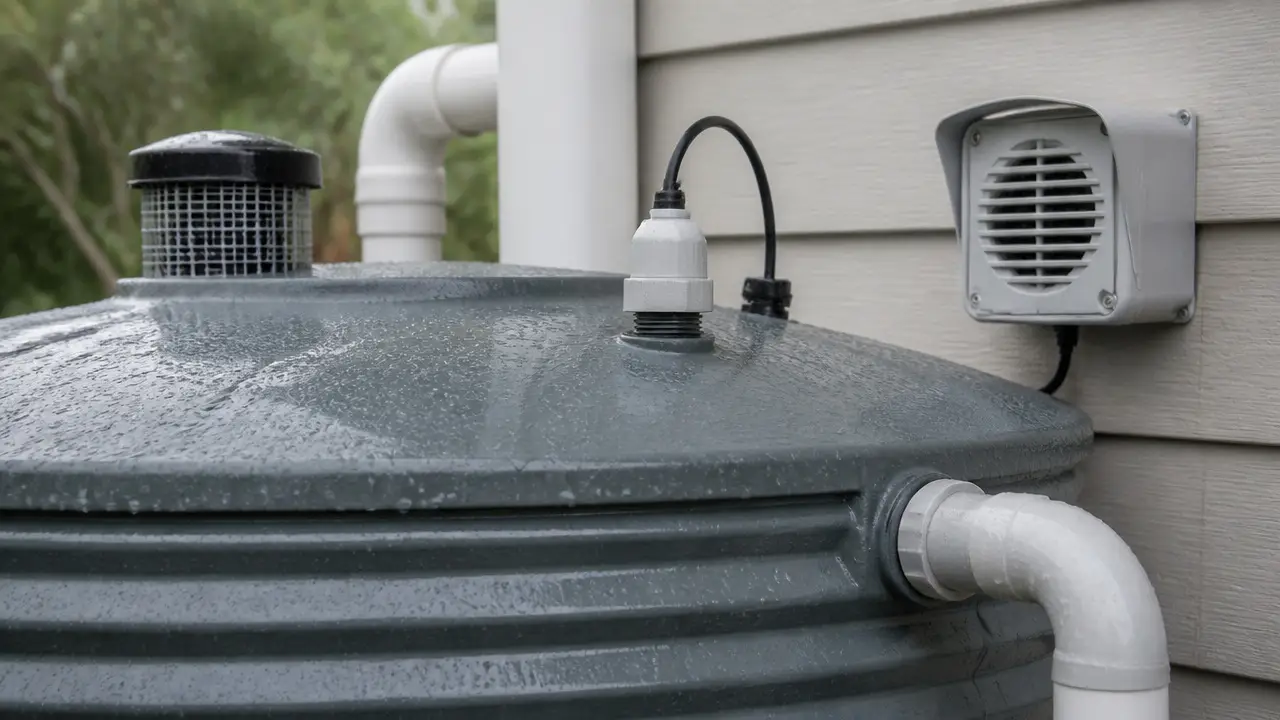
Keep the overflow opening protected against insects where appropriate, and check it periodically for leaves and debris.
Add Valves if You Want to Isolate Individual Barrels
One disadvantage of a simple bottom manifold is that a problem with one barrel can affect all of them.
If a fitting begins leaking, the connected barrels may continue feeding water toward that leak.
Isolation valves can make a larger system easier to service. They allow you to disconnect one tank while keeping the others in use.
Valves add cost and more joints, however, so they may not be necessary for a basic two-barrel setup.
At minimum, arrange the system so connections remain accessible for inspection and repair. Avoid burying fittings behind barrels where you cannot see a slow leak.
Think About Freezing Conditions
Water left in connecting hoses, pipes, valves, and fittings can freeze.
Freezing water expands and may damage plumbing or containers.
If your climate has freezing weather, the winter plan should include the connections as well as the barrels themselves. Simply draining the main barrel may not empty every low section of pipe.
Follow the container and fitting manufacturers' winterizing guidance, and design the system so low points can be safely drained where practical.
Keep Stored Rainwater Use in Mind
For garden irrigation and other non-potable uses, either connection method can work when the system is properly installed and maintained.
Non-potable means water that is not intended for drinking.
Connecting more barrels does not improve rainwater quality. Roof runoff can contain dirt, animal waste, microorganisms, metals, roofing residues, and other contaminants.
If rainwater is being considered for drinking or household plumbing, barrel connections are only one small part of the system. Safe drinking-water use requires suitable collection materials, appropriate prefiltration and treatment, current laboratory testing, ongoing maintenance, and compliance with applicable local requirements.
A Practical Setup for Most Multi-Barrel Systems
For a small group of rain barrels supplying a garden, a practical arrangement is often:
- Send roof runoff into the collection system with suitable debris control.
- Connect the barrels near the bottom so their levels can equalize.
- Keep the barrels on the same stable, level base.
- Use fittings intended for tank-wall connections.
- Provide a properly sized overflow for when all barrels are full.
- Put the main water outlet where it can draw from the connected storage.
- Keep hoses, valves, and fittings accessible for inspection.
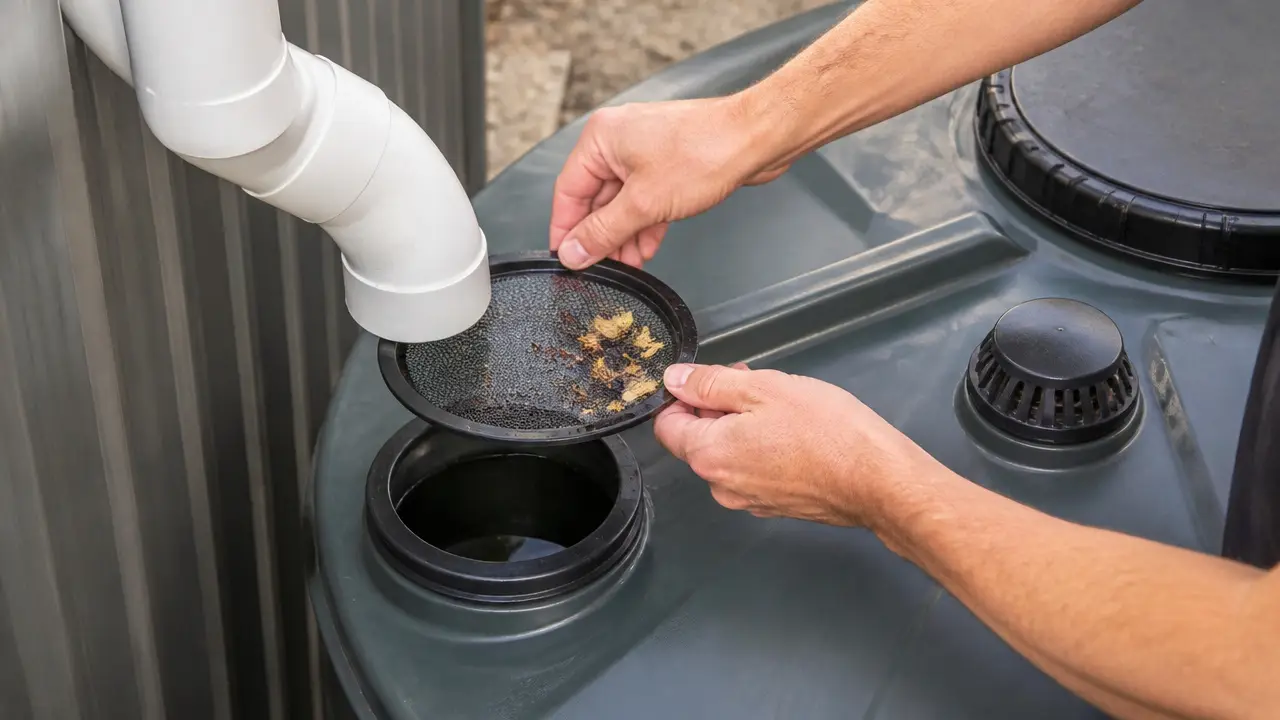
- Regularly check for leaks, sediment, blocked screens, insects, and damaged connections.
A first-flush device may also be useful in some roof collection systems. A first flush diverts an initial portion of roof runoff so some of the accumulated roof debris does not immediately enter storage. It is a prefiltration step, not a way to make rainwater safe to drink.
Bottom Line
For most multi-barrel systems, connect the barrels at the bottom if you want them to fill and drain as one combined water supply.
Use top connections when you mainly want one barrel to overflow into the next and do not need the stored water to equalize between them.
Whichever method you choose, provide a reliable overflow, use suitable watertight fittings, support the full weight of the barrels, and keep the connections accessible for maintenance.
Frequently Asked Questions
Will rain barrels connected at the bottom fill evenly?
They will generally move toward the same water level because water flows between the connected containers. They may not rise at exactly the same speed during heavy rainfall if the connecting pipe is too restrictive.
Can I use one faucet for several connected rain barrels?
Yes. Bottom-connected barrels can usually feed a single outlet because water from the other barrels flows toward the barrel or manifold being drained. The outlet and connecting plumbing still need enough flow capacity for the intended use.
Why is my first rain barrel overflowing before the others are full?
The connecting hose or pipe may not be transferring water as quickly as rain enters the first barrel. A small diameter, long hose, blockage, kink, or restrictive fitting can reduce transfer flow. The overflow system should still safely handle excess water.
Should the connecting hose be exactly at the bottom of the barrel?
Not necessarily. It can be installed near the lower part of the barrel while leaving room for the fitting and some sediment below it. The exact location should also be suitable for the barrel's construction and fittings.
Do bottom-connected rain barrels need separate overflows?
The system needs a dependable overflow once total storage is full. That may be one properly designed overflow for the connected system rather than a separate discharge from every barrel, depending on the layout.
Can barrels of different sizes be connected at the bottom?
They can sometimes be connected, provided the containers, connection heights, and maximum water levels are compatible. Because connected water seeks the same level, differences in barrel height and overflow height must be considered carefully.
Can I connect rain barrels with a garden hose?
A hose can transfer water between barrels, but its diameter and fittings may restrict flow. A small hose may equalize slowly during a strong storm. It should also be made from material suitable for the intended water use and installed where it will not kink or be pulled loose.