As an affiliate, we may earn a commission from qualifying purchases. We get commissions for purchases made through links on this website from Amazon and other third parties.
Rainwater usually has low total dissolved solids (TDS), but there is no single average that applies everywhere. Fresh rain can contain only a few milligrams per liter of dissolved material, while rainwater collected from a roof may measure several tens of milligrams per liter after it picks up dust, salts, and other material.
Published measurements show how much the number can vary. One study of direct rainfall measured an average TDS of about 5.3 mg/L. Another study measured about 17 mg/L in rain collected without roof contact, while rooftop samples in the same study were commonly around 20 to 40 mg/L. A separate study of rooftop-harvested rainwater reported averages of roughly 37 to 75 mg/L at different sites.
For a household rainwater system, a TDS reading in the tens of ppm is therefore not unusual. But the useful number is the normal reading for your own system, not a worldwide average.
What Does TDS Mean in Rainwater?
TDS means total dissolved solids. It is an estimate of the amount of dissolved material in the water.
That material can include:
- Calcium
- Magnesium
- Sodium
- Chloride
- Sulfate
- Bicarbonate
- Other dissolved minerals and salts
- Small amounts of dissolved organic material
TDS is normally shown as mg/L, or milligrams per liter. Many handheld meters display the result as ppm, or parts per million. For dilute water such as rainwater, ppm and mg/L are often treated as roughly equivalent.
Rain starts with little dissolved mineral content because evaporation leaves most minerals behind. However, rain does not remain chemically pure while falling through the air or moving through a collection system.
Fresh Rainwater vs. Roof-Collected Rainwater
The point where you measure the water matters.
Rain Collected Directly From the Sky
Direct rainfall normally has very little dissolved mineral material compared with groundwater or many municipal water supplies.
It can still contain dissolved substances from the atmosphere. These may come from:
- Sea spray
- Dust
- Smoke
- Vehicle and industrial emissions
- Agricultural activity
- Other airborne particles and gases
Location therefore matters. Rain near a coast may contain more sea salts than rain far inland. Dusty and polluted areas can also produce different readings.
One rainfall study in southwestern China measured an average TDS of about 5.3 mg/L, showing how low direct rainfall can be under some conditions.
That number should not be treated as a universal rainwater standard.
Rainwater Collected From a Roof
Once rain reaches a roof, the water changes.
It can pick up dissolved material from:
- Roof dust
- Dirt
- Bird and animal waste
- Leaves and plant debris
- Sea salt deposited on the roof
- Roofing materials
- Gutters and downspouts
- Sediment in the tank
- Previous water stored in the tank
A South African study found direct rain used as a control averaged about 17 mg/L TDS. Water collected from different roof materials at one sampling location averaged roughly 23 to 28 mg/L, with some other samples in the study reaching around 40 mg/L.
Another study of rooftop-harvested rainwater measured site averages from about 37 to 75 mg/L.
This is why someone measuring rain straight into a clean container may get a very different result from someone testing water from an IBC tote or cistern.
What Is a Normal TDS Reading for a Rainwater Tank?
There is no official "normal rainwater TDS" number.
As a practical reference, a reading of several tens of ppm can be reasonable for roof-collected rainwater, based on measurements reported in published studies. Much lower readings are also possible.
A higher reading does not automatically mean the water is unsafe. A lower reading does not automatically mean it is safe.
Instead, use TDS mainly as a way to watch your own system.
For example, suppose your tank normally measures around 30 to 50 ppm. If it suddenly begins measuring 150 ppm without an obvious reason, the change is worth investigating.
Possible causes include:
- A large amount of roof debris
- Salt or dust deposited during a dry period
- Contamination entering the tank
- Water added from another source
- Sediment being disturbed
- Evaporation concentrating dissolved material
- Changes to pipes, fittings, or storage materials
The change from your normal reading can sometimes tell you more than the number by itself.
Why TDS Can Rise After a Dry Period
The first rain after several dry weeks often washes more material from the roof.
Dust, pollen, leaves, bird waste, and airborne salts can accumulate between storms. The first runoff carries much of this material toward the tank.
A first-flush diverter sends away an initial portion of roof runoff before the cleaner portion of the storm is allowed into storage.
A first-flush system can help reduce some material entering the tank, but it does not make the remaining rainwater potable or remove every contaminant.
Keeping roofs, gutters, screens, and tanks reasonably clean can also help keep water quality more consistent.
Does Low TDS Mean Rainwater Is Safe to Drink?
No.
This is one of the most important limits of a TDS meter.
A TDS reading tells you approximately how much dissolved ionic material is present. It does not tell you exactly what that material is.
More importantly, a low TDS meter reading cannot establish whether rainwater contains:
- Harmful bacteria
- Viruses
- Protozoa
- Certain pesticides
- Metals at concerning individual concentrations
- Organic chemicals
- Other contaminants that a simple conductivity-based meter cannot identify
A tank could show 20 ppm on a TDS meter and still contain microorganisms from bird or animal waste.
The World Health Organization does not set a health-based guideline value specifically for TDS because TDS itself is not considered a health concern at levels normally found in drinking water. TDS is more useful for judging taste and general mineral content.
In the United States, the EPA lists 500 mg/L as a secondary drinking-water standard for TDS. Secondary standards mainly address issues such as taste, staining, deposits, and appearance. The 500 mg/L figure should not be interpreted as proof that water below 500 mg/L is microbiologically or chemically safe to drink.
Evaluating TDS meter accuracy helps interpret filtration performance suited to the home’s intended application.
Drinking rainwater safely requires looking at the whole system, including suitable collection surfaces, debris control, treatment, maintenance, current laboratory testing, and applicable local requirements.
What Does a TDS Meter Actually Measure?
Most inexpensive TDS meters do not directly weigh all the dissolved material in your water.
They first measure electrical conductivity. Water containing more dissolved ions conducts electricity more easily. The meter then converts that conductivity measurement into an estimated TDS value.
That means two meters can sometimes display slightly different TDS values for the same water because they may use different conversion factors.
A TDS meter is still useful for:
- Comparing your tank water over time
- Checking for sudden changes
- Comparing water before and after certain treatment stages
- Checking water used for irrigation or hydroponic mixing
- Finding unusually mineral-rich water entering the system
It is not a substitute for a laboratory water-quality analysis.
Rainwater TDS Compared With Other Water Sources
Rainwater often has much less dissolved mineral material than groundwater because it has not spent long periods moving through soil and rock.
A simple comparison looks like this:
| Water source | General TDS tendency |
|---|---|
| Direct rainfall | Usually very low |
| Roof-harvested rainwater | Usually higher than direct rain |
| Surface water | Highly variable |
| Groundwater or well water | Often more mineralized |
| Reverse-osmosis water | Usually very low |
These are tendencies rather than fixed ranges. Local geology, pollution, salt exposure, treatment, and storage can change the result substantially.
Is Low-TDS Rainwater Good for Irrigation?
Low mineral content can make rainwater useful for many garden applications.
Unlike hard groundwater, rainwater normally adds relatively little calcium, magnesium, and dissolved salt to soil.
However, TDS alone cannot tell you whether water is suitable for a particular plant.
For irrigation, the type of dissolved salts can matter as much as their total amount. Sodium or chloride, for example, may create problems for salt-sensitive plants even when the overall TDS number does not look extreme.
For ordinary roof-collected rainwater used around a home garden, watching for sudden changes in TDS can be useful. More detailed testing may be worthwhile if you have sensitive crops, suspected contamination, or unusually high readings.
How to Get a Useful TDS Reading
A handheld meter works best when you use it consistently.
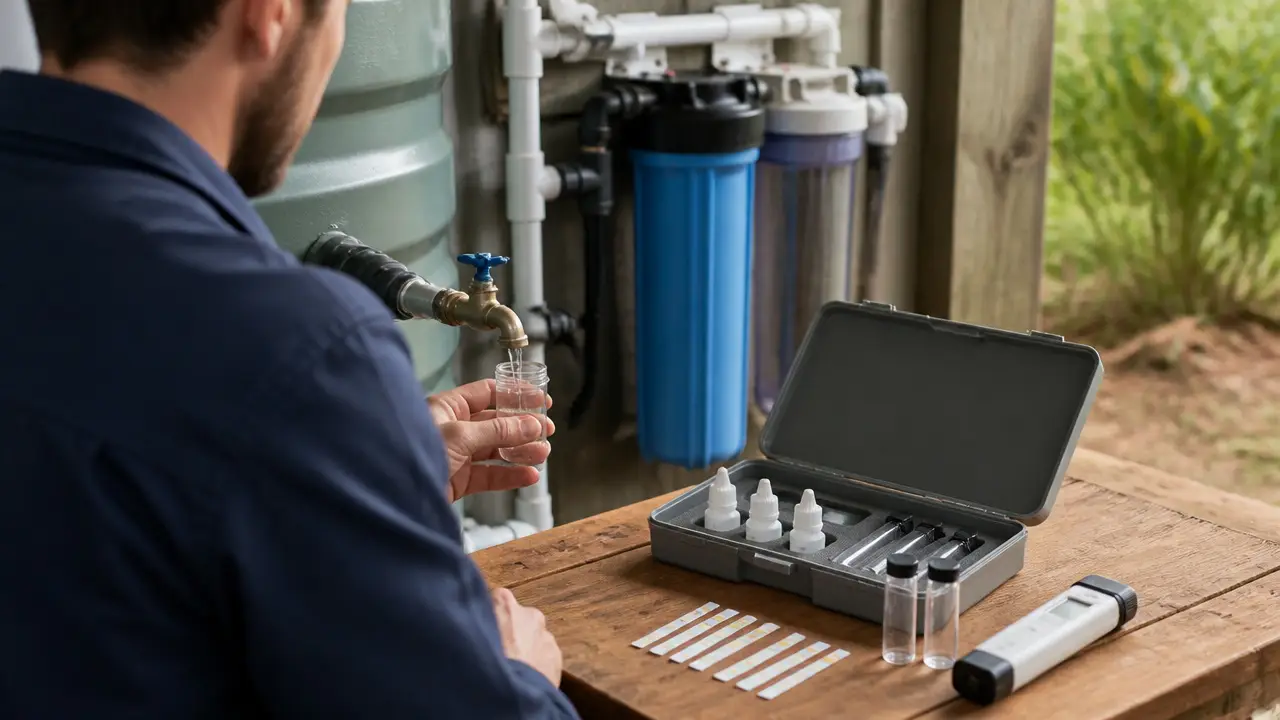
Use a clean sample container and follow the meter manufacturer's calibration and cleaning instructions. Measure water from approximately the same point in your system each time.
For example, you could track water taken from the tank outlet rather than sometimes testing gutter runoff and sometimes testing the bottom of the tank.
Keep a simple record containing:
- Date
- TDS reading
- Where the sample came from
- Recent weather
- Any cleaning or maintenance
- Any water added from another source
After several readings, you will start to establish a normal range for your system.
That baseline is more useful for troubleshooting than trying to match someone else's rainwater TDS.
When a TDS Change Is Worth Investigating
A single unusual reading does not necessarily mean something is wrong. Recheck the sample first.
If the reading remains substantially different from your normal level, inspect the collection and storage system.
Look for obvious changes such as heavy debris, sediment, another water source entering the tank, recent roof work, salt exposure, or unusual runoff.
For water intended only for landscape irrigation, the response may be as simple as checking the system and monitoring the trend.
For rainwater intended for drinking or other household uses where people may ingest it, do not use the TDS reading as a safety decision. Use appropriate laboratory testing and follow current local health and plumbing requirements.
Frequently Asked Questions
What is the average TDS of rainwater?
There is no worldwide average. Published measurements of direct rainfall include values as low as about 5 mg/L, while roof-harvested rainwater studies have reported averages ranging through several tens of mg/L. Location, weather, roof conditions, and storage all affect the result.
Is 20 ppm TDS normal for rainwater?
A reading around 20 ppm is possible for rainwater and falls within the range measured in some rainwater studies. It does not prove the water is clean or safe to drink.
Is 50 ppm TDS high for rainwater?
Not necessarily. Roof-collected rainwater can reach this level after picking up dissolved material from the air, roof, gutters, and storage system. Compare the reading with your tank's normal measurements rather than relying on one universal target.
Why is my rainwater TDS increasing?
Possible causes include roof debris, airborne salt or dust, evaporation, sediment, water added from another source, or changes in the collection system. A sudden increase is worth checking if your readings had previously been stable.
Does a first-flush diverter reduce TDS?
It may reduce some material washed from a dirty roof during the beginning of a storm. Its effect will vary with roof conditions and the contaminants involved. A first-flush diverter is not a complete water-treatment system.
Can a TDS meter tell whether rainwater is drinkable?
No. A TDS meter cannot establish whether water contains harmful microorganisms or specific chemical contaminants. Drinking-water decisions require suitable collection and treatment along with appropriate laboratory testing and local requirements.
What TDS level does the EPA allow in drinking water?
The U.S. EPA lists 500 mg/L TDS as a secondary drinking-water standard. It relates mainly to aesthetic and nuisance effects such as taste and deposits, rather than being a health-based threshold proving that water below that level is safe.