As an affiliate, we may earn a commission from qualifying purchases. We get commissions for purchases made through links on this website from Amazon and other third parties.
The best freshwater test kit is one that matches how you plan to use the water. For most rainwater and stored-water systems, a multi-parameter home kit is useful for routine checks, but it should not be treated as proof that water is safe to drink.
If the water will be used for drinking, cooking, brushing teeth, or other household uses where it may be swallowed, the better choice is laboratory testing for the contaminants that matter in your area and system. The CDC recommends regular testing of rainwater used for drinking, cooking, or bathing because collected rainwater can contain both germs and chemicals.
What Makes a Good Freshwater Test Kit?
A useful kit tests parameters that can tell you something actionable about your water.
For a rain barrel, cistern, IBC tote, well, or other freshwater storage system, common tests include:
- pH
- total dissolved solids, or TDS
- hardness
- nitrate and nitrite
- iron
- copper
- chlorine, when disinfectant is being used
- coliform bacteria or E. coli when microbial contamination is a concern
More tests are not always better. A kit with 20 test pads is not automatically more useful than one with six.
The important question is whether each test relates to your water source, plumbing, storage system, treatment system, or intended use.
The Best Type of Test for Different Uses
| Water use | Most useful testing approach |
|---|---|
| Garden irrigation | Basic pH and dissolved-solids testing, plus specific tests if plants or equipment show problems |
| Rain barrel monitoring | pH and general chemistry screening, with additional tests if contamination is suspected |
| Cistern or stored household water | Routine chemistry checks plus appropriate microbial testing |
| Private well water | Regular laboratory testing for bacteria, nitrate, TDS, pH, and locally relevant contaminants |
| Drinking rainwater | Appropriate laboratory testing for germs and chemicals, along with a properly designed and maintained treatment system |
A home test kit works best as a screening and maintenance tool. It can help you notice changes and decide when more testing is needed.
It is much less useful as a simple pass-or-fail test of whether unknown water is drinkable.
Test Strips Are Good for Quick Routine Checks
Test strips are usually the easiest option.
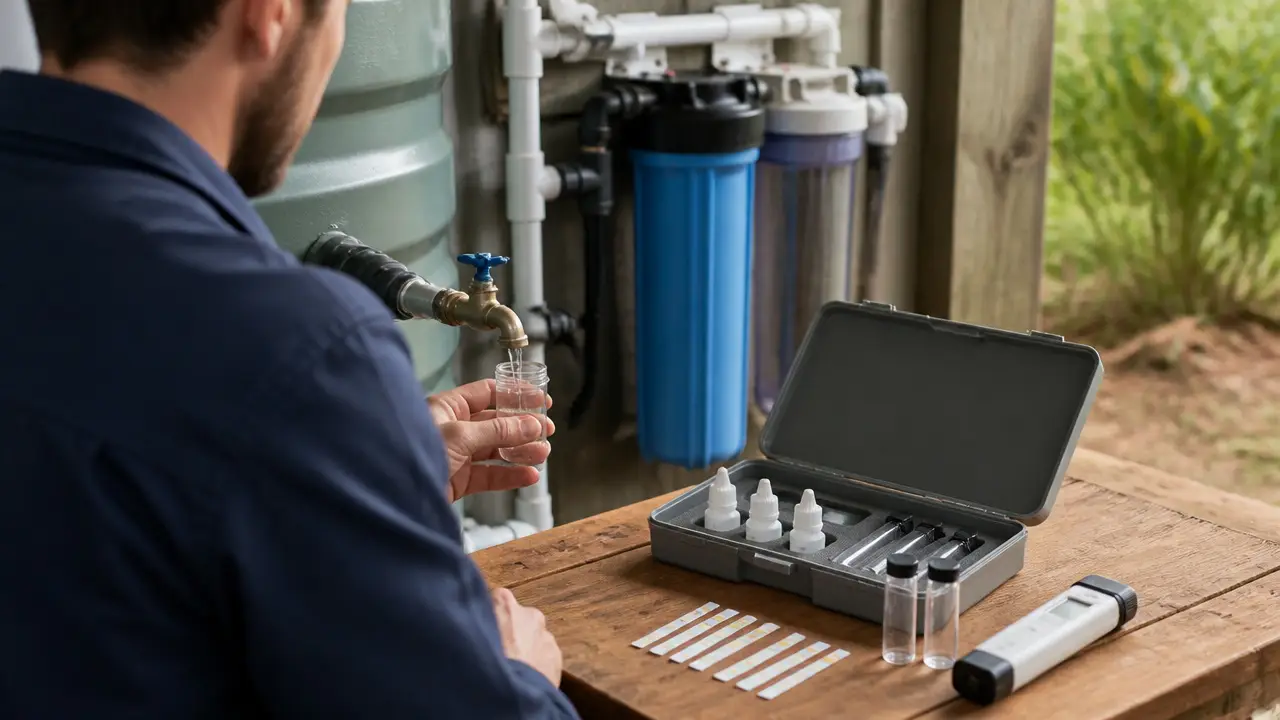
You dip a strip into a water sample and compare the resulting colors with a chart. Depending on the kit, one strip may test several parameters.
They work well when you want to see whether something has changed significantly between tests.
For example, they may help you notice that:
- pH has shifted.
- nitrate readings have increased.
- stored water chemistry has changed.
- disinfectant levels have changed.
- hardness is different from your normal reading.
Their main weakness is precision.
Colors can be difficult to distinguish. Lighting matters. Timing matters. Two people may interpret the same strip differently.
For that reason, test strips are better for screening and trends than for investigating a serious water-quality concern.
Liquid Drop Kits Can Be Easier to Read
Some freshwater kits use liquid reagents instead of strips.
You place a measured amount of water in a tube, add drops of reagent, and compare the color with a chart.
These kits can be useful when you regularly monitor one or two specific parameters.
They also require more work. Bottles must be stored correctly, instructions must be followed closely, and reagents eventually expire.
For a homeowner who only checks water occasionally, strips may be simpler. For someone regularly tracking a particular water condition, a drop kit can be useful.
Digital Meters Have a Narrower Job
Small digital meters commonly measure:
- pH
- electrical conductivity
- total dissolved solids
- temperature
They can be convenient because you get a number instead of comparing colors.
But a digital meter should not be confused with a complete water test.
What a TDS Meter Actually Measures
TDS means total dissolved solids. It is an estimate of how much dissolved material is present in water.
That material can include minerals and salts.
A TDS reading cannot tell you exactly what those substances are. It also cannot tell you whether harmful bacteria, pesticides, lead, or many other contaminants are present.
The CDC treats TDS as a useful water-quality indicator rather than a complete measure of water safety.
A very low TDS number therefore does not mean that rainwater is safe to drink.
Digital pH Meters Need Maintenance
Digital pH meters can provide finer readings than basic strips, but they need more care.
Depending on the meter, that may include calibration, correct storage, cleaning, and replacement of aging probes.
A poorly maintained meter can give a very precise-looking number that is still wrong.
For occasional home checks, a good pH strip or liquid kit may be simpler.
Bacteria Testing Is Different
Microbial contamination deserves special attention in rainwater and private water systems.
Roof runoff can pick up bird droppings, animal waste, dirt, insects, and other material before reaching the tank. CDC guidance notes that even rainwater that looks clean can contain germs or chemicals.
Some home kits include presence-or-absence tests for coliform bacteria.
These can sometimes provide a useful warning. However, they should not be treated as a complete microbiological analysis.
Total coliforms are a group of bacteria commonly used as an indicator of possible contamination. Testing can also target fecal coliforms or E. coli.
A positive result deserves attention, especially when the water may be swallowed.
The CDC recommends using appropriate laboratory testing for private drinking water and notes that local health departments can help determine which germs and chemicals should be tested.
What Should a Rainwater Test Kit Measure?
There is no single required panel for every rainwater system.
The useful tests depend on the roof, gutters, pipes, tank, treatment equipment, nearby contamination sources, and intended water use.
pH
pH tells you how acidic or basic the water is.
It matters partly because water chemistry can affect plumbing and corrosion. EPA and CDC guidance includes pH among the routine indicators recommended for private well testing.
TDS or Conductivity
These measurements can help you track changes in dissolved material.
They are useful for comparisons over time but cannot identify individual contaminants.
Nitrate and Nitrite
Nitrate testing is particularly important for private wells and some other water sources affected by agriculture, septic systems, animal waste, or runoff.
CDC recommends annual nitrate testing for private wells.
A nitrate result should not be used as a substitute for broader testing when drinking-water safety is involved.
Lead and Other Metals
Metals may come from the original water source or from components of the collection and plumbing system.
With rainwater, CDC specifically notes that roofing, gutters, piping, storage materials, and other collection surfaces can introduce substances such as lead or copper.
Look closely at a reliable home water-testing kit to assess how the selected parts interface in service.
If the system includes materials that could contribute metals, appropriate laboratory testing becomes especially useful.
Hardness
Hardness mainly reflects dissolved calcium and magnesium.
It can affect scale, soap use, fixtures, pumps, heaters, and other equipment.
Hardness testing can therefore be useful when freshwater is being used around a house or irrigation system, even though hardness by itself does not establish whether water is safe to drink.
Chlorine
A chlorine test can be useful when chlorine is intentionally being used as part of a managed treatment or disinfection process.
Its value depends on the treatment plan.
Simply detecting chlorine does not prove that every harmful organism has been removed or that chemical contaminants are absent.
What Home Freshwater Kits Cannot Tell You
This is the biggest limitation to understand.
A typical home kit cannot screen for every possible:
- bacterium
- virus
- parasite
- pesticide
- industrial chemical
- volatile organic compound
- heavy metal
- radioactive contaminant
It also cannot usually identify unknown contamination.
That is why a strip showing normal pH, low TDS, and acceptable nitrate should not be interpreted as evidence that untreated roof runoff is potable.
Potable means suitable for drinking.
CDC guidance states that rainwater is not necessarily safe to drink without removal of harmful germs and chemicals. It recommends regular testing when rainwater is used for drinking, cooking, or bathing.
When Laboratory Testing Is the Better Choice
Use a qualified laboratory when the answer could affect someone's health.
That is especially important when:
- rainwater will be consumed
- a private water supply is used for drinking
- a home test produces an unexpected result
- contamination is suspected
- water suddenly changes color, taste, or smell
- flooding or another contamination event affects the system
- you need to identify a specific chemical
- you need accurate concentrations rather than a rough range
- you are checking whether treatment is actually addressing known contaminants
For private wells, CDC recommends at least annual testing for total coliform bacteria, nitrate, TDS, and pH, along with additional contaminants that are important locally. CDC also recommends using a state-certified laboratory.
EPA likewise directs homeowners seeking drinking-water analysis toward certified laboratories.
Rainwater systems may need a different testing panel because their contamination pathways are different from those of wells.
Testing Should Match the Water Source
A generic freshwater kit becomes much more useful when you first ask where the water came from.
Rain Barrels
If the water is only being used on ornamental plants, testing needs may be simple.
Watch the system itself as well. Keep screens, gutters, and storage clean, and prevent animals, insects, leaves, and dirty runoff from entering.
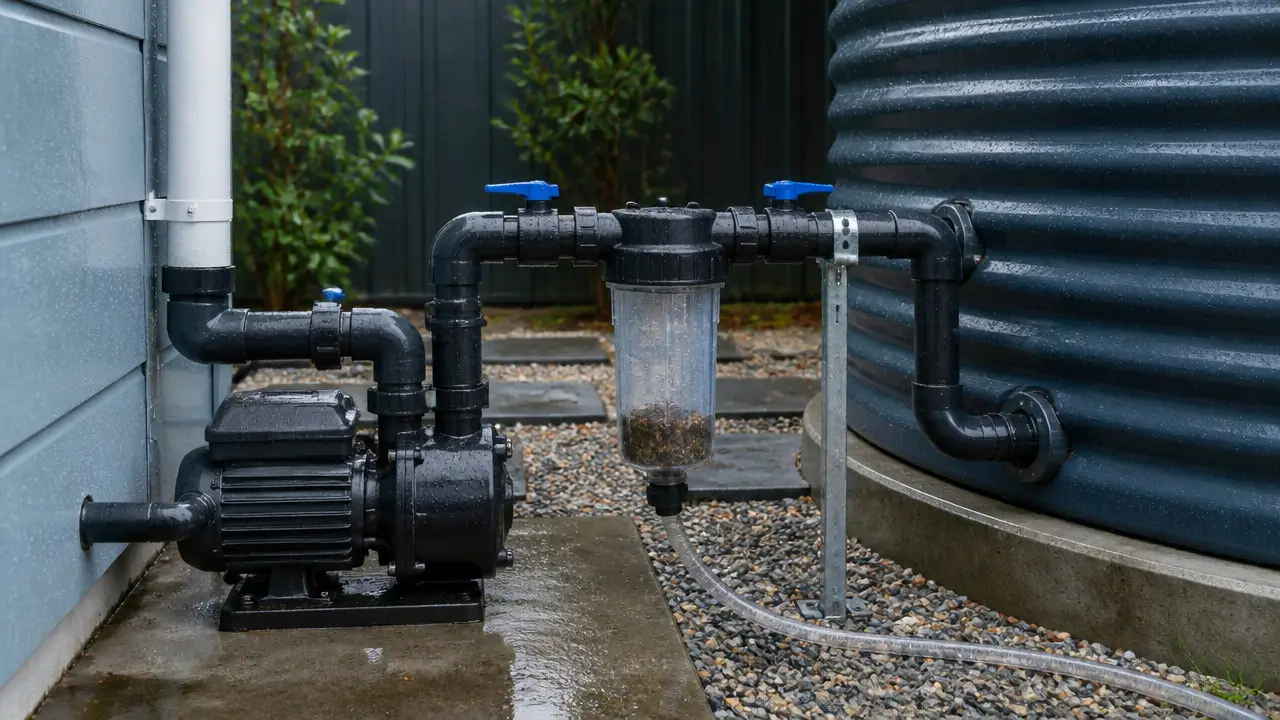
A first-flush diverter sends the first portion of roof runoff away from the storage tank. That early runoff often carries more dirt and contamination from the roof. CDC recommends considering first-flush diversion as one way to improve collected rainwater quality.
It does not make the remaining water automatically potable.
Large Cisterns
A cistern stores a much larger volume, so problems can remain in the system for longer periods.
Testing can help identify changes, but it should be combined with inspection and maintenance of the:
- catchment
- inlet
- screens
- tank
- overflow
- pipes
- treatment system
Cistern water can become contaminated even if it originally entered the tank in good condition. CDC identifies cisterns and storage tanks as private water sources that can contain microbial, chemical, or other contaminants.
Private Wells
For a well, start with the standard annual tests recommended by public-health guidance, then add tests based on local conditions.
For example, nearby agriculture, septic systems, fuel storage, mining, industrial sites, plumbing materials, and local geology can change which contaminants matter. EPA recommends contacting the local health department when deciding which additional substances to test.
Use Testing to Choose Treatment, Not the Other Way Around
It is easy to buy a filter first and test the water later.
The better order is usually:
- Determine how the water will be used.
- Identify likely contamination sources.
- Test for the relevant contaminants.
- Choose treatment designed for those contaminants.
- Maintain that treatment correctly.
- Test again as appropriate to verify water quality.
Different filters remove different things.
A sediment filter may remove particles but do little for dissolved chemicals. A carbon filter may address certain chemicals but is not a complete answer to every microbial hazard. UV treatment targets microorganisms under suitable operating conditions but does not remove dissolved metals or many chemicals.
CDC recommends testing water first and choosing treatment based on the harmful germs or chemicals actually present.
A Practical Choice for Most Rainwater Systems
For routine non-potable rainwater management, a basic freshwater kit that checks pH plus a few relevant chemical indicators is usually more useful than a large kit filled with unrelated tests.
Non-potable means the water is not intended for drinking.
Add a digital meter only when you have a reason to track pH, conductivity, or TDS more closely.
Add specific tests when your source or system creates a reason to look for a particular problem.
For drinking-water decisions, move beyond the general-purpose kit. Use appropriate laboratory testing, suitable collection and prefiltration, treatment matched to identified risks, regular maintenance, and any applicable local health requirements.
No single strip, meter, bacteria vial, filter, or purifier can substitute for that whole-system approach.
Frequently Asked Questions
Can a freshwater test kit tell me if rainwater is safe to drink?
Not by itself. Most home kits test only a small group of water-quality indicators. Rainwater can contain germs and chemicals that the kit does not measure. Water intended for drinking should be evaluated with appropriate laboratory testing and a suitable collection, treatment, and maintenance plan.
Are water test strips accurate?
They can be useful for quick screening and tracking broad changes. Their precision is limited by the test range, color chart, lighting, timing, storage, and the person reading the strip. Use a laboratory when an accurate concentration is important.
Is a TDS meter enough to test freshwater?
No. A TDS meter estimates the amount of dissolved material in the water. It does not tell you exactly what those substances are and does not test for many germs, chemicals, or individual metals.
Should I test rain barrel water before watering plants?
Testing can be useful when you suspect unusual water chemistry, contamination, or plant problems, but the amount of testing needed depends on what you are growing and your collection system. Water used on ornamental plants generally does not require the same testing approach as water intended for drinking.
How often should stored rainwater be tested?
The schedule should reflect how the water is used and the risks in the system. CDC recommends regular testing for germs and chemicals when rainwater is used for drinking, cooking, or bathing. Testing should also be considered after contamination events or noticeable changes in the water.
Can clear, odorless rainwater still be contaminated?
Yes. Harmful germs and chemicals may not change the appearance, smell, or taste of water. CDC specifically warns that these qualities are not reliable indicators of drinking-water safety.
What is the best test for freshwater intended for drinking?
A certified laboratory analysis selected for your water source and local risks is more appropriate than relying only on a general home kit. For rainwater, testing should be part of a larger plan that includes suitable collection, treatment, maintenance, and current local health guidance.