As an affiliate, we may earn a commission from qualifying purchases. We get commissions for purchases made through links on this website from Amazon and other third parties.
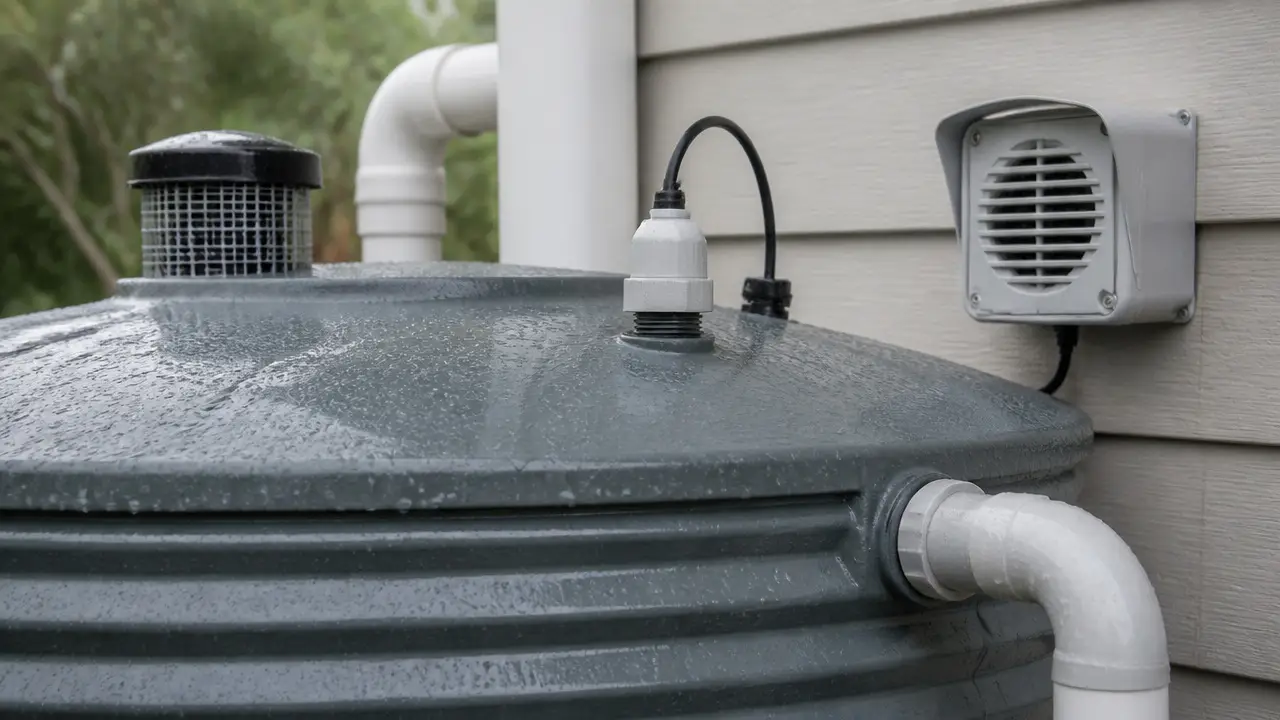
A smart water tank level detector is a sensor system that measures how much water is in a tank and sends that information to a display, phone app, or control system.
Unlike a basic float gauge, a smart detector can often report the water level without you opening the tank. Some systems can also send low-level alerts, warn about unusually high levels, or switch pumps and valves through a separate controller.
For rainwater tanks, cisterns, IBC totes, and household storage tanks, the main job is simple: tell you how much usable water you have without needing to check the tank by hand.
How a Smart Water Tank Level Detector Works
A smart tank monitor has two main parts:
- A sensor measures the water level.
- A controller or transmitter turns that measurement into useful information.
The reading may be shown as:
- A percentage, such as 65% full
- Water depth
- Estimated gallons or liters
- A simple full, medium, or low reading
- A graph showing how the level changes over time
Some systems send readings through Wi-Fi, Bluetooth, cellular service, or another wireless connection.
The exact method depends on the type of sensor.
Common Types of Smart Tank Level Sensors
Ultrasonic Sensors
An ultrasonic sensor is usually mounted near the top of the tank. It sends a sound pulse toward the water surface and measures how long the echo takes to return.
The system uses that distance to estimate the water level.
One advantage is that the sensor may not need to touch the water. This can make cleaning and installation easier.
However, readings can sometimes be affected by:
- Tank shape
- Internal braces
- Pipes
- Foam
- Condensation
- A poorly positioned sensor
The sensor also needs a reasonably clear path to the water surface.
Pressure Sensors
A pressure sensor is installed near the bottom of the tank or lowered into the water.
Water creates pressure as its depth increases. The sensor uses that pressure to estimate the amount of water above it.
Pressure sensors can work well in deep tanks, but they remain in contact with the stored water. The sensor, cable, fittings, and materials therefore need to be suitable for the intended water use.
Float Sensors
A float moves as the water level rises and falls.
Simple float switches usually tell a controller when the water reaches one particular point. More advanced float-based systems may measure several levels.
Float switches are commonly used for functions such as:
- Stopping a pump before a tank runs dry
- Starting a fill pump
- Triggering a high-water alarm
- Controlling a backup water supply
They are often better for control functions than for showing an exact percentage of water remaining.
Capacitive and Other Electronic Sensors
Some systems detect changes in electrical properties as the water level changes. Depending on the design, the sensor may be mounted inside or outside the tank.
These systems can be useful in certain installations, but tank material, wall thickness, water quality, and sensor placement can affect compatibility.
What Makes a Tank Level Detector "Smart"?
The sensor itself does not necessarily make the system smart.
A smart system usually adds communication, automation, or data tracking.
Depending on the equipment, you may be able to:
- Check the tank from a phone
- Receive a low-water alert
- Receive a high-level warning
- See past water-level readings
- Estimate water use
- Detect unusually fast water loss
- Operate a pump or valve through a compatible controller
These features are useful, but they do not replace good tank plumbing or routine inspections.
For example, a high-level notification is not a substitute for a properly sized overflow.
Why Use a Smart Detector on a Rainwater Tank?
Rainwater storage can change quickly.
A heavy storm may fill a tank in a short time. Irrigation can lower the water level just as quickly.
A remote monitor lets you check the tank without:
- Removing a lid
- Climbing near the tank
- Looking through an inspection opening
- Guessing from the weight or sound of the tank
This is especially useful for large cisterns, tanks hidden behind buildings, underground storage, or systems that supply automatic irrigation.
It can also help you decide whether there is enough stored water for the next planned use.
Smart Tank Monitor vs. Simple Tank Gauge
A smart monitor is not always necessary.
| Feature | Simple Gauge | Smart Detector |
|---|---|---|
| Shows approximate level | Yes | Yes |
| Remote viewing | Usually no | Often |
| Phone notifications | No | Often |
| Historical data | No | Sometimes |
| Needs power | Often no | Usually yes |
| Can connect to controls | Limited | Sometimes |
| Setup complexity | Low | Moderate |
For a small rain barrel beside a garden, a basic gauge may be enough.
For a large cistern that supplies irrigation or other regular uses, remote monitoring can be much more useful.
What to Check Before Choosing a Tank Level Detector
The detector needs to match the tank and the way you use the water.
Tank Height
Many sensors have a limited measuring range.
Measure the usable depth of the tank rather than assuming every detector will work with every tank size.
Tank Shape
A level sensor measures depth. Turning depth into gallons or liters requires knowing the shape and dimensions of the tank.
This is simple with a vertical tank that has straight sides.
Irregular, horizontal, or tapered tanks may need a tank profile or calibration table for accurate volume estimates.
Tank Material
Check whether the sensor can work with the tank material.
Common tank materials include:
- Polyethylene
- Fiberglass
- Concrete
- Steel
- IBC tote plastic
This is especially important for sensors designed to read through a tank wall.
Sensor Mounting Location
The sensor should have an appropriate mounting point.
An ultrasonic sensor, for example, should normally have a clear view of the water surface rather than aiming at a pipe, brace, or tank wall.
Power Supply
Smart monitors need power somewhere in the system.
Depending on the design, that could mean:
- Replaceable batteries
- Rechargeable batteries
- Solar power
- Low-voltage wiring
- A mains-powered control unit
Factor in echo signals used by an ultrasonic tank sensor to assess installation planning for dependable ongoing service.
Consider how easy the power source will be to inspect and maintain.
Wireless Connection
A tank near the house may have a good Wi-Fi signal.
A tank hundreds of feet away may not.
Check the actual communication method and range before relying on remote monitoring.
Metal tanks and buildings can also interfere with some wireless signals.
Water Contact
If any sensor or cable sits in the water, make sure its materials are appropriate for the intended use.
This is particularly important if the stored water could eventually be treated for household or drinking-water use.
A tank level sensor does not make rainwater potable. Potable means suitable for drinking.
Drinking-water use requires a suitable collection system, treatment process, maintenance plan, current water testing, and compliance with applicable local requirements.
Can a Smart Detector Control a Pump?
Some can, but the level sensor and pump controller are often separate parts.
A common arrangement might use a sensor to tell a controller that the tank has reached a low level. The controller then shuts off the pump.
This can help protect a pump from running without enough water.
Other systems may:
- Start a transfer pump
- Stop a filling pump
- Open or close a valve
- Change to a backup water source
Do not assume any tank monitor can directly switch a pump.
Pump motors can draw much more electrical current than a small sensor can handle. The monitoring system must be designed for the electrical load or connected through a suitable control device.
Electrical work around water deserves extra care. Use properly rated equipment and qualified help where required.
How Accurate Are Smart Tank Level Detectors?
Accuracy varies with the sensor type, tank setup, installation, and calibration.
Even a good sensor may give poor readings if it is mounted incorrectly.
Common causes of inaccurate readings include:
- Incorrect tank dimensions entered into the system
- A sensor mounted at an angle
- Obstructions inside the tank
- Condensation on the sensor
- Sediment around a submerged pressure sensor
- A moving or stuck float
- Poor calibration
- Wireless communication problems
For most homeowners, it is better to think of a tank monitor as a water-management tool rather than a precision measuring instrument.
If knowing the exact amount of water is important, verify the system's accuracy under real tank conditions.
Can It Detect a Leak?
Sometimes it can help identify one.
A monitor that records water level over time may show that the tank is losing water when nothing should be using it.
For example, you might notice the level falling overnight even though irrigation is turned off.
That could point to:
- A leaking pipe
- A dripping valve
- A damaged tank fitting
- An unnoticed pump cycle
- A siphoning problem
However, falling water level alone does not prove that the tank itself is leaking.
Evaporation, automatic equipment, and other water uses also need to be considered.
Installation and Maintenance
A tank monitor usually needs less maintenance than the tank itself, but it should not be ignored.
Periodically check:
- Sensor mounting
- Batteries or power supply
- Wiring and connectors
- Wireless connection
- Sensor cleanliness
- Calibration
- Tank dimensions stored in the app or controller
If the sensor touches the water, inspect it for sediment, mineral buildup, or biological growth as appropriate.
Keep electrical connectors and control equipment protected from rain and tank overflow unless they are specifically rated for those conditions.
Do not enter a water tank to install or repair a sensor. Tanks and cisterns can be dangerous confined spaces.
Where a Smart Water Level Detector Fits in a Rainwater System
A level detector is a monitoring device. It does not replace the other parts of a properly planned rainwater system.
A typical system may still need:
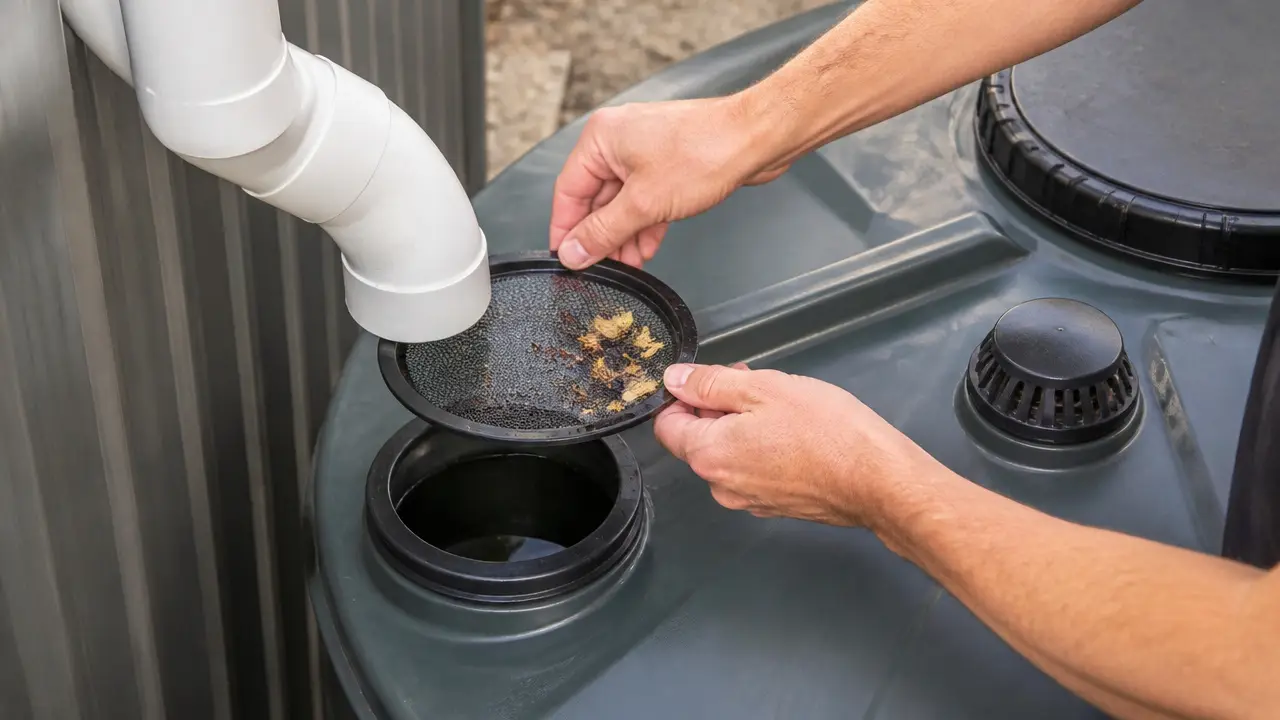
- Gutters and downspouts
- Leaf screens
- A first-flush device where appropriate
- A covered storage tank
- Inlet screening
- An overflow
- Mosquito protection
- A pump if pressure is needed
- Filtration or treatment appropriate for the intended use
A first flush device diverts some of the earliest roof runoff away from storage. That first runoff can carry dirt, pollen, bird droppings, and other material from the roof.
The tank monitor simply helps you see what is happening inside the storage part of the system.
Is a Smart Tank Level Detector Worth It?
It can be worthwhile when checking the tank manually is difficult or when knowing the available water helps you manage irrigation, pumps, or household reuse.
It is most useful when:
- The tank is large
- The tank is hard to see
- Water use changes often
- You want low-level alerts
- A pump depends on stored water
- You manage more than one tank
- You want to track water use over time
For a small, easily visible rain barrel, a simple mechanical gauge may provide all the information you need.
The best choice is the simplest level-monitoring method that gives you reliable information for the way you actually use the water.
Frequently Asked Questions
What does a smart water tank level detector measure?
It measures the amount or depth of water in a storage tank. The system may show the result as water depth, percentage full, or estimated gallons or liters.
Can I check my rainwater tank level from my phone?
Some smart detectors connect to a phone through Wi-Fi, Bluetooth, cellular service, or another wireless system. Whether remote access works depends on the particular monitor and the available connection at the tank.
Can a smart tank sensor stop my pump when the tank is empty?
Some systems can work with a pump controller to stop a pump at a low water level. Do not assume the sensor can switch the pump directly. The controller must be suitable for the pump's electrical requirements.
What is the best type of sensor for a rainwater tank?
There is no single best type for every tank. Ultrasonic sensors avoid contact with the water, pressure sensors can work well in deeper tanks, and float switches are useful for simple high- or low-level control. Tank size, shape, access, water use, and installation conditions determine the better choice.
Will an ultrasonic sensor work through a plastic tank wall?
A conventional ultrasonic level sensor usually measures from above the water rather than through the tank wall. Other types of sensors may be designed for external mounting. Always check that the sensing method is compatible with the tank material and wall thickness.
Does a smart level sensor make rainwater safe to drink?
No. A level sensor only measures the water level. It does not remove contaminants or confirm that the water is safe to drink. Drinking-water use requires suitable collection, treatment, maintenance, current testing, and compliance with applicable local requirements.
How often should a tank level sensor be checked?
Check it periodically and whenever the reading seems wrong. Inspect the mounting, power supply, connections, cleanliness, and calibration. Battery-powered systems also need battery replacement as required.