As an affiliate, we may earn a commission from qualifying purchases. We get commissions for purchases made through links on this website from Amazon and other third parties.
A water level alert system is a device that warns you when water in a tank, cistern, sump, or other container reaches a set level. It may alert you when the water is too high, too low, or both.
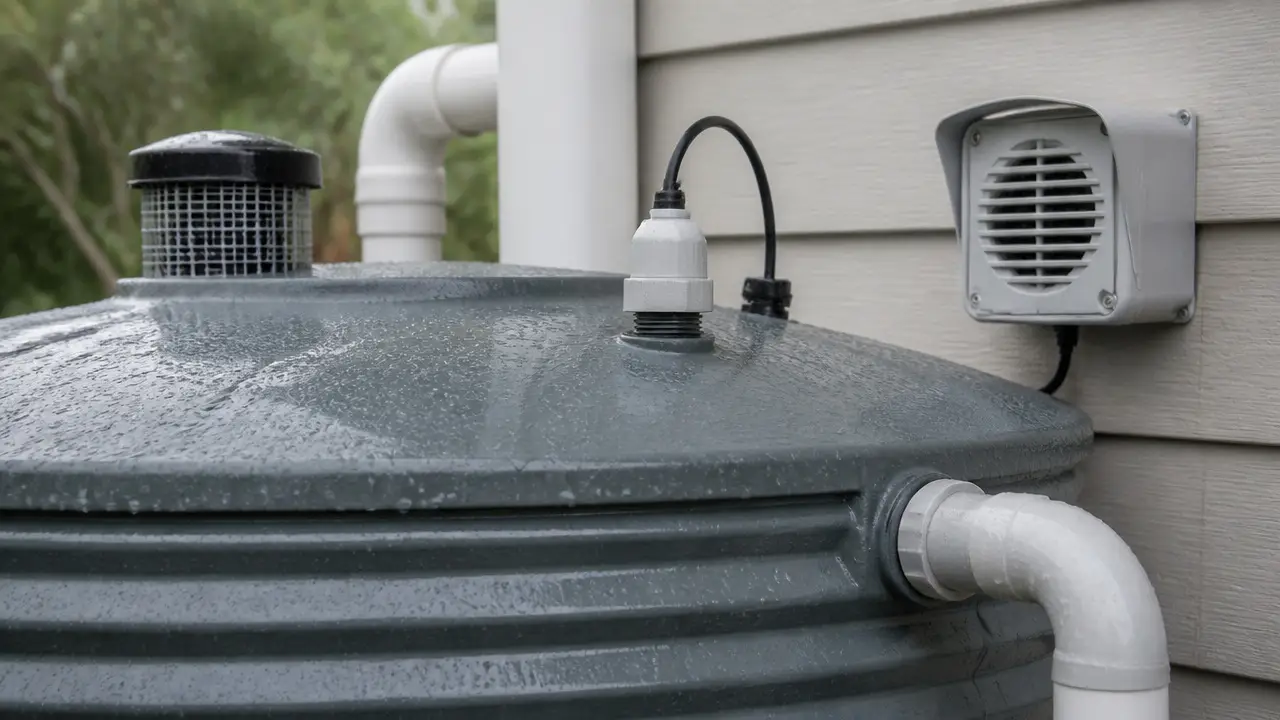
In a rainwater harvesting system, a level alert can help prevent overfilling, protect a pump from running dry, and tell you when stored water is getting low. Some systems use a local light or buzzer. Others can send an alert to a phone or connect to a pump controller.
How a Water Level Alert System Works
A water level alert system has two basic jobs:
- Detect the water level.
- Trigger an alert when the level reaches a set point.
The sensor may be installed inside the tank or mounted where it can measure the water without being submerged.
When the water crosses the chosen level, the system can activate:
- A warning light
- A buzzer or alarm
- A control panel indicator
- A text, app, or internet notification
- A relay that can communicate with other equipment
A simple system might only have one high-water alarm. A more complete setup may monitor several levels, such as low, half-full, high, and overfill.
Common Types of Water Level Sensors
The sensor is the part that determines how much water is in the tank. Different sensing methods suit different tank designs.
Float Switches
A float switch moves up or down with the water.
When the float reaches a certain position, it opens or closes an electrical switch. This can trigger an alarm or send a signal to a controller.
Float switches are often used for:
- High-level alarms
- Low-water alarms
- Pump controls
- Sumps
- Rainwater tanks
They are simple, but they only detect the level where the switch is installed unless several switches are used.
Conductive Probes
Conductive sensors use electrodes that detect when water touches them.
Several probes can be installed at different heights to show different tank levels.
These sensors depend on the electrical properties of the water, so suitability can vary with water quality and system design.
Pressure Sensors
A pressure sensor can estimate water depth from the pressure created by the water above the sensor.
This can provide a more continuous level reading instead of a simple full-or-empty signal.
Installation and calibration matter because tank height, sensor position, and venting can affect the reading.
Ultrasonic Sensors
An ultrasonic sensor is normally installed near the top of the tank. It sends sound waves toward the water surface and measures how long the signal takes to return.
The system then estimates the distance between the sensor and the water.
This approach can avoid placing an electrical sensor directly in the water. However, tank shape, condensation, foam, internal pipes, and other obstructions may affect measurements.
High-Level and Low-Level Alerts
A water level alert system should be chosen according to the problem you are trying to prevent.
High-Level Alerts
A high-level alarm warns you when the tank is close to full.
This may be useful when:
- An overflow could cause water damage
- A transfer pump is filling the tank
- Water is being moved between tanks
- You need warning before reaching maximum capacity
A rainwater tank should still have a properly sized overflow path. An electronic alarm should not be treated as a replacement for an overflow.
Sensors, wiring, batteries, communications, or power supplies can fail.
Low-Level Alerts
A low-water alarm warns you when storage is running out.
It can be useful for:
- Irrigation tanks
- Cisterns
- Cabins
- Pump-fed garden systems
- Household non-potable rainwater systems
A low-level alert can also be part of pump protection.
If a pump keeps operating after its water supply has dropped too far, it may run dry. Some pumps tolerate this better than others. Dedicated dry-run protection may still be needed.
Water Level Alert vs. Water Level Indicator
These terms are related but do not always mean the same thing.
A water level indicator tells you how much water is in the tank.
A water level alert warns you when the water reaches a particular condition.
For example, a tank display might show:
- 25%
- 50%
- 75%
- 100%
An alert system might instead send a warning only when the tank falls below 20%.
Many modern tank monitoring systems provide both functions.
Water Level Alert vs. Automatic Pump Control
An alert does not necessarily control anything.
A basic alarm only tells you that the water has reached a certain level. You still decide what to do.
An automatic controller can use a level sensor to start or stop equipment.
For example, a system could be designed to:
- Stop a transfer pump when a tank is full
- Start a refill pump when the tank becomes low
- Shut down a pump before the tank is empty
Automatic control adds more complexity. The sensor, relay, pump voltage, electrical load, and control system must all be compatible.
Electrical work around water should be installed with suitable equipment and protection. Bring in a qualified electrician when mains-voltage wiring or unfamiliar pump controls are involved.
Where Water Level Alerts Are Useful in Rainwater Systems
Level alerts can be useful at several points in a rainwater setup.
Rain Barrels
A simple rain barrel normally does not need an electronic level alarm. A visible water level or properly designed overflow is often enough.
An alert may make more sense if the barrel is hidden, difficult to access, or connected to powered equipment.
IBC Totes
An IBC tote used for rainwater storage may benefit from a level monitor if you cannot easily see through the container or if a pump depends on the stored water.
Make sure any sensor installation does not create an uncontrolled leak point in the tote.
Large Cisterns
A level alert becomes more useful as a tank gets larger or harder to inspect.
An underground or enclosed cistern might use a remote level monitor because the water surface cannot be checked conveniently.
Use temperature and obstruction effects on ultrasonic sensing to assess setup choices that improve routine system reliability.
Do not enter a cistern to install, inspect, or repair a sensor. Tanks and other confined spaces can contain serious hazards.
Pump Systems
Low-level sensors can help protect pump systems.
The correct control depends on how the pump operates. Some systems use a float switch, while others use a dedicated pump controller with dry-run protection.
Check the pump and controller requirements before connecting a sensor directly to either one.
Features to Consider
You do not need the most complicated monitoring system. You need one that works with your tank and intended use.
Alert Type
Decide how you want to receive the warning.
Options may include:
- Light
- Buzzer
- Control-panel alarm
- Phone notification
- Remote display
A local alarm may be enough for a tank beside the house. Remote alerts can be more useful for tanks at cabins, gardens, barns, or distant parts of a property.
Number of Alert Levels
Some systems have one sensor point. Others can track several.
A single low-water alarm may be enough if your main concern is protecting a pump.
If you want to manage storage more closely, several level points or a continuous level sensor may be more useful.
Tank Depth
Confirm that the sensor can work across the actual depth of your tank.
A system designed for a shallow container may not be suitable for a deep cistern.
Sensor Compatibility
Check whether the sensor is suitable for:
- Rainwater
- The tank material
- The operating temperature
- Indoor or outdoor installation
- Continuous submersion, if applicable
If a sensor needs a hole through the tank wall, the fitting also needs to match the tank.
A bulkhead fitting is a sealed fitting installed through the wall of a tank so a pipe, valve, or other connection can pass through without allowing water to leak around the opening.
Power Source
Water level alarms may use:
- Batteries
- Low-voltage power
- Mains power
- Solar power
Think about what happens during a power outage.
A battery-powered alarm also needs periodic battery checks. A wireless unit may need both power and a reliable communication signal.
Do You Still Need an Overflow?
Yes.
A high-water alert should not be the only protection against overfilling a rainwater tank.
Rainwater can enter quickly during heavy rainfall. If nobody responds to the alarm, the tank still needs a safe place for excess water to go.
A proper overflow should carry water away without damaging the tank, building foundation, or surrounding area.
The overflow arrangement may also need screening or other measures to reduce pest entry, depending on the system and local requirements.
Does a Water Level Alert Tell You Water Quality?
No.
A tank-level sensor tells you about the amount of water stored. It does not tell you whether the water is safe to use.
It cannot determine whether the tank contains:
- Harmful microorganisms
- Chemicals
- Animal waste contamination
- Fine suspended material
- Other water-quality problems
Even sensors that measure additional properties should not be treated as proof that roof-collected rainwater is potable.
Potable means suitable for drinking. Drinking-water use requires a whole-system approach that considers the collection surface, debris control, suitable treatment, maintenance, current laboratory testing, and applicable local requirements.
Maintenance
A level alarm is easy to forget once it has been installed, but it still needs checking.
Periodically:
- Test that the alarm actually activates
- Inspect accessible sensor components
- Look for corrosion or damaged wiring
- Check batteries
- Clean sensors when required by their instructions
- Confirm that floats can move freely
- Check wireless or remote notifications
- Make sure tank fittings are not leaking
Also test the system after tank cleaning or other work that could move or damage the sensor.
Do not climb into a tank to service a level sensor.
Is a Water Level Alert Worth Adding?
It can be, especially when knowing the tank level helps you prevent another problem.
A level alert is particularly useful when:
- A pump could run dry
- A tank is difficult to inspect
- Water is transferred automatically
- You want warning before storage becomes very low
- An unexpected high level could cause problems
For a small rain barrel with a working overflow and no pump, an electronic alarm may add little value.
The best system is not necessarily the one with the most sensors. It is the one that provides a useful warning before you need to take action.
Frequently Asked Questions
What is a water level alert system?
A water level alert system detects the water level in a tank or container and provides a warning when the level reaches a chosen high or low point.
Can a water level alarm stop a pump?
Some systems can send a signal to a compatible pump controller or relay, but a basic water level alarm may only provide a warning. Check the electrical and control requirements before connecting one to a pump.
Can I use a water level alert in a rainwater tank?
Yes. Level alarms can be used in many rainwater tanks, cisterns, and IBC totes as long as the sensor is suitable for the tank, water, installation environment, and required measuring range.
Do I need a high-water alarm if my tank has an overflow?
Not usually for basic overflow protection. A properly designed overflow should handle excess incoming water without relying on an alarm. A high-level alert can provide additional information or warning.
Can a water level sensor protect a pump from running dry?
It can be part of a dry-run protection system. A low-level sensor can signal that the tank is nearly empty, but the pump and controller must be set up to respond correctly. Dedicated dry-run protection may also be appropriate.
Are wireless water level alerts reliable?
They can be useful, but reliability depends on power, batteries, signal strength, communication service, sensor condition, and installation. Important systems should not depend on a wireless notification alone where failure could cause damage.
Does a tank level monitor tell me if rainwater is safe to drink?
No. It only provides information about water level unless it includes separate sensing functions. Tank level measurements do not establish microbiological or chemical drinking-water safety.