As an affiliate, we may earn a commission from qualifying purchases. We get commissions for purchases made through links on this website from Amazon and other third parties.
A rainwater system works best when you can tell what is happening before a small problem becomes a large one. You do not need a screen full of sensors. For many homes, simple checks of the tank level, pump behavior, filters, overflow, and water condition are enough.
The right monitoring setup depends on how you use the water. A garden barrel needs much less monitoring than a pumped cistern that supplies toilets, laundry, or household fixtures.
What Should You Monitor in a Rainwater System?
Most rainwater systems benefit from watching six things:
- Water level in the tank
- Water entering and leaving the system
- Pump pressure and operation
- Filter condition
- Leaks, overflow, and drainage
- Water quality when the intended use requires it
You do not have to measure all of these electronically. A sight tube, pressure gauge, clear filter housing, or regular visual inspection may provide all the information you need.
The goal is not to collect as much data as possible. It is to notice changes that tell you something is wrong.
Start With the Water Level
Knowing how much water is in storage is one of the most useful forms of monitoring.
It tells you whether:
- Rain is reaching the tank
- Your household or garden is using water faster than expected
- The tank is close to empty
- The tank is close to overflowing
- You may need another water source during a dry period
Simple tank level indicators
A small rain barrel may only need a visual check. Some tanks are translucent enough to see the water line from outside.
Other options include:
- A mechanical float gauge
- A clear external level tube designed for the tank
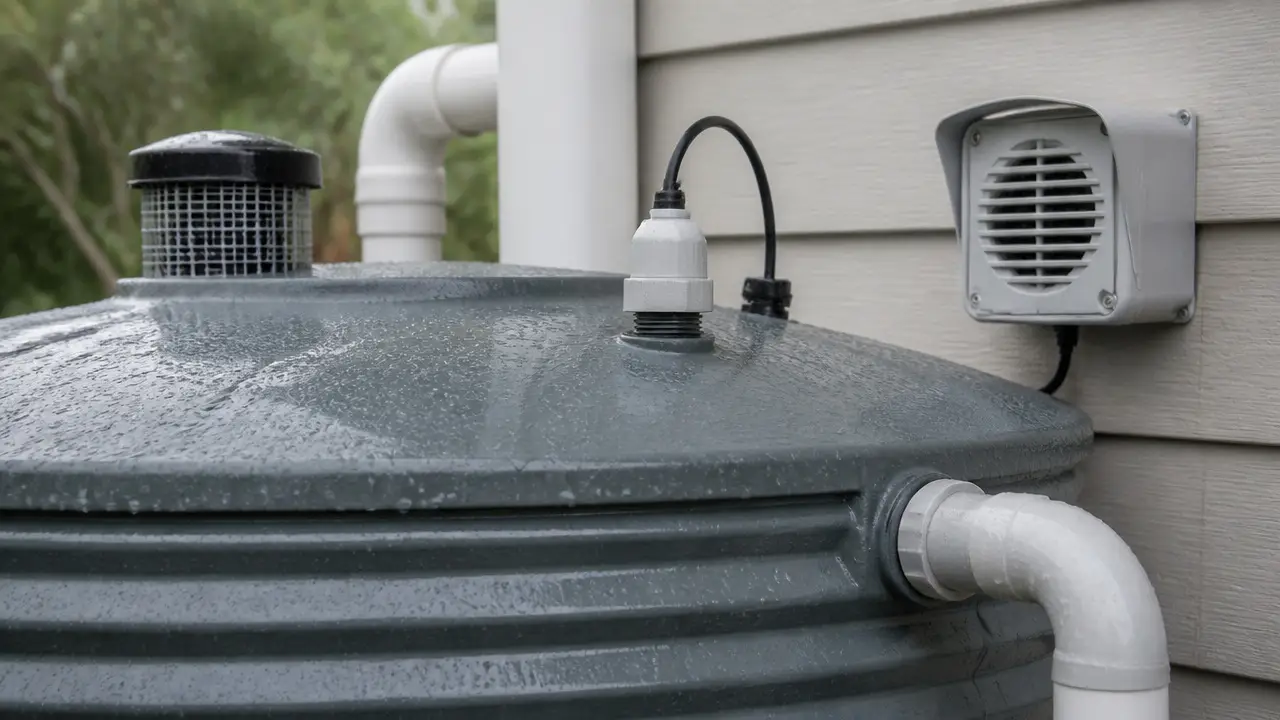
- A pressure-based level sensor
- An ultrasonic sensor mounted above the water
- An electronic level sensor connected to a display or controller
Choose a method that suits the tank design. Do not drill holes into a storage tank unless the tank can safely accept the fitting and you know where it can be installed.
A bulkhead fitting is a sealed fitting that passes through a tank wall. It can provide a secure connection for a pipe, valve, or level tube when installed in a suitable location.
Watch the level over time
One reading tells you how much water you have now. A pattern can tell you much more.
For example, a tank that drops noticeably overnight when no water is being used may have a leak. A tank that barely rises during a heavy rain may have a blocked inlet, overflowing gutter, clogged screen, or disconnected pipe.
Monitor How Water Enters the Tank
A full gutter does not mean the tank is receiving water.
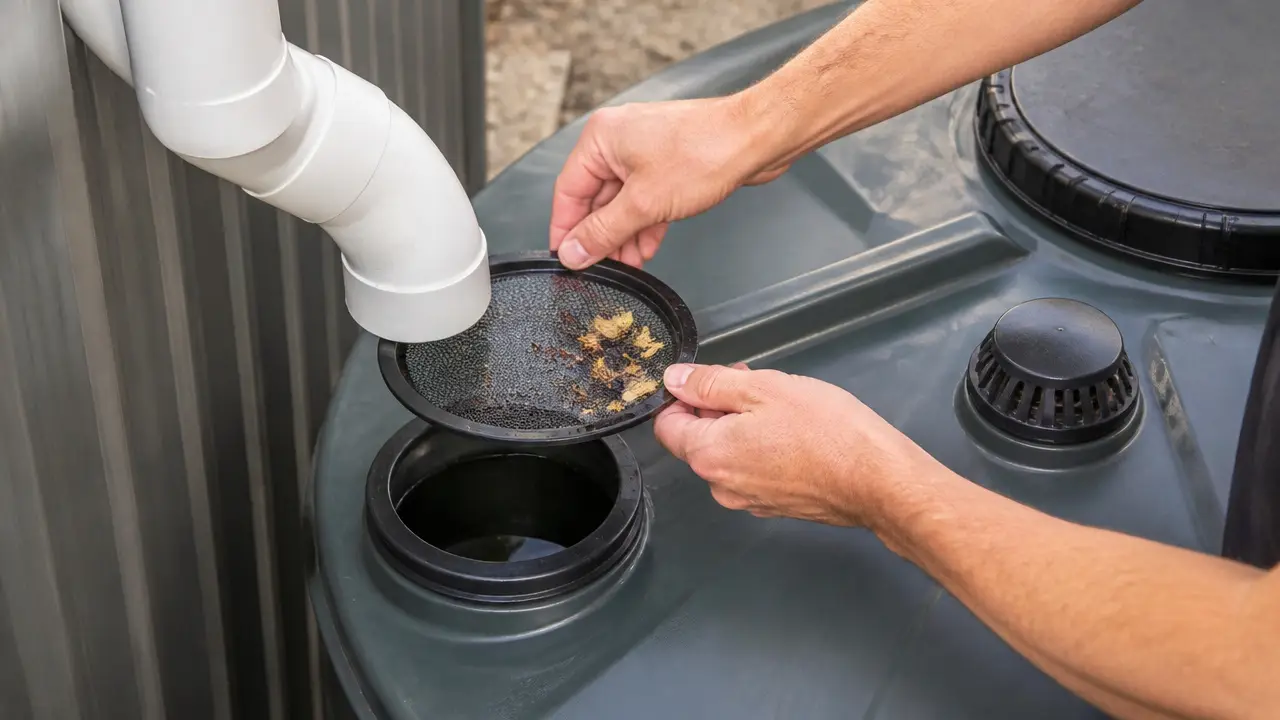
Leaves, roof debris, damaged screens, clogged pipes, or a full first-flush device can reduce collection.
A first-flush device diverts some of the first roof runoff away from the storage tank. This early runoff can carry dust and other debris from the roof.
During or shortly after a safe, accessible rain event, check that:
- Gutters are draining normally
- Downspouts are not backing up
- Leaf screens are clear
- First-flush components are draining and resetting as intended
- Inlet screens are not blocked
- Water is reaching the tank
- Overflow water has a clear path away
Do not climb onto a wet roof to inspect a rainwater system. Roof work can be dangerous, especially during rain.
Watch the Tank Overflow
Overflow is a normal part of a properly designed rainwater system. Once the tank is full, incoming water needs somewhere safe to go.
Monitor the overflow point for:
- Blockages
- Erosion
- Standing water
- Loose connections
- Water flowing toward a foundation
- Damaged mosquito screens
An overflow that suddenly stops working during rain can cause water to back up into pipes or spill where it should not.
A tank that never seems to overflow may also deserve attention if rainfall and roof collection should be filling it. That could point to an inlet problem, a leak, or unusually high water use.
Monitor Pump Pressure and Operation
Pumped rainwater systems need more attention than gravity-fed systems.
Start by learning what normal operation looks and sounds like.
Pressure
A pressure gauge can help you spot changes in a pressurized system.
Pressure that is lower than normal can result from several problems, including:
- A dirty filter
- A partially closed valve
- Air entering the suction line
- A clogged intake
- A falling tank level
- A pump problem
- A leak downstream
Do not assume the pump is faulty just because pressure falls.
Flow rate
Flow rate describes how much water moves through the system during a certain amount of time.
A garden hose that suddenly delivers much less water than usual may indicate a clogged filter, pipe restriction, pump problem, or low storage level.
Pressure and flow are related, but they are not the same thing. A system can show pressure on a gauge while still delivering poor flow.
Pump cycling
Pay attention to how often the pump starts and stops.
A pump that starts every few seconds while water is being used may be short cycling. Causes can include pressure tank problems, leaks, incorrect controls, or other system faults.
A pump that starts when no fixture or irrigation valve is open may also indicate a leak.
Frequent cycling can shorten pump life. If the cause is not obvious from basic checks, have the pump and pressure system inspected by a qualified person.
Dry-run protection
Some pumps include or can work with dry-run protection. This stops the pump when there is not enough water available.
Tank-level monitoring can also help prevent dry running. Pumps should not be allowed to continue operating when their water supply is gone unless they are specifically designed to do so.
Check Filters Before Flow Becomes Poor
Filters often give early warning that the system needs maintenance.
Do not wait until water stops flowing.
Check filters based on the manufacturer's instructions and actual conditions in your system. A roof under trees may load filters faster than a roof with little nearby vegetation.
Signs of a dirty filter can include:
- Reduced flow
- Lower pressure downstream
- Visible debris
- Increasing pressure difference across the filter
- More frequent pump operation
Some systems have pressure gauges before and after a filter. A growing difference between those readings can show that the filter is becoming restricted.
A micron rating describes the approximate size of particles a filter is designed to capture. A smaller micron number generally means finer filtration, but finer filters can also clog more quickly.
A filter's micron rating alone does not tell you whether rainwater is safe to drink.
Monitor Pipes, Valves, and Connections for Leaks
Small leaks can waste a surprising amount of stored water.
Regularly inspect accessible:
- Tank outlets
- Bulkhead fittings
- Hose connections
- Unions
- Valves
- Pump connections
- Filter housings
- Irrigation manifolds
- Above-ground pipes
Look for dripping, damp soil, mineral marks, algae growth around fittings, or unexplained wet areas.
A useful test is to watch the tank level or pressure when the system is not being used. An unexplained change can help point toward a leak.
Never enter a cistern or other confined tank to search for a leak. Confined spaces can be extremely dangerous and require special procedures and equipment.
Watch for Changes in Water Appearance and Odor
Stored rainwater can change over time.
Check accessible water for unexpected:
- Cloudiness
- Sediment
- Color changes
- Strong or unusual odors
- Visible algae
These signs do not tell you exactly what is in the water. They only tell you that the system deserves closer attention.
Clear, odor-free water is not proof that water is safe to drink. Many contaminants cannot be seen, smelled, or tasted.
Monitoring Water Used for Drinking
Drinking-water systems require more than visual checks or a home sensor.
Collected roof runoff should not be assumed to be potable.
Potable means suitable for drinking. Non-potable water is water that is not intended for drinking.
If rainwater is intended for drinking, monitoring should be part of a complete water-safety approach that includes suitable collection surfaces, debris control, proper storage, treatment, scheduled maintenance, and laboratory testing appropriate to the intended use and local requirements.
Devices such as turbidity sensors, conductivity meters, test strips, or total dissolved solids meters can provide limited information. They cannot by themselves establish that water is safe to drink.
With a suitable water level indicator for tanks, you can evaluate vessel construction compatible with the expected water use.
Total dissolved solids, or TDS, is a measure related to dissolved substances in water. A TDS reading does not identify harmful microorganisms or tell you whether specific contaminants are present.
UV treatment also needs proper monitoring when it is part of a drinking-water system. The lamp, power supply, pretreatment, flow conditions, and maintenance all need to remain within the equipment manufacturer's requirements. A UV unit should not be treated as proof that untreated roof runoff is safe.
For drinking-water systems, use current laboratory testing and follow applicable public-health and plumbing requirements. Get qualified help when treatment design, disinfection, plumbing connections, or test results are outside your experience.
Monitor Sediment Inside the Tank
Sediment can slowly collect at the bottom of a rainwater tank.
A small amount does not always mean the tank needs immediate cleaning. The important point is to track whether sediment is increasing and whether it is affecting the water or equipment.
Watch for:
- Sediment appearing at outlets
- Filters clogging unusually quickly
- Cloudy water after the pump starts
- Reduced intake flow
- Pump strain caused by blocked screens
The location of the tank outlet and pump intake can affect how much settled material gets drawn into the system.
Do not enter a tank to clean it. Use cleaning methods that can be performed safely from outside, or hire someone trained to work with tanks and confined spaces.
Monitor Irrigation Performance
Rainwater irrigation systems can often be monitored by simply watching how they operate.
Walk the irrigation area while it is running and look for:
- Dry sections
- Broken emitters
- Leaking connections
- Uneven sprinkler patterns
- Clogged drip lines
- Pressure changes
- Water pooling where it should not
If several emitters become weak at once, the problem may be upstream at the pump, filter, pressure regulator, or main line.
If only one emitter has poor flow, the problem is more likely to be local.
Monitor the System in Freezing Weather
Cold climates add another set of risks.
Keep an eye on exposed:
- Pipes
- Valves
- Filter housings
- Pump equipment
- Level tubes
- Hose fittings
- Overflow lines
Water trapped in these parts can freeze and expand.
Electronic monitoring does not replace proper winter preparation. A temperature sensor may warn you that conditions are cold, but it cannot guarantee that a pipe or filter will not freeze.
Follow the equipment manufacturer's winterizing instructions and use a system design suited to your climate.
Do You Need Smart Sensors?
Not necessarily.
Electronic monitoring can be useful when a tank is difficult to see, the system supplies important fixtures, or the property is sometimes unattended.
Smart monitoring may track:
- Tank level
- Pump status
- Pressure
- Flow
- Leak sensors
- Water temperature
- Equipment power
- Filter pressure difference
Some systems can also send alerts when readings move outside a chosen range.
But sensors add their own maintenance needs. They may require power, batteries, calibration, cleaning, network access, or replacement.
A simple mechanical gauge that you actually check can be more useful than a complicated monitoring system that nobody maintains.
Use Alerts for Problems That Need Fast Attention
Not every measurement needs an alarm.
Alerts are most useful for conditions where quick action can prevent damage or loss of water.
Examples include:
- Tank level very low
- Unexpected pump operation
- Water detected near equipment
- Loss of pump power
- Pressure outside the normal range
- Tank level rising unusually high where overflow problems are possible
Set alerts based on the way your own system normally behaves rather than copying someone else's numbers.
Different pumps, tanks, filters, pipe sizes, and uses can have very different normal operating ranges.
Keep a Simple Maintenance Record
You do not need special software.
A notebook or spreadsheet can track:
- Tank level
- Filter changes
- Tank inspections
- Pump problems
- Pressure readings
- First-flush cleaning
- Gutter cleaning
- Water testing
- Repairs
- Unusual odors or appearance
Records are especially useful when a problem develops slowly.
For example, you may notice that a filter once lasted several months between cleanings but now plugs much faster. That change can point toward a roof, gutter, tank, or water-quality issue that would otherwise be easy to miss.
A Practical Monitoring Schedule
The exact schedule depends on your system, weather, roof surroundings, and water use. Instead of following a rigid calendar, combine regular checks with inspections after unusual conditions.
During normal use
Regularly check:
- Tank level
- Pump behavior
- Pressure and flow
- Visible leaks
- Filter condition
After heavy rain
Check:
- Gutters
- Inlet flow
- First-flush equipment
- Tank overflow
- Drainage around the tank
After long dry periods
Check:
- Available storage
- Pump intake conditions
- Water appearance
- Filters
- Irrigation demand
Dry periods may also leave more dust and debris on a roof before the next rainfall.
After freezing weather
Inspect exposed components for:
- Cracks
- Loose fittings
- Leaks
- Damaged housings
- Blocked pipes
Do this before putting a winterized system fully back into use.
Learn What Normal Looks Like
The most useful rainwater monitoring system starts with a baseline.
Learn:
- How quickly your tank normally fills
- How much the level falls during normal use
- What pressure your pump normally maintains
- How the pump normally sounds
- How often it cycles
- How strong normal flow feels
- How quickly filters usually collect debris
Once you know what normal looks like, unusual behavior becomes much easier to notice.
For a simple rain barrel, this may take only a few minutes each month. For a larger cistern with pumps, filters, controls, and household connections, monitoring should be treated as part of routine system maintenance.
Frequently Asked Questions
What is the most important thing to monitor in a rainwater system?
Tank level is usually the best starting point because it shows how much water is available and can reveal collection or leakage problems. Pumped systems should also be monitored for pressure, flow, unusual cycling, and leaks.
Can I monitor a rainwater tank without electricity?
Yes. Mechanical float gauges, sight tubes designed for the tank, and direct visual checks can monitor water level without electricity. Pressure gauges can also work without electrical power.
Why is my rainwater tank level dropping when I am not using water?
Possible causes include a leaking pipe, dripping valve, irrigation leak, leaking tank fitting, or a fixture that is still drawing water. Confirm that all intended uses are off and inspect accessible parts of the system.
Why does my rainwater pump keep turning on and off?
Rapid pump cycling can be caused by pressure tank problems, leaks, restricted flow, controls, or other pump-system issues. Frequent cycling can damage equipment, so investigate the cause rather than allowing it to continue.
Does a TDS meter tell me whether rainwater is safe to drink?
No. A TDS meter provides limited information about dissolved substances. It does not detect every chemical contaminant or show whether harmful microorganisms are present. Drinking-water decisions require appropriate treatment, maintenance, and laboratory testing.
How often should I check my rainwater filters?
There is no single schedule that fits every system. Check them regularly and more often when roof debris is heavy, after major storms, or when pressure or flow begins to fall. Follow the filter manufacturer's maintenance instructions.
Do I need an automatic tank level sensor?
No. Automatic sensors are useful for hidden tanks, large systems, remote properties, or systems where running out of water could interrupt important uses. Small rain barrels and simple garden systems can often be monitored manually.
What should I record when monitoring a rainwater system?
Useful records include tank level, pressure, pump behavior, filter servicing, gutter and first-flush cleaning, leaks, repairs, and any water testing required for the intended use. Comparing records over time can reveal gradual changes.