As an affiliate, we may earn a commission from qualifying purchases. We get commissions for purchases made through links on this website from Amazon and other third parties.
For most homes, the best rainwater collection system is a roof-fed system with screened gutters, debris control, a covered opaque storage tank, a safe overflow, and an outlet or pump matched to how the water will be used.
There is no single best tank or setup for every property. A small rain barrel may be enough for hand-watering a garden. A larger cistern with a pump may make more sense for irrigation or other household non-potable uses. Drinking-water systems need a much higher level of treatment, testing, maintenance, and local approval.
The best system is the one that safely collects enough water for your intended use without adding equipment you do not need.
What a Good Rainwater Collection System Includes
A complete system does more than catch water in a container. Water travels through several parts before you use it:
Roof → gutters → debris screen → first-flush or prefilter stage → storage tank → outlet or pump → final filtration or treatment if needed
Each part has a job.
A Suitable Collection Surface
Most home systems collect rain from a roof because it provides a large, predictable catchment area.
The roof material and condition matter. Rainwater can pick up dirt, bird droppings, leaves, metals, chemicals, and other contaminants as it moves across the roof.
This matters even more if the water may eventually be used for bathing, cooking, or drinking.
Do not assume clear-looking roof runoff is clean water.
Gutters and Downspouts
Gutters carry rain from the roof to the storage system. They should:
- Drain toward the collection point
- Be kept reasonably clear of leaves and debris
- Have enough capacity for local rainfall
- Connect securely to the tank inlet system
A poorly maintained gutter can send leaves, sediment, insects, and organic matter into storage.
Leaf and Debris Screening
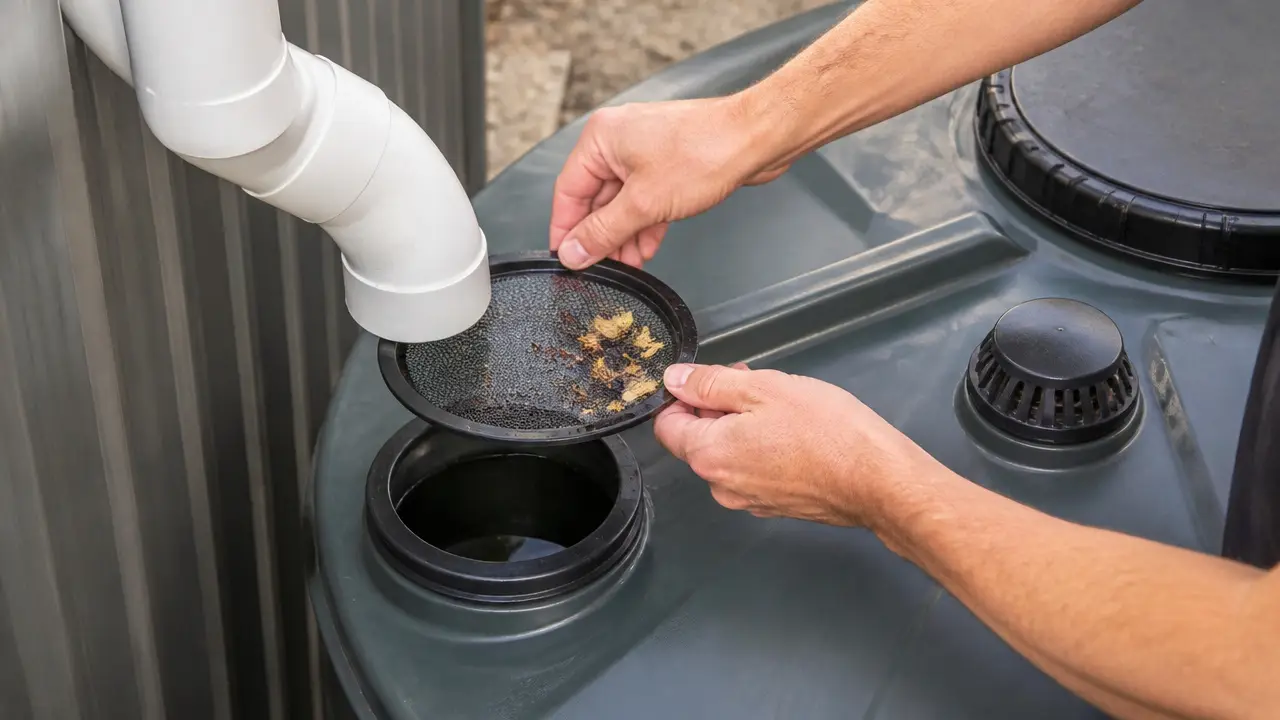
A screen or prefilter near the gutter or tank inlet keeps larger material out of the tank.
This can include:
- Leaves
- Twigs
- Seeds
- Insects
- Roof debris
Keeping this material out reduces sludge buildup and makes tank maintenance easier.
Screens still need cleaning. A clogged screen can cause water to back up or bypass the collection system during heavy rain.
A First-Flush Diverter
A first-flush diverter sends some of the first runoff from a storm away from the tank.
The first water moving across a roof often carries more accumulated dust, debris, animal waste, and other contaminants than later runoff. The CDC recommends considering first-flush diversion as one way to improve collected rainwater quality.
The correct amount to divert depends partly on the roof area and the collection system. A first-flush device is useful, but it does not disinfect water or make rainwater safe to drink.
Covered, Opaque Storage
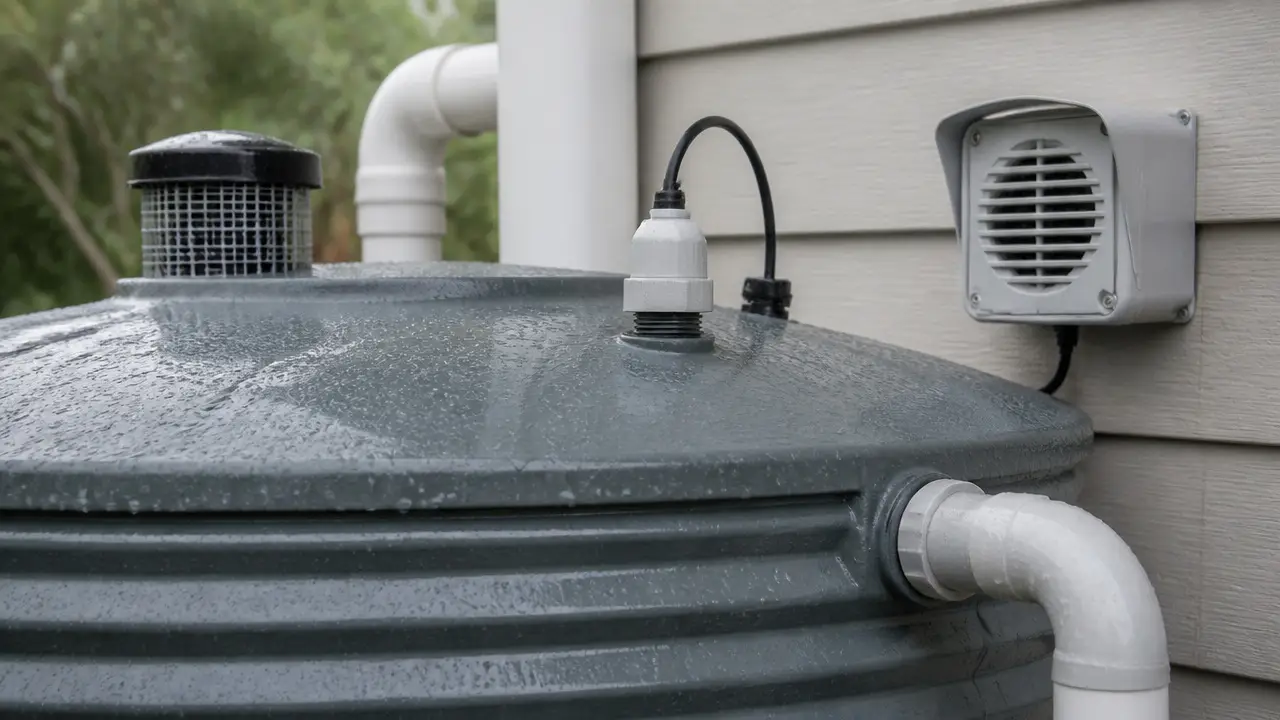
For most permanent systems, an enclosed and opaque rainwater tank or cistern is a better storage choice than an open container.
A good storage tank should:
- Be suitable for storing water
- Block sunlight as much as practical
- Have screened or protected openings
- Keep animals and insects out
- Have a secure cover
- Include a controlled overflow
- Have accessible fittings for inspection and maintenance
Blocking sunlight helps limit algae growth. Protecting openings also reduces insects and debris entering the water.
If the water will be treated for drinking, every material that contacts the water needs more careful consideration.
A Safe Overflow
Once a tank fills, incoming water needs somewhere to go.
The overflow should carry excess water away without:
- Eroding soil around the foundation
- Flooding buildings
- Creating standing water
- Washing out the tank base
- Sending water somewhere prohibited
Overflow openings should also be protected against insects and animals.
Overflow design becomes especially important with large tanks because a major storm can move a lot of water quickly.
Which Rainwater Collection System Is Best for Your Use?
The intended use should drive the system design.
| Intended use | System that usually makes sense |
|---|---|
| Hand-watering a small garden | Rain barrel with screen, overflow, and spigot |
| Larger garden or drip irrigation | Larger tank with screened inlet and gravity outlet or pump |
| Lawn or multiple irrigation zones | Cistern with suitable pump, controls, and filtration |
| Toilet flushing or other indoor non-potable use | Dedicated storage, treatment as required, separate plumbing, pump, and backflow protection |
| Drinking and cooking | Purpose-designed potable system with suitable collection materials, multiple treatment stages, testing, maintenance, and local approval |
Small Gardens: A Rain Barrel May Be Enough
For a small garden near a downspout, a simple rain barrel is often the most practical choice.
A useful setup includes:
- Screened inlet
- Secure lid
- Overflow connection
- Low outlet
- Stable base
Gravity may provide enough flow for filling watering cans or feeding a short hose at low pressure.
A barrel does not create much water pressure. If you want to operate sprinklers or pressure-dependent irrigation equipment, a pump may be needed.
Larger Gardens: Use a Tank or Cistern
For larger irrigation needs, a bigger above-ground or underground tank usually makes more sense.
Larger storage can capture more water between storms, but the tank should still be sized around:
- Roof catchment area
- Local rainfall pattern
- Intended water use
- Space available
- Expected dry periods
- Overflow capacity
Buying the largest tank that fits is not automatically the best approach. A large tank supplied by a small roof may rarely fill. A small tank connected to a large roof may overflow frequently.
Pressurized Irrigation: Add the Right Pump
Gravity pressure depends mainly on the height difference between the water surface and the outlet.
If the tank sits only slightly above the garden, gravity pressure may be too low for sprinklers, long hoses, or some irrigation components.
A pump should be chosen using the system's:
- Required flow rate
- Required pressure
- Vertical lift
- Pipe length
- Pipe diameter
- Power source
Flow rate is how much water the pump can move in a given time.
Head height describes how high a pump can lift water and is also used when estimating the resistance a pump must overcome.
Do not choose a pump by maximum flow alone. A pump's available flow falls as the required head increases.
A pump system may also need dry-run protection so the pump shuts down before an empty tank causes damage.
How Much Rainwater Can You Collect?
Roof area and rainfall determine the theoretical amount available.
For U.S. units:
Gallons = roof area in square feet × rainfall in inches × 0.623
For example, the formula can estimate what falls on the collection area during a storm or over a month.
For metric units:
Liters = roof area in square meters × rainfall in millimeters
These formulas give theoretical yield.
You will normally collect less because of:
- First-flush diversion
- Splashing
- Gutter losses
- Roof wetting
- Leaks
- Overflow
- Debris screens
- Water intentionally left behind or discarded
Use actual rainfall information for your location rather than assuming a generic annual rainfall amount.
Should You Use a First-Flush Diverter?
For most roof-fed tank systems, some form of first-runoff management is worth considering.
It is especially useful where roofs collect:
- Dust
- Leaves
- Bird droppings
- Pollen
- Smoke particles
- Other airborne material between storms
However, a first-flush diverter creates another maintenance point. It needs to drain, reset, or be emptied as its design requires.
A neglected diverter can clog and stop working properly.
It should be treated as a pre-cleaning step, not as a substitute for filtration, disinfection, or water testing.
Do You Need Filters?
That depends on the use.
For garden irrigation, the main goal may simply be keeping leaves and sediment from clogging valves, pumps, or irrigation emitters.
A system could use progressively finer debris control as needed:
Gutter screen → tank inlet filter → pump or irrigation filter
A micron rating describes the approximate size of particles a filter is designed to capture. A smaller micron number means finer filtration.
Finer is not always better. Very fine filters can reduce flow and clog quickly if the incoming water contains a lot of sediment.
Choose filtration based on what needs protection downstream.
Most importantly, particle filtration alone does not establish that water is safe to drink.
What About Drinking Rainwater?
Drinking-water use requires a different level of system planning.
Potable water means water intended to be safe for drinking and other uses involving human consumption. Non-potable water is water not intended for drinking.
According to the CDC, rainwater is not necessarily safe to drink. It can contain germs and chemicals picked up from the air, roof, gutters, pipes, storage system, and animal waste. The CDC recommends regular testing for appropriate germs and chemicals when collected rainwater is used for drinking, cooking, or bathing.
Reviewing efficient rainwater collection methods helps verify this decision in the broader rainwater layout.
A drinking-water rainwater system should therefore be treated as a whole system rather than as a tank with one filter attached.
It may require:
- Suitable roof and collection materials
- Good roof and gutter maintenance
- Debris screening
- First-flush management
- Suitable storage
- Sediment control
- Treatment designed for identified contaminants
- Disinfection where appropriate
- Current laboratory water testing
- Scheduled replacement and cleaning of treatment components
- Protection against cross-connections with other plumbing
- Compliance with applicable local health and plumbing requirements
No single sediment filter, carbon filter, UV unit, purifier, test strip, meter, or other device should be assumed to make untreated roof runoff safe to drink by itself.
If drinking-water use is planned, involve your local health authority and qualified water-treatment or plumbing professionals where appropriate.
Above-Ground vs. Underground Tanks
Both can work well.
Above-Ground Tanks
Above-ground storage is usually easier to inspect and service.
Advantages include:
- Easier access to fittings
- Easier leak detection
- Simpler plumbing
- No excavation
The tank needs a stable base and protection against conditions such as freezing, excessive heat, impact, or movement where relevant.
Water is heavy. Do not place large tanks on decks, platforms, roofs, or other structures unless the structure is designed for the load.
Underground Cisterns
Underground tanks can save surface space and may provide better protection from sunlight and temperature swings.
However, installation is much more involved.
Excavation can involve:
- Buried utilities
- Soil stability
- Groundwater
- Tank buoyancy
- Drainage
- Vehicle loads
- Structural requirements
Use a tank specifically designed for underground installation. Do not bury an above-ground tank unless its manufacturer specifically permits it.
Entering a cistern can also create confined-space hazards. Tank cleaning should normally be performed from outside unless safe professional procedures are in place.
Gravity-Fed or Pumped?
Gravity is the simplest option when it provides enough pressure.
Raising the tank increases available pressure, but large elevated tanks create serious structural loads. Elevating a tank should not be used as a casual way to obtain household-level pressure.
A pump is generally the better approach where dependable pressure is needed for:
- Long garden lines
- Sprinklers
- Multiple irrigation zones
- Elevated delivery points
- Indoor non-potable fixtures
Match the pump to the required pressure and flow rather than simply buying the largest pump available.
Connections Matter More Than They Look
Many rainwater systems become frustrating because individual parts do not fit together.
Check the size and type of:
- Tank inlet
- Tank outlet
- Overflow
- Pump inlet
- Pump discharge
- Hose fittings
- Irrigation pipe
- Filters
- Valves
A bulkhead fitting is a fitting that passes through the wall of a tank and creates a sealed connection for a pipe, valve, or outlet.
Avoid relying on stacks of reducers and adapters when a simpler matching connection is available. Extra joints create more places for restrictions and leaks.
Plan for Cleaning Before You Build
A good system is one you can maintain.
Before choosing a tank location, think about how you will:
- Reach gutter screens
- Clean inlet filters
- Service a first-flush diverter
- Inspect tank openings
- Remove accumulated sediment
- Reach valves
- Service the pump
- Replace filters
- Drain or winterize equipment if needed
A tank hidden behind landscaping may look tidy at first but become difficult to maintain later.
Rainwater Collection in Freezing Climates
Freezing conditions change the design.
Water trapped inside exposed pipes, pumps, filters, valves, and fittings can freeze and expand.
Depending on the system, winter preparation may involve draining or isolating vulnerable components and following equipment-specific freeze-protection instructions.
Do not assume that a large tank protects every connected component. Small pipes and pump housings can freeze even when the main storage tank has not frozen solid.
Buried systems need appropriate local frost-depth and installation guidance.
Common Rainwater Collection Mistakes
Choosing the Tank Before Deciding How the Water Will Be Used
Start with demand and intended use. Then size the collection and storage system.
Sending Dirty Roof Runoff Straight Into Storage
Screens and appropriate prefiltration can greatly reduce the material that settles inside a tank.
Forgetting About Overflow
Every tank will eventually overflow if rainfall continues after it fills.
Plan the overflow before the tank is installed.
Expecting Gravity to Run Pressure-Dependent Equipment
A ground-level rain tank may provide water flow but very little usable pressure.
Installing Filters That Are Too Fine
Unnecessarily fine filters can clog quickly and restrict flow.
Ignoring Pump Dry-Run Protection
Pumps that continue running when the tank is empty can be damaged.
Treating One Filter as a Drinking-Water Solution
Rainwater quality involves microbial, chemical, and physical contamination. Drinking-water treatment needs to address the actual risks in the complete system.
Making the Tank Hard to Maintain
Access to screens, fittings, filters, pumps, and tank openings matters throughout the life of the system.
So, What Is the Best Setup?
For a typical homeowner collecting roof runoff for garden use, a strong general-purpose system is:
Roof gutters → leaf screen → first-flush or suitable prefilter → covered opaque tank → screened overflow → accessible outlet → irrigation filter or pump if needed
It is simple enough to maintain while controlling the main sources of debris.
For a very small garden, a screened rain barrel may be all that is needed.
For larger irrigation systems, use larger storage and add a properly sized pump if gravity cannot provide the required flow and pressure.
For indoor use, keep harvested rainwater plumbing appropriately separated from drinking-water plumbing and follow applicable local requirements.
For drinking water, move beyond a basic collection system. Use suitable collection materials, multiple treatment barriers, current laboratory testing, regular maintenance, and professional or local health guidance.
As of August 31, 2026, rainwater collection and reuse requirements still vary by location and intended use. Check current local building, plumbing, environmental, and public-health requirements before installing indoor connections or a potable rainwater system. The CDC likewise recommends checking applicable state and local resources.
Frequently Asked Questions
What is the simplest rainwater collection system?
A screened rain barrel connected to a downspout is one of the simplest systems for garden use. It should have a secure lid, protected inlet, controlled overflow, stable base, and accessible outlet.
Is a rain barrel or a rainwater tank better?
A rain barrel is usually better for small amounts of garden water. A larger tank is better when you have a larger roof, higher water demand, longer dry periods, or irrigation that needs more stored water.
Do I need a pump for a rainwater collection system?
Not always. Gravity can work for filling watering cans and some low-pressure irrigation. A pump is useful when you need more pressure, longer delivery distances, sprinklers, several irrigation zones, or water delivered uphill.
Does a rainwater tank need a filter?
Some form of debris control is useful for most systems. The amount of filtration needed depends on how the water will be used and what equipment is downstream. Garden systems may only need screening and irrigation filtration, while indoor or potable systems can require much more treatment.
Can I drink water from a rainwater collection system?
Do not assume collected rainwater is safe to drink. Drinking-water systems require suitable collection materials, appropriate treatment, current laboratory testing, maintenance, and compliance with local requirements. A single filter or purifier does not provide a complete safety assessment.
How large should my rainwater tank be?
Size the tank using your roof area, local rainfall pattern, intended water use, available space, and expected time between useful rain events. The theoretical collection amount in U.S. units is roof area in square feet multiplied by rainfall in inches multiplied by 0.623 gallons.
Should a rainwater tank be above or below ground?
Either can work. Above-ground tanks are usually easier to install, inspect, and maintain. Underground cisterns save surface space but require suitable tanks, careful excavation, drainage planning, and more complex installation.
Do I need a first-flush diverter?
It is often useful for roof-fed systems because it diverts some of the initial runoff that can carry accumulated roof contamination. It can improve incoming water quality, but it does not make collected rainwater safe to drink.