As an affiliate, we may earn a commission from qualifying purchases. We get commissions for purchases made through links on this website from Amazon and other third parties.
For most homes, the best rain catchment system is a roof-fed system with screened gutters, an opaque storage tank, controlled overflow, an accessible drain, and either gravity flow or a properly sized pump. The right storage size depends on your roof area, rainfall pattern, available space, and how you plan to use the water.
A small rain barrel can be the best choice for a few garden beds. A larger above-ground cistern is usually better when you want dependable irrigation water. Underground tanks make sense when storage needs are large but yard space is limited. Systems that supply indoor plumbing or drinking water require much more planning, treatment, testing, and maintenance.
The Best Rain Catchment Systems by Use
| System type | Best for | Main advantage | Main limitation |
|---|---|---|---|
| Single rain barrel | Small gardens and containers | Simple setup | Limited storage |
| Linked rain barrels | Several garden areas | Easy to expand | More connections to maintain |
| Above-ground cistern | Large gardens and regular outdoor use | High capacity and easy access | Requires suitable space and support |
| IBC tote system | Larger DIY non-potable storage | Large volume in a compact footprint | Container history and sunlight protection matter |
| Underground cistern | Large storage with limited surface space | Keeps the tank out of the way | Excavation and installation are more complex |
| Pump-fed cistern system | Sprinklers, long hoses, larger irrigation systems | Better pressure and flow | Requires power and pump protection |
| Treated household system | Selected indoor uses | Can supply more household demands | Treatment, plumbing, testing, and regulations become much more important |
Best Simple System: A Rain Barrel
A rain barrel is usually the best starting point if you only want water for a few plants, raised beds, or other small outdoor jobs.
A basic system includes:
- A downspout or rain-chain collection point
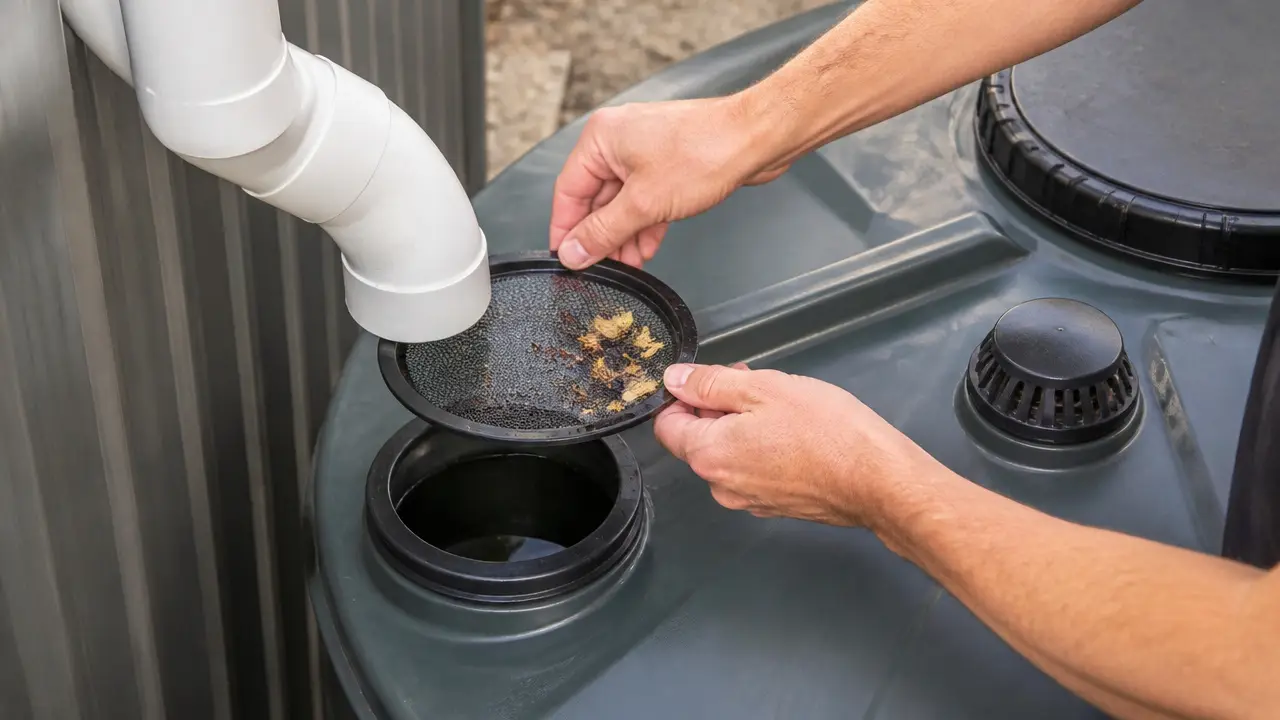
- A debris screen
- A covered barrel
- An overflow outlet
- A spigot near the bottom
- A stable, level base
The inlet should be screened so leaves, insects, and larger debris cannot easily enter. The lid should close securely, and the overflow should carry excess water away from foundations.
Rain barrels work especially well when you use the water between storms. Their main weakness is capacity. A typical roof can produce far more water during one storm than a small barrel can hold.
Best Expandable System: Linked Rain Barrels
Two or more barrels can be connected when one barrel is not enough but a large cistern is unnecessary.
The barrels can be connected near the top so one fills before water enters the next, or they can be connected lower down so water levels balance between containers.
Lower connections need dependable fittings. A bulkhead fitting is a fitting that passes through the wall of a tank while creating a watertight connection. It is commonly used for outlets and connecting pipes.
More barrels also mean more possible leak points. Make sure:
- Each container sits on solid support.
- Connecting pipes are large enough for expected flow.
- Overflow has a clear path.
- Every barrel can be drained and cleaned.
- Screens remain accessible.
A row of barrels can work well for a garden, but once a system becomes complicated, one larger tank may be easier to maintain.
Best All-Around Choice: An Above-Ground Cistern
For homeowners who expect to use rainwater regularly, an above-ground cistern is often the most practical catchment system.
Cisterns are simply larger storage tanks. They can supply garden irrigation, washing, and other appropriate non-potable uses. Non-potable means the water is not intended for drinking.
Compared with a group of small barrels, one cistern gives you fewer tank-to-tank connections and often makes plumbing easier.
A good system normally has:
- Roof and gutters in suitable condition
- Leaf and debris screening
- Optional first-flush management
- A screened tank inlet
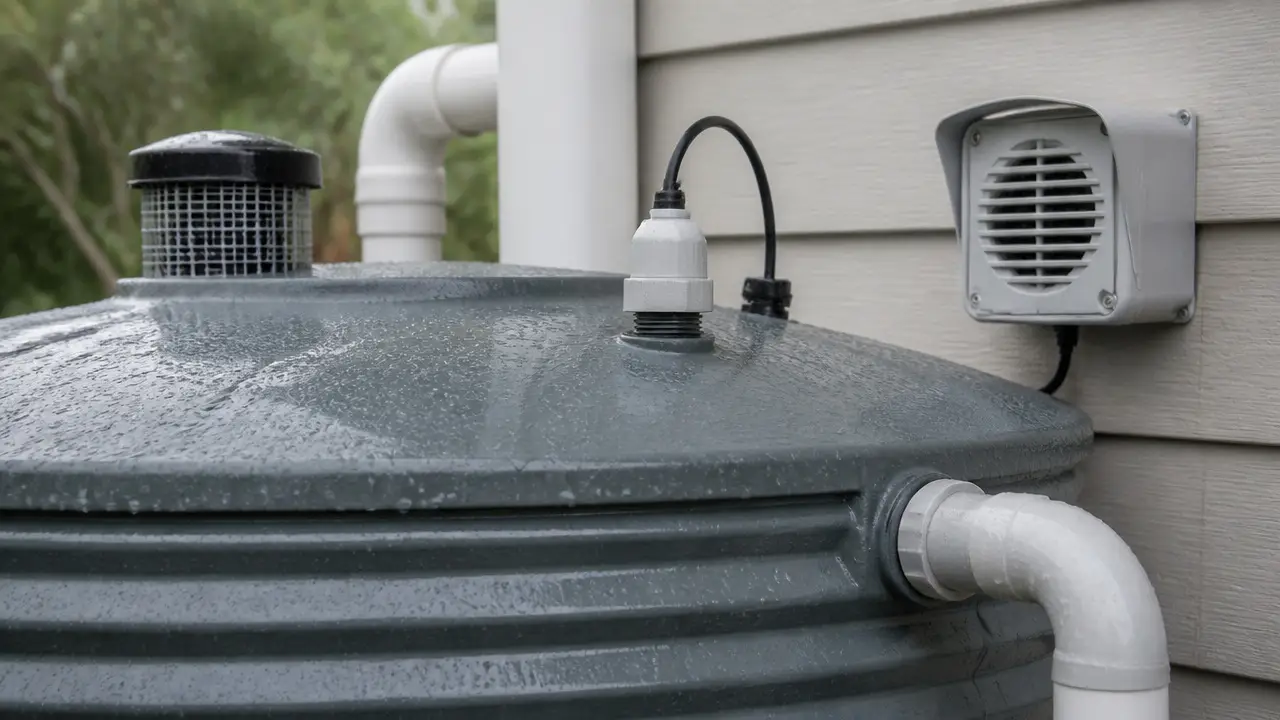
- An opaque, closed storage tank
- A properly placed outlet
- A drain or cleanout
- A screened overflow
- Gravity distribution or a pump
Opaque tanks are useful because blocking sunlight helps discourage algae growth.
The tank also needs a foundation that can safely carry its full weight. Water is heavy. A large tank should not simply be placed on loose soil, an improvised deck, or an uncertain structure.
IBC Totes Can Work, but Container History Matters
An IBC tote can provide useful storage for garden and other non-potable systems. However, not every used tote belongs in a water system.
Do not use a container if you cannot determine what it previously held. Containers that stored chemicals, oils, pesticides, industrial products, or unknown materials should not be repurposed for water that may contact people, animals, or food crops.
Sunlight is another concern. Many IBC containers are translucent, which allows light into the stored water. A suitable opaque cover or enclosure can reduce light exposure while still leaving fittings and inspection points accessible.
Also check that the tote's outlet size matches the plumbing you plan to use. Avoid building a complicated stack of adapters merely to make incompatible fittings connect.
Underground Cisterns Are Best When Space Is Limited
An underground tank can hold a large amount of water without taking up usable yard space.
These systems can be useful where:
- Large storage capacity is needed.
- Above-ground tanks would be difficult to place.
- Appearance is important.
- A pump-fed distribution system is already planned.
However, underground tanks are not simply above-ground tanks buried in soil.
The tank must be designed for burial and the loads around it. Groundwater, soil movement, vehicle loads, buoyancy, pipe penetrations, and excavation safety can all matter.
Large excavations and buried structural installations are a reasonable point to involve an experienced installer or engineer rather than treating the project as a simple barrel installation.
Pump-Fed Systems Are Best When You Need Pressure
Gravity can move water from a tank, but it may not provide enough pressure for long hoses, sprinklers, filters, or some irrigation equipment.
Head height is the vertical distance between the water level and the point where water is delivered. Greater elevation generally produces more gravity pressure.
As a useful rule, one vertical foot of water produces about 0.43 psi of pressure. Raising a barrel only 2 feet therefore provides less than 1 psi before losses in hoses and fittings.
That may be enough for gentle gravity watering but far below what many pressure-dependent devices need.
A pump becomes useful when you need:
- Longer hose runs
- Higher flow
- Sprinklers
- Pressure-regulated drip irrigation
- Water delivered uphill
- Multiple irrigation zones
Flow rate describes how much water moves in a given time, often measured in gallons per minute. A pump needs both enough flow and enough pressure for the intended system.
Do not select a pump by pressure alone. Consider the vertical lift, pipe length, pipe diameter, filters, valves, and irrigation equipment. Dry-run protection is also valuable because some pumps can be damaged if the tank empties while they are running.
How Large Should a Rain Catchment System Be?
Tank size should be based on both how much rain you can collect and how quickly you use it.
For a roof measured in square feet:
Potential gallons = roof area × rainfall in inches × 0.623
For example, a 1,000-square-foot collection area receiving 1 inch of rain has a theoretical yield of:
1,000 × 1 × 0.623 = 623 gallons
That is a theoretical amount. The tank will receive less because water can be lost through splash, gutter overflow, leaks, debris removal, first-flush diversion, and other parts of the system.
You also should not assume that a 1,000-gallon tank is automatically better than a 300-gallon tank. If rainfall is frequent and you use water quickly, a smaller tank may cycle efficiently. If rain comes in short wet seasons followed by long dry periods, greater storage can be more valuable.
Look at:
- Usable roof area
- Local rainfall patterns
- Length of dry periods
- Daily or weekly water demand
- Available tank space
- Overflow location
- Winter conditions
- Your maintenance capacity
What Is a First-Flush Diverter?
A first-flush diverter sends some of the first runoff from a rain event away from the storage tank.
That initial runoff can carry dust, bird droppings, plant material, and other material that accumulated on the roof between rains. CDC notes that first-flush diversion can improve collected rainwater quality, although the amount diverted depends partly on the size of the collection roof.
A first-flush device is not a water purifier. It does not make roof runoff safe to drink.
It also adds another maintenance point. A neglected diverter that stays full, becomes blocked, or collects organic material may not work as intended.
Choose the System Around the Intended Water Use
The best catchment system starts with the question: What will the water be used for?
Garden and Landscape Watering
This is usually the simplest application.
A screened barrel or cistern with an outlet may be enough for basic watering. Add a pump when the irrigation equipment requires more pressure.
For drip systems, consider emitter requirements and filtration. Small particles that easily pass through a hose can clog small drip passages.
Outdoor Cleaning
A larger tank and pump may be useful when you need reasonable hose pressure.
Review watering a garden from a rain barrel to assess tank footprint, connections, and site constraints.
Keep rainwater plumbing clearly separate from drinking-water plumbing.
Toilet Flushing and Other Indoor Non-Potable Uses
Indoor reuse is more complex.
EPA notes that onsite non-potable systems may be used for applications such as toilet flushing, but treatment, monitoring, plumbing, and regulatory requirements depend on the location and intended use.
Cross-connections are especially important. Untreated rainwater must not be allowed to flow backward into drinking-water plumbing.
Check current requirements with your local plumbing, building, environmental, or health authority before connecting harvested rainwater to household plumbing.
Drinking and Cooking
Do not assume roof runoff is drinkable because it looks clear.
Rainwater can collect germs and chemicals from the air, roofing, gutters, pipes, bird droppings, storage materials, and other surfaces. CDC advises regular testing for germs and chemicals when harvested rainwater is used for drinking, cooking, or bathing.
Potable means suitable for drinking.
Making collected rainwater potable is a whole-system job. It can involve suitable collection materials, source protection, prefiltration, correctly selected treatment stages, disinfection, current laboratory testing, and regular maintenance.
One sediment filter, carbon filter, UV unit, purifier, test strip, or water-quality meter cannot by itself establish that roof runoff is safe to drink. Different treatments address different contaminants.
For drinking-water systems, involve the appropriate local health authority and a qualified water-treatment professional.
Features Worth Having in Almost Any System
Regardless of tank size, several design details make a rain catchment system easier to live with.
Accessible Debris Screening
Leaves should be stopped before they enter the tank whenever practical. Screens should also be easy to remove and clean.
A screen that requires roof access every time it clogs is less convenient than one you can safely reach from the ground.
A Closed, Opaque Tank
A closed tank helps keep out animals, insects, debris, and sunlight.
Any vent or overflow opening should be designed so insects cannot easily enter.
Proper Overflow
Every tank eventually fills.
Overflow piping needs enough capacity to carry incoming water away without backing up the inlet. Discharge it somewhere that will not erode soil, flood a building, or send water toward a foundation.
A Low Drain or Cleanout
Sediment can accumulate at the bottom of storage tanks.
Designing the system so the tank can be safely drained and cleaned is much easier than trying to add access later.
Never enter a cistern or other confined tank. Confined-space entry can be deadly and belongs to trained professionals with appropriate equipment.
Compatible Connections
Check pipe sizes before buying fittings.
A system may involve:
- Downspout adapters
- Flexible or rigid pipe
- Tank inlet fittings
- Bulkhead fittings
- Valves
- Hose connections
- Pump fittings
- Overflow piping
Try to keep the system simple. Every extra reducer, adapter, and threaded joint creates another restriction or possible leak point.
Rain Catchment Systems in Freezing Climates
Cold climates change the design.
Water trapped in exposed pipes, valves, filters, pumps, and fittings can freeze and expand. This can crack components even when the main tank survives.
A cold-weather system may need a planned way to:
- Disconnect seasonal equipment
- Drain exposed pipes
- Protect pumps and filters
- Keep low spots from trapping water
- Route winter roof drainage safely
Buried components must also be appropriate for local frost conditions.
Do not assume insulation alone will prevent freezing during prolonged cold weather.
Maintenance Matters More Than System Complexity
A simple system that gets cleaned is usually more useful than an elaborate system that cannot be maintained.
A practical inspection routine includes checking:
- Roof and gutters for unusual debris
- Leaf screens for blockage
- Tank inlet screens
- First-flush components
- Tank lid and vents
- Mosquito screening
- Overflow piping
- Valves and bulkhead fittings
- Pump operation
- Filters
- Sediment buildup
- Freeze damage
- Leaks around pipe connections
CDC specifically recommends keeping rainwater systems clean, repairing damaged parts, and preventing insects from entering storage containers.
So, Which Rain Catchment System Is Best?
For small garden watering, start with a screened rain barrel.
For larger gardens, linked barrels can work, but a single above-ground cistern is often simpler once storage needs grow.
For regular irrigation and hose use, an above-ground cistern with a properly sized pump is usually the most versatile setup.
For large-capacity storage where yard space is limited, consider a purpose-built underground cistern and professional installation.
For indoor non-potable use, plan the collection, treatment, distribution, backflow protection, and local requirements as one system.
For drinking water, treat rainwater harvesting as a water-supply and treatment project rather than simply a tank-and-filter project.
The best system is not necessarily the one with the biggest tank or the most equipment. It is the one that collects enough water for your actual needs, fits the available space, uses compatible parts, manages overflow safely, and is simple enough for you to maintain.
Frequently Asked Questions
What is the best rainwater catchment system for a home?
For many homes, an above-ground cistern connected to screened roof gutters offers a useful balance of capacity, access, and simplicity. Small gardens may only need a rain barrel, while larger irrigation systems may benefit from a cistern and pump.
Is a rain barrel or cistern better?
A rain barrel is better for small water demands and simple installations. A cistern is better when you need larger storage capacity or want to supply several garden areas, a pump, or other non-potable uses.
How much rainwater can I collect from my roof?
One inch of rain falling on 1 square foot of roof represents about 0.623 gallons. Multiply roof collection area in square feet by rainfall in inches and 0.623 to estimate theoretical yield. Actual collection will be lower because of system losses.
Do I need a first-flush diverter?
Not every basic system uses one, but a first-flush diverter can reduce some of the debris and contamination washed from the roof at the beginning of a rain event. It still does not make collected water potable.
Do I need a pump for a rainwater tank?
Not always. Gravity can work for low-pressure watering when the tank is higher than the outlet. A pump may be needed for sprinklers, long hoses, uphill delivery, or equipment that requires specific pressure and flow.
Can I use an IBC tote for rainwater?
An IBC tote can be useful for non-potable rainwater storage when its previous contents are known and appropriate. Avoid containers that held hazardous or unknown substances, and protect translucent tanks from sunlight.
Can you drink water from a rain catchment system?
Roof-collected rainwater should not automatically be considered safe to drink. Drinking-water use requires appropriate collection, treatment, testing, maintenance, and compliance with applicable local requirements. CDC recommends regular testing for germs and chemicals when rainwater is used for drinking.