As an affiliate, we may earn a commission from qualifying purchases. We get commissions for purchases made through links on this website from Amazon and other third parties.
The best water level indicator for most rainwater tanks is a non-contact ultrasonic level sensor if you want an easy-to-read level without putting moving parts into the water. For a simple rain barrel or small above-ground tank, a mechanical float gauge is often the better choice because it needs no power and is easy to maintain.
The right choice depends on the tank shape, where you need to read the level, whether power is available, and how accurate the reading needs to be.
Which Tank Level Indicator Is Best?
There is no single indicator that is best for every tank.
| Type | Best for | Main advantage | Main drawback |
|---|---|---|---|
| Ultrasonic sensor | Cisterns and larger tanks | No contact with water | Needs correct mounting and power |
| Mechanical float gauge | Rain barrels and above-ground tanks | Simple and power-free | Moving parts can stick or wear |
| Pressure level sensor | Deep tanks and remote monitoring | Works well over a wide depth range | Sensor stays in contact with water |
| Sight tube | Simple above-ground tanks | Direct visual reading | Can stain, freeze, leak, or grow algae |
| Float switches | Pump control and alarms | Simple automatic control | Usually shows only specific levels |
| Capacitive or electronic probes | Specialized installations | Few or no moving parts | Tank material and water conditions matter |
For a typical household rainwater tank, an ultrasonic indicator provides the best balance of convenience, low maintenance, and useful level information.
Ultrasonic Water Level Indicators
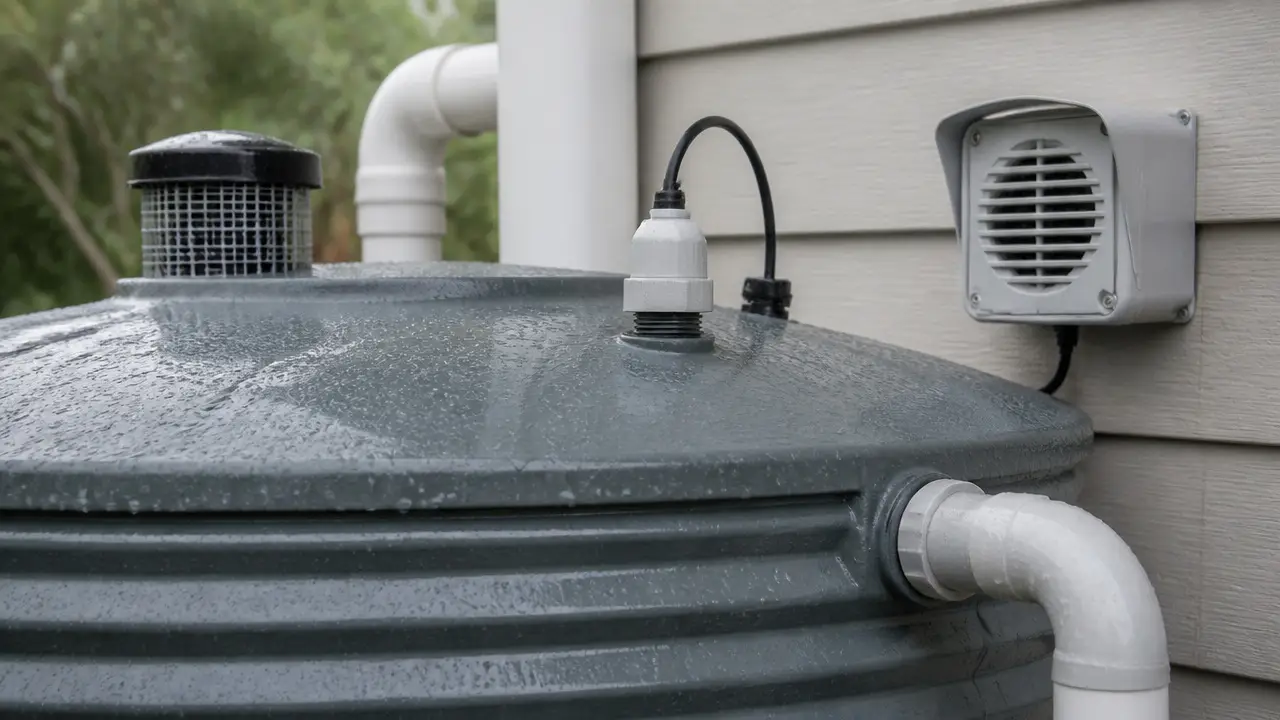
An ultrasonic sensor is mounted above the water.
It sends a sound pulse toward the water surface and measures how long the echo takes to return. The system then converts that distance into a tank level.
Because the sensor normally does not touch the water, there are no floats or probes sitting in the tank.
Ultrasonic indicators work well when you want:
- A percentage or depth reading
- A display inside the house or shed
- Remote monitoring
- High- and low-level warnings
- Minimal equipment in contact with stored water
- Monitoring of a large cistern or rainwater tank
They can be especially useful when the tank is difficult to see into.
Tank shape matters
An ultrasonic sensor measures the distance from the sensor to the water. The controller must know how that distance relates to the amount of water stored.
This is simple with a vertical tank that has straight sides. Half-full depth is roughly half-full volume.
Odd-shaped tanks can be different.
For example, a horizontal cylindrical tank does not lose volume at a constant rate as the water level falls. A controller that supports the correct tank shape can give a more useful percentage reading.
Installation matters too
Ultrasonic sensors need a clear path to the water.
Tank features can interfere with the signal, including:
- Inlet pipes
- Internal braces
- Ladders
- Pumps
- Tank walls
- Floating intake equipment
- Heavy condensation
- Foam or turbulence
The sensor should normally point at an open section of water rather than at plumbing or the side of the tank.
Always follow the sensor manufacturer's required clearance and maximum measuring distance.
Mechanical Float Gauges
A mechanical tank gauge uses a float that rises and falls with the water.
The float is connected to an indicator through a cable, rod, or similar mechanism.
For a small rainwater system, this can be all you need.
Mechanical gauges make sense when:
- The tank is easy to reach
- You only need a rough level
- Electricity is unavailable
- Remote monitoring is unnecessary
- You want a simple system with few electronic parts
They are commonly suitable for above-ground tanks and rain barrels.
Their main weakness is the moving mechanism. Floats can snag, cables can tangle, and dirt or biological growth can interfere with movement.
A mechanical gauge should also be installed so insects and debris cannot enter through the opening around it.
Pressure-Based Tank Level Sensors
A pressure sensor can measure water depth from near the bottom of the tank.
Water creates pressure according to the height of the water above the sensor. The monitoring equipment converts that pressure into a depth or tank level.
These sensors are useful for:
- Deep tanks
- Underground cisterns
- Remote monitoring systems
- Tanks where an ultrasonic sensor cannot get a clear reading
Pressure sensors can provide very stable measurements when properly installed.
However, unlike an ultrasonic sensor, a submerged pressure sensor is in direct contact with the stored water.
For water intended for household use, make sure any wetted materials are suitable for that intended use. Do not add questionable probes, cables, adhesives, or metal parts to a tank simply because they fit.
Sight Tubes
A sight tube is one of the simplest level indicators.
A clear or translucent tube is connected near the bottom of the tank. The water in the tube rises to roughly the same height as the water inside the tank.
That makes the tank level visible from outside.
Sight tubes are inexpensive and easy to understand, but they have drawbacks
Sunlight reaching the water in the tube can encourage biological growth.
Clear tubing can also:
- Become cloudy
- Develop staining
- Be damaged
- Leak at fittings
- Freeze in cold climates
The connection also creates another penetration near the lower part of the tank. A failed fitting there may release a large amount of stored water.
For that reason, a sight tube is not automatically the best choice just because it is simple.
If one is used, protect it from sunlight and physical damage and inspect its fittings regularly.
Float Switches Are Better for Control Than Measurement
A float switch normally does not tell you the exact tank level.
Instead, it changes state when the water reaches a certain point.
For example, a rainwater system might have:
- A low-level switch that shuts off a pump
- A high-level switch that sounds an alarm
- A switch that starts or stops a transfer pump
Float switches are very useful, but they solve a different problem from a continuous level indicator.
If you want to know whether a 5,000-gallon tank is 30%, 60%, or 90% full, a continuous level sensor is usually more useful.
What About Electronic Probe Sensors?
Some level systems use metal probes or electronic sensing rods inside the tank.
These may detect several water levels, such as:
- Empty
- One-quarter
- Half
- Three-quarters
- Full
They can work, but water chemistry affects some electrical sensing methods.
Mineral buildup, corrosion, dirty water, and electrical conductivity can all influence performance depending on the design.
For rainwater storage, a non-contact measurement method often avoids some of these problems.
The Best Indicator for Different Tank Systems
Small rain barrel
A simple mechanical float gauge is usually enough.
You generally do not need precise electronic monitoring for a small barrel that can be checked easily.
Large above-ground rainwater tank
An ultrasonic sensor is often the most practical option.
It can provide a continuous level without putting sensing equipment in the water.
Underground cistern
Either an ultrasonic sensor or a pressure-based sensor can work well.
Which one is better depends on:
- Tank depth
- Access opening
- Internal obstructions
- Condensation
- Cable routing
- Power availability
Check matching level-measurement technology to a storage tank to assess stored volume against consumption and seasonal refill patterns.
Avoid climbing into a cistern to install or service a sensor. Tanks and cisterns can be confined spaces and can present serious hazards.
Remote cabin or off-grid system
Power use becomes more important.
A simple mechanical gauge may be better if someone can inspect the tank directly.
If remote monitoring is important, look for an electronic system designed for the power source available at the site.
Pump-fed household rainwater system
A continuous level sensor combined with a separate low-water protection device can be a good arrangement.
Do not depend only on the level display to protect a pump.
A pump can be damaged if it runs without enough water. A suitable dry-run protection system or correctly installed low-level control provides more dependable automatic protection.
Features Worth Looking For
When comparing tank level indicators, focus on system fit rather than extra display features.
Measuring range
The sensor must be able to measure the full height of your tank.
Also check whether it has a minimum measuring distance. Some sensors cannot accurately measure water that gets very close to the sensor face.
Tank compatibility
Check that the system works with:
- Tank height
- Tank shape
- Tank material
- Tank opening size
- Indoor or outdoor installation
Weather protection
Electronics installed outside need suitable protection from rain, moisture, dust, and the temperatures expected at the site.
Do not assume an outdoor-looking enclosure is weatherproof.
Display location
Think about where you actually want to see the reading.
A display mounted directly on a large outdoor tank may not be very useful if you want to check the water level from the house.
Remote monitoring
Some systems can transmit the tank level to another display or monitoring system.
This can be useful for tanks located far from the house, but wireless range can be affected by walls, terrain, metal structures, and the tank itself.
Alarm outputs
High- and low-level alarms can be useful if the tank supplies irrigation, a pump system, or household non-potable water.
Make sure the indicator actually supports the kind of alarm or control output you need. A display showing "10% remaining" does not automatically shut down a pump.
Accuracy Is Not Always as Important as It Seems
Most homeowners do not need to know whether a rainwater tank contains exactly 2,713 gallons.
You usually need to know things such as:
- Is the tank nearly empty?
- Is there enough water for irrigation?
- Is the tank close to overflowing?
- Is the level falling unusually fast?
- Should I limit water use until the next rainfall?
A reliable approximate reading is often more useful than a complicated system promising extreme precision.
Tank dimensions and shape can also make calculated volume less precise than the displayed number suggests.
Avoid Making Extra Tank Openings Unless Needed
Every hole added to a rainwater tank creates another place that may eventually leak or allow contamination to enter.
Before drilling a tank for a level gauge, check whether an existing inspection opening or fitting can be used.
Never drill into a tank without knowing:
- What the tank is made from
- Whether the location is structurally suitable
- What type of fitting is required
- Whether the manufacturer allows the modification
A bulkhead fitting is a fitting designed to make a sealed connection through the wall of a tank. If a gauge requires one, the fitting and gasket need to match the tank material and wall thickness.
Consider Freezing Conditions
Cold climates change which indicator works best.
External sight tubes and exposed plumbing can freeze.
Ice can damage:
- Tubing
- Valves
- Fittings
- Sensors
- Tank penetrations
An ultrasonic sensor mounted above the water may reduce the amount of exposed water-filled equipment, although the sensor itself still needs to operate within its rated temperature range.
Any tank system exposed to freezing weather needs a broader freeze-protection plan. A level indicator alone does not protect the tank or plumbing.
Keep Drinking-Water Systems Conservative
If stored rainwater may eventually be used as drinking water, avoid adding unnecessary materials or openings to the tank.
A tank level indicator does not tell you anything about whether the water is safe to drink.
Water level and water quality are separate issues.
Drinking-water use requires appropriate collection, debris control, treatment, maintenance, testing, and compliance with applicable local requirements.
How to Choose the Right Tank Level Indicator
For most homeowners, the decision can be narrowed down quickly.
Choose a mechanical float gauge when you want the simplest possible indicator and can walk up to the tank to read it.
Choose an ultrasonic level sensor when you want continuous readings, remote viewing, or minimal contact with the stored water.
Choose a pressure sensor when the tank is deep, underground, or difficult for an ultrasonic sensor to measure reliably.
Choose a sight tube only when its simplicity is worth the added external water connection and you can protect it from sunlight, damage, leaks, and freezing.
Use float switches when the main goal is controlling pumps or alarms rather than displaying the exact level.
For a typical medium or large rainwater tank, a properly installed ultrasonic sensor is usually the best all-around choice.
Frequently Asked Questions
What is the most accurate way to measure water level in a tank?
Several properly installed electronic methods can provide good accuracy, including ultrasonic and pressure-based sensors. Actual accuracy depends on the sensor, installation, tank shape, calibration, and operating conditions. For most rainwater systems, repeatable readings are more important than extremely precise volume measurements.
Can an ultrasonic sensor measure through a plastic water tank?
Normally, an ultrasonic tank sensor is mounted so it sends its signal through air toward the water surface. Do not assume it can measure accurately through the tank wall or lid unless the sensor manufacturer specifically says it can.
Do tank level sensors work with IBC totes?
Many types can, but installation can be difficult because an IBC tote has a metal cage, a relatively small top opening, and internal shapes that may interfere with some sensors. A simple external visual check through the translucent container may already provide enough information for some uses.
Can I use a sight tube on a rainwater tank?
Yes, if the tank and fittings are suitable. Protect the tube from sunlight, impact, freezing, and accidental valve opening. Remember that the lower connection creates another possible leak point.
Can a water level indicator turn off my pump?
Some level systems can control a relay or provide an output to a pump controller, but many are display-only devices. Check the control requirements carefully. Pump protection should be designed so the pump cannot continue running dry if the display or monitoring system is ignored.
Do I need a level indicator on a rainwater tank?
Not always. A small tank that is easy to inspect may not need one. Level indicators become more useful when the tank is large, opaque, underground, remotely located, or connected to equipment that depends on maintaining a minimum water level.
Is a float gauge better than an ultrasonic sensor?
A float gauge is better when simplicity, low cost of operation, and no electrical power are priorities. An ultrasonic sensor is usually better when you want remote readings, continuous measurement, or fewer moving parts in the water.