As an affiliate, we may earn a commission from qualifying purchases. We get commissions for purchases made through links on this website from Amazon and other third parties.
What Is the Best Water Tank Monitor?
The best water tank monitor for most home rainwater systems is a non-contact level monitor that can show the tank level as a percentage and send a low-water alert.
For a typical above-ground rainwater tank, an ultrasonic monitor is often the best starting point. It measures the distance from the top of the tank to the water without putting a sensor in the water.
But ultrasonic is not best for every tank. A pressure-based sensor can work better when the tank has condensation, a difficult lid, internal pipes, or other conditions that interfere with an ultrasonic signal.
The right choice depends on your tank, how you use the water, and how much information you actually need.
The Main Types of Water Tank Monitors
Most tank monitoring systems use one of several basic methods.
| Monitor type | Best suited for | Main limitation |
|---|---|---|
| Ultrasonic | Most above-ground rainwater tanks | Can be affected by condensation and obstructions |
| Pressure sensor | Tanks where top-mounted sensing is difficult | Sensor contacts the stored water |
| Float sensor | Simple full, empty, or low-level indication | Usually gives limited level information |
| Radar | Difficult tanks and demanding installations | Often more complex than a home system needs |
| Sight tube | Simple tanks you can inspect directly | No remote alerts or automatic reporting |
Understanding these differences is more useful than choosing a monitor by the number of features it has.
Ultrasonic Monitors Are a Good Choice for Most Rainwater Tanks
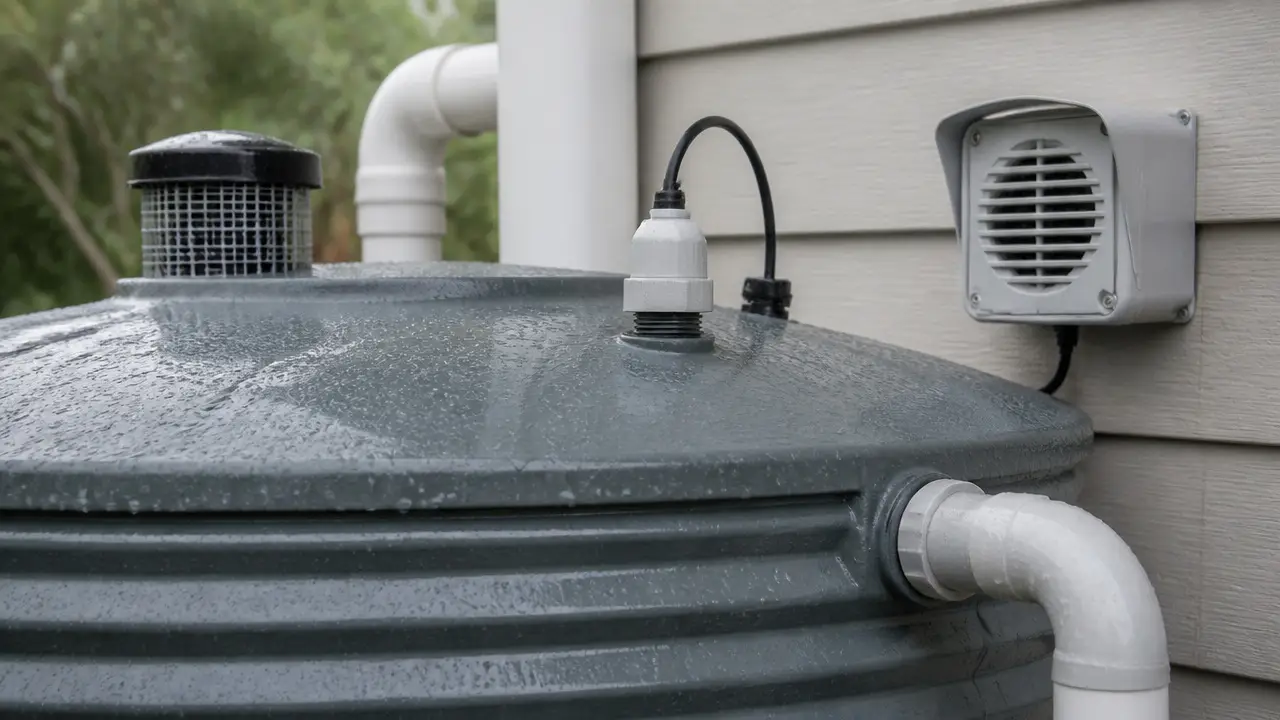
An ultrasonic monitor normally mounts at the top of the tank.
It sends a sound pulse toward the water. The monitor measures how long the pulse takes to return and uses that distance to estimate the water level.
The sensor does not normally need to touch the water.
This makes ultrasonic monitoring useful for:
- Rainwater tanks beside a house
- Above-ground cisterns
- Large garden tanks
- IBC tote systems
- Tanks supplying toilets, irrigation, or other non-potable uses
Non-potable means water that is not intended for drinking.
A useful ultrasonic system should let you enter the tank's dimensions or usable height. It should then display something easy to understand, such as percentage full or estimated water remaining.
When Ultrasonic Monitoring Can Have Problems
Ultrasonic sensors need a reasonably clear path to the water.
Readings may become unreliable if the sensor is directly above:
- An inlet pipe
- A floating intake
- A brace inside the tank
- A ladder
- Heavy turbulence
- Foam
- An uneven internal surface
Condensation on or around the sensor can also cause problems with some designs.
The sensor also has a minimum measuring distance. If the water rises too close to it, the monitor may not be able to measure correctly.
Check these limits before drilling a mounting hole.
When a Pressure Sensor Is Better
A pressure-based tank monitor measures the pressure created by the depth of water above the sensor.
It is usually installed near the bottom of the tank or suspended in the water.
For a simple vertical tank, deeper water creates more pressure. The system converts that pressure into a level reading.
Pressure monitoring can be a better option when an ultrasonic sensor does not have a good mounting location.
It can also work well in tanks with:
- Internal obstructions
- Condensation near the roof
- Complicated lids
- Narrow top openings
- Irregular conditions above the water
The important difference is that the pressure sensor normally contacts the stored water.
If the water may eventually be used for drinking, every wetted part needs to be suitable for that intended use. A tank monitor alone does not make rainwater safe to drink.
Float Sensors Are Best for Simple Level Alerts
A float switch can be a better choice if you do not need to know whether the tank is 42%, 58%, or 76% full.
A float simply changes position as the water rises or falls.
It can be used to signal conditions such as:
- Tank almost empty
- Pump shutoff level reached
- Tank full
- High-water warning
Float switches are especially useful as controls rather than detailed monitors.
For example, a low-level float can help stop a pump from running when there is not enough water available.
This is called dry-run protection. Running some pumps without water can damage them.
A float switch and a tank monitor can also serve different jobs in the same system. One can provide the level display while the other protects the pump.
What About Radar Tank Monitors?
Radar level sensors work on a similar basic idea to ultrasonic sensors, but they use radio waves instead of sound.
Radar can handle some difficult measurement conditions better than ultrasonic technology.
It may be useful where there is:
- Heavy condensation
- Vapor
- Difficult tank geometry
- A need for more dependable industrial-style measurement
For a normal backyard rainwater tank, however, radar may add complexity without solving a problem you actually have.
Choose the simplest measuring method that works reliably in your tank.
What Features Matter Most?
A long feature list does not automatically make a better water tank monitor.
For most homeowners, a few features matter much more than the rest.
Clear Tank-Level Reading
The monitor should give you information you can use.
A percentage reading is usually easier to understand than a raw sensor measurement.
Some systems can also estimate gallons or liters remaining. That calculation is only useful when the tank dimensions have been entered correctly.
Low-Level Alerts
An alert can be valuable if the tank supplies:
- A household pump
- Toilets
- Irrigation
- Animals
- A cabin
- Another regular water use
The warning gives you time to reduce water use or switch to another supply before the tank reaches the pump intake.
Reliable Communication
Remote monitors may send information using Wi-Fi, Bluetooth, radio, cellular service, or another wireless method.
Think about where the tank is located.
A Wi-Fi monitor is less useful if your home network barely reaches the tank. A system designed for longer-range communication may make more sense for a remote cistern.
Do not assume the advertised communication range will match your property. Walls, metal tanks, terrain, and other obstacles can reduce wireless range.
Local Display
An app is useful, but a simple display inside the house can also be valuable.
It lets you check the tank without depending on:
- Internet service
- A phone
- An online account
- A cloud service
For a basic rainwater system, simplicity can be an advantage.
Adjustable Alerts
Look for a system that lets you choose the low-water threshold.
A household using a pump may want an alert well before the tank reaches empty. That leaves a reserve and reduces the chance that the pump will lose its water supply.
Power Source
Tank monitors may use replaceable batteries, rechargeable batteries, mains power, or solar power.
Consider access before choosing.
Changing a battery once in a while may be easy on a tank beside the garage. It is much less convenient if the sensor is high above the ground or on a remote cistern.
Do not make routine sensor maintenance depend on unsafe roof or ladder access.
Match the Monitor to the Tank Shape
Use household water-level monitoring by sensor type to evaluate airflow and overflow provisions around the storage vessel.
Tank dimensions matter.
A level sensor directly measures water height, not necessarily the amount of water remaining.
With a straight-sided vertical tank, the relationship is simple. Half the usable water depth is close to half the usable tank volume.
That is not always true for tanks with:
- Rounded bottoms
- Sloped sides
- Horizontal cylindrical shapes
- Irregular underground designs
A monitor that calculates volume should support the tank shape you have.
Otherwise, treat the percentage as a level percentage rather than an exact volume measurement.
Check the Tank Before Buying a Monitor
Start by looking at the actual installation.
Measure or confirm:
- Tank height
- Usable water depth
- Tank shape
- Lid or inspection opening size
- Available sensor mounting area
- Maximum water level
- Distance from the tank to the house
Also look inside the tank from a safe position if the design allows it.
You need to know whether pipes, braces, floats, or other equipment are directly below the proposed sensor location.
Do not enter a water tank or cistern to install or inspect a monitor. Tanks can be confined spaces with serious hazards.
Think About the Tank Material
Plastic rainwater tanks are generally easy to work with, but mounting still needs care.
Metal tanks can create extra problems for wireless systems because metal can block or weaken radio signals.
Concrete cisterns may also make wireless communication harder depending on where the transmitter is installed.
If your monitor communicates wirelessly, the transmitter's location can be just as important as the level sensor.
Installation Matters as Much as the Sensor
A good sensor installed badly can give poor readings.
For a top-mounted ultrasonic monitor, the sensor normally needs to point straight at an open section of water.
Avoid placing it directly over the inlet.
Water entering during rain can create splashing and turbulence that interfere with measurements.
The mounting point should also stay above the tank's highest normal water level while remaining within the sensor's measuring range.
Follow the monitor manufacturer's required clearances rather than assuming one mounting distance works for every sensor.
Should a Tank Monitor Control the Pump?
A water-level monitor can be useful alongside a pump, but do not automatically depend on a general-purpose monitor as the only pump protection device.
Pump systems may need dedicated protection against:
- Dry running
- Excessive cycling
- Loss of pressure
- Electrical faults
A separate low-level float switch or purpose-built pump controller may provide more direct protection.
If the monitor has a relay output for pump control, confirm that its electrical rating and control method match the pump system.
Do not connect a pump motor directly to a small sensor relay unless the equipment is specifically designed for that load.
Mains-voltage pump wiring should be handled according to the equipment instructions and applicable electrical requirements.
How Accurate Does a Home Tank Monitor Need to Be?
Most homeowners do not need laboratory-level precision.
The practical questions are usually:
- Is the tank nearly full?
- Is there enough water for normal use?
- Is the level falling unusually fast?
- Should I reduce irrigation?
- Is the tank getting close to the pump's minimum level?
A stable reading that reliably shows these changes can be more useful than a system that claims very fine measurement but performs poorly in your tank.
Small changes in readings can also happen because of water movement or sensor conditions.
Look for useful trends rather than treating every displayed number as an exact measurement.
Tank Monitoring Does Not Measure Water Quality
A level monitor tells you how much water is in the tank.
It does not tell you whether that water is safe to drink.
It cannot determine whether the water contains harmful:
- Bacteria
- Parasites
- Chemicals
- Metals
- Contaminants from the roof or gutters
Even a monitor with temperature or other extra sensors does not replace proper water-quality testing.
If rainwater is intended for drinking, safety depends on the whole system. That includes suitable collection surfaces, debris control, first-flush management where appropriate, treatment, maintenance, and current laboratory testing based on the intended use and applicable requirements.
A first flush system diverts some of the first roof runoff from a rainfall event so that part of the dirt and debris washed from the roof does not enter storage.
Maintenance Is Easy to Forget
Tank monitoring equipment still needs checking.
A few times each year, compare the displayed level with what you can reasonably observe from the tank.
You should also check for:
- Loose sensors
- Damaged cables
- Low batteries
- Dirt or insects around the sensor
- Condensation problems
- Changes in wireless connection
- Incorrect readings after tank cleaning or maintenance
If readings suddenly become unrealistic, inspect the installation before assuming the water level has actually changed.
Sensors can shift or become obstructed.
Which Water Tank Monitor Should You Choose?
For a standard home rainwater tank, start with a top-mounted ultrasonic monitor with percentage display and adjustable low-level alerts.
Choose a pressure-based monitor when the tank layout makes ultrasonic measurement unreliable.
Choose a float switch or simple level indicator when you only need basic full, low, or empty information.
Consider radar when the tank environment is difficult enough that simpler sensing methods are not dependable.
The best monitor is not the one that collects the most data. It is the one that can reliably measure your particular tank and give you information you can actually use.
Frequently Asked Questions
Can I monitor a rainwater tank from inside my house?
Yes. Many tank monitors use a wireless transmitter to send the level to an indoor display or app. Check the communication method and expected range because walls, metal tanks, terrain, and distance can affect the signal.
Is an ultrasonic or pressure tank sensor better?
Ultrasonic is a good first choice for many above-ground rainwater tanks because the sensor does not normally touch the water. Pressure sensors can be better where condensation, tank shape, or internal obstructions make ultrasonic readings unreliable.
Can I use a water tank monitor on an IBC tote?
Often, yes. Make sure the sensor's measuring range works with the relatively shallow tote and that there is a suitable mounting location. Internal braces and the small distance between the sensor and maximum water level can make some ultrasonic sensors unsuitable.
Can a tank monitor stop my pump when the water is low?
Some monitoring systems can operate a relay or control signal, but compatibility must be checked carefully. A dedicated low-level float switch or pump controller may be a simpler way to provide dry-run protection.
Will a tank monitor tell me how many gallons are left?
Some will. The monitor needs the correct tank dimensions and must account for tank shape. A level percentage does not always equal the same percentage of tank volume in tanks with curved or irregular shapes.
Do tank level sensors need cleaning?
Sometimes. Ultrasonic sensors can collect dust, insects, or condensation around the sensing area. Submerged sensors may also develop deposits over time. Follow the manufacturer's inspection and cleaning instructions.
Does a water tank monitor test whether rainwater is safe to drink?
No. A level monitor measures the amount of water in the tank, not its drinking-water safety. Potable rainwater requires a suitable whole-system approach to collection, treatment, maintenance, and water-quality testing.