As an affiliate, we may earn a commission from qualifying purchases. We get commissions for purchases made through links on this website from Amazon and other third parties.
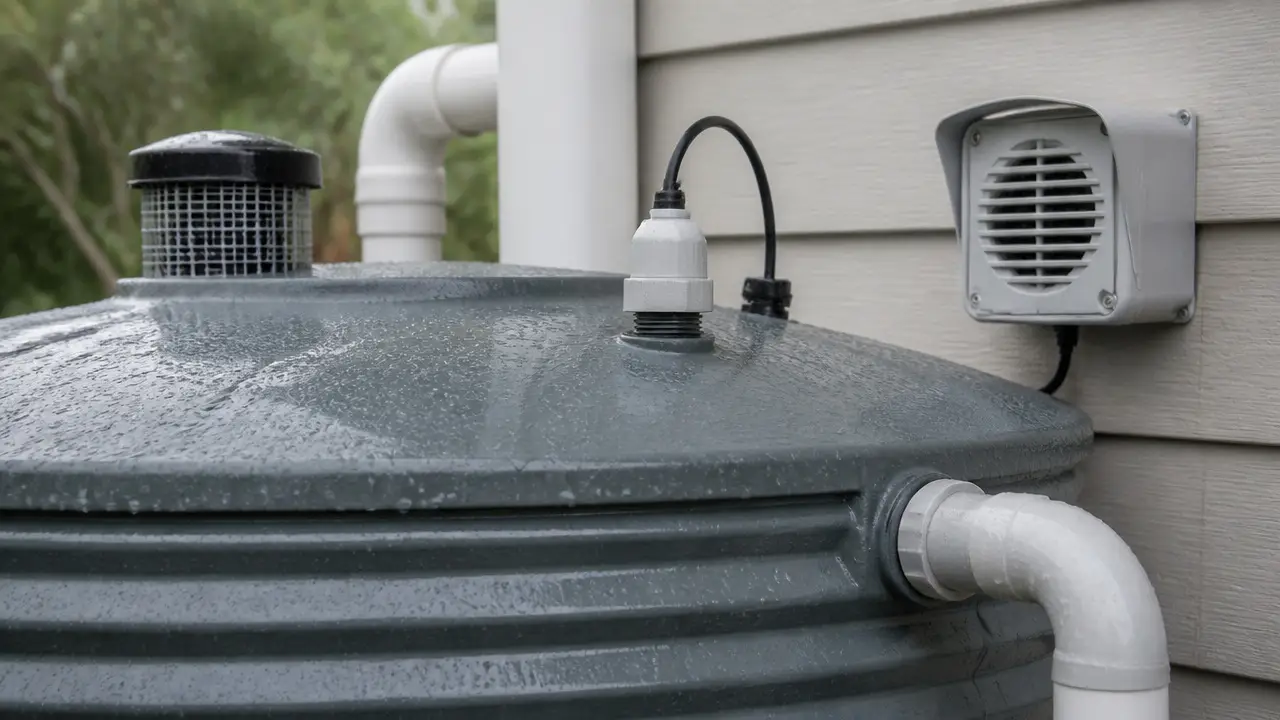
Tank level sensors tell you how much water is inside a rain barrel, IBC tote, cistern, or other storage tank. Some only tell you when the water reaches a certain point. Others give a continuous reading from empty to full.
The main types of tank level sensors are float sensors, pressure sensors, ultrasonic sensors, radar sensors, capacitive sensors, conductive sensors, optical sensors, and weight-based sensors. The best choice depends on the tank shape, water quality, access, power supply, and whether you need a simple high/low alarm or a full level reading.
Point-Level Sensors vs. Continuous Level Sensors
Before comparing sensor types, it helps to separate them into two groups.
Point-level sensors
A point-level sensor detects whether water has reached one specific height.
For example, you might install one sensor near the bottom of a cistern to stop a pump before the tank runs dry. Another sensor near the top could trigger a high-water alarm.
Point sensors are useful for:
- Low-water pump protection
- High-level alarms
- Automatic filling controls
- Overflow warnings
- Simple full-or-empty indicators
They usually do not tell you how much water is between those points.
Continuous level sensors
A continuous sensor measures the water level across most or all of the tank.
Depending on the system, the reading may be shown as:
- Water depth
- Percentage full
- Gallons or liters
- Distance from the sensor to the water
- An electrical signal sent to a controller
Continuous sensors are more useful when you want to track water use or know how much storage remains.
Float Level Sensors
Float sensors are among the simplest ways to detect water level.
A float rests on or near the water surface. As the level rises or falls, the float moves.
There are several versions.
Float switches
A float switch changes electrical state when the water reaches a set height.
These are commonly used for:
- Low-water shutoff
- High-water alarms
- Pump controls
- Automatic tank filling
A float switch is normally a point-level device rather than a full tank gauge.
Vertical float sensors
These use a float that slides up and down a vertical stem. Magnets or switches inside the stem detect its position.
Some provide only one switching point. Others can detect several levels.
Cable float switches
A cable float hangs inside the tank and tilts as the water rises or falls.
These are common in larger tanks and sumps, but they need enough open space to move without hitting the tank wall, pipework, or other equipment.
Mechanical float gauges
Some tank gauges use a float connected to a dial or indicator. They may work without electricity.
They can be useful when you only need a simple local reading.
Advantages
Float sensors are usually simple and easy to understand. Many work well with clean or moderately dirty stored water.
Limitations
Moving parts can become stuck because of:
- Sediment
- Biofilm
- Roots or debris
- Tank fittings
- Internal pipes
- Ice in freezing conditions
A float also needs room to move freely.
Hydrostatic Pressure Sensors
A hydrostatic sensor estimates water depth by measuring the pressure created by the water above it.
The deeper the water, the greater the pressure.
These sensors are often installed near the bottom of a cistern or suspended into the tank.
Because water pressure is related to depth, a controller can convert the pressure reading into a level measurement.
Where they work well
Pressure sensors can be useful in:
- Deep cisterns
- Buried tanks
- Tanks where the top is difficult to access
- Systems that need continuous monitoring
They do not need a clear line of sight to the water surface.
What to watch for
Sediment can collect around a sensor at the bottom of a rainwater tank. The sensor also needs to be compatible with the water and the expected pressure range.
Vented pressure sensors may use a cable that allows atmospheric pressure compensation. That vent must stay dry and protected according to the manufacturer's instructions.
Tank shape also matters if the display converts depth into gallons. A depth reading does not automatically equal a certain volume unless the tank dimensions are known.
Ultrasonic Level Sensors
Ultrasonic sensors usually sit above the water.
They send a sound pulse toward the surface and measure how long the echo takes to return. The system uses that distance to calculate the water level.
Because the sensor does not normally touch the water, ultrasonic sensing can be attractive for rainwater tanks.
Advantages
Ultrasonic sensors have:
- No float moving through the water
- Little direct contact with stored water
- Continuous level measurement
- Easy access when mounted at the tank top
Limitations
The sound path between the sensor and water must stay reasonably clear.
Readings may be affected by:
- Pipes
- Tank braces
- Ladders
- Uneven internal surfaces
- Heavy condensation
- Foam
- Turbulent water
- An installation too close to the tank wall
The sensor also needs enough distance between itself and the highest water level. Many sensors have a short area directly below them where accurate readings are difficult. Check the required measurement range before choosing one.
Radar Level Sensors
Radar sensors work somewhat like ultrasonic sensors, but they use radio waves instead of sound.
They measure the distance between a sensor above the tank and the water surface.
Radar systems can provide continuous readings without placing a sensor in the water.
Advantages
Radar can be less affected than ultrasonic sensing by some changes in air temperature, humidity, condensation, or vapor.
It can work well in demanding installations where reliable non-contact measurement is important.
Limitations
Tank geometry still matters. Internal structures can create unwanted reflections.
The sensor must also be installed within its specified measuring range and aimed correctly.
For a simple rain barrel, radar may offer more capability than needed. It becomes more useful in larger or more automated storage systems.
Capacitive Level Sensors
Capacitive sensors detect changes in electrical capacitance caused by the presence of water.
Capacitance is the ability of two conductive surfaces to store a small electrical charge. Water changes the electrical properties around the sensing area, allowing the sensor to detect its presence or estimate level.
Some capacitive sensors touch the water. Others can detect water through the wall of certain nonmetal tanks.
Common uses
Capacitive sensing can be used for:
- Point-level detection
- Multiple level points
- Continuous measurement
- External sensing on some plastic tanks
Advantages
Some versions have no moving parts.
External sensors can also avoid drilling into a compatible tank wall.
Limitations
Performance depends heavily on:
- Tank wall material
- Wall thickness
- Sensor calibration
- Water properties
- Moisture outside the tank
A sensor designed to read through plastic may not work through metal or very thick walls.
Do not assume every capacitive sensor can be mounted externally.
Conductive Level Sensors
Conductive sensors use water's ability to conduct electricity.
Usually, two or more electrodes are installed at different heights. When water touches the electrodes, it completes a small electrical sensing circuit.
Rainwater often contains dissolved minerals and other material that allow some electrical conductivity, but conductivity can vary.
Good uses
Conductive sensors are commonly suited to simple point-level detection such as:
- Tank full
- Tank low
- Pump shutoff level
Limitations
Electrodes may become coated with mineral deposits, sediment, or biofilm.
The sensing method also depends on the electrical conductivity of the liquid. Very low-conductivity water may not work reliably with every conductive sensor.
Use equipment designed for water-level sensing rather than putting an improvised electrical circuit into a tank.
Optical Level Sensors
Optical sensors usually detect whether their sensing tip is covered by liquid.
They commonly use infrared light. When the tip is dry, the light behaves one way. When water covers it, the light changes direction, allowing the sensor to detect the liquid.
These are generally point-level sensors.
Advantages
Optical sensors:
- Have no float mechanism
- Can be compact
- Respond quickly
- Can fit into small spaces
Limitations
Account for recommended water level alarms for rainwater tanks and sumps to verify vessel construction compatible with the expected water use.
The sensor tip must stay clean enough to work properly.
Film, algae, mineral buildup, or debris can interfere with some designs.
They are better suited to detecting a particular level than showing the total amount of water in a large cistern.
Weight-Based and Load-Cell Sensors
Instead of measuring the water directly, a load cell measures the weight of the tank.
Since water adds predictable weight, the system can estimate how much water is stored.
This method can provide continuous monitoring without putting a sensor inside the water.
Where it can work
Weight sensing is most practical with smaller tanks or containers that can sit fully on a suitable weighing platform or support structure.
Limitations
The reading includes everything supported by the load cells, including:
- The empty tank
- Pipes resting on the tank
- Stored sediment
- Attached equipment
The structure must also safely carry the full tank load.
Water is heavy. Large cisterns can place enormous loads on foundations and supports, so altering tank supports simply to add load cells is not a casual DIY project.
Magnetic Level Indicators
Some systems use a float containing a magnet inside a tube connected to the tank.
As the water level changes, the float moves and operates an external indicator.
Because the indicator is outside the main tank, the water can remain separated from much of the display mechanism.
These systems are more common on larger or specialized tanks than on basic household rain barrels.
The connecting fittings still need to match the tank and be installed without creating unnecessary leak points.
Sight Tubes and Level Gauges
A clear tube connected near the bottom of a tank can show the same approximate water level as the water inside.
Strictly speaking, a sight tube is a level indicator rather than an electronic sensor, but it can be a useful alternative when you only need a visible local reading.
Sight tubes are simple, but they have disadvantages.
Sunlight can encourage algae growth inside a clear tube. Tubing can also be damaged, frozen, or accidentally opened.
Any fitting added below the waterline creates another possible leak point.
Which Tank Level Sensor Is Best for Rainwater Storage?
There is no single best type.
Choose based on what the sensor needs to do.
| Need | Sensor types commonly suited to it |
|---|---|
| Stop a pump when water gets low | Float switch, conductive sensor, optical sensor |
| Trigger a tank-full alarm | Float switch, conductive sensor, optical sensor |
| Show continuous tank level | Ultrasonic, radar, pressure, capacitive, weight-based sensor |
| Avoid putting equipment in the water | Ultrasonic, radar, some capacitive sensors |
| Measure a deep cistern | Pressure, ultrasonic, radar |
| Simple non-powered local indication | Mechanical float gauge or sight tube |
| Detect several fixed levels | Multiple floats, conductive probes, some capacitive systems |
The sensing technology is only part of the decision. Installation conditions often matter more.
Check Tank Compatibility Before Choosing a Sensor
A sensor must physically and electrically fit the system.
Tank material
Some sensors work differently with:
- Polyethylene tanks
- Fiberglass tanks
- Concrete cisterns
- Metal tanks
- IBC totes
For example, an external capacitive sensor that works through plastic may not work through a steel tank.
Tank height
Every continuous sensor has a measuring range.
A sensor designed for a shallow container may not work in a deep underground cistern. A long-range sensor may also have restrictions near the top of the tank.
Measure the actual vertical distance the sensor must cover.
Tank shape
Depth and stored volume are not always proportional.
In a rectangular tank, halfway up is generally close to half the volume if the tank has straight vertical sides.
In a horizontal cylindrical tank, halfway in depth does not correspond linearly to volume throughout the range.
If you want a display in gallons or liters rather than simple depth, the controller must account for the tank geometry.
Mounting location
Check what is directly below or around the sensor.
Ultrasonic and radar sensors may need a clear path to the water. Float switches need movement space. Bottom-mounted pressure sensors need protection from heavy sediment.
Fittings
Some sensors require a threaded opening, bulkhead fitting, flange, or mounting bracket.
A bulkhead fitting is a fitting that passes through a tank wall and seals around the opening.
Avoid drilling a tank until you know:
- The manufacturer allows it
- The fitting matches the wall thickness
- The location will remain accessible
- The new hole will not weaken the tank
- You can make a reliable watertight connection
Consider What the Sensor Will Control
A tank level reading may simply appear on a display, but sensors are also used to control pumps and valves.
For example, a low-level switch can stop a pump before it runs without water.
This is called dry-run protection. Many water pumps can be damaged if they operate without enough water flowing through them.
A high-level sensor may control an inlet valve or activate an alarm.
When a sensor controls electrical equipment, make sure its output is compatible with the controller. A small level switch is not necessarily designed to carry a pump motor's electrical load directly.
Pumps and other higher-power devices normally need suitable relays, controllers, or motor controls.
Electrical equipment around water should be installed using appropriate weather protection and applicable electrical requirements.
Think About Power and Monitoring
Tank sensors can use several types of power and communication.
Depending on the system, you may find:
- Battery-powered gauges
- Low-voltage wired sensors
- Solar-powered monitors
- Wireless transmitters
- Sensors connected to pump controllers
- Sensors that send readings to home automation systems
Wireless monitoring is convenient, especially for remote cisterns, but signal strength can be affected by distance, buildings, buried tanks, and metal enclosures.
Battery-powered equipment also becomes another maintenance item.
For a tank beside the house, a simple mechanical or wired system may be easier to maintain than a complicated remote monitor.
Rainwater Quality Affects Sensor Reliability
Stored rainwater is not always free of debris.
Even with good screens and prefiltration, tanks can develop:
- Fine sediment
- Biofilm
- Organic material
- Insects
- Mineral deposits
- Algae where light enters
Sensors that touch the water may need occasional inspection and cleaning.
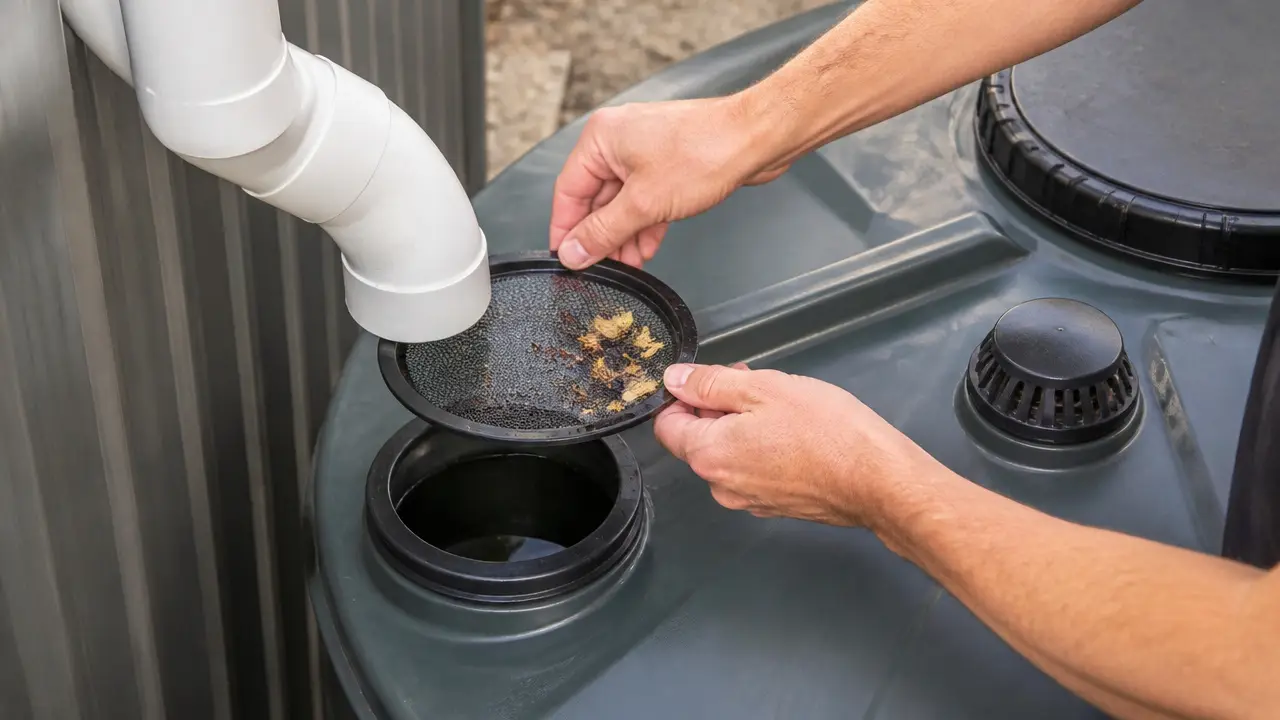
A good collection system can reduce the load entering the tank. Gutter screens, inlet screens, and a first-flush device can help remove some roof debris before it reaches storage.
A first-flush device diverts an initial portion of roof runoff that may contain a higher amount of dust, pollen, bird droppings, and other roof debris.
These steps can help sensor reliability, but they do not make rainwater safe to drink.
Maintenance Matters
A level sensor is useful only if you can trust its reading.
Check the system periodically for:
- Stuck floats
- Dirty optical tips
- Coated electrodes
- Sediment around pressure sensors
- Condensation near electronics
- Loose wiring
- Damaged cables
- Weak batteries
- Blocked sensing paths
- Incorrect calibration
Compare the electronic reading with the actual tank level occasionally when practical.
If a gauge suddenly reports full after a dry period or empty immediately after heavy rain, inspect the sensor before assuming the tank level is correct.
Tank Sensors and Freezing Weather
Water-level equipment installed in exposed tanks needs extra attention in freezing climates.
Ice can:
- Trap floats
- Damage probes
- Stress fittings
- Break sight tubes
- Damage exposed cables or housings
Outdoor electronics must also be suitable for the expected temperature and weather exposure.
Do not assume a sensor protects the rest of the rainwater system from freezing. Pipes, pumps, valves, filters, and exposed fittings may need separate freeze planning.
Do You Need a Tank Level Sensor?
Not every rainwater tank needs electronic monitoring.
A simple barrel used for garden watering may only need a visible indicator or occasional manual check.
A level sensor becomes more valuable when:
- The tank is difficult to inspect
- The cistern is buried
- A pump depends on stored water
- Running the tank empty could damage equipment
- The tank automatically fills another system
- You want to track water use
- Overflow or low level needs to trigger an alarm
For many homeowners, the simplest reliable sensor that provides the needed information is the better choice.
Frequently Asked Questions
What is the simplest type of water tank level sensor?
A float switch is one of the simplest options for detecting whether water has reached a certain height. For a basic visual reading without electronics, a mechanical float gauge may also be suitable.
Can an ultrasonic sensor measure rainwater without touching it?
Yes. An ultrasonic sensor is normally mounted above the water and measures the distance to the surface using sound. It needs a suitable mounting position and a reasonably clear path to the water.
Can I put a tank level sensor in an IBC tote?
Many sensor types can be used with an IBC tote, but the mounting method matters. Avoid cutting or drilling the container unless the installation is suitable for the tank and fitting. External capacitive sensors, top-mounted ultrasonic sensors, and some float systems may be possible depending on the equipment.
Which sensor can protect a pump from running dry?
A low-level float switch, conductive probe, optical sensor, or other suitable level switch can provide a signal for dry-run protection. The sensor should normally operate through a compatible pump controller or relay rather than directly carrying the pump's motor current unless specifically designed for that purpose.
Are pressure sensors accurate in irregular-shaped tanks?
A pressure sensor can measure water depth even when the tank shape is unusual. However, converting that depth into gallons or liters requires the tank's shape and dimensions to be accounted for correctly.
Do tank level sensors need cleaning?
Sensors that contact stored water may need cleaning because of sediment, biofilm, algae, or mineral deposits. Even non-contact sensors should be inspected for condensation, dirt, or obstructions that could affect their readings.
Is radar better than ultrasonic for a rainwater tank?
Not always. Both can provide non-contact continuous measurement. Radar may handle some difficult conditions better, while ultrasonic sensing may be fully adequate for a straightforward tank installation. Tank size, mounting space, internal obstructions, and the required measuring range should guide the choice.