As an affiliate, we may earn a commission from qualifying purchases. We get commissions for purchases made through links on this website from Amazon and other third parties.
Hunter and Rain Bird both make solid irrigation equipment. Hunter is often the better fit if you want advanced smart controls or Hunter MP Rotator nozzles. Rain Bird is often the better fit if you want a straightforward residential sprinkler system with a wide range of sprays, rotors, valves, and controllers.
For most homeowners, though, the brand name is not the main deciding factor. Your water pressure, available flow, zone design, existing parts, and local parts availability matter more.
If you already have a Hunter or Rain Bird system, staying with that brand can also make repairs and adjustments simpler.
Hunter vs. Rain Bird at a Glance
| Consideration | Hunter | Rain Bird |
|---|---|---|
| Standard lawn irrigation | Very good | Very good |
| Spray heads | Very good | Very good |
| Gear-driven rotors | Very good | Very good |
| Rotary nozzles | Strong MP Rotator range | Strong rotary nozzle range |
| Smart controllers | Strong Hydrawise system | Strong Rain Bird connected-controller range |
| Drip irrigation | Available | Available |
| Rainwater-fed systems | Suitable when pressure and filtration are correct | Suitable when pressure and filtration are correct |
| Best reason to choose | Controls and MP Rotator ecosystem | Broad conventional irrigation ecosystem |
Neither brand automatically waters better. A well-designed Rain Bird system can outperform a poorly designed Hunter system, and the reverse is also true.
When Hunter Is the Better Choice
Hunter makes sense when its particular irrigation system features fit your yard.
You Want MP Rotator Nozzles
Hunter's MP Rotator is a rotating-stream nozzle designed to apply water more slowly than many conventional spray nozzles. Hunter offers matching pressure-regulated spray bodies intended for these nozzles.
Slow application can be useful on soil that cannot absorb water quickly. It may reduce runoff when the irrigation system is designed and scheduled correctly.
That does not mean you should replace ordinary spray nozzles with MP Rotators one at a time.
Different sprinkler types can have different precipitation rates. The precipitation rate is how quickly a sprinkler applies water over an area. Mixing very different rates within one zone can cause some parts of the yard to receive too much water while other areas receive too little.
You Want Hydrawise Controls
Hunter's Hydrawise platform provides remote irrigation control and weather-based scheduling with compatible Hunter controllers. Some configurations can also use flow monitoring to help detect unusual water use.
This can be especially useful for:
- larger residential systems
- properties with many zones
- systems you manage while away
- irrigation systems where detecting abnormal flow matters
You still need correctly sized valves, piping, sprinkler heads, and zones. A smart controller cannot fix poor hydraulic design.
You Already Have Hunter Equipment
If most of your existing sprinkler system is Hunter, there often is little reason to change brands just because another company makes a similar part.
Keeping the existing system can simplify:
- nozzle selection
- adjustments
- spare parts
- troubleshooting
- controller accessories
- future repairs
Replace equipment because it solves a problem, not simply because another brand exists.
When Rain Bird Is the Better Choice
Rain Bird is also a strong choice for normal residential irrigation.
You Want Conventional Spray and Rotor Choices
Rain Bird currently offers residential spray bodies, pressure-regulated spray bodies, standard spray nozzles, rotary nozzles, and other watering patterns. Its 1800-series spray bodies are available in several configurations, including pressure-regulated versions.
That makes it possible to build systems for small planting areas, lawns, slopes, and other common landscape layouts without relying on one sprinkler type everywhere.
You Want Rain Bird Smart Controls
Rain Bird is not limited to basic timers.
Its connected-controller lineup includes several residential and larger controllers that can use the Rain Bird app for remote control and weather-based watering adjustments. Compatibility varies by controller model, so check the exact controller before assuming a particular app or feature will work.
That last point matters when upgrading an older system. Some older controllers use different connectivity options or may not support the newest app.
Your Existing System Is Mostly Rain Bird
As with Hunter, keeping an existing Rain Bird system can simplify maintenance.
The planning note “Which Drip Company Is Best?” connects this choice to the way the complete rainwater system performs.
For example, if you already have Rain Bird spray bodies throughout a lawn, replacing a damaged body with the appropriate Rain Bird model may be much easier than redesigning the entire zone.
Which Brand Has Better Sprinkler Heads?
There is no useful answer based only on the logo.
Choose a sprinkler according to the area it must cover.
Small lawn areas commonly use sprays or rotary nozzles. Larger open areas may use gear-driven rotors. Narrow strips may need specialty patterns rather than standard round coverage.
The important specifications are:
- operating pressure
- flow rate
- radius
- spray pattern
- precipitation rate
- inlet connection
- pop-up height
Flow rate is how much water the sprinkler uses over time.
Two sprinklers that look similar may require very different amounts of water.
Before choosing either Hunter or Rain Bird heads, calculate whether the water supply can operate all the sprinklers on that zone at the same time.
Hunter MP Rotator vs. Rain Bird Rotary Nozzles
This is one area where homeowners often compare the two companies directly.
Hunter has its MP Rotator family. Rain Bird offers rotary nozzles such as its R-VAN line. Rain Bird specifies a recommended operating pressure of 45 psi for its R-VAN rotary nozzles, while Hunter offers pressure-regulated spray bodies designed around its MP Rotator systems.
Do not choose between them only because one has a longer advertised throw.
Check:
- The distance you actually need to cover.
- Your available pressure while the zone is running.
- The total flow required by the zone.
- The patterns needed around sidewalks and planting beds.
- Whether the nozzles can provide reasonably even head-to-head coverage.
Head-to-head coverage generally means one sprinkler's water reaches the next sprinkler. Proper spacing is a major part of getting even coverage.
Which Brand Has Better Controllers?
For basic scheduling, either brand can work well.
The difference becomes more important when you want internet-connected irrigation.
Hunter has built much of its connected control system around Hydrawise. Rain Bird currently has its Rain Bird 2.0 connected platform, although controller compatibility differs by model.
Before selecting a smart controller, look beyond the app.
Check whether it supports:
- your number of zones
- rain or weather sensors
- flow monitoring, if needed
- pump-start controls
- master valves
- remote access
- the electrical requirements of your valves
Also consider what happens if Wi-Fi or internet service stops. Basic irrigation operation should not depend on you being able to reach a phone app at every moment.
Can You Mix Hunter and Rain Bird Parts?
Sometimes, but do not assume every part is interchangeable.
Check choosing a suitable water pump to assess pressure-switch behavior across normal draw cycles.
Many residential irrigation systems use common pipe threads, standard irrigation tubing, and 24-volt AC valves. That can make certain parts from different manufacturers physically usable within the same overall system.
But physical connection is only the first check.
The comparison “Which Brand Drip Irrigation System Is Best?” clarifies a related design decision that can affect day-to-day operation.
You also need to confirm:
- thread type and size
- operating pressure
- required flow
- nozzle precipitation rate
- controller voltage
- sensor compatibility
- solenoid requirements
- app or communication compatibility
A Rain Bird valve, for example, does not mean the whole zone needs Rain Bird sprinklers. Likewise, a Hunter controller does not automatically require Hunter sprinkler heads.
However, proprietary controller accessories and connected features may be brand- or model-specific.
Which Is Better for a Rainwater Irrigation System?
For stored rainwater, neither Hunter nor Rain Bird has an automatic advantage.
The bigger issue is whether your rainwater system can provide the pressure and flow required by the irrigation equipment.
A typical setup may look like:
Cistern or tank → pump → filter → irrigation valves → irrigation zones
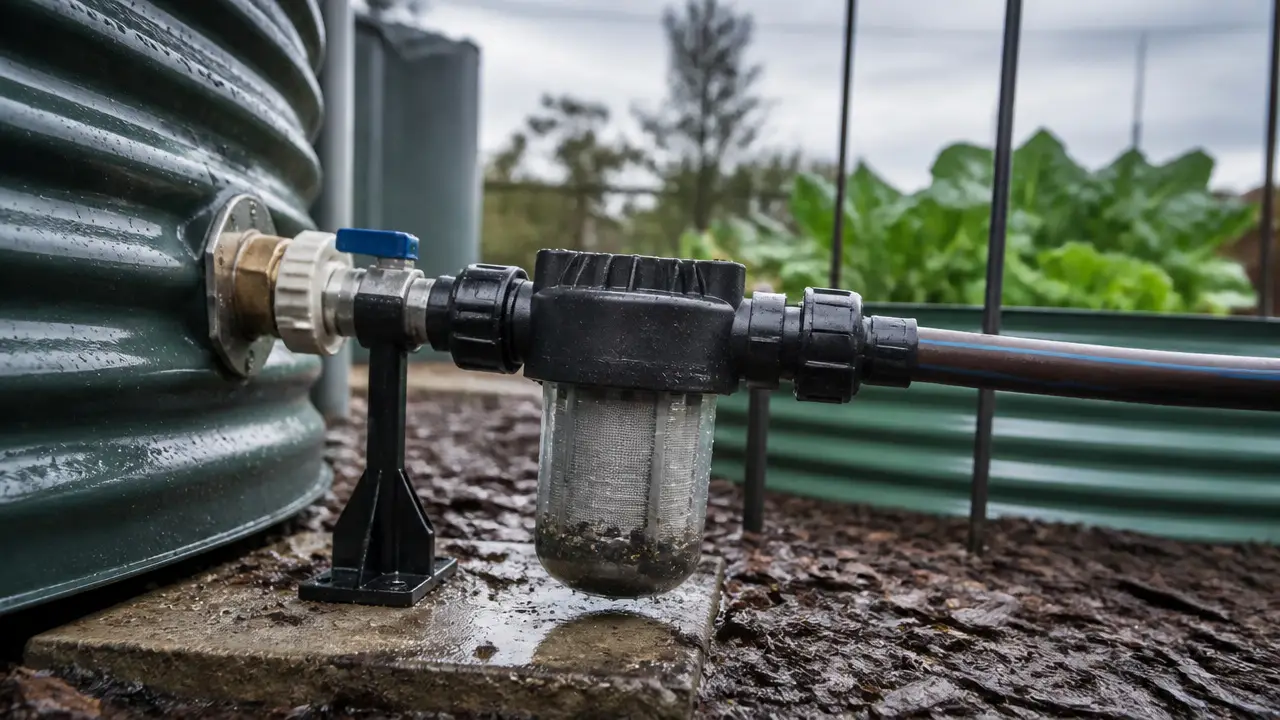
A filter is especially important because collected rainwater can contain small pieces of roof debris, sediment, insects, or organic material. Small sprinkler and drip openings can clog.
The filter must be suitable for the smallest passages downstream. Its micron rating describes the approximate size of particles it is designed to capture. A lower micron number means finer filtration, but finer filters can also create more pressure loss and require more cleaning.
Do not select a filter size without checking the irrigation equipment and the required system flow.
Gravity Pressure Can Be a Problem
A raised rain barrel may work for some low-pressure watering methods, but normal lawn sprinklers often need substantially more pressure than a typical barrel can provide by gravity alone.
Water gains only about 0.43 psi for every foot of vertical water height.
For example, 10 feet of vertical water height produces only about 4.3 psi before pipe and fitting losses.
That is far below the recommended operating pressure of many conventional sprinkler products.
A pump is therefore commonly needed when a cistern or tank supplies an in-ground sprinkler system.
Choose the pump from the irrigation zone requirements rather than choosing the pump by brand.
Pressure Regulation Matters More Than Brand
Too much pressure can be almost as troublesome as too little.
Excess pressure at spray nozzles can produce smaller droplets and misting. Poor pressure control can also make it harder to obtain even irrigation.
Both Hunter and Rain Bird offer pressure-regulated sprinkler options.
Pressure regulation is especially worth considering when:
- supply pressure is high
- different elevations exist around the property
- rotary nozzles require a particular pressure
- misting is visible
- local irrigation rules require pressure regulation
Do not assume the pressure shown on a pump or municipal supply is the pressure reaching the sprinkler.
The options compared “4 Best Irrigation Pressure Regulators for Rainwater Systems” shows where this detail fits into planning the broader system.
Pressure falls as water moves through pipes, filters, fittings, valves, and elevation changes.
Do Not Replace a Whole System Just to Change Brands
If an existing irrigation system works reasonably well, changing every Hunter component to Rain Bird—or every Rain Bird component to Hunter—usually provides little benefit.
Start with the problem.
If one sprinkler is leaking, repair the sprinkler.
If coverage is poor, check nozzle selection, spacing, pressure, and flow.
If watering continues during rain, investigate the controller, sensor, or scheduling setup.
If a rainwater pump cycles rapidly, loses prime, or cannot maintain pressure, investigate the water-supply side rather than replacing the sprinkler heads.
The system works as a whole.
What Should You Choose?
Choose Hunter when Hunter's controller features, MP Rotator system, or compatibility with equipment you already own makes it the cleaner fit.
Choose Rain Bird when its sprinkler, valve, controller, or existing-system compatibility better matches your installation.
If you are starting from scratch, compare the actual components rather than trying to select one winner for the entire brand.
For a rainwater-fed irrigation system, put these factors ahead of brand:
- Available water flow.
- Pump pressure.
- Zone requirements.
- Filtration.
- Pipe and connection sizes.
- Sprinkler spacing.
- Ease of getting replacement parts.
- Maintenance.
A properly sized system using either brand is usually a better choice than an improperly designed system using the supposedly "better" brand.
Frequently Asked Questions
Is Hunter higher quality than Rain Bird?
Not across the board. Both companies make residential and commercial irrigation equipment. Compare the exact sprinkler, valve, nozzle, or controller needed for your system rather than judging the entire brand as one product.
Are Hunter and Rain Bird sprinkler heads interchangeable?
Some components can fit common irrigation connections, but that does not make every sprinkler interchangeable. Check thread size, pressure, flow, radius, and precipitation rate before making a substitution.
Can I use Hunter sprinklers with a Rain Bird controller?
In many conventional residential systems, the controller operates the zone valves rather than communicating directly with each sprinkler head. That means the sprinkler heads do not necessarily need to match the controller brand. Check the valve and controller electrical requirements before mixing components.
Are Hunter MP Rotators better than Rain Bird rotary nozzles?
Neither is automatically better. Choose according to coverage distance, pattern, pressure, flow, precipitation rate, adjustment needs, and compatibility with the rest of the zone.
Which is better for a rainwater tank?
Either can work. The tank, pump, filter, pipes, valves, and irrigation zones must provide the pressure and flow required by the selected sprinklers. Filtration is also important when using stored rainwater.
Can I run Hunter or Rain Bird sprinklers directly from a rain barrel?
Usually not if you mean conventional lawn sprinklers. A typical rain barrel produces very little gravity pressure. Low-pressure drip equipment may be more practical, while conventional sprinklers often require a properly sized pump.
Should every sprinkler in a zone be the same brand?
Not necessarily, but sprinklers within a zone should have compatible watering characteristics. Matching precipitation rates, pressure needs, flow requirements, and spacing is more important than matching logos.