
As an affiliate, we may earn a commission from qualifying purchases. We get commissions for purchases made through links on this website from Amazon and other third parties.
Best Overall
Best for 1/2 Inch Lines
Best for Rainwater Irrigation
A check valve lets water move in one direction and blocks it from flowing backward when the pump stops. In a rainwater system, that can help hold prime, stop a pressurized line from draining backward, isolate branches, or prevent an elevated irrigation zone from emptying through a lower point.
The valve has to match more than pipe diameter. Spring check valves close positively and can work in several orientations, but the spring adds resistance. Swing check valves usually need favorable orientation and enough forward flow to open cleanly. Small irrigation check valves solve low-head drainage problems but may not be appropriate as a pump-discharge valve.
Thread fit is the first hard boundary. A valve that leaks at both ends is worse than no upgrade at all. Several prepared products here show conflicting dimensions or field-fit complaints, so this guide avoids turning questionable measurements into fit promises. Use the exact thread type and measured connection on the received valve and mating pipework.
Check Valves at a Glance
| Product | Best For | Key Strength | Main Tradeoff |
|---|---|---|---|
| Uenede Inline Spring Check Valve | General pump-line backflow control | Solid-brass body, spring action, flow-direction marking | Prepared connection-size fields are inconsistent |
| Valterra Brass Check Valve | 1/2-inch male-threaded plumbing | Clear 1/2-inch MPT connections and compact brass body | Internal valve components can wear over time |
| Hunter HCV | Rainwater-fed sprinkler zones | 3/4-inch female-to-male irrigation format and low-head drainage control | Not a general-purpose high-flow pump-discharge valve |
| Uenede Horizontal Swing Check Valve | Horizontal 3/4-inch layouts | Simple brass swing design with directional flow | Repeated thread-sealing and backflow complaints reduce confidence |
Best Overall: Uenede Inline Spring Check Valve
1 / 4
Uenede Inline Spring Check Valve

Design
Inline spring check
Body
Solid brass
Maximum Operating Pressure
200 PSI
The Uenede spring check valve is the strongest general-purpose option here because its spring-loaded closure is designed for pump and pressure-line backflow control rather than one narrow irrigation use. The solid-brass body has a flow-direction mark on the outside, which helps prevent the most basic installation mistake: putting the valve in backward.
Its maximum operating-pressure field is 200 PSI, well above the normal pressure of many residential rainwater systems. That rating does not mean the system should run anywhere near 200 PSI. The pump, pipe, tank, filters, regulators, fittings, and outlets still determine the safe working pressure.
The prepared connection-size fields disagree with one another, so this guide does not use an exact port size for this valve. That is important because a check valve should be selected by the actual thread and line size, not by a nearly matching product headline. Measure the mating fittings and use the exact model connection before installation.
Why It Works
- Spring action closes the valve positively when forward flow stops.
- A brass body suits wet pump-line service better than a light disposable fitting.
- The external flow arrow makes orientation easy to see.
- Its pressure rating leaves ample margin for ordinary rainwater pump pressures when the rest of the system is appropriately rated.
What To Keep In Mind
- Exact connection size is omitted because the prepared fields conflict.
- A spring check creates some pressure loss, which matters on low-head pumps.
- Install it where the body can be removed if the internal mechanism ever sticks.
- Keep sediment upstream under control so debris does not hold the valve open.
Best for 1/2 Inch Lines: Valterra Brass Check Valve
2 / 4
Valterra Brass Check Valve

Size
1/2 in
Connections
1/2 in MPT x MPT
Thread
NPT
The Valterra is the clearest fit when the rainwater line uses 1/2-inch female NPT fittings on both sides. The valve itself has 1/2-inch male pipe threads at each end, so it can screw between two compatible female fittings without adding thread adapters.
That simple male-to-male format is useful in compact pump assemblies, small cabin water systems, RV-style freshwater plumbing, or a branch line where larger valves would add unnecessary bulk. A direction arrow on the body shows how water should move through the valve.
The main durability tradeoff is inside the brass shell. Product-specific use notes that the internal valve element contains plastic parts, and some units have failed during repeated seasonal service while others have continued working for years. That mixed history makes inspection and easy replacement access worthwhile.
Why It Works
- Clear 1/2-inch MPT connections remove guesswork for matching female NPT plumbing.
- The compact brass body fits small pump and water-heater layouts.
- Direction markings simplify installation.
- Long-running installations show the design can serve well when the internal valve remains healthy.
What To Keep In Mind
- Internal plastic components can eventually wear or fail.
- Drain seasonal systems so freezing water does not stress the valve.
- Use the proper thread sealant for NPT connections without over-tightening the brass body.
- Replace the valve if backflow returns after the pump stops.
Best for Rainwater Irrigation: Hunter HCV Check Valve
3 / 4
Hunter HCV 3/4 Inch Check Valve
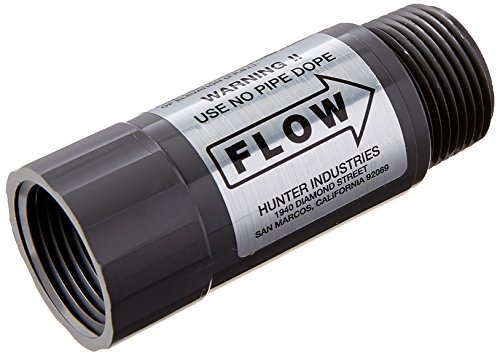
Inlet
3/4 in female
Outlet
3/4 in male
Construction
Schedule 80 specification
The Hunter HCV is a specialty irrigation check valve rather than the best choice for a general pump discharge. Its role is controlling low-head drainage in sprinkler systems where water in elevated lateral piping would otherwise migrate toward lower heads after the irrigation zone shuts off.
The connection layout is 3/4-inch female on one side and 3/4-inch male on the other. That can fit directly into certain sprinkler-head and riser arrangements without using a separate nipple. Schedule 80 construction is intended to give the body more strength than a thin irrigation fitting.
Its limits matter. Product-specific attempts to use it as a sump-pump backflow valve were unsuccessful, and overtightening can crack the female side. Use it where it was designed to work: rainwater-fed sprinkler or irrigation plumbing with compatible 3/4-inch connections and modest flow demands.
Why It Works
- The female-to-male layout is convenient in sprinkler riser assemblies.
- It helps keep elevated irrigation laterals from draining through low heads.
- Schedule 80 construction gives a more substantial body than light sprinkler fittings.
- It can replace a failed built-in irrigation check where a separate valve is needed.
What To Keep In Mind
- It is not the right choice for every pump-discharge or sump application.
- Do not overtighten the female threaded side.
- Keep grit out of the irrigation line so the valve can close cleanly.
- Match it to the sprinkler flow and pressure rather than assuming all 3/4-inch valves behave alike.
Best Horizontal Swing Option: Uenede Brass Swing Check Valve
4 / 4
Uenede 3/4 Inch Horizontal Swing Check Valve

Size
3/4 in female
Thread
NPT claim
Body
Solid brass
This Uenede valve uses a swing-style internal closure rather than a spring. That can reduce spring resistance in a suitable horizontal line, and the brass body has a marked flow direction for orientation.
The product is presented as a 3/4-inch female-threaded valve. In theory, that makes it a simple fit between two male NPT pipe ends in a horizontal pump or circulation line. In practice, thread fit has been the main weakness. Multiple installations have struggled to seal both ends even with different nipples and normal pipe-thread sealing methods.
There are also reports of a small amount of reverse leakage when forward pressure disappears. Those two concerns put it last in this group. It can still suit a layout where the exact threads mate cleanly and minor pressure loss from a spring is undesirable, but the valve deserves a careful bench fit before it is buried in hard-to-reach plumbing.
Why It Works
- A swing design avoids a spring-loaded closure.
- The solid-brass body is compact and direction-marked.
- A 3/4-inch female format can fit common water plumbing when the threads mate correctly.
What To Keep In Mind
- Thread-sealing complaints are too frequent to ignore.
- Some units have allowed slow reverse leakage.
- Use it only in an orientation appropriate for a swing check.
- Do not hide the valve behind finished work until it has held pressure without leakage.
How to Choose a Check Valve for a Rainwater Pump
Decide What Backflow You Are Stopping
A pump-discharge check valve prevents pressurized water from returning through the pump. A suction-line valve helps hold prime. An irrigation check valve stops low-head drainage. These are related jobs, but the best valve design and location can differ.
Start with the actual reverse-flow path you need to stop. Then choose the valve type and connection around that job.
Match Pipe Size and Thread Type
NPT threads seal by taper. Male and female fittings tighten together over several turns with an appropriate thread sealant. A fitting that stops almost immediately or remains visibly loose may be the wrong thread standard or a poorly machined part.
Do not use extra force as a substitute for matching threads. Over-tightening can crack plastic valves, distort brass fittings, or damage pump ports.
Consider Cracking Pressure
A spring check needs enough forward pressure to open the internal spring. That minimum opening force is called cracking pressure. On a powerful pressure pump, a small cracking pressure may barely matter. On a gravity-fed or low-head rainwater system, it can reduce already limited flow.
A swing check may open with less resistance in the correct orientation, but it can be more sensitive to installation angle and slow reverse leakage.
Keep Sediment Out
Debris can hold a check valve partly open. Rainwater pump systems should have coarse screening before the pump and filtration appropriate to the intended use.
If a valve begins allowing backflow, inspect for debris and internal wear rather than assuming the pump has failed.
Plan for Freezing
A check valve can trap water in a line that would otherwise drain. In a freezing climate, that can create a pocket vulnerable to freeze damage. Seasonal plumbing needs drains, unions, or valve placement that allows proper winterization.
Frequently Asked Questions
Where should a check valve go on a rainwater pump?
Placement depends on the job. Pump-discharge valves go downstream of the pump, while suction-side valves or foot valves are used to help hold prime. Follow the pump maker's recommended layout.
Does a check valve reduce pump flow?
Yes, every valve adds some resistance. Spring checks also need pressure to open the spring. The effect is usually smaller when the valve is properly sized for the flow.
Can I use a swing check valve vertically?
Only when the exact valve design allows that orientation and gravity helps the flap close correctly. Many swing valves are intended for specific orientations, so follow the valve instructions.
Why does water flow backward through a new check valve?
The valve may be installed backward, held open by debris, damaged internally, poorly oriented, or simply defective. A leaking thread joint can also look like valve failure.
Is a check valve the same as a foot valve?
A foot valve is a type of check valve designed for the end of a suction line and usually includes a screen. A general inline check valve normally does not include that inlet strainer.
Can a check valve make a pump self-priming?
No. It can help retain prime in a properly designed suction line, but it does not change the pump's basic priming capability or fix suction leaks.
For the control side of a pumped system, automatic pump controllers handle start-and-stop logic. If pressure swings are the bigger issue, pressure tanks for rainwater systems add drawdown between pump cycles. When downstream pressure is too high, water pressure regulators for rainwater reduce it to a safer operating level.