
As an affiliate, we may earn a commission from qualifying purchases. We get commissions for purchases made through links on this website from Amazon and other third parties.
Best Overall
Best Simple Gauge
Best for Freezing Weather
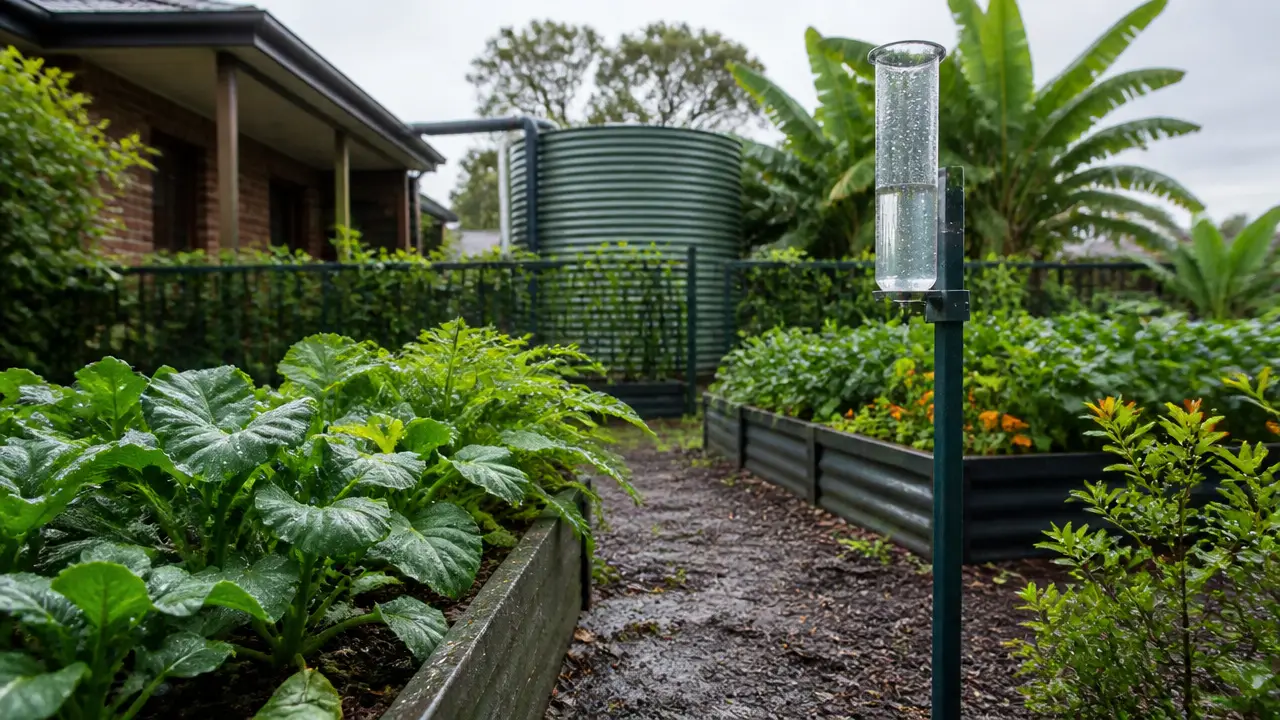
A rain gauge gives a rainwater-harvesting system something a weather app cannot: a measurement from the exact property where the roof, gutters, and tank are located. Local rainfall can differ from the nearest official station, and even a basic gauge can help you compare storms, check whether expected collection matches what reached the tank, and decide when garden watering can rely on stored rainwater rather than irrigation.
For rainwater use, the best gauge is not necessarily the one with the most features. It needs an open location, markings you can read accurately, a mounting method that keeps the collector level, and materials that can survive the conditions where you leave it. Freezing water, UV exposure, accidental knocks, and poor placement can ruin a simple gauge faster than the measurement scale itself.
The four picks here cover different priorities: the oversized Headwind EZRead is easiest to see from a distance, the AcuRite is a straightforward low-complexity option, the Taylor uses flexible silicone for freeze resistance, and the La Crosse waterfall design emphasizes visibility with a floating marker.
Quick Rain-Gauge Placement Checklist
- Keep the opening level. A tilted gauge changes how much rain enters the collector.
- Avoid roof drip and splash. Do not mount directly under an eave, tree canopy, sprinkler, or runoff path.
- Give the opening clear sky exposure. Nearby walls, fences, and vegetation can block wind-driven rain.
- Make emptying easy. A gauge you cannot reach will eventually become a multi-storm total rather than a useful event measurement.
- Plan for winter. Rigid plastic can crack when trapped water freezes; either choose a freeze-resistant design or bring the gauge in before freezing weather.
- Read at the same stage of each storm. Consistent timing makes your rainfall records much more useful.
Rain Gauges at a Glance
| Product | Best For | Key Strength | Tradeoff |
|---|---|---|---|
| Headwind EZRead 26-Inch Rain Gauge | Reading from a window or distance | Oversized 26-inch body with bright float and large markings | Large format takes more mounting space |
| AcuRite 5-Inch Magnifying Rain Gauge | Simple backyard rainfall tracking | Water magnifies the scale for easier reading | Rigid acrylic can crack if water freezes inside |
| Taylor Freeze-Proof Silicone Rain Gauge | Cold-weather climates | Flexible silicone collector is designed to tolerate freezing water | Holder and support parts still need weather exposure care |
| La Crosse 705-109 Waterfall Rain Gauge | Reading from a deck or fence | Wide waterfall shape and floating rain marker | Plastic body has reported sun-aging and leak issues |
Which Rain Gauge Fits a Rainwater-Harvesting Setup?
The Headwind EZRead is the strongest overall choice when the gauge needs to be checked regularly from a house or shed. Its oversized 26-inch format, large markings, and high-visibility float are designed to be readable from far away. That does not make it inherently more precise than every smaller gauge, but easier reading reduces the temptation to guess at a tiny scale.
The AcuRite 5-Inch Magnifying Rain Gauge is the better fit for someone who wants a simple manual reference beside the garden or tank area. Its water-magnified markings are easy to understand, the capacity covers most ordinary single storms, and there are no wireless connections or apps to maintain. Its biggest weakness is cold weather: water freezing inside a rigid tube can crack it.
The Taylor Freeze-Proof Silicone Rain Gauge has the clearest role where freezing temperatures are expected. The flexible silicone collector is designed to resist the cracking that can happen when water freezes in rigid glass or plastic. It is still worth inspecting the holder and mounting hardware because freeze resistance of the tube does not make every attached part indestructible.
The La Crosse Waterfall Rain Gauge works well when horizontal mounting and long-distance visual reading matter. The wide profile and floating marker are easy to see from indoors, but long-term sun exposure and leaking are recurring concerns.
The prepared JMBay Rain Gauge is not ranked because its adjustable stake and floating marker overlap roles already covered here, while customer reports of missing or damaged parts make it a weaker choice without a distinct measurement advantage.
Best Overall: Headwind EZRead 26-Inch Rain Gauge
1 / 4
Headwind EZRead 26-Inch Rain Gauge

Height
26 in
Reading Aid
High-visibility float
Mounting
Stake, fence, or post
The Headwind EZRead solves the most basic rain-gauge problem: a measurement is not very useful if you have to walk outside and squint at tiny markings after every shower. Its oversized 26-inch body uses large numbers, a red float, and magnification to make the water level visible from much farther away than a conventional tube.
For a rainwater-harvesting owner, that makes frequent observation easier. You can check whether a storm produced a small amount or a meaningful collection event without walking to the gauge every time. When you need the exact number, the collector slides out for closer reading and emptying.
Mounting flexibility is also useful. The gauge can be staked into the ground or attached to a fence or post. Whichever method you choose, keep the opening above nearby surfaces that can splash extra water into it.
Customer evidence is strongest around visibility and sturdy mounting. There are also isolated reports of leaks or inconsistent readings, so compare the gauge against another known measurement if a result seems implausible.
Why It Works
- Large markings and the bright float make rainfall easier to read from a distance.
- Stake and bracket options support garden, fence, or post installation.
- The removable collector is convenient for emptying between storms.
What To Keep In Mind
- Oversized construction needs more clear mounting space than a narrow tube gauge.
- Keep the opening away from fence tops or surfaces that can splash into it.
- If the reading suddenly disagrees with nearby observations, inspect for leaks or a blocked opening.
Best Simple Gauge: AcuRite 5-Inch Magnifying Rain Gauge
2 / 4
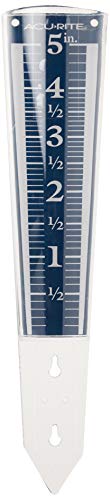
AcuRite 5-Inch Magnifying Rain Gauge
Capacity
5 in
Reading
Magnified scale
Body
Acrylic
AcuRite's familiar tube-style gauge is the least complicated option here. It collects up to five inches of rainfall and uses the water itself to magnify the markings, making the scale easier to read than an equally narrow unmagnified tube.
That simplicity is useful when the goal is to maintain a handwritten rainfall log or compare a storm total with the amount collected in a barrel or tank. There are no batteries, gateways, displays, or moving parts to troubleshoot.
Mounting is straightforward on a vertical surface, although the required screws are not included. The bigger limitation is winter durability. Customer evidence includes cracking after frozen precipitation collected in the tube. If temperatures can drop below freezing, empty it promptly or bring it inside.
Why It Works
- The magnifying shape improves readability without electronics.
- Five-inch capacity is enough for routine storm tracking in many locations.
- The narrow body can mount on a fence, post, or other vertical support.
What To Keep In Mind
- Mounting screws are not included.
- The rigid acrylic tube can crack if water freezes inside.
- The scale is suited to ordinary backyard monitoring rather than very fine reporting resolution.
Best for Freezing Weather: Taylor Freeze-Proof Silicone Rain Gauge
3 / 4
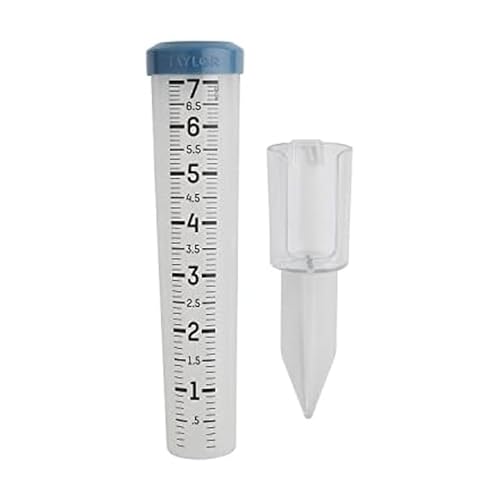
Taylor Freeze-Proof Silicone Rain Gauge
Capacity
7 in
Increment
1/10 in
Collector
Flexible silicone
The Taylor gauge uses flexible silicone specifically to address one of the most common failure modes of outdoor rain gauges: water freezes, expands, and cracks a rigid tube. The collector is designed to flex instead of shattering when frozen water is left inside.
It has a seven-inch capacity with one-tenth-inch markings and can be installed using the ground stake or mounting bracket. That makes it practical for a year-round rainwater log where bringing the gauge inside before every cold night is unrealistic.
The silicone collector is the reason to choose this model, not a belief that the entire assembly is immune to weather. Customer notes include failures of plastic holder or ring components after extended outdoor exposure. Inspect the support hardware as part of seasonal maintenance.
Why It Works
- Flexible silicone reduces the risk of freeze cracking in the collector.
- Seven-inch capacity allows larger storm totals before emptying.
- Stake and bracket mounting give you more placement options.
What To Keep In Mind
- Freeze resistance applies most directly to the flexible collector, not every holder component.
- UV exposure can still age exterior parts over time.
- Keep the top opening clear and level even when using the ground stake.
Best Waterfall-Style Gauge: La Crosse 705-109
4 / 4
La Crosse 705-109 Waterfall Rain Gauge

Capacity
6 in
Reading Aid
Floating marker
Mounting
Deck, fence rail, or stake
The La Crosse 705-109 takes a wider approach than a conventional tube. Its waterfall-shaped body and floating marker make the accumulated rainfall easier to see from a porch or window, and the gauge can mount to a deck, fence rail, or stake.
That visibility is useful for quick rainwater decisions. If you only need to know whether a storm delivered roughly half an inch or several inches before checking the tank, the large visual format is convenient.
Long-term material exposure is the compromise. Customer evidence includes units that leaked or developed sun-related cracking after extended outdoor use. If your mounting location receives strong direct sun all day, inspect the collector for hazing, cracks, and slow leakage.
Why It Works
- The wide body and floating marker are easy to read from indoors.
- Six-inch capacity handles a broad range of storm totals.
- Multiple mounting options suit decks and fences where a narrow stake is inconvenient.
What To Keep In Mind
- Long-term UV exposure can age the plastic.
- Check periodically for slow leaks that would understate rainfall.
- Make sure the floating marker is present and moving freely.
How to Use Rainfall Data for Rainwater Collection
A rain gauge does not directly tell you how many gallons entered a tank. It tells you the rainfall depth at the gauge. Collection depends on roof catchment area, runoff losses, first-flush diversion, gutter performance, filters, and whether the tank was already full.
The most useful habit is comparison. Record the rainfall total and compare it with the change in stored water after the same storm. Over several events, you will learn how your actual system behaves rather than relying only on theoretical yield.
Material choice matters for durability and reading clarity, so compare glass and plastic rain gauges for the intended location.
If the gauge reports substantial rain but the tank level barely changes, inspect the roof-to-tank path. A blocked screen, leaking gutter, poorly positioned diverter, overflowing first-flush chamber, or already-full tank may explain the mismatch.
Common Rain-Gauge Errors
Mounting Too Close to a Wall or Tree
Wind changes around buildings and vegetation. A sheltered gauge can under-catch rainfall even though it stays conveniently close to the house.
Letting Multiple Storms Accumulate
A five-inch reading is ambiguous if you do not know whether it came from one storm or three. Empty the gauge after recording each event whenever practical.
Reading a Tilted Gauge
The collector opening needs to remain level. Stakes can lean as soil softens, and fence mounts can shift after impact.
Ignoring Freezing Water
Rigid collectors can crack. If the gauge is not designed for freezing conditions, empty it before a freeze or store it indoors for winter.
Assuming Backyard Rainfall Equals Tank Yield
A gauge measures rain depth, not hydraulic efficiency. Use the reading as one part of system diagnosis rather than as a direct tank-volume measurement.
Frequently Asked Questions
Where is the best place to put a rain gauge?
Choose an open, level location with clear exposure to the sky and minimal interference from trees, walls, roof edges, sprinklers, or splash. The gauge should also be accessible enough to empty and inspect.
How often should I empty a rain gauge?
Empty it after you record each storm or measurement period. That keeps individual rainfall totals clear and prevents evaporation or old water from confusing the next reading.
Can I use a rain gauge to estimate how much water my roof collected?
Yes, rainfall depth is an important input, but roof area and system losses also matter. Compare theoretical collection with actual tank-level change for a more realistic picture of your system.
Do rain gauges work in winter?
Some do, but rigid collectors can crack if captured water freezes. Use a model designed for freezing conditions or remove and empty the gauge when freezing weather is expected.
Why does my rain gauge disagree with the weather report?
Rainfall can vary over short distances, and local placement also affects readings. A nearby official weather station may legitimately record a different amount from your property.
Is a larger rain gauge more accurate?
Not automatically. A larger format may be easier to read, but accuracy also depends on collector geometry, level placement, exposure, and whether the gauge leaks or is obstructed.
To compare rainfall with the water actually moving through a hose or fill line, see our guide to water flow meters for rainwater systems. For unwanted water around tanks, pumps, or indoor plumbing, smart water leak detectors cover the monitoring side of system failures.