As an affiliate, we may earn a commission from qualifying purchases. We get commissions for purchases made through links on this website from Amazon and other third parties.
A rain barrel usually has low water pressure because gravity is doing all the work. The most effective ways to increase usable pressure are to raise the barrel, reduce restrictions in the water line, or add a pump.
Raising the barrel can help with simple watering. A pump is usually the better choice when you need stronger pressure for a hose, sprinkler, or irrigation system.
How Much Pressure Does a Rain Barrel Produce?
Water pressure from a rain barrel depends mainly on head height.
Head height is the vertical distance between the water surface in the barrel and the point where the water comes out.
As a useful rule:
- About 2.31 feet of water height produces 1 psi
- 5 feet of head produces about 2.2 psi
- 10 feet produces about 4.3 psi
- 20 feet produces about 8.7 psi
That is much lower than typical household water pressure.
Also, the pressure drops as the barrel empties. A full barrel has more head height than a nearly empty one.
This is why putting a barrel on a short stand can improve flow, but it will not turn the barrel into a high-pressure water source.
Raise the Rain Barrel
Raising the barrel is the simplest way to increase gravity pressure.
For example, if the outlet is currently only 1 foot above your watering area, raising the barrel another 2 feet increases the available head by about 2 feet.
The improvement may be enough for:
- Filling watering cans
- Slow garden watering
- Soaker hoses designed for low pressure
- Some gravity-fed drip systems
It usually will not provide enough pressure for equipment designed around household water pressure.
Be Careful With the Weight
A gallon of water weighs about 8.34 pounds. A full 55-gallon barrel contains roughly 459 pounds of water, before adding the weight of the barrel and fittings.
Do not place a full barrel on stacked blocks, loose soil, lightweight shelving, or an unstable homemade platform.
Use a level, firm base that is designed to support the full load. Larger tanks become much heavier and may require a properly designed foundation.
Use a Larger Outlet and Hose
Sometimes the problem is not low pressure alone. The system may have poor flow rate.
Flow rate is how much water moves through the system in a given amount of time, such as gallons per minute.
A small outlet, narrow hose, clogged screen, or restrictive valve can greatly reduce flow.
For better gravity-fed performance:
- Use a reasonably large tank outlet.
- Avoid reducing the pipe size immediately after the tank.
- Use a larger-diameter hose when practical.
- Keep the hose as short as practical.
- Avoid unnecessary elbows and fittings.
- Make sure screens and valves are clean.
- Check for partially closed valves.
A larger hose does not create more static water pressure. It reduces resistance, which can let more of the available pressure reach the end of the line.
This distinction matters. If your barrel has enough pressure but the water only trickles through a long narrow hose, improving the plumbing may solve the problem without a pump.
Put the Barrel Above the Watering Area
Gravity systems work best when the water travels downhill.
A barrel beside a garden that slopes downward may provide much better results than the same barrel feeding plants uphill.
Measure the vertical difference between:
- The water level inside the barrel.
- The highest point where water must travel.
If your irrigation line climbs above the barrel's water level, gravity alone may not move water through that section.
Remember that the relevant measurement is the water surface, not just the height of the spigot.
Add a Pump for Higher Pressure
If you want noticeably stronger pressure, a pump is usually the practical solution.
A rain barrel pump can be useful for:
- Garden hoses
- Spray nozzles
- Sprinklers
- Larger drip irrigation systems
- Watering areas above the barrel
- Moving water a longer distance
Do not choose a pump based only on its maximum pressure.
You also need to consider:
- Required flow rate
- Required pressure
- Vertical lift
- Hose or pipe length
- Connection sizes
- Available electrical power
- Pump inlet requirements
- Dry-run protection
Vertical lift, sometimes called head height in pump specifications, is the height the pump must move the water upward.
A pump that works well beside a barrel may perform very differently when pushing water uphill through a long hose.
Protect the Pump From Running Dry
Rain barrels eventually empty.
Some pumps can be damaged if they continue running without water. This is called dry running.
Consider pressure needs that justify adding a pump to evaluate the system’s suction conditions and dry-run protection.
For an automatic system, look for a setup that can stop the pump when the tank level becomes too low. Depending on the system, this may involve a float switch, level sensor, pump controller, or built-in dry-run protection.
Also keep leaves and debris from entering the pump. A suitable intake screen or prefilter can help protect the pump without creating excessive restriction.
Check the Barrel Outlet
A poorly installed or undersized outlet can become the bottleneck in the whole system.
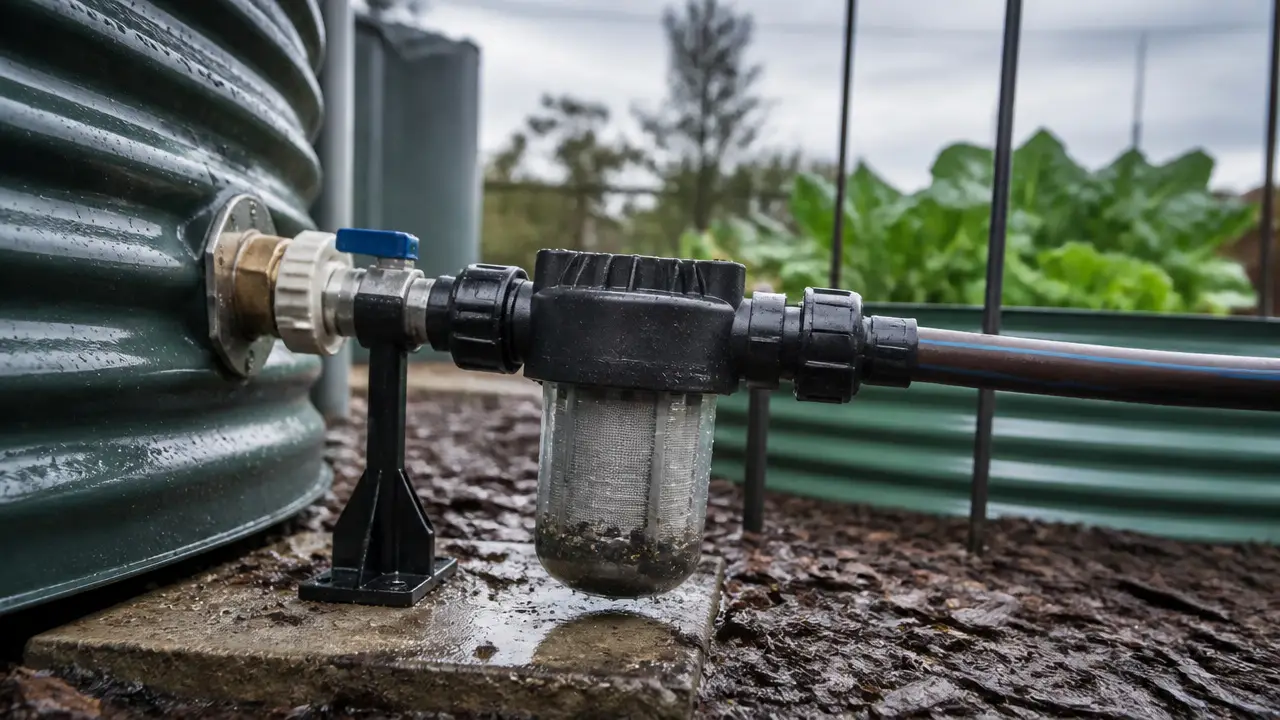
Many rainwater tanks use a bulkhead fitting to pass through the tank wall. A bulkhead fitting creates a sealed connection where a pipe, valve, or hose attaches to the tank.
Check that:
- The valve opens fully.
- The fitting is not clogged.
- The inside opening is not blocked by sediment.
- The hose connection is not much smaller than the tank outlet.
- Washers and seals are not interfering with the opening.
Sediment often collects near the bottom of a rain barrel, so inspect and clean this area as part of normal maintenance.
Can You Increase Pressure With a Smaller Nozzle?
A smaller nozzle can make water leave the nozzle faster under the right conditions, but it does not create additional pressure inside the rain barrel.
In a low-pressure gravity system, making an opening too small may simply reduce the amount of water you receive.
If your goal is stronger sprinkler performance, a pump is usually more effective than trying to restrict the outlet.
Using a Rain Barrel With Drip Irrigation
Drip irrigation can work well with rainwater, but the components need to match the available pressure.
Some drip equipment is intended for pressurized household water and may not perform evenly from a low-pressure rain barrel. Emitters near the barrel may release more water than emitters farther away.
For a gravity-fed system:
- Keep irrigation zones reasonably small.
- Limit unnecessary hose length.
- Avoid large elevation changes.
- Use components intended for low-pressure or gravity-fed operation.
- Keep filters clean.
- Check water output at both the beginning and end of the line.
If the system needs more pressure than gravity can provide, add a suitable pump rather than continually raising the storage tank.
What About Soaker Hoses?
Results vary widely.
Some soaker hoses need more pressure than a typical ground-level rain barrel can provide. A short hose running downhill may work, while a long hose on level or rising ground may barely release water.
Before building a large system, test a short section using your actual barrel height and hose layout.
If the flow is poor, raising the barrel slightly may help. For a long run, a pump may be a better solution.
Do Not Pressurize a Standard Rain Barrel
Do not try to increase pressure by sealing a normal rain barrel and applying compressed air.
Most rain barrels are designed for atmospheric storage, not pressure.
A sealed container that is not designed and rated as a pressure vessel can rupture or fail unexpectedly. Keep ordinary rain barrels vented and use gravity or a suitable water pump when additional pressure is needed.
Gravity or Pump: Which Should You Use?
| Watering job | Usually best approach |
|---|---|
| Filling a watering can | Gravity |
| Watering nearby plants through a short hose | Raised barrel or gravity |
| Low-pressure drip irrigation | Gravity may work |
| Long irrigation lines | Pump often works better |
| Watering uphill | Pump |
| Spray nozzle | Usually pump |
| Lawn sprinkler | Usually pump |
| Moving water a long distance | Pump |
Start with the simplest fix.
Clean the outlet, remove unnecessary restrictions, use an appropriate hose size, and take advantage of natural elevation. If those changes still do not provide enough pressure for the equipment you want to operate, move to a pump.
Frequently Asked Questions
How high should I raise a rain barrel for better pressure?
Every 2.31 feet of vertical water head adds about 1 psi. Raising a barrel a few feet can improve gravity flow, but the support must safely carry the full weight of the barrel and water.
Will a bigger hose increase rain barrel pressure?
A bigger hose does not increase the pressure created by gravity. It can reduce friction and restriction, allowing better flow and helping more of the available pressure reach the hose outlet.
Can a rain barrel run a garden sprinkler?
Many lawn sprinklers need more pressure than a gravity-fed rain barrel can provide. A suitable pump is generally needed unless the sprinkler is specifically designed for very low-pressure operation.
Can I connect a pump directly to a rain barrel?
Often, but the pump must be suitable for the required flow, pressure, lift, connections, and water source. It should also be protected from debris and running dry when the barrel empties.
Why does my rain barrel hose only trickle?
Common causes include low barrel elevation, a small outlet, a long or narrow hose, clogged screens, sediment around the outlet, partially closed valves, or trying to move water uphill.
Does a full rain barrel have more pressure than an empty one?
Yes. The pressure depends on the height of the water above the outlet. As the water level drops, the available gravity pressure also decreases.
Can I seal my rain barrel to build pressure?
No. A standard rain barrel should not be turned into a pressure vessel. Use elevation or a water pump instead of compressed air or another method of pressurizing the barrel.