As an affiliate, we may earn a commission from qualifying purchases. We get commissions for purchases made through links on this website from Amazon and other third parties.
For most home drip irrigation systems, a 20 to 25 psi pressure regulator is a good starting point. But the correct regulator is the one that matches the pressure rating of your drip tubing, emitters, fittings, and irrigation layout.
A regulator that is set too high can cause fittings to leak or pop apart. One that is set too low may leave the far end of the system with weak or uneven flow.
What Pressure Does Drip Irrigation Need?
Drip irrigation normally works at much lower pressure than standard household plumbing or many sprinkler systems.
PSI means pounds per square inch. It is a measure of water pressure.
Many common drip systems operate somewhere around 10 to 30 psi, depending on the tubing and emitters. A regulated pressure near 20 or 25 psi is common for small garden systems.
That does not mean every drip system should run at 25 psi. Check the recommended operating pressure for your specific:
- Drip tubing
- Drip tape
- Emitters
- Soaker-style dripline
- Barbed fittings
- Valves
- Filters
The lowest-rated important component may determine how much pressure the system can safely handle.
A Simple Pressure Regulator Guide
These ranges can help narrow the choice.
| Drip system | Typical regulator range to consider |
|---|---|
| Low-pressure drip tape | About 8–15 psi |
| Small garden drip system | About 15–25 psi |
| Standard dripline and emitters | About 20–30 psi |
| Manufacturer-specified system | Use the stated operating pressure |
These are general ranges, not universal limits. Drip tape in particular can have a much lower pressure rating than thicker polyethylene drip tubing.
If your tubing manufacturer calls for 15 psi, use a regulator intended to provide about that pressure rather than assuming a 25 psi model will work.
Why 20 to 25 PSI Is Common
A regulator in the 20-to-25-psi range works well for many home systems because it provides enough pressure to move water through:
- Main drip tubing
- Small distribution tubing
- Emitters
- Tees and elbows
- Moderate-length garden rows
At the same time, it reduces the higher pressure that may come from a house faucet, well pressure system, or irrigation pump.
Without regulation, household water pressure can be far higher than some drip components are designed to handle.
Match the Regulator to the Emitters
The emitters are one of the first things to check before choosing a regulator.
Some standard emitters work over a fairly broad pressure range. Others need a narrower range to deliver water at the intended rate.
Pressure-compensating emitters are designed to keep their flow more consistent as system pressure changes within their specified operating range. They can help on longer runs or areas with elevation changes.
However, "pressure compensating" does not mean they can be connected to any pressure. They still have a minimum and maximum operating range.
If the emitter instructions specify an operating pressure, use that figure as one of your main regulator-selection limits.
Drip Tape Usually Needs Lower Pressure
Drip tape should not automatically be treated the same way as standard drip tubing.
Drip tape has thinner walls and is commonly used for vegetable rows and seasonal irrigation. Many systems operate at relatively low pressure.
Using a regulator intended for a higher-pressure dripline can put unnecessary stress on the tape, connectors, and row ends.
For drip tape, check the tape manufacturer's pressure recommendation before buying the regulator. Some systems may call for pressure around 10 psi, while others allow more.
Make Sure the Regulator Can Handle Your Flow Rate
Pressure alone is not enough. The regulator also needs to work at the amount of water your system uses.
Flow rate describes how much water passes through the system over time. In the United States, it is often measured in gallons per minute, or GPM.
Add up the approximate flow from all emitters running in the same irrigation zone.
For example, if you have:
- 100 emitters
- Each emitter delivers 0.5 gallons per hour
The zone uses:
100 × 0.5 = 50 gallons per hour
That is about:
50 ÷ 60 = 0.83 gallons per minute
Your regulator should be designed to operate properly at that flow.
This matters because some pressure regulators need a minimum amount of flowing water before they regulate accurately. An oversized regulator on a tiny drip zone may not behave as expected.
Check Your Incoming Pressure
A regulator reduces pressure. It does not normally increase it.
If your water source supplies 60 psi and the drip system needs 25 psi, a 25 psi regulator can reduce the pressure to a suitable level.
But if the water source only provides 10 psi, installing a 25 psi regulator will not give you 25 psi.
This is especially important with rainwater systems.
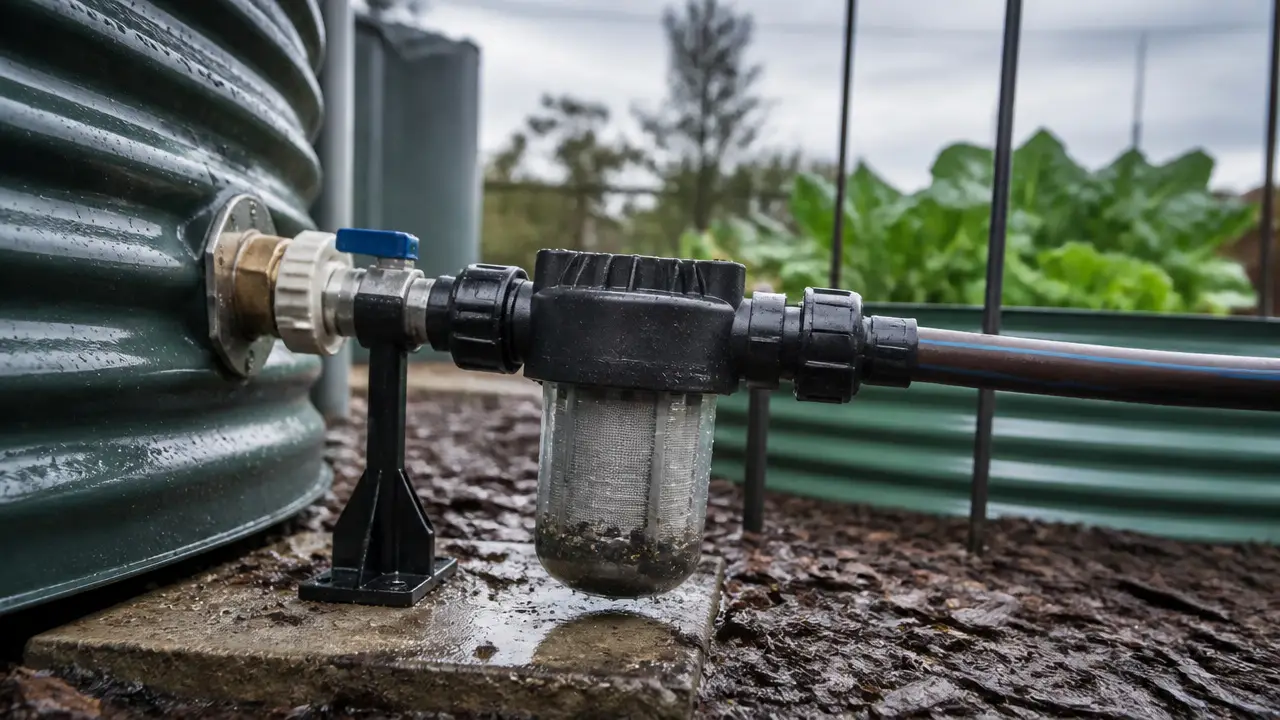
Pressure Regulators and Rain Barrels
A gravity-fed rain barrel may not need a pressure regulator at all.
Water pressure from gravity depends mainly on head height, which is the vertical distance between the water surface in the tank and the irrigation outlet.
A rough rule is that every 2.31 feet of vertical water height produces about 1 psi.
For example, a water level 5 feet above the emitters produces only a little over 2 psi before losses from tubing, filters, valves, and fittings.
That is far below the pressure used by many regulated household drip systems.
Adding a standard 20 or 25 psi regulator to a low-pressure rain barrel system does not create more pressure. In fact, the regulator may add resistance and make flow worse.
For gravity-fed rainwater irrigation, use components specifically intended for very low pressure.
Pressure Regulators and Rainwater Pumps
A pump-fed rainwater system is different.
A pump may produce substantially more pressure than drip tubing needs. In that case, a pressure regulator can protect the irrigation system and keep emitter operation more consistent.
A typical arrangement may look like:
Tank → pump → filter → pressure regulator → drip irrigation
The exact order can depend on the pump, filter, regulator, and control system.
Filtering is especially important with collected rainwater because small debris can clog drip emitters. The filter must be suitable for the emitter openings and the expected water quality.
Do not assume the pump's advertised maximum pressure is the pressure that will reach the irrigation line. Actual pressure changes with flow, elevation, pipe size, filters, valves, and other restrictions.
Choose the Correct Connection Size
The regulator also has to physically fit the system.
Review practical considerations for 30 psi too high for drip irrigation to assess zone design that limits pressure imbalance.
Common irrigation connections may include:
- 1/2-inch pipe thread
- 3/4-inch hose thread
- 3/4-inch pipe thread
- Larger irrigation fittings
Hose thread and pipe thread are not interchangeable even when both are described as 3/4 inch.
A regulator that fits a garden hose or hose bib may have garden-hose threads. A regulator used in a permanent irrigation manifold may use pipe threads instead.
Check both ends of the regulator before buying adapters.
Where Should the Pressure Regulator Go?
For a small hose-connected drip system, the setup is often similar to:
Faucet → backflow protection if required → filter → pressure regulator → drip tubing
Some components combine several functions in one assembly.
The exact order can vary because regulators and filters are not all designed the same way. Follow the installation direction and placement instructions supplied with each component.
The regulator should normally serve the part of the system that needs the reduced pressure.
If several irrigation zones require different pressures, regulating each zone separately may work better than using one regulator for the entire system.
Fixed vs. Adjustable Pressure Regulators
Drip irrigation regulators are commonly available in fixed-pressure and adjustable designs.
Fixed-pressure regulator
A fixed regulator is simple. It is designed to reduce flowing pressure to approximately one specified level under its intended operating conditions.
It makes sense when:
- Your drip system has one known pressure requirement
- Your water supply is reasonably consistent
- You do not expect to change the irrigation layout much
For a basic home garden, a fixed regulator matched to the drip components is often enough.
Adjustable regulator
An adjustable regulator lets you change the outlet pressure.
It can be useful when:
- You have several types of irrigation equipment
- You are troubleshooting pressure problems
- Your system may expand
- You need to fine-tune pressure using a gauge
An adjustable model should be used with a pressure gauge rather than adjusted by guesswork.
Static Pressure Is Not the Same as Operating Pressure
A pressure gauge can show different readings depending on whether water is moving.
Static pressure is the pressure measured while no water is flowing.
Dynamic pressure, sometimes called working pressure, is the pressure while the irrigation system is running.
Drip irrigation performance depends more on the pressure available while water is actually flowing.
For example, a faucet might show 60 psi with everything closed but fall substantially once a large irrigation zone starts running.
When troubleshooting a drip system, measure pressure under normal operating conditions whenever possible.
Signs Your Drip Pressure Is Too High
Excess pressure can cause:
- Tubing connections that repeatedly separate
- Leaking barbed fittings
- Drip tape failures
- Emitters delivering more water than expected
- End fittings that will not stay attached
- Premature wear on irrigation components
Do not automatically assume every leak means excessive pressure. Poorly fitted connectors, damaged tubing, incompatible sizes, and deteriorated seals can create similar symptoms.
Signs Your Pressure Is Too Low
Low operating pressure can cause:
- Emitters near the source working better than those at the end
- Very slow filling of long drip lines
- Poor operation of pressure-compensating emitters below their minimum pressure
- Uneven watering
- Little or no water reaching higher parts of the garden
A regulator is not always responsible.
Low pressure can also result from:
- A clogged filter
- Excessively long tubing
- Small supply pipe
- Too many emitters on one zone
- Elevation gain
- Partially closed valves
- Weak pump performance
- Low rainwater tank level
Check the whole flow path before replacing the regulator.
Do Not Use a Regulator to Fix an Undersized System
A pressure regulator can reduce excessive pressure, but it cannot correct every irrigation design problem.
Suppose a long garden zone requires more flow than the supply tubing can carry. Raising regulator pressure may not solve the problem and could put excessive pressure on components near the inlet.
A better solution may be to:
- Divide the garden into zones
- Use a larger main supply line
- Shorten individual drip runs
- Reduce the number of emitters operating at once
- Correct restrictions in filters, valves, or fittings
Pressure and flow have to work together.
A Good Way to Choose Your Regulator
Start with the equipment rather than the water source.
Check these five things:
- Required emitter pressure. Find the recommended operating range.
- Tubing pressure limit. Pay special attention to thin drip tape.
- Zone flow rate. Add the flow of all emitters operating together.
- Incoming pressure. Make sure there is enough pressure for the regulator and irrigation system.
- Connection type. Match hose thread, pipe thread, and fitting size.
For many ordinary home drip systems supplied by a pressurized faucet, 20 or 25 psi is a sensible starting range. Use a lower-pressure regulator when the drip tape or irrigation equipment specifically requires it.
For gravity-fed rain barrels, do not assume a conventional pressure regulator is necessary. Low available head pressure is usually the bigger concern.
Frequently Asked Questions
Is 25 psi too high for drip irrigation?
Not for many standard drip systems, but it can be too high for some low-pressure drip tape. Check the pressure rating of the tubing and emitters before choosing a 25 psi regulator.
Can I use a 30 psi regulator for drip irrigation?
Some dripline and emitters are designed to operate around that pressure. Others are not. A 30 psi regulator should only be used when the irrigation components are rated for it.
Do I need a pressure regulator on a garden hose drip system?
Usually, if the hose is connected to normal household water pressure. Household plumbing can supply much more pressure than many drip components require.
Does a rain barrel need a pressure regulator?
Usually not when the barrel feeds the irrigation system by gravity. Gravity-fed barrels often have very low pressure already. A conventional regulator may create additional restriction rather than helping.
Should the filter go before or after the pressure regulator?
In many small drip systems, the filter is installed before the regulator so debris is removed before water enters the irrigation tubing. Component designs vary, so follow the installation instructions for your specific filter and regulator.
Can a pressure regulator increase low water pressure?
No. A regulator reduces pressure. If a gravity-fed rainwater system does not have enough pressure, you may need a low-pressure irrigation design, more elevation, fewer restrictions, or a properly selected pump.
How can I tell if my regulator is working?
Install a pressure gauge downstream of the regulator and check the pressure while the drip zone is operating. Make sure the flow through the regulator is within its intended operating range.