As an affiliate, we may earn a commission from qualifying purchases. We get commissions for purchases made through links on this website from Amazon and other third parties.
The best float switch is the one that matches what you want the water level to control, the space inside the tank, and the electrical load being switched. There is no single float switch that is best for every rainwater system.
For most rain barrels, IBC totes, and cisterns, a tethered float switch is a practical choice when there is enough room for the float to move freely. A vertical float switch is often better in narrow tanks or when you need a more precise switching point. For pumps with higher electrical loads, the float switch should usually operate a properly sized relay or pump controller rather than carry the full pump current unless it is specifically rated to do so.
Which Type of Float Switch Is Best?
The main float-switch types work differently.
| Float switch type | Best suited for | Main limitation |
|---|---|---|
| Tethered float | Large tanks, cisterns, sump-style applications | Needs room to swing |
| Vertical float | Narrow tanks, compact spaces, fixed level control | Smaller operating range |
| Side-mounted float | Tanks where top access is difficult | Requires a suitable tank-wall opening |
| Cable float | Large tanks with wider level changes | Can snag or become obstructed |
| Electronic level sensor | Systems needing more control or fewer moving parts | Usually requires compatible electronics |
For a basic rainwater storage system, mechanical float switches are often the simplest option because they have few parts and are easy to understand.
Tethered Float Switches Are Good for Large Tanks
A tethered float hangs from a cable. As the water rises or falls, the float changes angle and operates an internal switch.
This design works well when the tank has plenty of open space.
Common uses include:
- Cistern pump control
- Low-water pump protection
- Tank filling
- Sump pumps
- Transfer pumps
The distance between the float and its cable attachment point affects how far the water level changes before the switch operates.
That can be useful when you do not want a pump constantly turning on and off because of small changes in water level.
The downside is space. A tethered float can become caught on pipes, tank walls, pump cables, inlet screens, or other equipment.
It is usually a poor choice for a crowded rain barrel.
Vertical Float Switches Work Well in Tight Spaces
A vertical float switch normally has a small float that slides up and down a stem.
This design takes much less space than a tethered float.
It can be a good choice for:
- Rain barrels
- Small tanks
- Narrow sumps
- IBC totes
- High-level alarms
- Low-water cutoff systems
The switching point is also more predictable because the float moves over a short fixed distance.
However, that short movement means the pump may cycle more often if the switch directly controls filling or pumping.
A vertical float is often better as a level sensor than as the only control for a pump that moves large amounts of water.
Side-Mounted Float Switches Can Simplify Some Installations
A side-mounted float enters through the tank wall instead of hanging from the top.
These switches are useful when the tank lid is difficult to reach or when you need a switch at a specific water level.
For example, one side-mounted switch could detect a nearly full tank while another detects a low-water condition.
Tank compatibility matters.
Any fitting installed through a tank wall must seal properly. The wall must also be suitable for drilling and supporting the fitting.
Do not assume a float switch can simply be screwed into any rain barrel or cistern.
Choose Normally Open or Normally Closed Carefully
Float switches may be described as normally open or normally closed.
These terms describe the switch's electrical state under a specified float position.
For example, a system might need the circuit to close when the water level drops so a fill valve or pump turns on.
Another system might need the circuit to open when water drops so a pump shuts down before running dry.
The important point is that the switching action must match your controller.
Some float switches can reverse their switching action by changing the float orientation. Others cannot.
Check the switch diagram and controller requirements before wiring anything.
Match the Float Switch to What You Want It to Do
The best switch becomes much easier to identify when you start with the job.
For Pump Dry-Run Protection
A low-level float switch can stop a pump when stored water falls too low.
This is especially useful with pumps pulling water from rain tanks.
Running some pumps without enough water can damage them.
For this job, look for a switch arrangement that reliably detects the low-water point before the pump intake begins drawing air.
A separate pump controller with dry-run protection may provide better protection in more complex systems.
For Automatic Tank Filling
A float switch can tell a valve, controller, or pump when the water level becomes low.
Using two level points can reduce short cycling:
- The lower level starts filling.
- The upper level stops filling.
This creates a useful gap between starting and stopping.
For a High-Level Alarm
A small vertical or side-mounted switch is often enough.
The float does not need to control a pump directly. It can simply signal an alarm, indicator, or control system.
For Preventing Overflow
A high-level float can be part of an automatic shutoff system, but it should not replace a properly designed overflow outlet.
Rainwater tanks should still have a safe path for excess water when rainfall exceeds storage capacity.
Electrical controls can fail. An overflow pipe works without electricity.
Check the Electrical Rating
This is one of the most important specifications.
A float switch has limits on:
- Voltage
- Current
- Type of electrical load
- Switching capacity
A small float switch may safely provide a signal to a controller but may not be designed to carry the starting current of a water pump.
Pump motors can draw much more current when starting than when running normally.
Because of this, larger pumps often use a float switch to activate a relay or contactor. The relay handles the pump's electrical load while the float switch handles only the control signal.
Do not choose a float switch based only on whether its wires can physically connect to the pump.
Examine the role of a tank float switch to compare how this decision affects connected system stages.
Follow the pump, switch, and controller specifications. Mains-voltage wiring should be handled according to applicable electrical requirements, and qualified help is appropriate when you are not experienced with this work.
Make Sure the Switch Fits the Tank
Physical compatibility matters just as much as electrical compatibility.
Before choosing a float switch, check:
Available Movement
A tethered float needs enough open water space to rise, fall, and tilt freely.
Keep it away from:
- Tank walls
- Pumps
- Intake pipes
- Overflow pipes
- Inlet plumbing
- Cables
- Screens
Mounting Location
Vertical switches may mount from the top, bottom, or through a tank fitting.
Side-mounted switches require access through the wall.
Make sure the mounting method works with the tank material and thickness.
Cable Length
The cable must reach the controller or junction point without being stretched or improperly spliced in wet locations.
Tank Access
A switch eventually needs cleaning or replacement.
Avoid installing it where it cannot be reached without major tank disassembly.
Look for Materials Suitable for the Water
Rainwater is not necessarily chemically aggressive, but float-switch materials still matter.
Common switch materials include plastics and stainless steel.
Choose materials that are intended for the liquid and environment involved.
Also consider what may accumulate inside the tank.
Roof runoff can carry:
- Fine sediment
- Plant debris
- Insects
- Organic material
- Biofilm
A switch with exposed moving parts may eventually become dirty enough to stick.
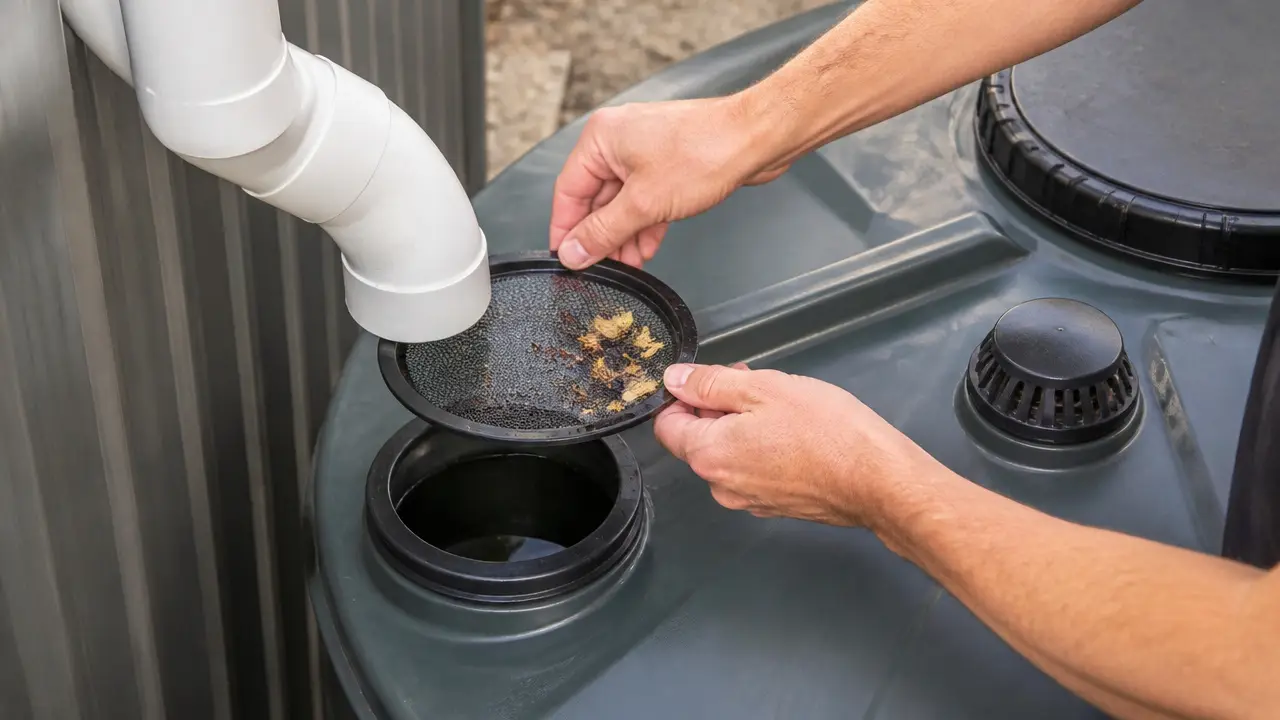
Keeping larger debris out of the tank with appropriate inlet screening and prefiltration can reduce this problem.
A Float Switch Should Be Easy to Inspect
Reliability depends partly on maintenance.
At reasonable intervals, check that the float:
- Moves freely
- Has not become wrapped around a cable
- Is not blocked by sediment or debris
- Has not shifted from its mounting position
- Has no obvious cable damage
- Still activates the intended control
A switch protecting an important pump deserves more frequent attention than one operating a simple indicator light.
Never rely on a float switch indefinitely without checking its operation.
Avoid Excessive Pump Cycling
One common mistake is placing the pump's start and stop levels too close together.
Suppose a small vertical float starts a transfer pump whenever the water rises slightly. The pump removes that small amount of water and shuts off. More water arrives, and the process repeats.
This is called short cycling.
Frequent starting can be hard on pumps, relays, and other components.
A tethered float with a wider operating range or a two-switch controller can create more distance between the pump's start and stop levels.
Consider What Happens If the Switch Fails
Good system planning does not assume the switch will always work.
For example, if a tank-filling float fails in the "on" position, the tank should still have a properly sized overflow route.
If a low-water float fails, additional pump protection may help prevent damage.
Important systems sometimes use multiple controls, such as:
- Low-level float
- High-level float
- Pump controller
- Dry-run protection
- Overflow piping
- Alarm
You may not need every one of these. The right combination depends on what failure would cause.
What Is the Best Float Switch for a Rainwater Tank?
For many straightforward rainwater systems:
Choose a tethered float switch when you have a large tank and want a broad difference between start and stop levels.
Choose a vertical or side-mounted float switch when space is limited or when you want to detect one specific water level.
For pump control, make sure the electrical arrangement is suitable for the pump. A small float switch is often better used as an input to a relay, contactor, or dedicated pump controller rather than directly switching a motor.
The best choice is therefore not a particular brand or model. It is a switch that has the correct switching action, electrical rating, mounting style, materials, operating range, and space to move reliably inside your tank.
Frequently Asked Questions
Can a float switch turn a water pump on and off directly?
Some can, but only if the switch is specifically rated for the pump's voltage and electrical load. Motor starting current can be much higher than normal running current. Many systems use the float switch to operate a relay or pump controller instead.
Is a vertical or horizontal float switch better?
Neither is always better. Vertical switches are useful in narrow spaces and for detecting a specific level. Side-mounted or horizontal switches can be convenient when access through the tank wall is easier.
Is a tethered float better for a cistern?
It often is when there is plenty of open space. A tethered float can provide a wider difference between start and stop levels, which may reduce pump cycling.
Can I put a float switch in an IBC tote?
Yes, if the mounting method, switch dimensions, materials, and electrical design are suitable. Make sure the float cannot become trapped by the tote wall, plumbing, pump, or internal components.
Where should a low-water float switch be installed?
It should operate before the water becomes too low for the pump to draw reliably. The exact level depends on the pump intake position, tank shape, plumbing, and required pump submergence or suction conditions.
Can a float switch prevent a rainwater tank from overflowing?
It can control a pump or valve, but it should not be the only overflow protection. A rainwater tank should still have a properly designed overflow path for excess water.
How often should a float switch be checked?
Check it as part of routine tank and pump maintenance, and whenever the system behaves unexpectedly. Make sure it moves freely and is not blocked by debris, sediment, cables, or plumbing.