
As an affiliate, we may earn a commission from qualifying purchases. We get commissions for purchases made through links on this website from Amazon and other third parties.
Best Overall
Best Compact Threaded Sensor
Best Stainless Steel Pick
A float switch does not move water by itself. It gives an electrical signal when the water level rises or falls past a point. That signal can feed an alarm, controller, relay, or properly designed pump-control circuit.
The most important buying detail is the switch contact rating. Small float switches are usually not meant to carry the current of a water pump directly. Several products here specifically require a relay or contactor for pump control. Connecting a high-current AC pump straight through a tiny reed switch can damage the switch and create an unsafe control system.
The four switches here suit different installations. LEVEL SENSE has a long 15-foot cable and pipe-mount bracket for flexible high- or low-level detection. Madison's M8000 is a compact 1/8-inch NPT vertical switch. uxcell uses a stainless-steel vertical body and can be configured for rising or falling level logic. The six-piece PP set is useful for multi-level projects but has the most concerning reliability feedback.
Quick Comparison
| Float Switch | Best For | Mounting / Connection | Electrical Limit | Main Tradeoff |
|---|---|---|---|---|
| LEVEL SENSE 15-Foot | Remote high/low tank signal | Bracket for 1-4 in pipe; long wire lead | DC only, up to 1.5 A / 50 W | Needs relay or contactor for AC pump control |
| Madison M8000 | Compact through-wall or threaded mounting | 1/8-in NPT vertical stem | 30 W SPST | Pipe-mounted design does not include a mounting nut |
| uxcell Stainless M10 | Small vertical stainless sensor | Top or bottom vertical installation | Low-current signal device | Requires relay/contactor for pump loads |
| 6-Piece PP DP5200 Set | Several level points or spare sensors | Side-mounted horizontal switches | About 0.5 A maximum switch load | Failure-open/closed reports make redundancy important |
Decide What the Switch Should Do When Water Moves
A float switch can be wired or physically configured to change state when water rises or when it falls. The words normally open and normally closed describe the contact state under a defined float position, not whether the pump will fill or drain the tank.
For a pump that refills a tank, the controller may need the pump to start at low level and stop at high level. For a drainage pump, the logic is usually the opposite. Draw the desired sequence before connecting anything.
Some vertical floats can reverse their action by flipping the float on the stem. Cable-style floats can also be mounted to detect high or low level depending on orientation. Test the switch with a meter before connecting it to a control circuit.
A Long-Cable Switch for High or Low Level Detection
1 / 4
LEVEL SENSE 15-Foot Water Level Float Switch With Bracket

Cable Length
15 ft
Contact Rating
50 W
Control Use
High or low level detection
The LEVEL SENSE switch has the clearest role for a larger tank where the sensor is inside or near the water but the control equipment sits farther away. Its 15-foot lead reduces the need for a splice close to the tank, and the included bracket can mount to pipe from roughly 1 to 4 inches in diameter.
The switch can be arranged to detect either high or low level and is sealed for underwater use. Its contact rating is 50 watts, and the product specifically limits direct use to DC applications up to about 1.5 amps. For an AC pump, the float should operate a correctly selected relay or contactor rather than carry pump current itself.
Reliability is the reason to design a fail-safe around it. Some switches have lasted only months, and a failed level switch can leave a pump running dry or allow a tank to overflow. For a critical system, use independent overflow protection, dry-run protection, a second level switch, or another control layer appropriate to the consequence of failure.
Why It Works
- Fifteen-foot cable gives useful separation between the wet tank area and control equipment.
- Bracket supports a range of pipe diameters without requiring a small threaded tank penetration.
- Can be positioned for either high-level or low-level signaling.
What To Keep In Mind
- Direct contact rating is too small for most pump motors.
- Use a relay or contactor for AC pump control.
- A single float switch should not be the only protection against overflow or dry running when failure would cause damage.
A Compact 1/8-Inch NPT Vertical Switch
2 / 4
Madison M8000 Miniature Vertical Float Switch

Mounting Thread
1/8-in NPT
Switch Rating
30 W SPST
Lead Wires
24 in / 22 AWG
The Madison M8000 is the most compact threaded option in this group. Its polypropylene stem uses a 1/8-inch NPT mounting connection and the switch is rated at 30 watts SPST. That makes it suitable for a small tank, reservoir, treatment housing, or controller input where a large external float would take too much space.
The threaded design is important because this sensor is meant to screw into a compatible NPT port. It does not rely on a mounting nut in the way some panel-mounted float switches do. The 24-inch wire leads are shorter than the LEVEL SENSE cable, so the controller or a suitable junction point needs to be relatively close.
The operating direction deserves testing before final wiring. Depending on orientation and the float position, the signal can be opposite of what an installer expects. Some users have also experienced intermittent or failed switching. Test the float through several cycles with a meter before putting it in charge of a refill or pump-protection function.
Why It Works
- Small 1/8-inch NPT mounting thread fits compact tanks and equipment housings.
- Polypropylene construction suits many water-level sensing applications.
- 30 W SPST output is appropriate as a control signal for a suitable relay or low-power input.
What To Keep In Mind
- No mounting nut because the sensor is designed around a pipe-thread installation.
- Test the switching direction before wiring the controller logic.
- Use a separate rated device to switch pump current when the load exceeds the float's contact rating.
A Stainless Steel Vertical Level Switch
3 / 4
uxcell Stainless Steel M10 Vertical Float Switch

Body
Stainless steel
Length
116 mm
Configuration
Top or bottom tank level sensing
The uxcell switch is the metal-bodied choice for a compact vertical installation. Its 116 mm stainless-steel stem can be installed from the top or bottom of a tank depending on the level function you need. The float can also be reversed on the stem to change the contact behavior.
That flexibility is useful for a controller input, alarm signal, or low-current automation project. The important limitation is explicit: it should not directly switch a solenoid valve, high-power relay, pump motor, or AC contactor load. A small relay or other suitable interface is needed between the float signal and higher-power equipment.
A level switch can fail even when the metal body looks durable. One failure-open or failure-closed event can flood an area or leave a pump running. Mineral buildup can also interfere with free float movement over time. Inspect the stem, make sure the float slides freely, and design the control so one failed sensor does not create the worst possible outcome.
Why It Works
- Stainless-steel body gives a different construction option from the plastic switches here.
- Top- or bottom-mount arrangement supports several tank-control layouts.
- Reversing float orientation can change the switching logic without replacing the sensor.
What To Keep In Mind
- Not designed to carry pump or solenoid current directly.
- Mineral deposits can eventually restrict float movement.
- Critical fill or pump-protection systems benefit from redundant level protection.
A Six-Pack for Multi-Level or Spare-Sensor Projects
4 / 4
6-Piece DP5200 PP Water Level Float Switch Set

Quantity
6 switches
Mounting
Side-mounted horizontal
Maximum Switch Load
About 0.5 A
The DP5200 set gives you six small polypropylene float switches, which can be useful when a project needs separate low, normal, and high-level signals or when you want spare sensors on hand. The switches mount horizontally through the side of a compatible tank or bracket.
The low-current limit is central to safe use. The product guidance puts the carried current around 0.5 amp and calls for a relay or contactor when controlling a larger load. These are sensor contacts, not miniature pump switches.
Reliability is the largest drawback. Some users have kept them operating outdoors for years, while others experienced units that failed in the on position or did not work consistently. If you use this set for a hobby or non-critical controller, test every switch before installation. For a system where a failed sensor can flood a room or destroy a pump, use a more robust control design with redundancy and independent protection.
Why It Works
- Six sensors support multi-level control or provide immediate spare switches.
- Horizontal side mounting can suit narrow reservoirs where a long vertical stem will not fit.
- Simple low-current contacts interface easily with a controller or relay input.
What To Keep In Mind
- Direct current capacity is only about 0.5 amp.
- Failure reports make them a poor single point of protection for a high-consequence system.
- Hole size and bracket fit should be checked before modifying a tank wall.
Use a Relay or Contactor for Pump Motors
A float switch is often best thought of as a signal. The relay or contactor is the device that handles the motor load.
Pump motors can draw much more current at startup than during normal running. The switching device needs to be rated for the actual motor, voltage, and duty—not merely the pump's average wattage.
If you are not experienced with electrical control wiring, have a qualified professional design or install the circuit. Water-level automation combines electricity, wet locations, and unattended equipment, so improvised wiring is a poor place to learn by trial and error.
Build a Fail-Safe Around the Float
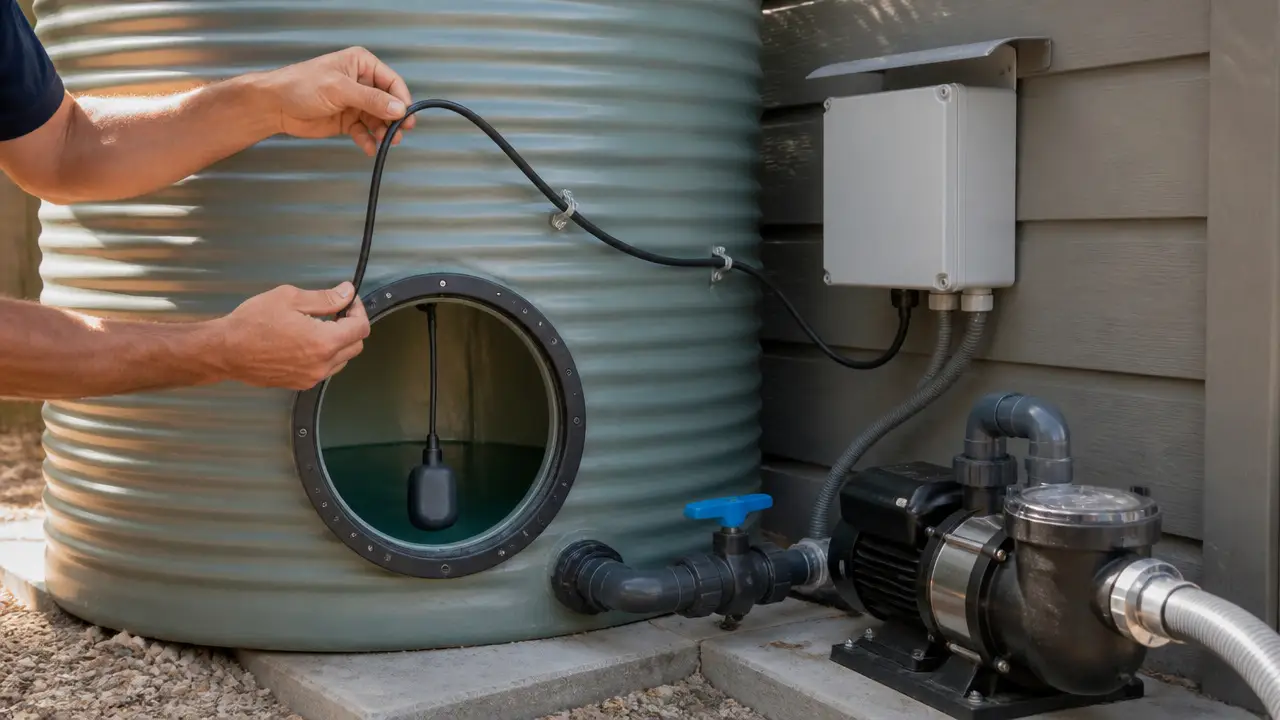
For a fill pump, consider an independent high-level alarm or overflow path. For a pump pulling from a rainwater tank, use appropriate dry-run protection so one low-level switch failure does not destroy the pump.
Two switches can also create a start and stop band instead of cycling at one exact point. The controller needs to be designed for that logic; simply wiring multiple switches together without understanding their contact states can create the opposite behavior.
Keep the Float Clear of Tank Hardware
A float must move freely. Keep it away from hoses, pump cables, inlet turbulence, tank ribs, screens, and sediment. A switch that is electrically perfect can still fail mechanically if the float gets trapped.
Test the control through a full rise-and-fall cycle before leaving it unattended. Repeat that test during periodic maintenance.
Frequently Asked Questions
Can a float switch turn a water pump on directly?
Usually not with small level switches like these. Their contacts are intended for low-current signaling. A properly rated relay, contactor, or pump controller should handle the motor load when required.
What is the difference between a float valve and a float switch?
A float valve mechanically opens or closes a water supply. A float switch changes an electrical contact so another device can respond to the water level.
What does normally open mean on a float switch?
It describes the contact state in a defined float position when the circuit is not actuated. Always test the actual switch orientation because flipping or mounting the float differently can reverse the behavior on some models.
Can I use one float switch for both high and low level control?
A single switch detects one transition point. Some cable floats can be positioned for either high or low detection, but maintaining a separate start and stop level usually requires two sensors or a controller with another sensing method.
Why did my float switch fail to stop the pump?
Possible causes include stuck float movement, failed contacts, incorrect wiring logic, excessive electrical load, a broken cable, or a relay/control failure.
Are stainless float switches better than plastic ones?
Not automatically. Material must suit the water and environment, but contact quality, mounting, electrical load, deposits, and control design can matter more than the outer material alone.
Should a rainwater tank have a backup high-level alarm?
It is a sensible extra layer when a failed fill control could cause flooding or water waste. The right backup may be an alarm, second switch, overflow, or independent controller depending on the system.
For mechanical water-level control without electrical wiring, float valves for water tanks serve a different purpose. Remote level viewing is covered by wireless water tank level monitors. A simple alarm-only layer is available in water level alarms, while automatic pump controllers cover the pump-control hardware that sits beyond a basic level signal.