
As an affiliate, we may earn a commission from qualifying purchases. We get commissions for purchases made through links on this website from Amazon and other third parties.
Best Overall
Best Replacement Screen
Best for Rain Barrels
A tank inlet screen is the last easy place to catch leaves, insects, roof grit, and other coarse debris before rainwater enters storage. The right screen needs to fit the actual opening, pass storm flow without backing up, and come out easily enough that you will clean it when needed.
IBC totes create a special fit problem because many lid-filter kits use metric pipe dimensions that do not match standard U.S. PVC. A product can fit the tote lid perfectly and still leave you searching for a transition fitting above it. Rain barrels are simpler when you can cut a known-size opening and drop in a removable basket screen.
The six options here include complete IBC lid-and-filter assemblies, simple replacement filter bags, a drawstring mesh cover, and a 6-inch cut-in rain-barrel screen. Choose the format first; then compare mesh and cleaning needs.
Rainwater Tank Inlet Screens at a Glance
| Product | Best For | Key Strength | Main Tradeoff |
|---|---|---|---|
| DVECUE 45° IBC Lid Filter | Most IBC tote systems | Complete angled lid, filter, and PVC fitting | Fine mesh can clog quickly with roof grime |
| DVECUE 3-Way IBC Lid Filter | Branching or overflow layouts | Lid, washable filter, and vertical three-way fitting | Supplied pipe is an awkward non-standard size |
| samou Straight IBC Lid Filter | Straight-down inlet | Removable filter and straight connector | Connector dimensions are not standard U.S. PVC sizes |
| brougetme IBC Nylon Filters | Replacing only the mesh | Two washable fine-mesh filter bags | Requires the correct lid opening and can clog fast |
| TIONLCLC IBC Mesh Cover | Simple top cover | Drawstring-style cover needs little plumbing work | Surface mesh can clog with leaves and organic film |
| ANTOBLE 6 Inch Screen | DIY rain barrels | Known 6-inch cut-in size and removable basket | Requires cutting the barrel lid accurately |
Best Overall: DVECUE 45° IBC Tote Lid Filter
1 / 6
DVECUE 45° IBC Tote Lid Filter

Lid
165 mm IBC style
Fitting ID
75 mm / 2.95 in
Fitting OD
84 mm / 3.3 in
The 45-degree DVECUE kit is the most complete starting point for a 275-gallon IBC tote because it combines the tote lid, washable nylon filter, and angled pipe connection in one assembly. The documented fitting dimensions are 75 mm inside and 84 mm outside, which gives you useful numbers for planning the downspout transition.
The angled entry can help when a downpipe approaches the tote from the side rather than dropping perfectly vertically. The filter catches bugs, leaves, and roof debris before water reaches the tote. It can be pulled out, turned inside out, rinsed, and returned to service.
The main limitation is exactly what makes the filter effective: fine mesh can load up quickly with roof grime. A small amount of dirty runoff can slow flow enough to cause backup in the pipe above it. The fitting also should not be assumed to match standard U.S. PVC just because its inside diameter is close to 3 inches.
Why It Works
- The lid, mesh filter, and angled inlet are already designed as one IBC assembly.
- Clear metric fitting dimensions make adapter planning easier.
- The washable filter is accessible from the top of the tote.
- The angled connection can simplify side-entry downspout routing.
What To Keep In Mind
- Fine mesh needs frequent cleaning during dirty roof runoff.
- Standard PVC fit should not be assumed.
- Keep enough access above the tote to remove the filter bag.
- This is coarse debris control, not a drinking-water treatment stage.
Best for a Branching Inlet: DVECUE 3-Way IBC Lid Filter
2 / 6
DVECUE 3-Way IBC Tote Lid Filter
PVC Fit
2.95 in nominal
Filter
Washable nylon
Layout
Vertical three-way
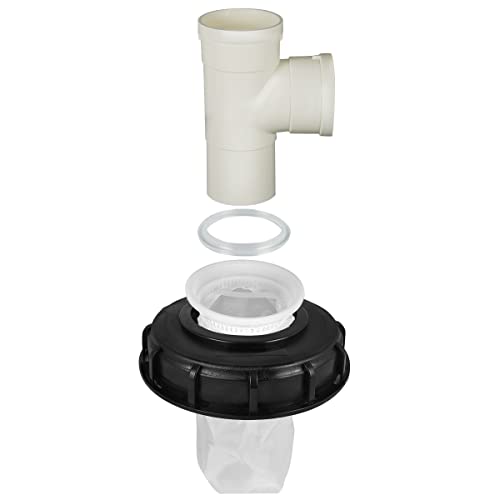
This DVECUE version uses a vertical three-way fitting above the tote lid, which can be useful when you want a more complex inlet or overflow layout than a simple straight pipe. The lid itself fits standard-style IBC tote openings, and the nylon filter can be removed for rinsing.
The problem is the supplied pipe connection. It is described around a 2.95-inch PVC size, but standard U.S. 3-inch pipe is not a reliable direct fit. Several installations needed rubber adapters, tape, or other improvised transitions. That makes this kit best for someone who is comfortable building a deliberate metric-to-local-pipe connection.
The filter mesh can also be too fine for a dirty roof if it is the only debris-control stage. Leaves and roof grit can fill the bag quickly and push water back up the inlet. A gutter guard or downspout filter upstream reduces that load.
Why It Works
- The three-way fitting gives more routing options than a straight inlet.
- The tote lid and filter are already paired.
- The nylon bag is washable and reusable.
- It can work well when the adapter path is planned before installation.
What To Keep In Mind
- The supplied pipe does not reliably mate with standard 3-inch U.S. PVC.
- The filter may clog rapidly when roof debris reaches it directly.
- Do not force mismatched pipe into the fitting.
- Leave room to remove the filter for cleaning.
Best Straight IBC Inlet: samou IBC Lid Filter
3 / 6
samou Straight IBC Lid Filter

Style
Straight inlet
Filter
Washable nylon
Use
IBC rainwater tote
The samou filter is the cleaner choice when your downspout can drop straight toward the tote. The assembly combines an IBC lid, removable mesh filter, and straight connector instead of the angled or three-way layouts used by the DVECUE kits.
It has worked well as a debris barrier during both roof collection and tote-to-tote transfer. A straight layout also reduces the number of direction changes in the inlet path, which can make the plumbing easier to support.
The connector is again the weak point for U.S. plumbing. Its dimensions do not line up neatly with common schedule 20, 40, or 80 PVC, and some users removed the supplied fitting and adapted the lid another way. Because the available dimension and material details conflict, this guide avoids using disputed body measurements as a fit promise.
Why It Works
- The straight inlet suits a downpipe positioned directly above the tote.
- The mesh filter can be removed and washed.
- The lid can still be useful even if the supplied connector is replaced.
- It catches debris before water reaches pumps or valves downstream.
What To Keep In Mind
- The supplied connector is not a standard U.S. PVC size.
- Exact dimensions are omitted where the product fields disagree.
- The mesh still needs cleaning when roof sediment builds up.
- Plan the pipe transition before permanently positioning the tote.
Best Replacement Screen: brougetme IBC Nylon Lid Filters
4 / 6
brougetme IBC Nylon Lid Filters

Pack
2 filters
Mesh
200 mesh
Dimensions
4 in diameter
The brougetme filters make sense when you already have a compatible IBC lid and only need the removable mesh element. The two-pack avoids buying another pipe assembly, and the fine nylon mesh can be rinsed and reused.
The 200-mesh fabric catches small debris, but that also means it can choke flow quickly. In a roof-fed system with no upstream leaf screen, runoff can back up in the pipe within minutes once the bag fills with dirt and organic material. This screen works best as a final polish for coarse debris, not as the first and only filter after the gutter.
Fit must be checked carefully. These bags do not fit every IBC lid opening, and the wrong cap size leaves you with a filter that cannot seat correctly. Measure the opening you already have rather than assuming all tote caps are identical.
Why It Works
- You get two washable filters without buying a complete lid kit.
- Fine mesh catches smaller roof debris than a coarse basket.
- The lightweight filter is easy to remove and rinse.
- It can help protect pumps and check valves during tote transfer.
What To Keep In Mind
- Fine 200 mesh can clog very quickly.
- The filter needs the correct lid opening.
- It is not universal across all IBC caps.
- Use upstream debris control to reduce the cleaning burden.
Best No-Cut Cover: TIONLCLC IBC Mesh Cover
5 / 6
TIONLCLC IBC Mesh Cover

Flat Diameter
9.8 in
Attachment
Adjustable drawstring
Use
IBC top opening
The TIONLCLC cover is the least plumbing-heavy option here. It is a flat mesh cover that sits over the tote opening and tightens with an adjustable cord. That can work when you do not need a rigid pipe connection and simply want a removable barrier over the inlet.
Its 9.8-inch flat diameter gives a useful sizing reference, and the cord can be retightened after storms. The cover can also be lifted away quickly for cleaning or tote transfer.
The tradeoff is exposed surface area. Leaves can sit directly on the mesh, and a dark organic film can develop when debris stays wet. Once that happens, flow drops sharply. The material fields are mixed, so this guide does not use a specific polymer as the reason to choose it. The practical advantage is the drawstring format.
Why It Works
- It installs without cutting a new hole or building a pipe adapter.
- The drawstring can fit around a range of compatible top openings.
- The cover lifts off quickly for cleaning.
- It works well as a simple screen during tote-to-tote transfer.
What To Keep In Mind
- Surface debris can clog the mesh quickly.
- Retighten the cord if the cover shifts after storms.
- The mesh can tear if pulled hard during installation.
- It is best paired with cleaner incoming water from upstream screens.
Best for Rain Barrels: ANTOBLE 6 Inch Rain Barrel Screen
6 / 6
ANTOBLE 6 Inch Rain Barrel Screen

Opening
6 in
Dimensions
6.69 x 6.69 x 0.98 in
Style
Drop-in basket
The ANTOBLE screen is the clearest choice when you are building a rain barrel from a plastic drum rather than connecting an IBC tote. It is designed around a 6-inch hole and drops into the barrel lid as a removable basket screen.
That known opening size makes installation straightforward: trace the screen, cut the hole carefully, smooth the edge, and insert the basket. The screen stays accessible from above, so you can lift it out when leaves or roof grit collect.
The available material details are mixed between aluminum and stainless components, so this guide focuses on the physical design rather than promising one metal throughout. A snug 6-inch opening is the important fit detail. Cut too large and the basket can sit loosely; cut too small and it will not seat.
Why It Works
- The 6-inch cut-in size gives DIY builders a clear installation target.
- The basket can be removed without disconnecting downspout plumbing.
- Fine mesh helps keep larger debris and insects out of the barrel.
- The low-profile screen works well in removable barrel lids.
What To Keep In Mind
- Measure and cut the opening carefully.
- The screen still needs regular cleaning during dirty runoff.
- Mixed material fields mean corrosion resistance should not be generalized beyond the documented components.
- Use appropriate sealing around the cut edge when the barrel design requires it.
How to Choose a Tank Inlet Screen
Start With the Opening You Already Have
IBC totes, rain barrels, and custom tanks use different lid sizes. Measure the opening or cap before choosing a screen. For IBC hardware, also identify whether the downpipe connection is metric or standard U.S. PVC.
A screen that fits the lid but not the pipe can still be useful, but you need to budget for the correct transition fitting. Avoid forcing near-fit pipe together because a stressed joint above the tank is likely to leak or separate.
Match Mesh Fineness to Upstream Debris Control
Fine mesh catches more material but needs more cleaning. If your gutters and downspouts already have leaf guards and rain heads, a fine inlet bag can work well as a final coarse-debris stage.
If raw roof runoff reaches the tank, a tiny filter bag can plug almost immediately. In that case, improve debris control upstream rather than relying on one small inlet screen to handle the entire roof load.
Keep the Screen Easy to Remove
A tank inlet should be serviced from a safe standing position. Do not bury the filter under permanent pipework that must be dismantled every time the mesh clogs.
Angled and straight IBC kits are most useful when the filter can still lift out. A drop-in barrel basket is even simpler because the whole screen comes out from the lid.
Watch for Flow Backup
During the first heavy rain, inspect the inlet. Water should pass through the screen without rising back into the downpipe. If the filter clogs faster than expected, use a coarser upstream stage or increase cleaning frequency.
Overflow routing still needs to work even when the inlet is partially restricted. A blocked filter should not turn the downspout into a pressurized pipe.
Frequently Asked Questions
What mesh size is best for a rainwater tank inlet?
There is no single best mesh. Fine mesh catches more debris but clogs faster. Use upstream gutter and downspout screening so the tank inlet only has to catch the material those stages miss.
Do all IBC tote lid filters fit standard 3-inch PVC?
No. Several IBC filter kits use metric dimensions near 3 inches but do not directly fit common U.S. PVC schedules. Measure both parts and plan the adapter before installation.
Can an inlet screen keep mosquitoes out?
A fine, well-seated screen can help block insects at that opening, but the whole tank also needs screened vents, closed lids, and no other insect entry points.
How often should I clean a tank inlet screen?
Check it during the first storms and whenever nearby trees drop leaves, pollen, seeds, or needles. Clean it before flow becomes restricted enough to back water up the inlet pipe.
Is an IBC filter bag enough for dirty roof runoff?
Usually not by itself. A small fine-mesh bag can clog quickly. Gutter guards, downspout filters, and first-flush control can reduce the debris load before water reaches the tote.
Does an inlet screen make rainwater safe to drink?
No. It only removes coarse physical debris. Drinking-water use requires suitable collection, treatment, current laboratory testing, maintenance, and applicable local requirements for the complete system.
For earlier debris control before water reaches the tank, downspout filters reduce the load on a small inlet screen. Gutter guards for rainwater harvesting can keep larger roof debris out of the gutter itself. If you are building a standard barrel rather than an IBC tote, rain barrel screens cover more barrel-specific inlet options.