
As an affiliate, we may earn a commission from qualifying purchases. We get commissions for purchases made through links on this website from Amazon and other third parties.
Best Overall
Best 115V Option
Best for Built-In Pulsation Control
Diaphragm pumps are a good fit for small pressurized rainwater systems because they can self-prime, tolerate intermittent demand, and use a pressure switch to start when an outlet opens. They are especially common in 12V freshwater systems, cabins, mobile setups, and compact utility installations where a large centrifugal pump would be unnecessary.
The important differences are flow, pressure, chamber design, power supply, and how the pump handles small demand. SEAFLO's 55 Series offers the most flow and uses a five-chamber design with bypass control. The 42 Series is the straightforward 115V choice. SHURFLO's Revolution 4008 gives a moderate 3 GPM 12V option. Flojet's triplex pump adds built-in pulsation control, while SEAFLO's 21 Series serves very small one-fixture systems.
A diaphragm pump can move rainwater, but it does not make the water suitable for a particular use. If the system supplies potable fixtures, every part of the collection, storage, treatment, pump, plumbing, maintenance, and current testing plan has to be suitable for drinking-water service.
Quick Comparison
| Pump | Best For | Flow | Pressure | Diaphragm / Control Advantage | Main Tradeoff |
|---|---|---|---|---|---|
| SEAFLO 55 Series | Higher-flow 12V pressure systems | 5.5 GPM | 60 PSI | Five-chamber design with bypass | More electrical demand and more setup sensitivity |
| SEAFLO 42 Series | Plug-in AC systems | 4.0 GPM | 55 PSI | Automatic demand switch | Long runs can create substantial heat |
| SHURFLO Revolution 4008 | Moderate 12V systems | 3.0 GPM | 55 PSI | Automatic bypass demand design | Replacement mounting may not match older pumps |
| Flojet 03526-144A | Compact smooth-flow systems | 2.9 GPM | 50 PSI | Triplex design with pulsation control | Needs careful winter draining |
| SEAFLO 21 Series | One light-duty fixture | 1.2 GPM | 35 PSI | Compact low-current pressure pump | Limited simultaneous flow |
Why Diaphragm Pumps Work Well With Stored Water
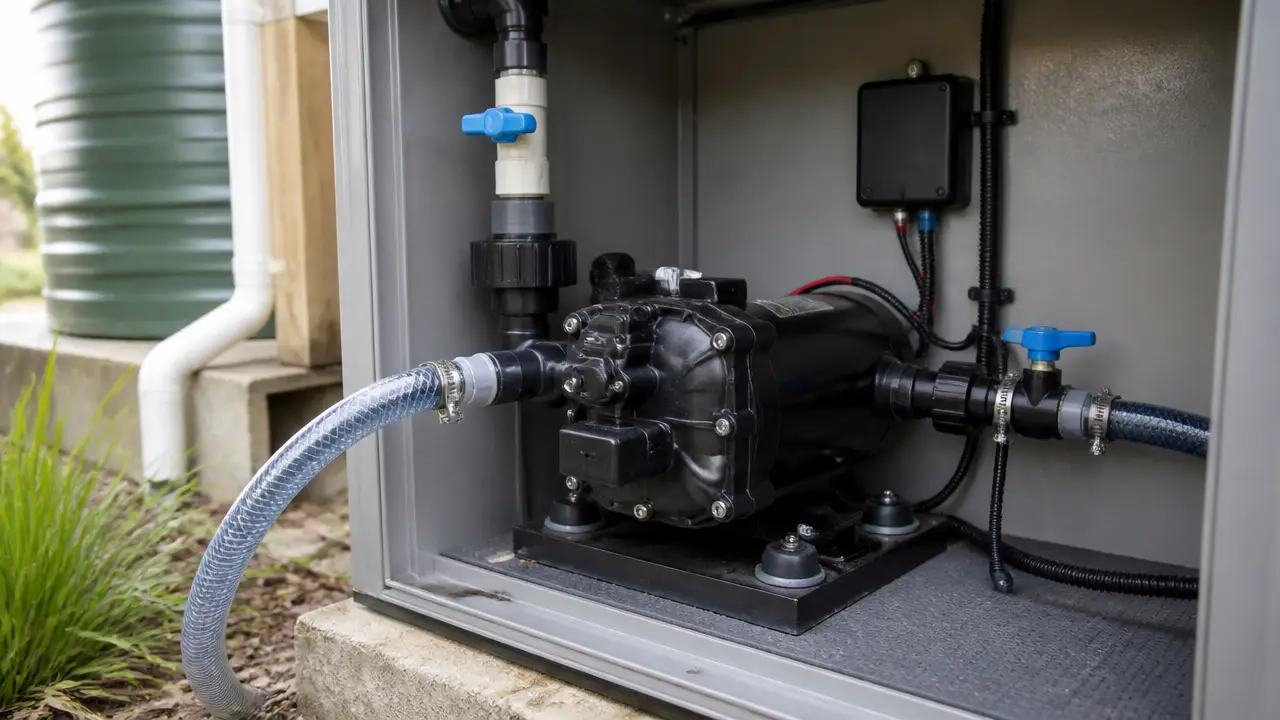
A diaphragm pump uses flexible pumping chambers and check valves instead of relying on a continuously flooded centrifugal impeller. That lets many models pull water from a tank below the pump and recover prime after short interruptions.
The pressure switch also makes diaphragm pumps practical for intermittent demand. Open a faucet and pressure falls, starting the motor. Close it and pressure rises until the switch stops the pump.
The drawback is pulsation and cycling. Each diaphragm stroke moves a small volume of water. A well-designed multi-chamber pump smooths those pulses, but restrictive plumbing or tiny demand can still make the pump cycle rapidly. Internal bypass and compatible accumulator tanks are two ways systems may manage that behavior.
A Five-Chamber Pump for Higher 12V Flow
1 / 5
SEAFLO 55 Series 12V 5.5 GPM Diaphragm Pump

Chambers
5
Maximum Flow
5.5 GPM
Pressure
60 PSI
The SEAFLO 55 Series has the strongest diaphragm-specific advantage in this group: a five-chamber design paired with up to 5.5 GPM and 60 PSI. More pumping chambers can help smooth output and support higher flow while the built-in bypass reduces the need for the pressure switch to cycle constantly during smaller demands.
It is built for 12V DC systems and can self-prime up to nine feet. The included 50-mesh strainer and two 1/2-inch barbed adapters make it easier to protect the pump and connect flexible freshwater plumbing. That makes it a strong fit for a battery-backed cabin, off-grid utility line, or multi-outlet small rainwater system.
Higher flow does make the installation less forgiving. The electrical supply must handle the pump's current without voltage drop, and the inlet needs enough diameter to avoid starving the chambers. Users have also encountered rapid cycling or poor shutoff behavior when the bypass and pressure-switch setup did not match the plumbing well. Treat the 12V operating configuration as authoritative and omit conflicted material and voltage details.
Why It Works
- Five-chamber design supports the highest flow in this diaphragm-pump group.
- Built-in bypass helps smooth smaller demands and reduce unnecessary switch cycling.
- Nine-foot self-prime rating gives useful placement flexibility above a rainwater tank.
What To Keep In Mind
- A high-flow 12V pump needs properly sized wiring, fuse protection, and battery capacity.
- Poor bypass or pressure-switch setup can lead to rapid cycling or failure to shut off cleanly.
- Keep the inlet strainer accessible because debris restriction can starve the pump.
A Plug-In 115V Diaphragm Pump
2 / 5
SEAFLO 42 Series 115V AC Diaphragm Pressure Pump

Maximum Flow
4.0 GPM
Pressure
55 PSI
Self-Priming
Up to 6 ft
The SEAFLO 42 Series keeps the automatic diaphragm-pump behavior but uses a standard 115V AC power configuration. For a shed, utility room, or equipment area with a suitable protected outlet, that can be much simpler than designing a 12V battery and wiring system.
Its 4 GPM output and 55 PSI shutoff pressure fit a small pressurized rainwater network with intermittent demand. The pump includes a 50-mesh strainer, two 1/2-inch hose-barb fittings, and a wall plug. It is also documented as self-priming up to six feet and capable of brief run-dry operation within its design.
The main limitation is duty cycle. Continuous demand can make the pump very hot. Diaphragm pressure pumps are at their best when fixtures open and close, not when they are asked to behave like a bulk-transfer pump for long uninterrupted periods. Use the exact 115V configuration and avoid relying on the conflicting voltage wording elsewhere in the product data.
Why It Works
- 115V wall-plug power makes it easy to integrate where AC service is already available.
- 4 GPM and 55 PSI suit small intermittent pressure loads.
- Included strainer and hose fittings cover basic inlet protection and plumbing setup.
What To Keep In Mind
- Heat can build quickly during extended high-flow use.
- A six-foot self-prime rating does not remove the benefit of a short, easy suction path.
- This is an intermittent pressure pump, not a substitute for a continuous-duty transfer pump.
A Moderate 3 GPM Bypass Pump
3 / 5
SHURFLO Revolution 4008-101-E65 Diaphragm Pump

Maximum Flow
3.0 GPM
Pressure
55 PSI
Control
Automatic demand with bypass
SHURFLO's Revolution 4008 is a practical middle-size diaphragm pump at 3 GPM and 55 PSI. It suits systems that need more than one tiny outlet can use but do not need the extra flow and current draw of a 5.5 GPM pump. Its automatic bypass design is intended to make low-flow demand smoother and reduce cycling.
The pump is designed for 12V freshwater pressure service and can tolerate brief dry running. That makes it useful around tanks where the water level may occasionally drop below the pickup during cleaning or seasonal shutdown. Flexible plumbing and vibration-isolating mounts help keep diaphragm pulses from being transmitted through cabinet walls or rigid pipe.
Do not assume a replacement pump will bolt into an older installation. Users have found differences in height, mounting holes, and bracket position. Check the body size and port orientation before removing the existing pump, especially in a tight pump compartment.
Why It Works
- 3 GPM is a useful middle ground for modest rainwater fixture demand.
- Automatic bypass helps the diaphragm pump handle lower flows more smoothly.
- Run-dry protection provides some tolerance during brief loss of water supply.
What To Keep In Mind
- Mounting pattern may differ from the pump being replaced.
- Rigid plumbing can amplify vibration and pump noise.
- Flow capacity still needs to cover the fixtures that may run at the same time.
A Triplex Pump With Built-In Pulsation Control
4 / 5
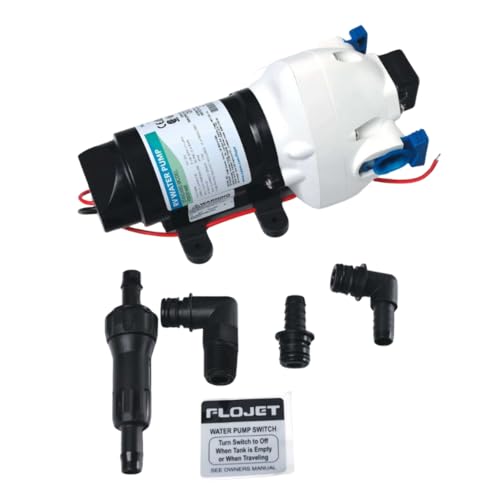
Flojet 03526-144A Triplex Diaphragm Pump
Pump Design
Triplex
Maximum Flow
2.9 GPM
Pressure
50 PSI
The Flojet 03526-144A uses a triplex diaphragm arrangement and a built-in pulsation eliminator. That gives it a clear role where smoother small-system flow matters and you would prefer not to add an accumulator tank automatically. The pump delivers up to 2.9 GPM at a 50 PSI pressure setting.
It self-primes up to nine feet and uses 1/2-inch snap-in ports. Soft mounting points help isolate vibration, while the totally enclosed permanent-magnet motor suits a compact equipment space better than an open transfer-pump motor.
The weak point is cold-weather care. Water held inside the pump can freeze and break internal parts. It needs complete winterization in freezing climates. Also check that the snap-in port fittings are present and seated correctly before startup; a small inlet leak can cause priming trouble even without visible water escaping.
Why It Works
- Triplex design and built-in pulsation control target smoother pressure delivery.
- Nine-foot self-prime rating gives flexibility when the pump sits above storage.
- 2.9 GPM and 50 PSI fit compact freshwater-style rainwater systems.
What To Keep In Mind
- Drain and winterize carefully before freezing weather.
- Snap-in fittings are essential parts of the plumbing connection.
- Built-in pulsation control does not guarantee that every system can skip an accumulator.
A Small Diaphragm Pump for One Fixture
5 / 5
SEAFLO 21 Series 12V 1.2 GPM Diaphragm Pump

Maximum Flow
1.2 GPM
Pressure
35 PSI
Current Draw
About 4 A
The SEAFLO 21 Series is the small-system choice. At 1.2 GPM and 35 PSI, it is designed for a single fixture or similarly light demand. The low output is not a flaw when the goal is one rainwater-fed sink, a compact wash station, or a low-flow off-grid outlet.
Its 12V motor draws about four amps, which reduces battery and wiring demands compared with the larger pumps. It self-primes up to four feet and has run-dry capability within its documented design. The compact body also fits equipment spaces where a five-chamber pump would be unnecessary.
The pump becomes a poor choice as soon as several outlets need to operate together. Noise is also installation dependent and can be louder than expected. Choose it because the water demand is genuinely small, not because the light weight or compact body looks convenient.
Why It Works
- 1.2 GPM is appropriately scaled for one small outlet.
- Low current draw is easier to support from a small battery system.
- Compact design fits tight rainwater equipment spaces.
What To Keep In Mind
- Limited flow for simultaneous fixtures.
- Mounting and hose isolation affect perceived noise.
- Use the supported 12V two-wire configuration rather than conflicting voltage or dimension details.
How Chamber Count Changes the Feel of the Pump
A diaphragm pump moves water in pulses. With more chambers operating out of phase, the pulses can overlap and create smoother flow. That is one reason a five-chamber pump can feel different from a smaller triplex or compact pump even when both reach similar pressure.
Chamber count is not the only factor. Internal bypass, check-valve design, plumbing elasticity, accumulator volume, and fixture flow all affect cycling and pulsation.
Buy from the system demand first. A one-fixture setup does not need a five-chamber high-flow pump simply because more chambers sound better.
Self-Priming Is Useful, but Keep the Inlet Easy
Self-priming lets the pump sit above the water level and pull water up from a tank. The ratings here range from about four to nine feet.
Actual priming becomes harder with a long suction hose, small diameter, dirty strainer, air leaks, and many fittings. Mounting the pump close to the tank and below or only slightly above the normal water level reduces strain and usually gives quieter operation.
Use flexible reinforced hose where required by the pump. A soft inlet tube that collapses under suction can make a good pump look weak.
Prevent Freeze Damage and Debris Problems
Diaphragm pumps contain small chambers and check valves where water can remain after the system stops. In a freezing climate, drain and winterize them according to the manufacturer's directions.
Keep sediment out with an accessible inlet strainer and sensible tank maintenance. Fine pump strainers protect internal valves; they are not a replacement for roof debris control, tank cleaning, or treatment needed for the intended water use.
Frequently Asked Questions
Are diaphragm pumps good for rainwater tanks?
They can be very useful for small pressurized systems because many self-prime, start automatically with demand, and work well with intermittent fixture flow.
What is the difference between a diaphragm pump and a transfer pump?
A diaphragm pressure pump is often designed to maintain pressure and cycle with fixture demand. A transfer pump mainly moves water from one place to another and may require manual start and stop.
How many GPM should a diaphragm pump provide?
Choose enough flow for the outlets that may operate at the same time. One small fixture may need only 1.2-3 GPM, while several outlets can justify 4-5.5 GPM or a different pump class.
Do diaphragm pumps need an accumulator tank?
Not always. Some use internal bypass or pulsation control. A compatible accumulator can still smooth demand and reduce cycling in systems designed for one.
Can a diaphragm pump run dry?
Some models have documented run-dry capability, but it varies by pump. Run-dry protection is a safeguard, not a reason to operate without water routinely.
Why is my diaphragm pump pulsing?
Pulsing can come from the pumping chambers themselves, very low fixture flow, restrictive plumbing, air in the system, or rapid pressure-switch cycling. Bypass settings or a compatible accumulator may help when appropriate.
Can a diaphragm pump be used for potable rainwater?
Only when the exact pump and the entire rainwater system are suitable for that use. Potable service requires appropriate collection, treatment, plumbing materials, maintenance, current testing, and local compliance.
For automatic fixture behavior, on-demand pumps for rainwater systems focuses on pressure-switch use. If the main goal is simply higher outlet pressure, booster pumps for rainwater systems compares the same problem from system pressure and power. Bulk moves between tanks are better served by transfer pumps for rainwater, while submersible pumps for rainwater tanks avoid a suction line by placing the pump in the water.