
As an affiliate, we may earn a commission from qualifying purchases. We get commissions for purchases made through links on this website from Amazon and other third parties.
Best Overall
Best for Higher 12V Flow
Best Moderate 12V Pick
An on-demand pump starts when a faucet, hose nozzle, or other outlet lowers system pressure and stops when the outlet closes. That behavior is what separates it from a simple transfer pump. For a small rainwater system, the pump has to match the expected fixture flow while cycling cleanly instead of running nonstop or switching on and off every few seconds.
The five options here are diaphragm-style freshwater pumps with automatic-demand roles. SEAFLO's 42 Series is the simplest plug-in 115V choice. The 55 Series offers the most 12V flow. SHURFLO's Revolution 4008 is a moderate 3 GPM option. Flojet's triplex pump offers a compact 2.9 GPM alternative, while SEAFLO's 21 Series is best kept to a single light-duty outlet.
Fixture demand and controls should be matched to rainwater pump pressure requirements before choosing an on demand model.
On-demand operation does not mean “install anywhere and forget it.” The inlet has to stay supplied with water, the electrical system has to support the motor, and downstream plumbing must be rated for the operating pressure. A rainwater tank also needs suitable filtration and treatment for its intended water use; the pressure pump does not improve water quality.
Quick Comparison
| Pump | Best For | Flow | Pressure | Power | Main Tradeoff |
|---|---|---|---|---|---|
| SEAFLO 42 Series | Small AC-powered fixture systems | 4.0 GPM | 55 PSI shutoff | 115V AC | Can run hot during long demand periods |
| SEAFLO 55 Series | Higher-flow 12V demand | 5.5 GPM | 60 PSI | 12V DC | Bypass and switch behavior need a well-matched system |
| SHURFLO Revolution 4008 | Moderate 12V demand | 3.0 GPM | 55 PSI | 12V | Mounting fit can differ from older pumps |
| Flojet 03526-144A | Compact 12V alternative | 2.9 GPM | 50 PSI | 12V | Must be drained carefully before freezing |
| SEAFLO 21 Series | One light-duty outlet | 1.2 GPM | 35 PSI | 12V DC | Not enough flow for larger simultaneous demand |
What Makes an On-Demand Pump Work Well
The pressure switch needs a stable system to react to. When a faucet opens, pressure drops and the pump starts. When the faucet closes, pressure rises until the pump reaches its shutoff setting.
Problems begin when the plumbing demand is much smaller than the pump's minimum comfortable flow. The pump can build pressure almost instantly, stop, then start again a moment later. That rapid cycling creates noise and wear. A pump with internal bypass control can smooth some low-flow conditions, while compatible systems may use an accumulator tank.
The inlet side matters just as much. A clogged strainer, soft hose that collapses, tiny pipe, or air leak can make an on-demand pump noisy and weak. Keep the run from tank to pump short, clean, and properly sized whenever possible.
The Simplest Plug-In On-Demand Choice
1 / 5
SEAFLO 42 Series 115V AC Water Pressure Pump

Flow
4.0 GPM
Shutoff Pressure
55 PSI
Self-Priming
Up to 6 ft
The SEAFLO 42 Series is the easiest option here for a small rainwater setup with safe 115V power nearby. Its built-in pressure switch starts the pump when a fixture opens, and the supplied wall plug removes the need to build a separate 12V electrical system. It also includes a 50-mesh inlet strainer and two 1/2-inch hose-barb fittings.
At up to 4 GPM and a 55 PSI shutoff setting, it has enough capacity for a small sink, washing point, hose nozzle, or another modest fixture combination without jumping to the highest-flow pump. Self-priming up to six feet gives some freedom to mount it above the tank outlet, though a shorter and easier suction path is still better.
The main weakness is heat during longer runs. Intermittent fixture demand suits an on-demand pump; continuous high-flow use is a different duty. If the application routinely asks the pump to run for long stretches, make sure its duty cycle fits that use instead of assuming the automatic pressure switch makes it a continuous-duty transfer pump.
Why It Works
- Built-in pressure switch gives true automatic start and stop with fixture demand.
- 115V plug-in power is simple where a suitable AC outlet already exists.
- 4 GPM is a useful middle range for small rainwater fixture systems.
What To Keep In Mind
- Long demand periods can create substantial heat.
- Keep the 50-mesh inlet strainer accessible for cleaning.
- Use the supported 115V configuration for this model rather than conflicting voltage wording.
Higher Flow for a 12V Demand System
2 / 5
SEAFLO 55 Series 12V 5.5 GPM Diaphragm Pump

Flow
5.5 GPM
Pressure
60 PSI
Self-Priming
Up to 9 ft
The SEAFLO 55 Series is the highest-flow on-demand pump in this group. Its five-chamber diaphragm design reaches up to 5.5 GPM and uses a 60 PSI pressure setting. That gives it more room for several small outlets or a higher-demand garden-water setup than the 1.2-3 GPM pumps.
It is also built around 12V DC power, which makes it useful for battery-backed, solar, RV-style, or off-grid rainwater systems. The pump includes a 50-mesh inlet strainer and 1/2-inch barbed adapters, and it can self-prime up to nine feet. An internal bypass is intended to reduce rapid cycling at lower flows.
That bypass and pressure switch need the plumbing to be matched well. A pump that will not shut off, cycles rapidly, or draws excessive current may be telling you that the system settings, demand, or electrical supply are wrong—or that the pump itself needs service. Do not keep adjusting control screws blindly. The 12V wiring and fuse also need to be sized for the motor's actual current.
Why It Works
- 5.5 GPM is the strongest flow in this on-demand group.
- Internal bypass can help smooth smaller demands that would make a simple switch pump cycle rapidly.
- Nine-foot self-prime rating gives useful placement flexibility around a tank.
What To Keep In Mind
- Higher flow can be unnecessary for one low-flow fixture.
- Pressure-switch or bypass problems can prevent clean shutoff.
- A 12V installation needs correctly sized wiring and overcurrent protection.
A Moderate 3 GPM Demand Pump
3 / 5
SHURFLO Revolution 4008-101-E65 12V Demand Pump

Flow
3.0 GPM
Pressure
55 PSI
Protection
Run-dry capable
SHURFLO's Revolution 4008 lands in the middle of the group at 3 GPM and 55 PSI. That is enough for a modest freshwater-style rainwater system without the larger electrical draw and extra flow of a 5.5 GPM pump. It uses automatic demand control and an internal bypass, so it is intended to respond directly to fixtures rather than run as a manual transfer pump.
The pump is particularly useful when replacing or building a compact 12V system where one or two outlets are likely to be used at a time. Run-dry protection gives some tolerance when the tank empties briefly during use or maintenance.
Physical replacement fit is not guaranteed. A pump with similar flow and pressure can still be taller or use different mounting holes from the old unit. Measure the equipment space, port location, and mounting pattern before planning a direct swap. Rubber isolation and flexible connections also help keep vibration out of nearby panels and plumbing.
Why It Works
- 3 GPM gives a practical balance between single-fixture and higher-flow demand.
- Automatic pressure operation fits faucets and hose outlets better than a manually switched pump.
- Run-dry protection provides extra tolerance during brief low-water conditions.
What To Keep In Mind
- Mounting dimensions may not match the pump being replaced.
- Noise depends heavily on mounting and rigid plumbing contact.
- Three GPM may still be too little for several high-demand outlets at once.
A Compact Triplex Alternative
4 / 5
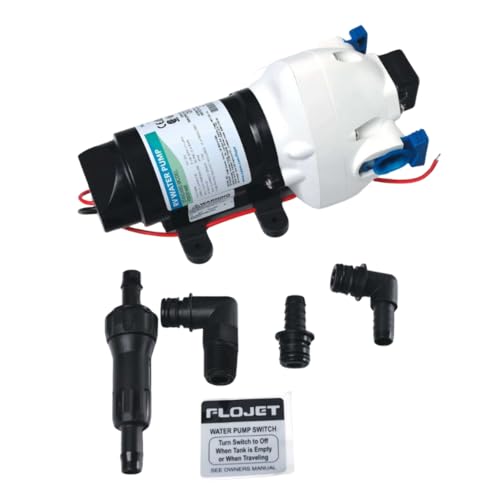
Flojet 03526-144A Triplex Automatic Water System Pump
Flow
2.9 GPM
Pressure
50 PSI
Self-Priming
Up to 9 ft
Flojet's 2.9 GPM triplex pump is close to the SHURFLO in output but has a nine-foot self-priming rating and a built-in pulsation eliminator. Those features give it a good role in a compact 12V system where the pump may sit above the water level and you want smoother flow without automatically adding an accumulator tank.
The pump uses 1/2-inch snap-in port fittings and soft, noise-absorbing mounts. Its automatic pressure behavior suits a small sink, wash point, or other intermittent freshwater-style outlet supplied from stored rainwater.
Winter care is the key caution. Water trapped inside a diaphragm pump can freeze and break plastic internal parts. Drain and winterize it according to the manufacturer's directions before freezing conditions. Also make sure the snap-in fittings are fully seated because a suction-side leak can cause poor priming long before a visible drip appears.
Why It Works
- 2.9 GPM and 50 PSI suit modest on-demand plumbing.
- Nine-foot self-priming capability is useful when the pump cannot sit at tank level.
- Built-in pulsation control can simplify a small installation.
What To Keep In Mind
- Freeze protection and winter draining are essential.
- Snap-in fittings need to seal completely on the suction side.
- It is intended for small-system demand, not continuous bulk transfer.
A Small On-Demand Pump for One Outlet
5 / 5
SEAFLO 21 Series 12V 1.2 GPM Pressure Pump

Flow
1.2 GPM
Pressure
35 PSI
Self-Priming
Up to 4 ft
The SEAFLO 21 Series is deliberately small. Its 1.2 GPM flow and 35 PSI pressure setting make sense for one sink, a low-flow wash point, or another light-duty outlet where a 4-5.5 GPM pump would be unnecessary. It draws about four amps at 12V, which also makes it easier to support from a small battery system.
The compact body can fit into a small equipment box, van, cabin cabinet, or pump compartment, and it self-primes up to four feet. It is a pressure-switch pump, so water is available when the outlet opens without a separate manual motor switch.
The limit is simultaneous demand. A second fixture can use much of the available flow and cause weak output. Noise has also disappointed some users, so do not buy it for quiet operation alone. The best reason to choose it is a genuinely small water demand and low electrical load.
Why It Works
- 1.2 GPM is appropriately sized for a single low-demand fixture.
- Low 12V current draw suits small off-grid electrical systems.
- Compact body fits installations where larger diaphragm pumps are awkward.
What To Keep In Mind
- Not a good match for several outlets running together.
- Noise can be higher than expected depending on mounting.
- It uses 12V two-wire power rather than a household plug.
Avoid Rapid Cycling
Rapid cycling happens when the pump reaches shutoff pressure almost as soon as it starts. A tiny faucet opening, highly restrictive filter, undersized tubing, or low-flow emitter can trigger this behavior.
If the pump has an adjustable bypass, follow the manufacturer's setup procedure. If the system supports an accumulator, that can add a small reserve of pressurized water so the pump does not start for every brief demand.
Also look for leaks. A slow drip after the pump can lower pressure enough to restart the motor when nobody is using water.
Size Power and Plumbing Together
A 12V pump may be convenient off grid, but larger models draw more current. Long wire runs need larger conductors to avoid voltage drop. A 115V pump reduces low-voltage current but needs a suitable safe AC installation around water.
On the plumbing side, use hose and fittings large enough for the pump inlet. Restricting the suction side creates more trouble than slightly oversizing it. Keep the inlet strainer clean and make it easy to service.
Rainwater Quality Still Depends on the Whole System
An on-demand pump can serve treated or untreated stored water, depending on its intended use and suitable materials, but it does not remove contaminants. Garden irrigation and potable use have very different treatment expectations.
For drinking-water applications, collection surfaces, prefiltration, tank condition, treatment stages, pump materials, plumbing, maintenance, current laboratory testing, and local requirements all need to be considered together.
Frequently Asked Questions
How does an on-demand water pump know when to turn on?
A pressure switch senses the drop in plumbing pressure when an outlet opens. The pump starts, then stops once the outlet closes and pressure rises to the shutoff setting.
What flow rate should I choose for one sink?
A small outlet can often work with a 1.2-3 GPM pump, depending on the faucet and desired flow. Choose from the actual fixture demand rather than automatically buying the highest-flow pump.
Can an on-demand pump run a garden hose?
Yes when the pump provides enough flow and pressure for the hose and nozzle. Long hose runs and restrictive fittings reduce delivered performance.
Why does my on-demand pump keep cycling when no faucet is open?
A downstream leak, pressure-switch problem, check-valve leak, trapped air, or another loss of system pressure can make the pump restart when there is no intended demand.
Do I need a pressure tank with an on-demand diaphragm pump?
Not always. Some pumps include bypass or pulsation-control features. A compatible accumulator can still reduce cycling and smooth small demands in systems designed for one.
Can an on-demand pump run dry?
Some models here have documented run-dry capability, but that is not universal and does not mean the pump should routinely operate without water. Follow the exact pump's limits.
Does an on-demand pump make rainwater safe for household use?
No. It supplies pressure only. Household or potable use requires a complete rainwater system designed for that purpose, including suitable treatment, plumbing, maintenance, testing, and local requirements.
For a broader pressure-focused comparison, booster pumps for rainwater systems covers the same decision from pressure capacity and system sizing. Bulk water movement is better handled by transfer pumps for rainwater when automatic fixture pressure is unnecessary. Submersible pumps for rainwater tanks remove the suction-line problem by placing the pump in storage. Smaller backyard systems may need only one of the rain barrel pumps.