
As an affiliate, we may earn a commission from qualifying purchases. We get commissions for purchases made through links on this website from Amazon and other third parties.
Best Overall
Best High-Flow 12V Pick
Best for Moderate 12V Demand
A booster pump for stored rainwater has a different job from a basic transfer pump. Instead of simply emptying a tank, it needs to create usable pressure when a faucet, hose, sprayer, or irrigation outlet opens and then stop when demand ends. That makes pressure-switch behavior, flow rate, power supply, self-priming lift, and duty cycle central to the choice.
The five pumps here are compact diaphragm pressure pumps rather than large household well pumps. They range from 1.2 to 5.5 GPM and are aimed at freshwater systems in RVs, boats, cabins, mobile setups, and other small pressure applications. That scale can fit a rainwater system serving a few outlets, but it is not automatically suitable for whole-house demand.
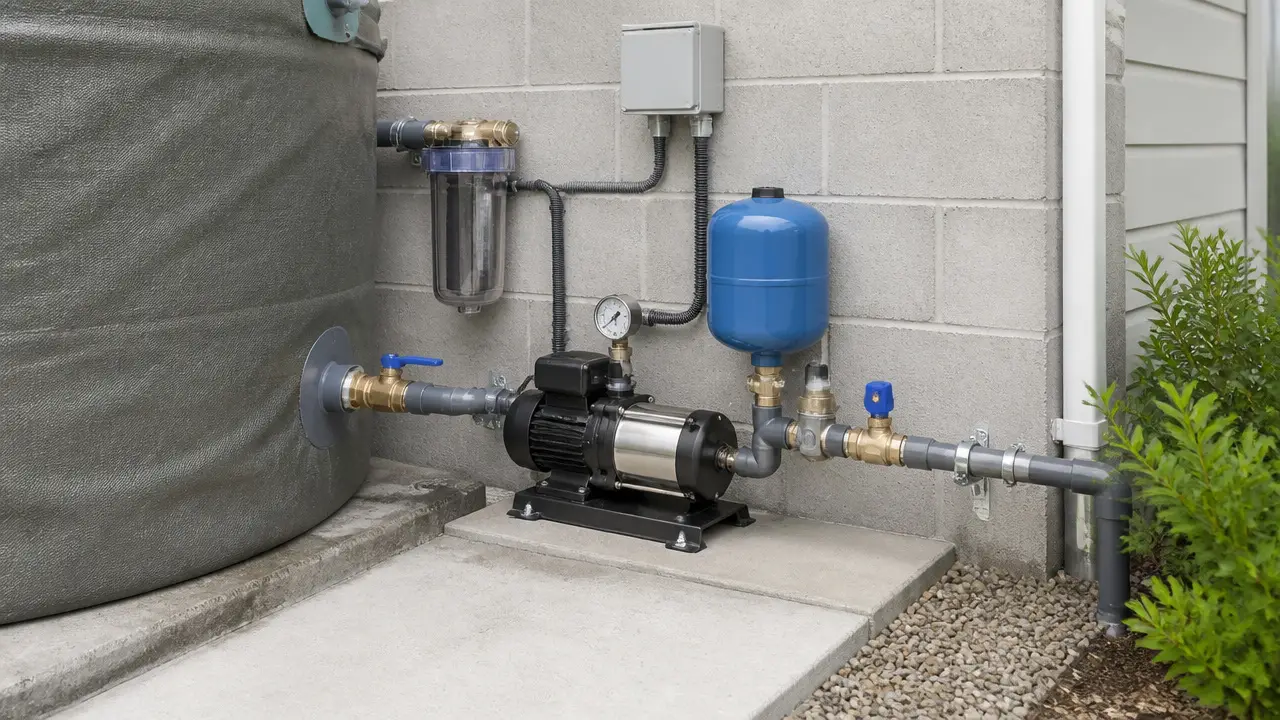
Before buying, map the water path from the tank to the pump and then to the fixtures. A pump rated for 55 or 60 PSI still needs a properly sized inlet, suitable outlet plumbing, compatible power, and controls that match the intended use. Drinking-water service also requires the full rainwater system—not only the pump—to use suitable components and current treatment and testing.
Quick Comparison
| Pump | Best For | Maximum Flow | Pressure | Power | Main Tradeoff |
|---|---|---|---|---|---|
| SEAFLO 42 Series | Plug-in small rainwater pressure systems | 4.0 GPM | 55 PSI shutoff | 115V AC | Long runs can build substantial heat |
| SEAFLO 55 Series | Higher-flow 12V systems | 5.5 GPM | 60 PSI | 12V DC | Pressure-switch and rapid-cycling behavior need good setup |
| SHURFLO Revolution 4008 | Moderate 12V fixture demand | 3.0 GPM | 55 PSI | 12V battery/DC system | Physical replacement fit can differ from older pumps |
| Flojet 03526-144A | Compact self-priming 12V systems | 2.9 GPM | 50 PSI | 12V DC | Freeze damage and early failure are reported risks |
| SEAFLO 21 Series | One fixture or very light demand | 1.2 GPM | 35 PSI | 12V DC | Too little flow for larger multi-outlet systems |
A Booster Pump Needs More Than a Pressure Number
A 60 PSI label can sound like household pressure, but the useful result depends on flow at that pressure. If several fixtures open at once, a small diaphragm pump may not keep up even though its pressure switch is set high.
Flow and pressure also change as the pump pulls water from the tank. Long suction lines, clogged strainers, small tubing, air leaks, and excessive vertical lift can starve the inlet. A pump cannot boost water it cannot receive.
For a rainwater system, keep the pump close enough to storage that the suction side stays simple. A self-priming rating gives some flexibility, but it is not a reason to place the pump far above the tank when an easier layout is available.
A Plug-In Pressure Pump for Small AC Systems
1 / 5
SEAFLO 42 Series 115V AC Water Pressure Pump

Maximum Flow
4.0 GPM
Shutoff Pressure
55 PSI
Self-Priming
Up to 6 ft
The SEAFLO 42 Series is the easiest fit here when the rainwater system has a normal 115V AC power source and needs automatic on-demand pressure. Its built-in pressure switch starts the pump when a fixture opens and stops it as pressure recovers. That gives it the basic behavior expected from a small booster system without requiring a separate manual switch for every watering or utility task.
The pump is documented at up to 4.0 GPM with a 55 PSI shutoff setting and self-priming up to six feet. Standard 1/2-inch ports and included hose-barb fittings make it straightforward to integrate into compact freshwater plumbing. A 50-mesh inlet strainer is also included, which is important because diaphragm pumps do not benefit from grit and tank debris entering their valves.
The main limitation is runtime. Users have found the pump can become very hot during longer operation, with practical duty periods much shorter than a continuous transfer-pump job. That makes it a better match for intermittent faucets, a watering wand, or short demand cycles than a system expected to run at high flow for an hour without stopping. The prepared voltage field carries more than one signal, so use the supported 115V AC configuration for this exact pump.
Why It Works
- 115V wall-plug setup is convenient where AC power is already available near the rainwater equipment.
- 4.0 GPM and 55 PSI suit a small on-demand pressure system better than a basic transfer pump.
- Built-in pressure switch, inlet strainer, and 1/2-inch fittings cover key installation needs.
What To Keep In Mind
- Heat buildup makes long continuous operation a poor assumption.
- The inlet still needs clean, unrestricted water despite the self-priming capability.
- Use the supported 115V configuration rather than relying on conflicting voltage wording elsewhere.
The Highest-Flow 12V Option
2 / 5
SEAFLO 55 Series 12V 5.5 GPM Pressure Pump

Maximum Flow
5.5 GPM
Pressure
60 PSI
Self-Priming
Up to 9 ft
The SEAFLO 55 Series is the strongest 12V choice here when several small outlets or a more demanding irrigation line need more flow. Its five-chamber diaphragm design delivers up to 5.5 GPM and is paired with a 60 PSI pressure setting. It can self-prime up to nine feet, giving more installation flexibility than the lower-flow models.
A 12V pump makes sense for a battery, solar, RV-style, or off-grid rainwater setup where running a 115V circuit is impractical. The pump includes two 1/2-inch barbed adapters and a 50-mesh inlet strainer. Its built-in bypass is intended to smooth flow and reduce rapid cycling compared with simpler pressure-switch pumps.
The pressure control still needs the system around it to behave well. Users have experienced pumps that would not shut off properly or cycled more than expected. Wiring also needs to support the pump's current draw without voltage drop or undersized protection. The prepared material and voltage fields contain conflicts, so the supported 12V DC operating role, flow, pressure, self-priming lift, and included fittings are the safe comparison points.
Why It Works
- 5.5 GPM is the highest flow among these compact pressure pumps.
- 60 PSI output gives useful pressure headroom for a larger small-system demand.
- Nine-foot self-priming capability helps when the pump cannot sit directly beside the tank outlet.
What To Keep In Mind
- Pressure-switch and bypass adjustment affect whether the pump cycles or shuts down cleanly.
- A 12V system needs properly sized wiring, fuse protection, and a power source that can handle the load.
- Do not infer exact wetted-material composition from conflicted material fields.
A Familiar 3 GPM 12V Demand Pump
3 / 5
SHURFLO Revolution 4008-101-E65 12V Fresh Water Pump

Maximum Flow
3.0 GPM
Pressure
55 PSI
Power
12V DC
The SHURFLO Revolution 4008 fits a system that needs less flow than the 5.5 GPM SEAFLO but still wants automatic pressure around 55 PSI. Its 3.0 GPM capacity is easier to match to one or two modest outlets without oversizing the pump for a small cabin, garden sink, or controlled rainwater reuse setup.
The pump uses an automatic demand diaphragm design with bypass control and run-dry protection. It is built for compact installation and is commonly used as a freshwater pressure pump rather than a simple transfer unit. That distinction matters because it is meant to react to fixture demand instead of running continuously whenever power is supplied.
Replacement fit deserves attention. Users replacing an older SHURFLO pump have found that body height, mounting holes, or rubber mounting arrangement can differ even when the plumbing function is similar. Measure the mounting space and connection positions instead of assuming every 4008-style replacement drops into the same holes.
Why It Works
- 3.0 GPM and 55 PSI give a useful middle ground for modest 12V rainwater demand.
- Automatic demand operation is better suited to fixtures than a manual transfer pump.
- Run-dry protection adds tolerance for brief low-water conditions.
What To Keep In Mind
- Physical mounting can differ from older pumps even when the plumbing role matches.
- It is a moderate-flow pump, not a whole-house solution by default.
- Noise depends on mounting, hose rigidity, and installation even when the pump is designed for quieter operation.
A Compact 2.9 GPM Self-Priming Pump
4 / 5
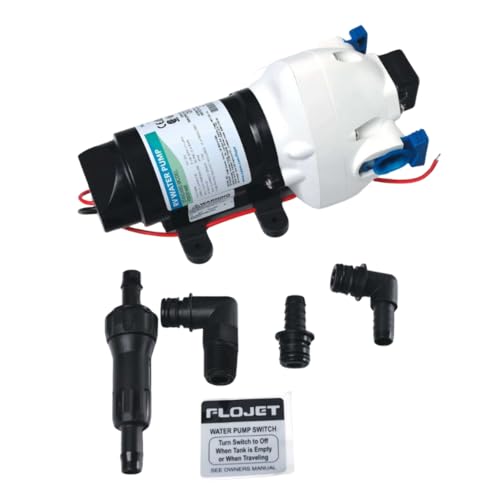
Flojet 03526-144A Triplex Automatic Water System Pump
Maximum Flow
2.9 GPM
Pressure
50 PSI
Self-Priming
Up to 9 ft
Flojet's triplex diaphragm pump sits close to the SHURFLO in flow but has its own installation strengths. It is documented at 2.9 GPM and 50 PSI, with self-priming up to nine feet. The pump uses 1/2-inch snap-in port fittings and has a built-in pulsation-control design intended to smooth operation without requiring an accumulator tank in every setup.
That makes it a useful alternative for a compact 12V freshwater pressure system where mounting space and suction lift matter. Noise-absorbing mounts and a totally enclosed permanent-magnet motor also suit an installation near occupied space better than a noisy open-frame transfer pump.
Cold-weather storage is important. A diaphragm pump can retain water in small internal chambers, and freeze damage has occurred when the pump was left with water inside. Complete kit contents should also be checked at installation because the port fittings are essential to making the connection. Use the supported 12V draw and self-priming behavior rather than the generic “corded electric” label in the structured field.
Why It Works
- 2.9 GPM and 50 PSI suit a compact one- or two-outlet pressure system.
- Nine-foot self-priming capability gives useful tank-placement flexibility.
- Built-in pulsation control can simplify a small system that does not need a separate accumulator.
What To Keep In Mind
- Drain and winterize thoroughly before freezing conditions.
- Snap-in port fittings need to be present and correctly seated.
- Use the documented 12V freshwater-pump configuration rather than a generic power-source label.
A Small Pump for One Light-Duty Fixture
5 / 5
SEAFLO 21 Series 12V Water Pressure Diaphragm Pump

Maximum Flow
1.2 GPM
Pressure
35 PSI
Self-Priming
Up to 4 ft
The SEAFLO 21 Series is the smallest option here. It delivers up to 1.2 GPM at a 35 PSI pressure setting and is explicitly aimed at a single fixture or other light-duty freshwater use. That can be exactly right for a small rainwater-fed sink, a low-flow rinse point, or a compact off-grid setup where electrical draw matters more than serving several outlets.
Its 12V DC motor draws about four amps and the pump can self-prime up to four feet. The small body is easier to fit in a cabinet or equipment box than the higher-flow pumps. It can also run dry within its documented design limits, which gives some protection when a small tank is briefly emptied.
Do not stretch a 1.2 GPM pump into a job meant for a larger pressure system. Two fixtures at once can already use most or all of the available flow depending on their demand. Some users also find it louder than expected, so “quiet” should not be the deciding reason. The prepared voltage and dimension fields contain conflicts; the supported 12V two-wire configuration, flow, pressure, and four-foot self-prime rating are the safer fit points.
Why It Works
- Low 1.2 GPM flow is appropriately scaled for one light-duty outlet.
- Four-amp 12V demand fits small battery and solar systems better than higher-flow pumps.
- Compact body is easier to place in tight equipment spaces.
What To Keep In Mind
- Too small for several high-demand outlets at once.
- Actual noise depends on installation and can be higher than expected.
- This is a two-wire 12V pump, not a household wall-plug appliance.
12V vs. 115V for Rainwater Pressure
A 115V pump is convenient when a safe AC outlet already exists in the equipment area. It avoids the heavy current and larger wire sizes that a high-flow 12V pump can require.
A 12V pump is useful for off-grid, solar, battery-backed, RV-style, or mobile systems. The tradeoff is electrical design. Low voltage does not mean low current. Long undersized wires create voltage drop, heat, and poor pump performance.
Use proper fusing, connections, and wire size for the exact pump. Permanent outdoor or household electrical work is a job for a qualified professional when you are not equipped to do it safely.
Why a Pressure Switch Can Cycle Too Fast
A pressure pump starts when system pressure falls and stops when the shutoff point is reached. A tiny demand, restrictive hose, trapped air, or very small water volume can make the pump switch on and off rapidly.
Some pumps use an internal bypass to smooth this behavior. An accumulator tank can also help in systems designed for one. The right approach depends on the pump model and plumbing layout.
Do not keep turning adjustment screws without understanding what they control. Incorrect pressure-switch or bypass settings can keep a pump running when it should stop or make it cycle even more.
Keep the Suction Side Clean and Airtight
Pressure pumps are often good self-primers, but an inlet air leak can still cause noise, poor flow, and failure to build pressure. Use the correct hose and fittings and keep the inlet strainer clean.
Rainwater tanks can carry sediment, especially near the bottom. A 50-mesh pump strainer is protection for the pump, not complete filtration for the intended water use. Clean the tank and manage debris upstream rather than making the small pump strainer handle the entire sediment load.
Frequently Asked Questions
What is a booster pump in a rainwater system?
It raises stored-water pressure so faucets, hoses, or other outlets can operate more like a pressurized system. Many compact booster pumps use a pressure switch to start when water is demanded and stop when pressure recovers.
How many GPM do I need from a rainwater booster pump?
Add the realistic simultaneous demand of the fixtures or irrigation devices you plan to run, then allow for plumbing losses. One small outlet may use a 1.2-3 GPM pump, while several outlets can need more.
Is 55 PSI too much for a rainwater system?
It depends on the plumbing, fixtures, filters, tank outlet, and intended use. Every component downstream must be rated and configured for the operating pressure.
Can a 12V booster pump run from solar power?
It can be part of a solar-battery system when the electrical supply, battery, wiring, fuse, controller, and pump current are correctly sized. Do not connect a pump directly to an undersized panel and assume it will run reliably.
Do I need an accumulator tank with a diaphragm pump?
Not always. Some pumps use internal bypass or pulsation-control designs that can work without one. An accumulator can still reduce cycling in compatible systems when sized and installed correctly.
Why does my rainwater pressure pump keep turning on and off?
Rapid cycling can come from small intermittent demand, a restrictive line, pressure-switch settings, trapped air, leaks, or a system with very little pressurized water volume.
Can a booster pump make rainwater potable?
No. It changes pressure, not water quality. Potable use requires suitable collection, treatment, plumbing materials, maintenance, current testing, and compliance with applicable local requirements.
For simple tank-to-tank movement without automatic pressure control, transfer pumps for rainwater are a better comparison. If the pump can live inside the tank, submersible pumps for rainwater tanks avoid a suction line. Smaller backyard storage may only need one of the rain barrel pumps. For off-grid backup without any electrical system, hand pumps for water barrels keep the job manual.