As an affiliate, we may earn a commission from qualifying purchases. We get commissions for purchases made through links on this website from Amazon and other third parties.
Yes. Activated carbon filters do work, but only for the contaminants they are designed to reduce.
Activated carbon is especially useful for improving taste and odor and removing many dissolved organic chemicals. It can also remove chlorine. Some certified carbon filters can reduce specific contaminants such as certain pesticides, volatile organic compounds (VOCs), lead, or PFAS.
But a carbon filter is not a complete rainwater treatment system. It does not reliably make roof runoff safe to drink. It is generally poor at removing bacteria, viruses, nitrate, dissolved salts, and many minerals. What a filter removes depends on the carbon, filter design, water flow, condition of the cartridge, and the specific contaminant claim.
How Activated Carbon Filters Work
Activated carbon is carbon that has been processed to create a huge number of tiny pores.
Those pores give it a very large internal surface. As water passes through the filter, certain chemicals stick to that surface. This process is called adsorption.
Adsorption is different from absorption. With absorption, one material soaks into another. With adsorption, contaminants stick to a surface.
Granular activated carbon, often called GAC, is widely used by water treatment systems because it can remove many organic compounds that cause taste, odor, or water-quality problems.
The important point is that carbon has limited space available. Once enough contaminants have attached to it, its treatment capacity drops. The carbon then needs to be replaced or regenerated.
What Does an Activated Carbon Filter Remove?
Activated carbon is particularly good at dealing with some dissolved organic chemicals.
Depending on the filter, it may reduce:
- Chlorine
- Unpleasant tastes
- Unpleasant odors
- Some volatile organic compounds
- Some pesticides and herbicides
- Some industrial organic chemicals
- Some disinfection byproducts
- Certain other chemicals when the filter has been tested for them
EPA guidance lists granular activated carbon as useful for removing taste- and odor-producing compounds, natural organic matter, VOCs, and a range of synthetic organic compounds.
That does not mean every carbon cartridge removes every chemical on that list. Different carbon materials have different adsorption capacities.
The complete filter design also matters.
What Activated Carbon Usually Does Not Remove
This is where carbon filters are often misunderstood.
A basic carbon filter should not be expected to reliably remove:
- Bacteria
- Viruses
- Nitrate
- Dissolved salts
- Most dissolved minerals
- Hardness
- All metals
- Sediment unless the filter also includes mechanical filtration
- Every pesticide or industrial chemical
EPA consumer guidance notes that activated carbon filtration does not remove nitrate, bacteria, or dissolved minerals.
A carbon cartridge therefore should not be treated as a universal purifier.
This matters even more with collected rainwater. Roof runoff can pick up dust, bird droppings, insects, roofing debris, pollen, airborne pollution, and material already inside gutters or tanks. A carbon filter alone does not address all of those risks.
Do Activated Carbon Filters Work for Rainwater?
They can be very useful in a rainwater system, but their job needs to be clearly defined.
For example, you might have a system that follows this path:
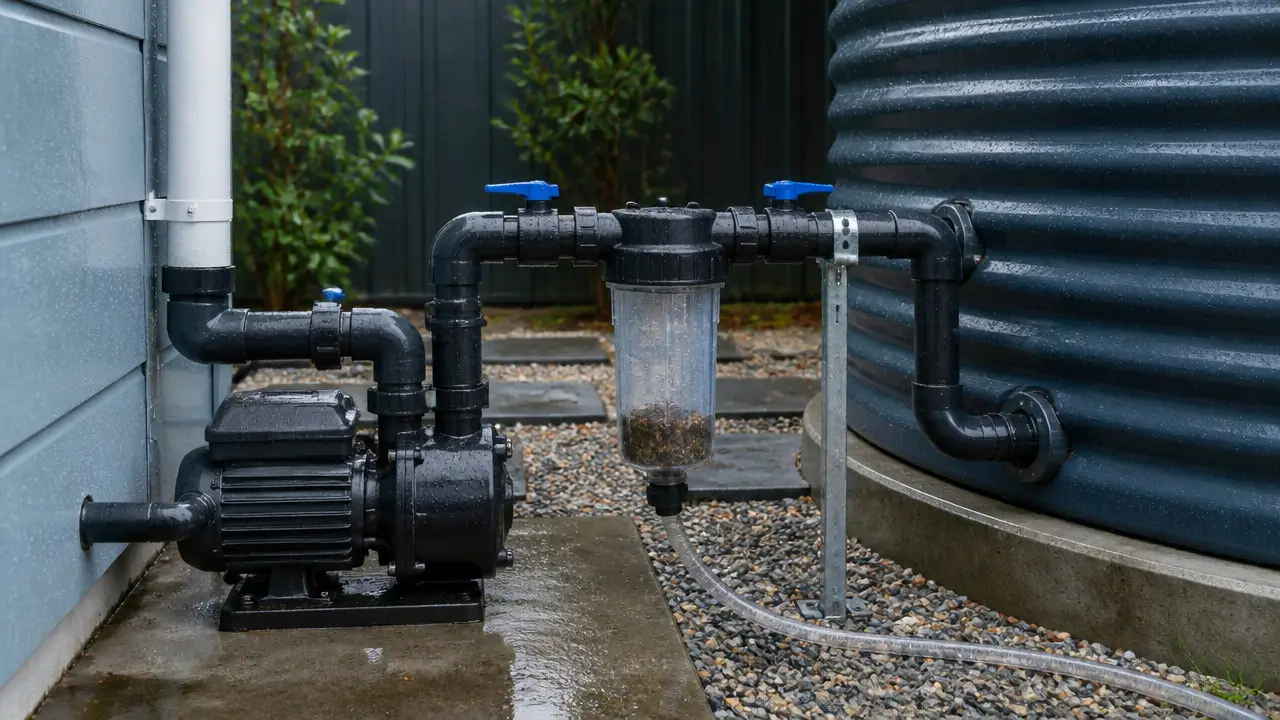
Roof → gutter screen → first-flush or debris control → storage tank → sediment filtration → activated carbon → intended use
A first flush is a system that diverts some of the first runoff from a storm. That early runoff may carry a heavier load of debris and contamination from the roof.
Activated carbon normally makes more sense after larger debris and sediment have already been removed.
Sending dirty tank water straight into a fine carbon cartridge can clog it quickly. Sediment can reduce water flow and shorten cartridge life even when the carbon itself has not reached its chemical adsorption limit.
For Garden Water
A carbon filter is often unnecessary for ordinary rainwater irrigation.
A debris screen and suitable sediment control may be more important, especially when the goal is preventing emitters, valves, or hoses from clogging.
Whether additional treatment is needed depends on where the rainwater came from, the plants being watered, and how the water will contact edible portions of crops.
For Toilet Flushing or Cleaning
Carbon may improve odor or appearance, but it is not automatically required.
Good tank management, debris removal, appropriate plumbing, and treatment matched to the specific reuse system may matter more.
For Drinking Water
Carbon can be one treatment stage, but it should not be the reason you decide rainwater is safe to drink.
Drinking-water treatment needs to consider the entire system:
- Collection surface
- Gutters and prefiltration
- Storage conditions
- Sediment removal
- Chemical contaminants
- Microbial contamination
- Appropriate disinfection or other treatment
- Current laboratory testing
- Ongoing maintenance
- Applicable local requirements
A carbon filter by itself should not be used to turn microbiologically unsafe water into drinking water. EPA guidance has specifically warned against relying on carbon filtration alone where the source may be microbiologically unsafe.
Granular Carbon vs. Carbon Block Filters
Two forms are common in household systems.
Granular Activated Carbon
Granular activated carbon contains loose carbon granules.
Water moves through the spaces around those granules. GAC can provide good adsorption when the system gives the water enough contact with the carbon.
Large treatment vessels may use substantial beds of granular carbon.
Carbon Block
A carbon block compresses carbon into a solid cartridge.
The tighter structure can provide both adsorption and some physical filtration. Performance depends heavily on how the block is made.
A carbon block with a particular micron rating should not be assumed to remove microorganisms just because the pores are small.
A micron is one-millionth of a meter. Micron ratings mainly describe the filter's ability to control particles. They do not tell you everything about chemical adsorption or microbial safety.
Flow Rate Matters More Than Many People Realize
Carbon needs contact time with the water.
If water rushes through the media too quickly, some contaminants may not have enough opportunity to adsorb onto the carbon.
This is one reason a very small cartridge may perform poorly when installed on a high-flow rainwater pump.
Suppose a pump supplies several fixtures at once. A cartridge designed for one drinking-water faucet may become a major flow restriction.
Before adding a carbon filter, check:
- Required system flow
- Filter's rated flow
- Inlet and outlet connection sizes
- Maximum operating pressure
- Pressure loss across the filter
- Cartridge or media capacity
- Replacement requirements
Do not assume a larger pipe connection automatically means the filter can handle a larger flow.
More Carbon Can Mean More Treatment Capacity
In general, a larger amount of suitable carbon gives the system more adsorption capacity.
But simply installing a larger housing does not guarantee better treatment.
Performance also depends on:
- Type of activated carbon
- Contaminant being treated
- Concentration of that contaminant
- Water chemistry
- Water temperature
- Flow rate
- Contact time
- Other organic matter in the water
Alongside maintenance tradeoffs of activated-carbon filters, compare household filtration suited to the way the water will be used.
Natural organic material in rainwater can compete for adsorption sites. That can use some of the carbon's capacity even when the contaminant you care about is present at a low concentration.
This is why cartridge life cannot always be predicted just from the number of gallons of water you use.
Carbon Filters Eventually Stop Working
A carbon filter does not normally give an obvious warning when its adsorption capacity has been used up.
Water may still look clear.
It may still flow normally.
It might even taste fine.
Yet the carbon may no longer be reducing a particular contaminant as intended.
Follow the filter manufacturer's replacement requirements. Replace cartridges sooner when water conditions or actual use call for it.
Do not extend cartridge life simply because the filter still passes water.
Dirty Filters Can Cause Other Problems
Rainwater systems can contain sediment and microorganisms.
Leaving a wet cartridge in service far beyond its intended life is poor practice. Organic material may collect in the filter, and microbial growth can occur under favorable conditions.
Maintenance should include the filter housing itself, not just the cartridge.
When servicing the system:
- Isolate the water supply and pressure safely.
- Replace or service the media as required.
- Inspect the housing and seals.
- Clean components according to the manufacturer's instructions.
- Reassemble the housing correctly.
- Check for leaks before returning the system to normal use.
Pressurized housings can release water suddenly if opened while still under pressure. Always depressurize them according to the system instructions.
Look at the Actual Certification Claim
Labels such as "activated carbon," "premium carbon," or "5-stage filtration" do not tell you which contaminants have been proven to be reduced.
For drinking-water equipment, look for independent certification covering the specific reduction you need.
For example, NSF explains that:
- NSF/ANSI 42 covers aesthetic effects such as chlorine, taste, and odor.
- NSF/ANSI 53 covers specific contaminants with health effects.
- NSF/ANSI 401 covers certain emerging or incidental contaminants.
Certification is tied to specific performance claims. A filter being certified to one standard does not mean it removes every contaminant covered by that standard.
Read the actual contaminant reduction claims for the complete filter system.
This distinction matters with substances such as lead or PFAS. Some carbon-based filters may be designed and certified for specific reductions, while an ordinary carbon cartridge may have no such claim.
Does Activated Carbon Remove PFAS?
Activated carbon can reduce some PFAS under suitable conditions.
EPA identifies granular activated carbon as one of the treatment technologies used for PFAS removal. Performance varies with the type of PFAS, carbon, operating conditions, and other factors.
Do not assume that any carbon cartridge removes PFAS.
If PFAS is a concern, use laboratory testing to understand the water and choose treatment that carries an appropriate reduction claim for the contaminants involved.
Does Activated Carbon Lower TDS?
Usually, not much.
Total dissolved solids, or TDS, is a broad measure related to dissolved minerals and salts in water.
Activated carbon is mainly an adsorption treatment for certain organic chemicals. It is not designed to remove most dissolved mineral salts.
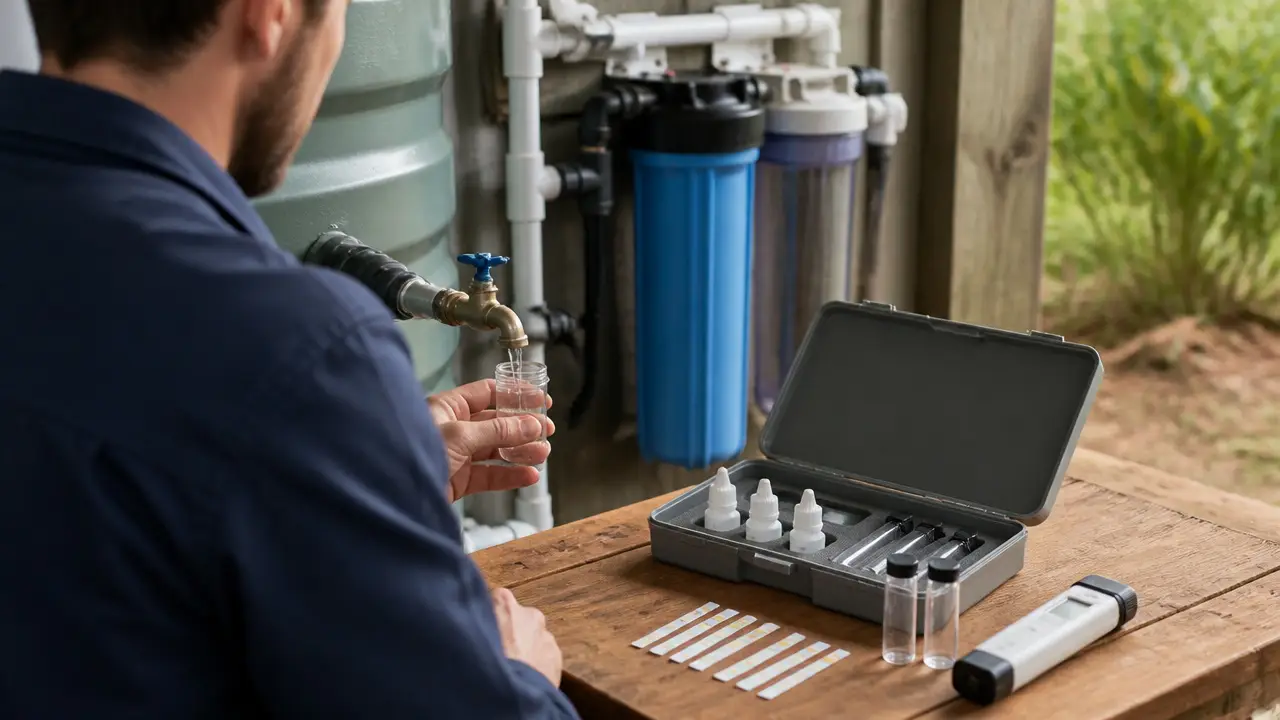
That means a TDS meter may show nearly the same number before and after a carbon filter even when the carbon is doing its intended job.
The reverse is also important: a low TDS reading does not prove water is safe to drink.
A TDS meter cannot tell you whether rainwater contains harmful bacteria, viruses, individual pesticides, PFAS, or many other contaminants.
Where Should a Carbon Filter Go in a Rainwater System?
Carbon usually belongs after basic debris and sediment control.
A typical arrangement might be:
Tank → pump → sediment filtration → activated carbon → additional treatment if required → use
The exact order depends on the system.
For drinking-water applications, carbon is often only one part of a larger treatment train. Treatment design should be based on the source water and laboratory results rather than adding cartridges at random.
If UV disinfection is used, for example, the water normally needs to meet the UV equipment manufacturer's requirements for clarity and other water conditions. Carbon does not replace that preparation.
When Is an Activated Carbon Filter Worth Using?
Activated carbon makes sense when you have a reason for using it.
It can be a good choice when:
- You want to reduce chlorine in treated water.
- Taste or odor is a problem that carbon is suited to treat.
- Testing identifies an organic contaminant that suitable carbon treatment can reduce.
- A certified filter has a specific contaminant reduction claim you need.
- Carbon is one planned stage in a larger water-treatment system.
It makes less sense when the main problem is mud, sand, hardness, nitrate, microorganisms, or another contaminant that carbon does not effectively address.
Start with the problem, then choose the treatment.
Do not start with the filter and hope it solves whatever is in the water.
Frequently Asked Questions
Can activated carbon make rainwater safe to drink?
Not by itself. Carbon can reduce certain chemicals, tastes, and odors, but it does not provide complete protection against microbial and chemical contamination. Potable rainwater requires a whole-system approach with suitable collection, treatment, maintenance, current laboratory testing, and compliance with local requirements.
Does activated carbon remove bacteria?
A normal activated carbon filter should not be relied on to remove or disinfect bacteria. If microbial safety matters, treatment must include suitable processes designed for that purpose.
Does activated carbon remove chlorine?
Yes. Activated carbon is commonly used to reduce chlorine, which can improve the taste and odor of chlorinated water. The amount removed depends on the filter design, flow, carbon condition, and other factors.
Does activated carbon remove lead?
Some specially designed filters can reduce lead, but you should not assume that every carbon filter does. Look for an independently certified lead-reduction claim for the complete filter system.
How often should an activated carbon filter be changed?
Follow the manufacturer's service-life instructions. Actual life can depend on water quality, contaminant levels, flow, cartridge size, and the amount of water treated. A cartridge may need replacement even when water still flows through it normally.
Should I put a sediment filter before a carbon filter?
In many rainwater systems, yes. Removing dirt and suspended particles before the carbon stage can help prevent premature clogging and protect downstream treatment equipment.
Will a carbon filter remove the color or smell from stored rainwater?
It may help when the color or odor is caused by compounds that activated carbon can adsorb. However, unusual color or odor can also signal tank contamination, sediment buildup, decaying organic material, or another problem that should be corrected rather than hidden with filtration.