
As an affiliate, we may earn a commission from qualifying purchases. We get commissions for purchases made through links on this website from Amazon and other third parties.
Best Overall
Best High-Output Tankless
Best Compact Tanked System
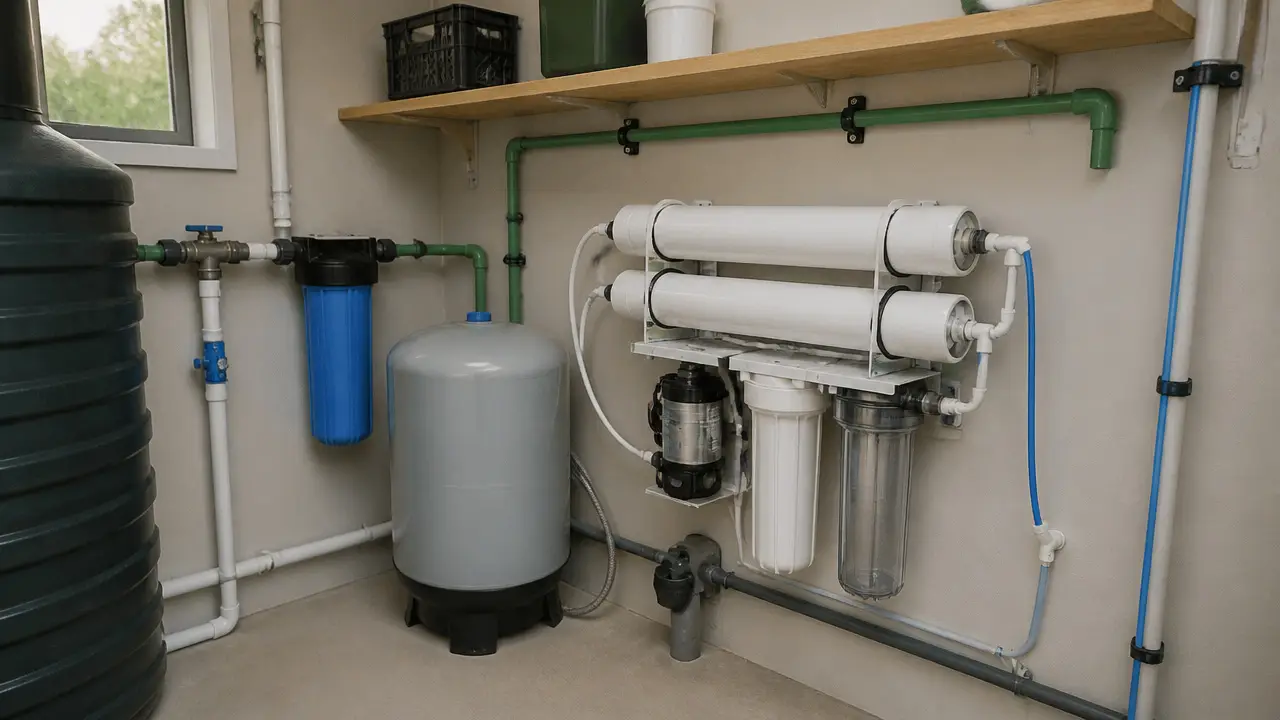
Reverse osmosis can be useful in a rainwater system when testing shows a need to reduce dissolved contaminants that sediment filters, carbon, or UV do not address. It should not be installed simply because RO sounds like the most advanced treatment option. Roof-collected rainwater is often relatively low in dissolved minerals, and an RO membrane adds reject water, maintenance, pressure requirements, and a drinking-water faucet that may be unnecessary for some systems.
RO also needs good feed water. Sediment, biological growth, oxidants, and unsuitable pressure can foul or damage membranes and prefilters. In a rainwater setup, the RO unit should receive water that has already been collected cleanly, stored correctly, pumped to the required pressure, and prefiltered for the contaminants that could shorten membrane life.
The five systems here are under-sink point-of-use units. Four use a conventional storage tank or tanked layout, while the Waterdrop G3P600 uses a powered tankless design. Their daily-production ratings are more useful than the prepared “capacity” fields, which mix storage-tank volume and membrane output and therefore are not treated as directly comparable capacities.
Reverse Osmosis Systems at a Glance
| Product | Best For | Key Strength | Main Tradeoff |
|---|---|---|---|
| iSpring RCC7AK-BN | Best overall | NSF/ANSI 58-certified six-stage RO with remineralization and no electrical power | Larger under-sink footprint and more filter stages to maintain |
| Waterdrop G3P600 | High-output tankless use | 600 GPD claim, 2:1 product-to-reject ratio, smart faucet, NSF/ANSI 58 and 372 certifications | Requires electricity and filter-removal clearance |
| Express Water RO5DX | Compact conventional tanked system | 50 GPD membrane, 4-gallon tank, included leak detector and spare filter set | Housing and tank failures appear in product-specific use |
| iSpring RCC7-BN | Standard five-stage RO | 75 GPD conventional tanked design with no power requirement | Takes more cabinet volume than a narrow tankless unit |
| APEC ROES-50 | Simple five-stage 50 GPD RO | Conventional carbon + RO layout with tank and quick-connect tubing | Repeated housing/manifold leak reports make inspection essential |
Best Overall: iSpring RCC7AK-BN
1 / 5
iSpring RCC7AK-BN 6-Stage Reverse Osmosis System

Production Claim
75 GPD
Certification
NSF/ANSI 58
Final Stage
Alkaline remineralization
The iSpring RCC7AK-BN is the strongest all-around point-of-use choice in this group because it combines a conventional 75-gallon-per-day RO membrane with full-system NSF/ANSI 58 certification and a final remineralization stage. It also operates without electricity, which is useful in a rainwater system where the pressure pump already provides the required feed pressure.
The first stages use sediment and carbon media before the RO membrane, then the alkaline stage adds minerals back after membrane treatment. That can be useful when you prefer the taste of remineralized RO water rather than very low-mineral permeate.
The extra stage is not automatically necessary. If testing does not show a need for RO, adding six filter stages only creates more cartridges, fittings, and service work. And if a household specifically wants very low-TDS water for a technical reason, a remineralization stage works against that goal.
Installation is designed around quick fittings and a feed-water adapter compatible with 1/2-inch NPT and 3/8-inch compression connections. Under-sink room still matters: the system, pressure tank, faucet tubing, drain saddle, and service clearance all need space.
Why It Works
- The complete system carries NSF/ANSI 58 certification in the prepared product evidence.
- A 75 GPD production class suits typical drinking and cooking demand.
- It runs without electricity when feed pressure is adequate.
- The remineralization stage gives treated water a different mineral and taste profile than plain RO permeate.
What To Keep In Mind
- The prepared capacity fields conflict, so this guide uses the supported 75 GPD production role rather than treating “75 gallons” as tank storage.
- More stages mean more replacement parts and more opportunities for a loose fitting or exhausted cartridge.
- Rainwater still needs an appropriate microbial treatment strategy; RO should not be assumed to replace UV or other validated disinfection.
- Check under-sink fittings after installation and after every filter change.
Best High-Output Tankless: Waterdrop G3P600
2 / 5
Waterdrop G3P600 Reverse Osmosis System

Production Claim
600 GPD
Reject Ratio Claim
2:1 product to reject
Certification
NSF/ANSI 58 and 372
The Waterdrop G3P600 is the clear pick when you want a tankless system with much higher stated production than a traditional 50- or 75-GPD unit. The system is rated at 600 gallons per day and uses an internal pump, so it requires electrical power.
Waterdrop states a two-to-one product-water-to-reject-water ratio, meaning two cups of filtered water are produced for every one cup sent to drain under the stated operating conditions. That is a meaningful distinction because conventional RO systems can waste more water when feed pressure, temperature, membrane condition, or system design is unfavorable.
The G3P600 carries NSF/ANSI 58 certification for TDS reduction and NSF/ANSI 372 for lead-free materials in the prepared evidence. It also has NSF 42 certification information for chlorine, taste, and odor reduction. The smart faucet gives a more modern point-of-use interface than a passive tanked RO faucet.
The system is narrow, but service clearance matters. Product-specific use notes that a cabinet could physically hold the unit while still making filter removal difficult. Plan room in the direction cartridges slide out rather than measuring only the chassis.
Why It Works
- The 600 GPD production claim provides far more output headroom than conventional tanked systems here.
- Tankless construction frees cabinet space otherwise occupied by a pressure-storage tank.
- The stated 2:1 product-to-reject ratio reduces drain-water volume compared with less efficient RO layouts.
- NSF/ANSI 58 and 372 certifications provide useful third-party performance and material context.
What To Keep In Mind
- It requires electricity, so RO production stops during a power outage unless backup power is available.
- The internal pump creates some operating noise.
- Leave enough space to remove and replace the long cartridges.
- Product dimensions vary across references, so measure the current unit before cabinetry work.
Best Compact Tanked System: Express Water RO5DX
3 / 5
Express Water RO5DX
Production Claim
50 GPD
Storage Tank
4 gal nominal / 3.2 gal water claim
Feed Pressure
40-80 psi
The Express Water RO5DX is the most straightforward conventional option when you want a smaller five-stage RO system with a tank and no powered booster built into the unit. The membrane is rated at 50 GPD, while the included tank is listed at four gallons nominal with about 3.2 gallons of water capacity.
Its feed-pressure guidance is particularly useful for rainwater systems: 40 to 80 psi. Stored rainwater usually reaches an under-sink RO unit through a pump and pressure tank, so that upstream pump system has to maintain sufficient pressure. A gravity-fed rain barrel will not provide the same operating conditions.
The package includes an extra filter set and a leak detector. The leak shutoff has real practical value under a sink, especially because product-specific use includes a cracked housing after extended operation. A leak detector reduces consequences only if it is positioned and maintained correctly; it does not eliminate the need to inspect plastic housings.
Why It Works
- A 50 GPD membrane is adequate for many drinking-water-only households.
- The four-gallon nominal storage tank provides reserve water without an electric pump in the RO unit.
- Clear 40-80 psi feed guidance helps integrate it with a rainwater pressure system.
- The included leak detector and spare filters are useful ownership extras.
What To Keep In Mind
- Inspect housings and the tank as the system ages; product-specific failures include cracks and tank damage.
- A tanked system occupies more cabinet volume than a tankless unit.
- Low feed pressure reduces RO production and can increase reject-water waste.
- Additional tubing or a delivery pump may be needed for remote installation.
Best Standard Five-Stage System: iSpring RCC7-BN
4 / 5
iSpring RCC7-BN 5-Stage Reverse Osmosis System

Production Claim
75 GPD
Stages
5
Power
No electricity required
The RCC7-BN is the simpler iSpring choice for readers who want conventional RO without the alkaline remineralization stage of the RCC7AK. It uses sediment and carbon pretreatment followed by the RO membrane and post-treatment in a standard under-sink, tanked format.
The 75 GPD production class gives it more membrane output than the 50 GPD APEC and Express Water systems while retaining a passive, no-electricity layout. That can be a good match for a rainwater system that already has reliable household pressure and where drinking-water demand is modest enough for a storage tank to buffer membrane production.
The prepared capacity metadata conflicts, so this guide does not treat “75 gallons” as a storage capacity. The useful number is the product’s 75-GPD membrane role.
There is no clean product-specific customer evidence left after contamination filtering for this exact model, so the recommendation rests on the documented design, installation, and treatment configuration rather than anecdotal durability claims.
Why It Works
- A conventional five-stage layout is easier to understand than a feature-heavy tankless system.
- The 75 GPD production class offers useful drinking-water output.
- It does not require a dedicated electrical outlet.
- Push-to-connect tubing simplifies a standard under-sink installation.
What To Keep In Mind
- The tank, filter rack, faucet tubing, and drain line need substantial cabinet space.
- Replacement intervals differ between sediment, carbon, RO membrane, and postfilter stages.
- A no-power RO system still depends on adequate feed pressure from the rainwater pump system.
- Leak inspection should be part of every filter-change routine.
Best Simple 50 GPD System: APEC ROES-50
5 / 5
APEC Water ROES-50

Production Claim
50 GPD
Stages
5
Treatment
Carbon + reverse osmosis
The APEC ROES-50 is a traditional five-stage under-sink RO system with a 50 GPD production claim, storage tank, faucet, filter set, and color-coded tubing. Its design is familiar and does not depend on electricity.
The treatment train combines sediment and activated-carbon pretreatment with reverse osmosis. APEC lists broad contaminant-reduction claims for the system, but the prepared evidence contains conflicting capacity signals. For that reason, this guide uses the clearly stated 50 GPD production role and does not turn the generic “50 gallons” capacity field into a storage claim.
The main reason it ranks lower is housing reliability in product-specific use. Multiple reports describe cracks or leaks around filter housings or the manifold after months or years of service, sometimes causing cabinet damage. Any under-sink RO can leak, but repeated housing comments make routine inspection especially important here.
Why It Works
- The conventional five-stage design is easy to understand and service.
- A 50 GPD membrane is sufficient for many point-of-use households.
- Quick-connect fittings and colored tubing simplify installation.
- The complete kit includes tank, faucet, filters, and installation hardware.
What To Keep In Mind
- Inspect filter housings and the manifold regularly for hairline cracks or moisture.
- Consider a separate leak alarm or automatic shutoff under the sink.
- Do not over-tighten canisters during filter changes.
- Include replacement housing and manifold availability in long-term ownership planning.
When RO Makes Sense for Rainwater
RO is most useful when testing identifies dissolved contaminants that other stages do not adequately address or when you specifically want low-TDS point-of-use water. Examples may include certain dissolved salts, metals, fluoride, or other substances for which the chosen system has supported reduction performance.
RO is less compelling when rainwater is already low in dissolved solids and the main concerns are sediment and microbes. In that case, good collection, sediment filtration, carbon where needed, and validated disinfection may solve the actual problem with less reject water and fewer cartridges.
Do not choose RO from a generic “more stages is better” assumption. Start with water testing and the intended use.
Pretreatment Before RO
Keep Sediment Out
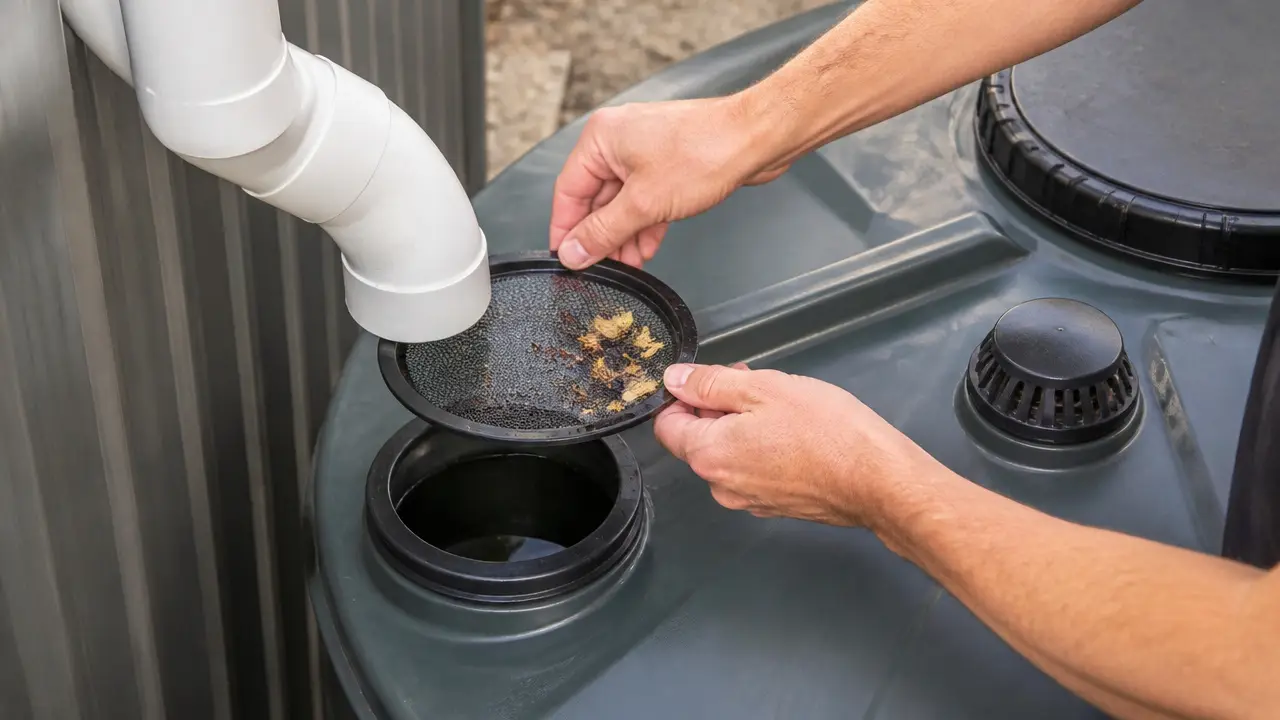
Fine sediment can clog prefilters and increase pressure drop. Use appropriate roof screening, tank settling, spin-down filtration, or cartridge filtration before the under-sink RO system.
Control Biological Fouling
Stored rainwater can support microbial growth. RO membranes and carbon cartridges can foul when feed water is biologically active. The complete system needs a microbial-control strategy appropriate to the source and intended use.
Protect Carbon and Membranes
Carbon stages are often used before RO to control oxidants and organics. Feed-water chemistry determines which pretreatment is appropriate. Do not assume a standard city-water RO layout is automatically ideal for untreated rainwater.
Feed Pressure Matters
RO membranes require pressure to drive water across the membrane. A typical under-sink tanked system may need roughly household plumbing pressure to produce at its rated output.
Rainwater from an above-ground tank under gravity alone usually does not provide enough pressure for a conventional RO membrane. A pump and pressure system—or a tankless RO with its own powered pump—may be needed.
Low pressure reduces production and may worsen the product-to-reject-water ratio. Excessive pressure can also exceed component limits, so size the pump and regulator to the RO system’s current specifications.
Tanked vs Tankless RO
Tanked Systems
Tanked systems make water slowly and store it under pressure for quick faucet delivery. They do not need a powered booster when feed pressure is adequate, but the tank consumes cabinet space and loses usable volume as pressure conditions change.
Tankless Systems
Tankless units use a high-output membrane and internal pump to produce water on demand. They save cabinet space and can achieve better reject ratios, but they require electricity, make pump noise, and use proprietary cartridges in many designs.
Reject Water and Rainwater Conservation
RO sends a portion of the feed water to drain as concentrate. That can feel counterintuitive in a rainwater-harvesting system built to conserve water.
If local plumbing rules and the system design allow, reject water may sometimes be captured for suitable non-potable uses rather than sent directly to waste. Do not route concentrate back into the clean-water tank without understanding how that recirculation would increase dissolved contaminants.
The Waterdrop G3P600 has the strongest prepared reject-ratio claim here at two parts product water to one part reject water. Actual performance still depends on pressure, temperature, membrane condition, and feed-water quality.
Common RO Failure Modes
Housing or Fitting Leaks
Inspect every push fitting, threaded housing, O-ring, and manifold after installation and after service. Keep the cabinet dry enough that a slow leak is easy to notice.
Low Production
Check feed pressure, prefilter condition, membrane age, storage-tank precharge, and water temperature. Cold water reduces membrane production.
Frequent Filter Changes
Rainwater carrying sediment or biological load may exhaust prefilters faster than treated municipal water. Improve upstream treatment rather than simply replacing cartridges more often.
Bad Taste or Odor
Flush new filters as directed. If taste changes later, inspect cartridge age, tank sanitation, microbial growth, and the broader rainwater treatment system.
Final Recommendations
The iSpring RCC7AK-BN is the best overall choice for a conventional rainwater point-of-use RO system because it combines NSF/ANSI 58 certification, 75 GPD production, no-power operation, and remineralization. The Waterdrop G3P600 is the better fit when high output, tankless installation, and a low stated reject ratio matter more than electrical independence.
The Express Water RO5DX is a practical compact tanked system with useful feed-pressure guidance and a leak detector. The iSpring RCC7-BN keeps the design simpler for readers who do not want remineralization, while the APEC ROES-50 remains a conventional 50 GPD option but deserves especially careful housing and leak inspection.
Use RO because testing and intended use justify it—not because it is the most elaborate filter on the list. In a rainwater system, clean collection, pretreatment, reliable pressure, microbial control, maintenance, and current finished-water testing remain the foundation.
Frequently Asked Questions
Do I need reverse osmosis for rainwater?
Not automatically. Use water testing to identify whether dissolved contaminants or a low-TDS treatment goal justify RO. Many rainwater systems need sediment control and disinfection more urgently than reverse osmosis.
Can RO make rainwater safe to drink by itself?
Do not rely on RO alone as the entire rainwater drinking-water system. Collection hygiene, sediment control, microbial treatment, maintenance, and current finished-water testing all matter.
Does RO remove TDS?
Reducing dissolved solids is one of the main roles of an RO membrane. The actual reduction depends on the membrane, pressure, water chemistry, system condition, and supported performance claims.
Will a rain barrel provide enough pressure for RO?
Usually not by gravity alone. Conventional under-sink RO systems generally need pressurized feed water. Use a suitable pump/pressure system or an RO design with an internal booster pump.
How much water does RO waste?
It depends on the design and operating conditions. The Waterdrop G3P600 in this guide claims a 2:1 product-to-reject ratio. Conventional systems may send a larger share to drain, especially at low pressure or with an aging membrane.
Is remineralization necessary after RO?
No. It is a preference and treatment-design choice. Remineralization can change taste and add minerals after RO, while some users specifically want very low-mineral permeate.
Should UV go before or after RO?
System design depends on the water quality and equipment. UV is often used as a microbial-control stage after adequate filtration, and some point-of-use systems place final disinfection downstream of other treatment. Follow a treatment design matched to test results rather than a universal stage order.