
As an affiliate, we may earn a commission from qualifying purchases. We get commissions for purchases made through links on this website from Amazon and other third parties.
Best Overall
Best for Heavy Sediment
Best Compact Manual
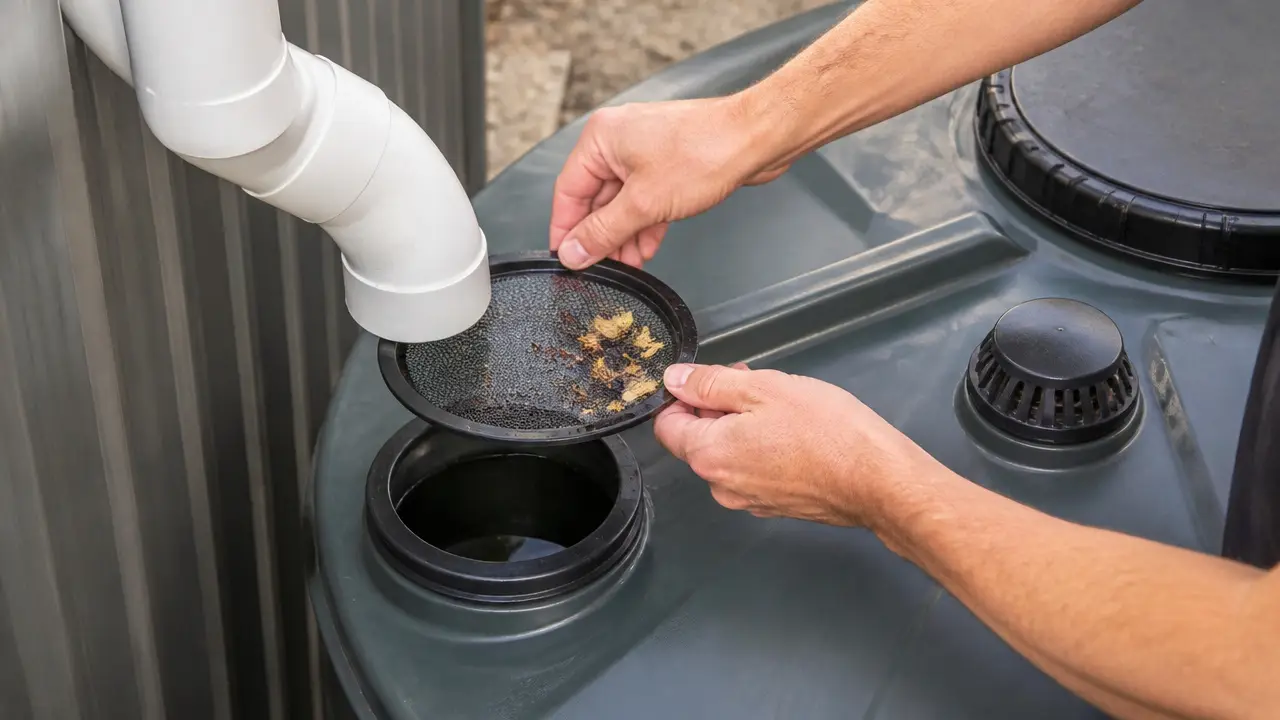
A reusable sediment filter is most useful when rainwater carries enough grit to make disposable cartridges expensive or annoying to replace. The filter catches larger particles on a washable mesh, then lets you flush or rinse the screen and put it back into service.
For most rainwater systems, reusable sediment filtration belongs early in the treatment path. It protects pumps, valves, fine cartridges, carbon media, UV chambers, and other equipment from sand, rust, roof grit, and tank sediment. It does not replace finer filtration when the intended water use needs smaller-particle removal.
Five products here are true reusable spin-down or mesh filters. One prepared product was a replaceable pleated cartridge rather than a clearly reusable system, so it is not included as a pick. The comparison below stays focused on filters designed around repeated flushing or screen cleaning.
Reusable Sediment Filters at a Glance
| Product | Best For | Key Strength | Main Tradeoff |
|---|---|---|---|
| iSpring WSP-50 | Most rainwater systems | Simple 50-micron manual screen with common threads | Needs regular cleaning in heavy sediment |
| iSpring WSP50ARJ | Heavy sediment | Jumbo screen and automatic scheduled flushing | Large powered system with high drain flow |
| Waterdrop RPFK | Compact manual filtration | 40–50 micron screen and several connection options | Little product-specific field history |
| iSpring WSP50ARB | Automatic flushing in less space | Auto, semi-auto, and manual modes | Flush module can fail |
| Waterdrop PF01 | Compact 50-micron use | Small housing and dual-thread plumbing | Drain and union leaks have occurred |
Best Overall: iSpring WSP-50
1 / 5
iSpring WSP-50 Reusable Spin-Down Sediment Filter

Screen
50 micron
Connections
1 in MNPT / 3/4 in FNPT
Pressure Range
15-115 PSI
The WSP-50 is the easiest reusable filter to recommend for a typical rainwater system because there is very little to go wrong. A stainless 50-micron screen sits inside a clear housing, sediment falls into the lower chamber, and a manual flush valve sends the collected material out through a hose barb.
The head provides 1-inch male NPT and 3/4-inch female NPT connection choices on both sides. That makes it easy to place after a pump or pressure tank without stacking several reducers. The documented working range is 15 to 115 PSI and 40°F to 100°F, with indoor use specified.
Rainwater-specific use supports its role well. It has been installed between collection tanks and a 12-volt pump, where sediment buildup remained visible and cleaning was straightforward. The limitation is screen loading. When the water carries a lot of fine grit, a 50-micron mesh can need frequent manual cleaning in addition to valve flushing.
Why It Works
- The 50-micron stainless screen can be cleaned and reused.
- Manual flushing avoids motors, timers, and power supplies.
- Dual thread sizes fit many pump-room layouts.
- A clear bowl makes maintenance need easy to see.
What To Keep In Mind
- Heavy sediment can overwhelm a 50-micron screen quickly.
- Use it in a protected location within its temperature range.
- Avoid excessive force on the clear bowl during service.
- Reusable sediment removal is not complete water treatment.
Best for Heavy Sediment: iSpring WSP50ARJ Jumbo
2 / 5
iSpring WSP50ARJ Jumbo Reusable Sediment Filter

Screen
50 micron
Connections
1 in MNPT / 3/4 in FNPT
Flush
Programmable automatic
The WSP50ARJ is the better choice when a standard screen needs attention too often. Its large filter area gives sediment more room to collect before water flow begins to suffer, while a 50-micron stainless mesh still catches much smaller grit than a coarse tank inlet screen.
Automatic flushing is the main reason to choose it. The control can open the drain on a schedule instead of depending on someone to remember every purge. That is useful when rainwater carries recurring iron particles, sand, or tank sediment and the filter is part of a busy whole-system line.
The tradeoff is complexity and drain volume. Product-specific use shows several gallons can leave the filter in only a few seconds, so the drain needs a real destination. The automatic module and drain valve can also fail. Exact housing capacity and dimensions are omitted because those prepared fields conflict.
Why It Works
- Larger screen area extends time between deep cleanings.
- Automatic flushing can handle routine sediment removal unattended.
- A reusable 50-micron screen protects finer media downstream.
- Common 1-inch and 3/4-inch NPT connection options simplify plumbing.
What To Keep In Mind
- The flush outlet can release water very quickly.
- Power and the control module add maintenance points.
- Manual cleaning may still be needed when sediment sticks to the mesh.
- Mount the heavy filter securely rather than letting pipe support its weight.
Best Compact Manual: Waterdrop RPFK
3 / 5
Waterdrop RPFK Reusable Sediment Filter

Screen
40-50 micron
Connections
1 in MNPT / 3/4 in MNPT / 3/4 in FNPT
Control
Manual
The Waterdrop RPFK is the most useful compact manual alternative to the iSpring. Its reusable 316L mesh is presented in the 40–50 micron range, and the filter body measures about 3.78 x 2.56 x 7.9 inches. That small footprint works well in a tight pump cabinet or filtration panel.
Connection flexibility is a strong point. The filter supports 1-inch male NPT, 3/4-inch male NPT, 3/4-inch female NPT, and a 3/4-inch push-fit option. It is not designed as a direct garden-hose fitting, so a hose-fed setup still needs the correct adapter.
There are no usable product-specific customer notes after contamination filtering, so this pick ranks on its documented construction and plumbing flexibility rather than a large field-use history. The prepared capacity value does not make sense for this small inline filter and is not used here.
Why It Works
- A reusable 40–50 micron screen provides useful prefiltration.
- Several connection styles reduce adapter count.
- Compact dimensions suit crowded equipment spaces.
- Manual operation avoids an electronic flush controller.
What To Keep In Mind
- Do not mistake the 3/4-inch plumbing ports for garden-hose thread.
- Long-term service history is limited in the prepared customer material.
- Keep the housing protected from freezing and damaging exposure.
- A finer downstream stage may still be needed.
Best Automatic Compact Option: iSpring WSP50ARB
4 / 5
iSpring WSP50ARB Automatic Reusable Sediment Filter

Screen
50 micron
Connections
1 in MNPT / 3/4 in FNPT
Modes
Auto / semi-auto / manual
The WSP50ARB adds scheduled flushing without moving all the way to the jumbo housing. Its 50-micron stainless mesh can be cleaned repeatedly, and the controller offers automatic, semi-automatic, and manual modes. That makes it easier to trigger an extra purge after a dirty storm without changing the normal schedule.
The dual-thread head supports 1-inch male NPT and 3/4-inch female NPT plumbing. Product-specific installations show it working as the first stage ahead of multi-filter systems, reducing the amount of debris reaching later cartridges.
The flush module is the main weakness. A failed power or valve controller can leave the filter working only as a basic screen until the module is repaired. Exact capacity and body dimensions are omitted because the prepared fields conflict.
Why It Works
- A reusable 50-micron screen reduces disposable-media use.
- Three flush modes provide more control than a fixed timer alone.
- Common thread options simplify whole-system plumbing.
- Scheduled purging is useful when sediment load is predictable.
What To Keep In Mind
- The electronic flush module can fail before the filter body does.
- Keep the controller protected from water and weather.
- Automatic flushing still needs a safe drain route.
- Deep manual cleaning may still be required periodically.
Best Compact 50-Micron Alternative: Waterdrop PF01
5 / 5
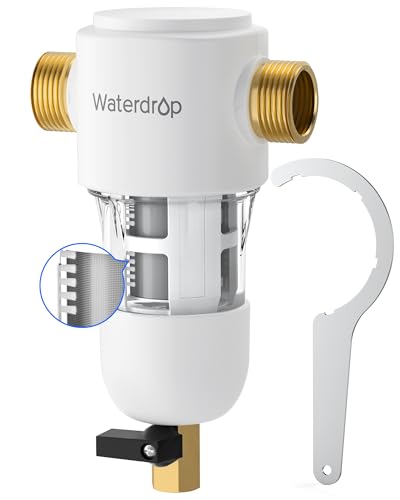
Waterdrop PF01 Reusable Spin-Down Sediment Filter
Screen
50 micron
Dimensions
6.5 x 2.9 x 7.7 in
Connections
1 in MNPT / 3/4 in FNPT
The PF01 combines a compact housing with a reusable 50-micron stainless screen. Its body measures about 6.5 x 2.9 x 7.7 inches, and the head provides 1-inch male NPT plus 3/4-inch female NPT connections.
Flushing the bottom chamber activates an internal cleaning action around the screen. That can reduce the need to open the housing every time sediment accumulates. Product-specific use shows it working ahead of sprinklers and disposable filters where sand and rust would otherwise cause more frequent clogs.
Seal reliability is the reason it ranks last. The purge control and union-style connections have leaked on some units, and replacement-part availability has been questioned. A bypass and isolation-valve layout makes this kind of filter easier to own long term.
Why It Works
- A reusable 50-micron mesh reduces cartridge waste at the first sediment stage.
- Compact size fits tight pump areas.
- Dual thread options work with common pipe sizes.
- The purge-cleaning action makes routine service fast.
What To Keep In Mind
- Watch the drain valve and unions for leakage.
- Replacement parts may not be as easy to source as the filter body itself.
- Use it in protected above-freezing conditions.
- Add isolation valves if removing the filter would otherwise shut down the entire system.
Reusable Filter vs Disposable Cartridge
A reusable mesh is best for larger sediment that can be flushed away. It reduces waste and protects finer filters, but the screen usually cannot catch particles as small as a dense 5-micron depth cartridge.
A disposable cartridge is better for fine sediment polishing. It costs more over time and creates more waste, but it can capture smaller particles without the complex flow paths of a very fine reusable screen.
Many rainwater systems benefit from both: reusable first, disposable fine stage second.
Maintenance Routine
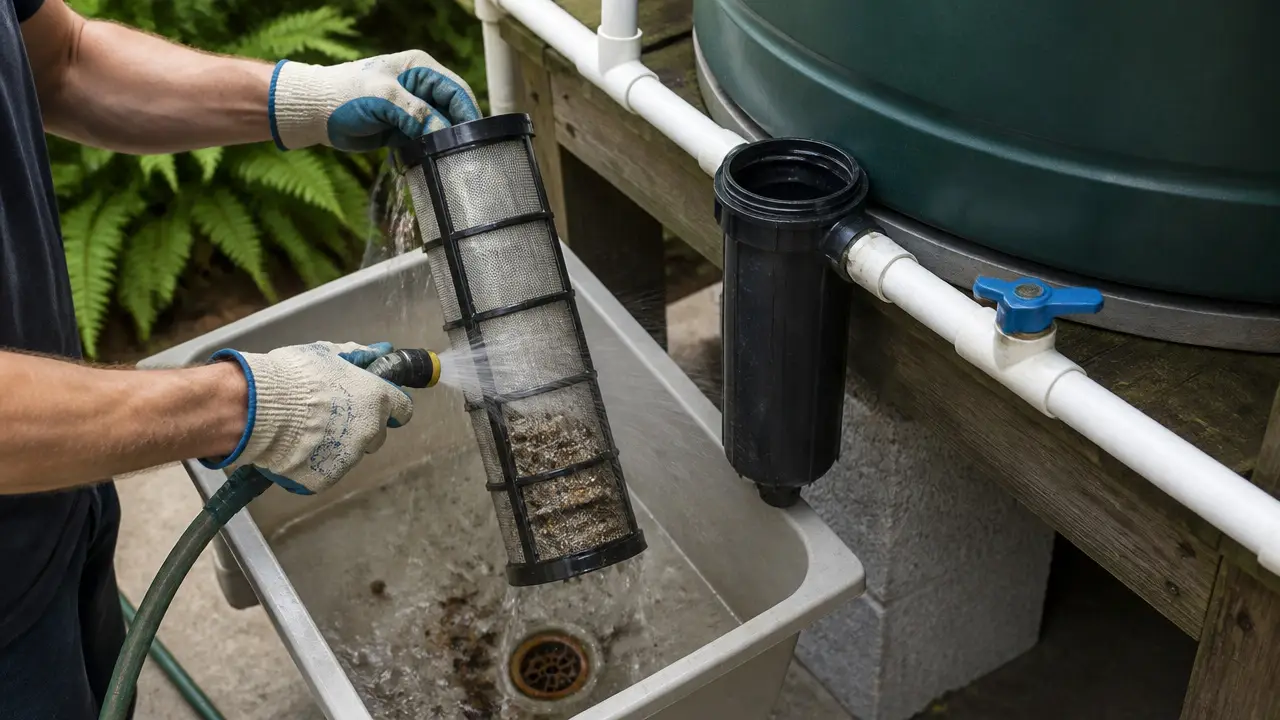
Flush the reusable filter before pressure drop becomes noticeable. When valve flushing no longer restores flow, isolate the housing, relieve pressure, remove the screen, and clean it according to the filter instructions.
Inspect O-rings and sealing surfaces during disassembly. A small grain of sand on a housing seal can create a leak when the filter is put back together.
Keep clear housings out of sunlight when the product is intended for indoor use, and drain seasonal systems before freezing weather.
Frequently Asked Questions
Can reusable sediment filters replace cartridge filters?
They can replace the coarse sediment stage, but fine cartridges may still be needed when smaller-particle removal is part of the treatment plan.
How long does a reusable sediment screen last?
Service life depends on screen material, sediment load, cleaning method, pressure, and damage. Replace a screen that is torn, distorted, or no longer seals correctly.
What micron size should a reusable rainwater filter use?
A coarse 100- to 500-micron first stage can suit dirty water, while 40- to 50-micron mesh catches smaller grit. The right choice balances debris capture and cleaning frequency.
Do reusable filters lower water pressure?
Any filter creates some pressure loss, especially as sediment builds on the screen. A properly sized clean filter should preserve useful flow, while a clogged one can cause a noticeable drop.
Can I clean a spin-down screen without opening the housing?
Routine flushing often removes loose sediment. Sticky iron, scale, or packed debris may require removing and washing the screen.
Does a reusable sediment filter make rainwater safe to drink?
No. It removes physical sediment only. Drinking-water use needs suitable microbial and chemical treatment, current testing, maintenance, and applicable local requirements.
For a direct comparison of automatic and manual screen designs, spin-down sediment filters goes deeper into that format. Sediment filters for rainwater compares reusable systems with finer cartridges. Upstream, rainwater tank inlet screens keep larger debris out of storage before the pump starts moving water.