As an affiliate, we may earn a commission from qualifying purchases. We get commissions for purchases made through links on this website from Amazon and other third parties.
Reverse osmosis is one of the most complete home water treatment methods, but it is not always the best choice. A different treatment—or a combination of treatments—can be better depending on what is actually in your water.
For rainwater, well water, or other private supplies, the best approach is usually to test the water first and build treatment around the contaminants found. CDC recommends choosing treatment that targets the specific germs or chemicals of concern rather than assuming one filter can handle everything.
What Reverse Osmosis Does
Reverse osmosis, usually called RO, uses water pressure to push water through a very fine membrane. Many dissolved substances cannot pass through the membrane and are sent to a separate reject-water line.
RO can reduce a wide range of contaminants, including:
- Dissolved salts
- Sodium
- Lead
- Copper
- Chromium
- Many other dissolved minerals
- Some nitrates
- Some arsenic
- Some fluoride
- Many organic chemicals
RO membranes can also provide strong removal of parasites, bacteria, and viruses when the system is designed and maintained correctly. Exact performance depends on the complete system and its certification.
The main drawbacks are that RO produces reject water, needs adequate pressure, requires filter and membrane maintenance, and removes minerals along with unwanted contaminants. EPA also notes that pretreatment is often needed to keep membranes from fouling.
Is Anything Actually Better Than Reverse Osmosis?
There is no single treatment method that is better in every situation.
The better choice depends on the problem you need to solve.
| Treatment | Often Better When You Need To | Main Limitation |
|---|---|---|
| Reverse osmosis | Remove a broad range of dissolved contaminants | Produces reject water and needs pressure |
| Activated carbon | Improve taste and odor or reduce certain organic chemicals | Does not remove most dissolved salts or germs |
| Ultrafiltration | Remove particles, parasites, and bacteria without removing most minerals | Does not remove most dissolved chemicals |
| UV disinfection | Control microorganisms in already clear water | Does not remove chemicals or particles |
| Distillation | Remove many dissolved contaminants and microorganisms | Slow and energy intensive |
| Ion exchange | Target hardness or particular dissolved ions | Does not provide complete water treatment |
| Multi-stage treatment | Handle several different contamination problems | More equipment and maintenance |
For many homes, the system that is "better than RO" is actually several treatment stages working together.
Distillation vs. Reverse Osmosis
Distillation heats water until it becomes vapor and then condenses that vapor back into liquid.
CDC states that distillation can remove parasites, bacteria, viruses, and many chemicals, including lead, nitrate, sodium, calcium, and magnesium. However, some volatile organic chemicals can pass through unless the system is designed to address them.
Any alternative should be compared with the health implications of reverse osmosis water rather than with taste or mineral content alone.
Distillation may make sense when very small amounts of drinking water need extensive treatment.
Its disadvantages are important:
- It uses significant electricity.
- Water production is slow.
- Mineral deposits must be cleaned from the unit.
- It is usually impractical for supplying large amounts of household water.
For most whole-house or higher-volume systems, RO is more practical than distillation.
Ultrafiltration vs. Reverse Osmosis
Ultrafiltration, or UF, uses a membrane too, but its openings are larger than those in an RO membrane.
CDC describes ultrafiltration as effective at removing parasites and bacteria and somewhat effective against viruses. It does not provide the same removal of dissolved chemicals that RO provides.
UF can be a better choice when your main concerns are:
- Sediment
- Very small suspended particles
- Parasites
- Bacteria
It can also be useful when you want filtration without removing most dissolved minerals.
But if your water contains unwanted dissolved salts, nitrate, arsenic, or similar dissolved contaminants, UF normally cannot replace RO.
Activated Carbon vs. Reverse Osmosis
Activated carbon works differently from a membrane. Chemicals attach to the large internal surface of the carbon as water flows through it.
Carbon can be very useful for reducing:
- Chlorine
- Unwanted tastes
- Unwanted odors
- Certain organic chemicals
- Some pesticides and treatment byproducts, depending on the filter
It generally does not remove dissolved minerals, nitrate, or microorganisms by itself.
That means carbon is not necessarily an alternative to RO.
It is often a partner to RO.
A carbon filter can treat contaminants that the carbon media is certified to reduce, while the RO membrane handles many dissolved substances.
UV vs. Reverse Osmosis
Ultraviolet treatment exposes water to UV light to disinfect it.
UV can be an excellent treatment stage when microorganisms are the main concern. Unlike RO, it does not need to remove dissolved minerals from the water to perform its main job.
But UV does not remove:
- Lead
- Arsenic
- Nitrate
- Salt
- Sediment
- Most chemical contaminants
It also works best when the incoming water is properly prefiltered. Cloudy or dirty water can interfere with UV treatment.
For private water supplies where microbial contamination is a concern, UV may therefore be used after filtration rather than instead of all other treatment.
Ion Exchange Can Be Better for Specific Problems
Ion-exchange media are designed to exchange certain charged substances in the water for other ions.
A common example is a water softener. It removes hardness minerals such as calcium and magnesium.
Special ion-exchange systems can also target particular contaminants.
If your only problem is hard water, installing RO throughout the house would usually be unnecessary. A properly selected softener is much better suited to that particular job.
Likewise, targeted treatment can sometimes make more sense when laboratory testing identifies one specific contaminant.
A Multi-Stage System Can Be Better Than RO Alone
Water problems often come in several forms at the same time.
You might have:
- Sediment
- Organic material
- Unwanted dissolved chemicals
- Microorganisms
Trying to make one filter handle all four is not ideal.
A treatment system can instead give each stage a specific job.
For example, a private water system might use:
- Sediment removal to protect later equipment.
- Activated carbon where suitable for identified organic chemicals, tastes, or odors.
- RO if dissolved contaminants need to be reduced.
- UV or another suitable disinfection stage when microbial control is required.
The exact order and equipment depend on the source water and treatment goals.
CDC specifically notes that multiple types of treatment can be used when needed to more effectively address different germs and chemicals.
What Is Better for Rainwater?
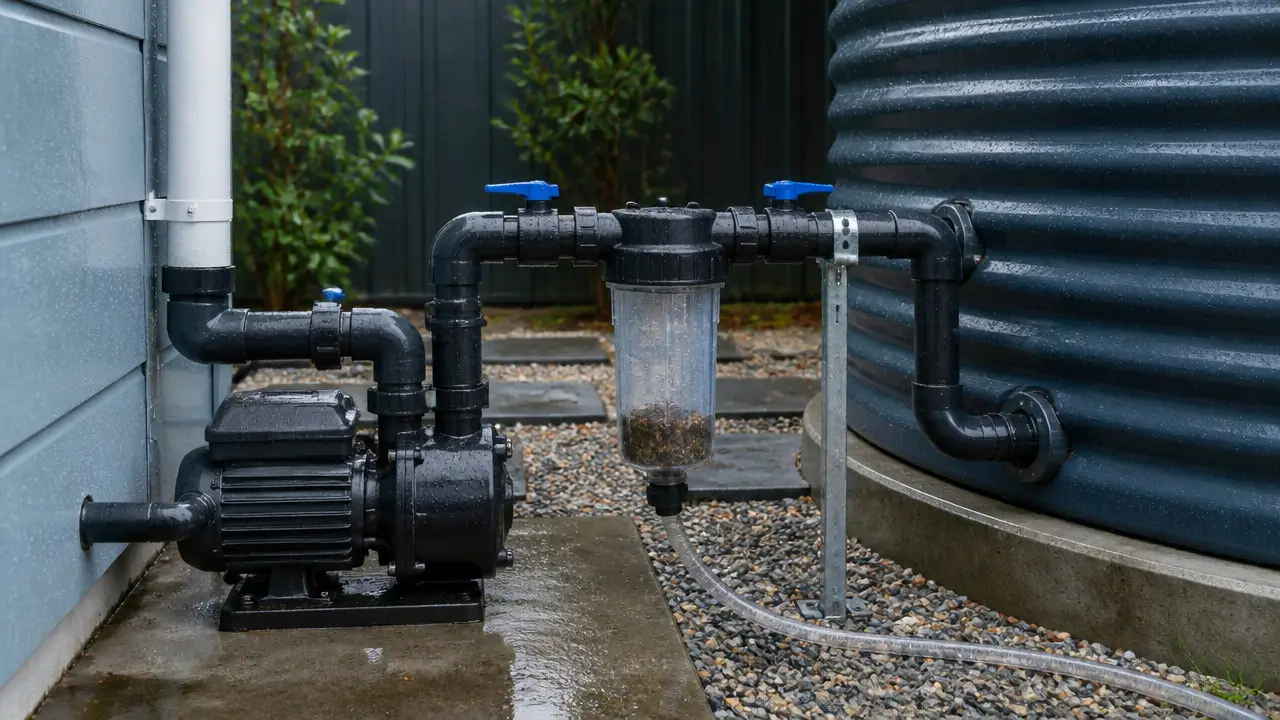
Rainwater needs a different way of thinking because treatment starts before the water reaches a filter.
Roof runoff can pick up dirt, bird droppings, microorganisms, metals, roofing contaminants, and substances from gutters, pipes, or tanks. Water that looks clear is not necessarily safe.
A good rainwater system starts with contamination control.
That may include:
Roof and Gutter Management
Evaluate practical considerations for reverse osmosis good for rainwater to understand installation planning for dependable ongoing service.
Keep the roof, gutters, and collection surfaces reasonably clean. The materials that contact the water also matter.
Debris Screening
Screens help keep leaves, insects, and larger debris out of the tank.
First-Flush Diversion
A first flush diverter sends away some of the first runoff from a storm.
That first runoff can carry a heavier load of dirt, germs, and chemicals that collected on the roof between rains. CDC recommends considering first-flush diversion as one way to improve collected rainwater quality.
Sediment Filtration
Sediment filters remove suspended particles and help protect later treatment equipment.
A micron rating describes approximately how small a particle a filter is designed to capture. A lower micron number generally means finer filtration, but micron size alone does not tell you whether water is safe to drink.
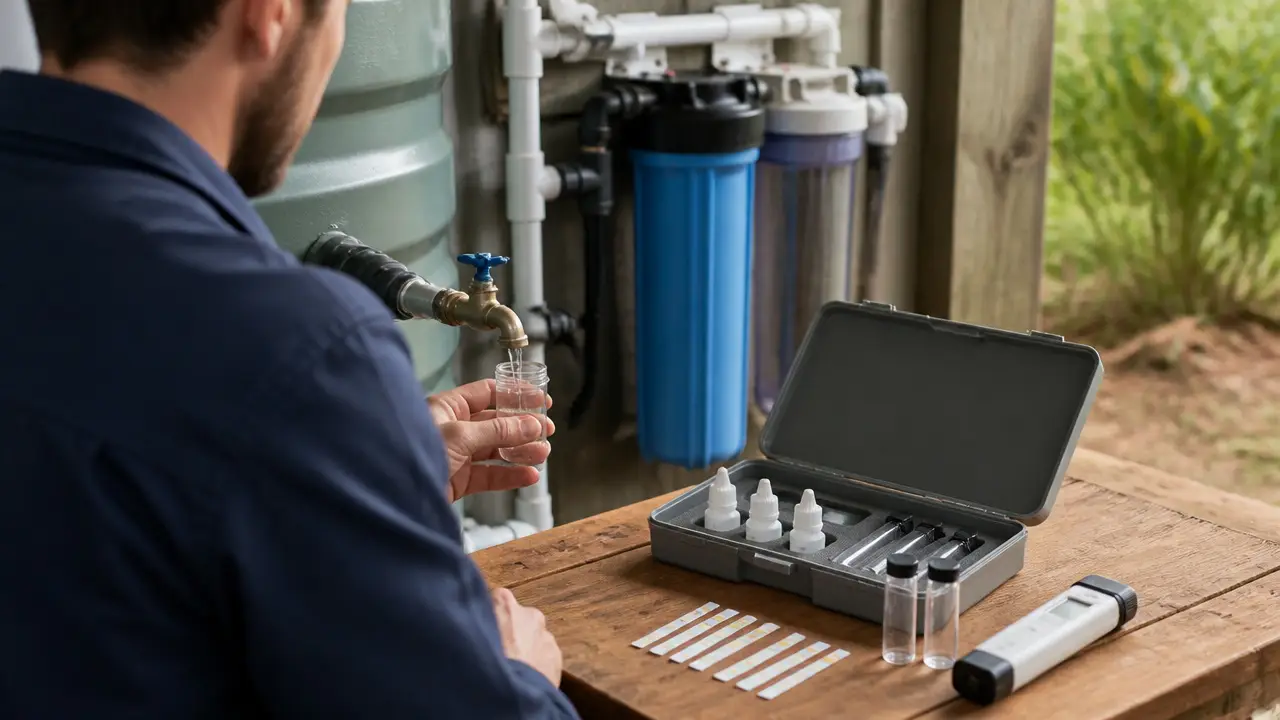
Treatment Based on Testing
Carbon, RO, ion exchange, UV, or another treatment can then be selected based on the water quality and intended use.
RO might be one stage. It should not automatically be treated as the entire rainwater purification system.
Is RO Necessary for Rainwater?
Not always.
For non-potable uses such as landscape irrigation, RO usually provides far more treatment than necessary.
Non-potable means water that is not intended for drinking.
If collected rainwater is being used for garden irrigation, the main concerns may instead be keeping debris out, maintaining the tank, protecting pumps and irrigation equipment, and preventing cross-connections with drinking-water plumbing.
Drinking water is different.
CDC says rainwater is not necessarily safe to drink without removing harmful germs and chemicals. If rainwater is used for drinking, cooking, or bathing, CDC recommends regular testing for germs and chemicals and choosing treatment appropriate for what is found.
RO alone should not be assumed to make roof runoff potable.
Potable means suitable for drinking.
A drinking-water rainwater system needs to be considered as a whole, including the collection surface, first flush, storage tank, prefiltration, treatment, disinfection where required, maintenance, current laboratory testing, and applicable local requirements.
What About RO Wastewater?
Reject water is one of the biggest reasons someone might choose another technology.
RO cannot send all incoming water through the membrane as treated water. Part of the flow carries concentrated contaminants away from the membrane.
The amount varies with system design, water pressure, temperature, feed-water quality, and operating conditions.
EPA notes that RO and nanofiltration create a concentrate stream and that this water loss can be an important consideration where water is scarce.
That matters with rainwater because stored water is limited.
If your cistern contains a fixed amount of water, RO reject water reduces the amount available as treated water. Whether that tradeoff makes sense depends on what contaminants actually need removal.
Does Removing Minerals Make RO Water Bad?
RO removes many dissolved minerals along with unwanted contaminants.
That does not automatically make RO water unsafe.
It does mean that RO should not be chosen simply because a lower mineral or total dissolved solids (TDS) reading sounds healthier.
TDS is a broad measurement of dissolved substances in water. It does not tell you exactly what those substances are.
A low TDS reading does not prove that water is microbiologically safe. A higher reading also does not automatically mean that dangerous contamination is present.
Water testing should identify the actual contaminants that matter.
When RO Is Probably the Better Choice
RO remains a strong option when testing shows that you need broad removal of dissolved contaminants.
It can be especially useful when several dissolved substances need treatment rather than only sediment, taste, or hardness.
Look for treatment equipment that is independently certified for the specific contaminant reduction you need. An RO label alone does not mean every RO system has been verified to reduce every possible contaminant.
When Another Treatment Is Better
You may not need RO when the problem is narrow.
For example:
- Hard water: A suitable ion-exchange softener may make more sense.
- Sediment: Mechanical filtration may be enough.
- Taste or odor: Activated carbon may be more appropriate.
- Microorganisms: Proper filtration followed by suitable disinfection may be more appropriate.
- Large amounts of non-potable rainwater: Simple filtration may be much more practical than RO.
- Several different contamination problems: A treatment train may be better than relying on RO alone.
The first question should therefore not be, "What is stronger than reverse osmosis?"
It should be, "What needs to be removed from this water, and what will the water be used for?"
Frequently Asked Questions
What water filter is better than reverse osmosis?
No filter is better than RO for every situation. Activated carbon may be better for simple taste and odor problems. Ultrafiltration can be better when particles and microorganisms are the concern. Ion exchange is better suited to hardness. The correct choice depends on water testing and intended use.
Is distilled water better than reverse osmosis water?
Not necessarily. Distillation removes many microorganisms and dissolved contaminants, but it is slow and uses substantial energy. RO is generally more practical where larger amounts of treated water are needed. Neither method should be assumed to remove every possible contaminant.
Is UV better than reverse osmosis?
UV can be better for disinfecting properly pretreated water, but it does not remove dissolved chemicals, salts, or sediment. RO removes many dissolved contaminants. Some systems use both because the technologies perform different jobs.
Can activated carbon replace reverse osmosis?
Sometimes, but only when the contaminants being treated can be handled by the carbon filter. Carbon is useful for chlorine, taste, odor, and certain organic chemicals. It generally cannot replace RO when unwanted dissolved salts or similar contaminants need removal.
Do I need reverse osmosis for rainwater?
Usually not for basic non-potable uses such as landscape watering. Drinking-water use is much more demanding. Rainwater intended for drinking should be regularly tested and treated for the specific germs and chemicals present rather than relying on RO alone.
Does reverse osmosis make rainwater safe to drink?
RO should not be considered a guarantee that collected rainwater is safe to drink. Roof runoff can contain both microbial and chemical contaminants. Drinking-water use requires a properly designed collection and treatment system, maintenance, current laboratory testing, and compliance with applicable local requirements.
Is a multi-stage water filter better than RO?
It can be. Different treatment stages solve different problems. Sediment filtration, activated carbon, RO, and disinfection can complement one another. A well-designed system based on actual water quality is usually more reliable than choosing treatment simply because it has the finest membrane.