
As an affiliate, we may earn a commission from qualifying purchases. We get commissions for purchases made through links on this website from Amazon and other third parties.
Best Overall
Best Multi-Test Pack
Best for Total Bacteria Screening
A bacteria water test kit can answer a narrower and more useful question than a general chemistry strip: does this sample show signs of coliform bacteria, E. coli, or elevated microbial activity? That makes these kits useful after tank cleaning, plumbing repairs, treatment changes, long storage, or a contamination concern.
They are still screening tools. A negative home test does not prove roof-collected rainwater is safe to drink, and a positive test does not identify every organism or tell you where contamination entered the system. When drinking-water safety depends on the answer, use suitable treatment and current laboratory testing for the full system.
The six choices here include dedicated bacteria tests, multi-test packs for repeated sampling, and broader water kits that include bacteria alongside chemistry strips. The best choice depends on whether you want one focused answer or a larger monitoring kit.
Bacteria Water Test Kits at a Glance
| Product | Best For | Key Strength | Tradeoff |
|---|---|---|---|
| Safe Home DIY Bacteria Test | One focused bacteria screen | Dedicated coliform/E. coli screening with results from about 6-72 hours | Final interpretation may require the full incubation window |
| AquaVial E. Coli and Coliform 8-Pack | Repeated sampling | Eight individual tests and high-sensitivity format | Some samples take longer than expected to change color |
| AquaVial Plus | Total microbial load plus E. coli | Separate total-microbial and E. coli testing | More specialized and less useful for general chemistry |
| VARIFY 17-in-1 Kit | Bacteria plus broad chemistry | Two bacteria tests plus 100 multi-parameter strips | Bacteria testing is only one part of a much broader kit |
| Safe Home 14-in-1 Kit | Occasional broad home check | Includes bacteria and lead with basic chemistry | Smaller repeat-test supply than bulk strip kits |
| SJ WAVE 22-in-1 Kit | Broad ongoing screening | Dedicated bacteria tests plus a large strip supply | Color interpretation across many parameters can be demanding |
Coliform and E. Coli Are Not the Same as “All Bacteria”
Coliform bacteria are commonly used as indicators of sanitary quality. E. coli is a specific member of that broader group and is more closely associated with fecal contamination. A kit may screen for coliform and E. coli without identifying every organism present in the sample.
Some tests also estimate total microbial load. That can be useful for identifying a system that needs attention, but it still does not provide a full species-level laboratory analysis.
Read the test's scope before using the result. A coliform test does not cover every pathogen, and a general bacteria result does not prove that a particular organism is present.
A Focused Coliform and E. Coli Test
1 / 6
Safe Home DIY Bacteria in Water Test Kit

Focus
Coliform bacteria including E. coli
Result Window
About 6-72 hours
Tests
1
The Safe Home kit is the best fit when bacteria are the only question you need answered. It is a dedicated test designed to screen for multiple species of coliform bacteria, including E. coli, rather than combining the bacteria test with dozens of unrelated strip pads.
Results can begin showing in as little as about six hours, but the full result may take up to 72 hours depending on incubation conditions and bacterial concentration. That longer window matters. An early yellow result should not be treated as the final answer if the instructions call for continued incubation.
Product-specific use includes both successful detection and cases where later local testing found bacteria that the home kit did not show. That is exactly why this is best used as a screening tool. It can tell you when a system needs attention, but a high-stakes negative result still deserves a stronger test method.
Why It Works
- Focuses on coliform bacteria including E. coli.
- Simple single-purpose format is easier to interpret than a large chemistry panel.
- Can begin showing positive results within hours.
- Useful after tank maintenance, plumbing work, or suspected contamination.
What To Keep In Mind
- Wait through the full required incubation period before final interpretation.
- Does not test metals, pesticides, or other chemical contaminants.
- A negative home result is not a complete drinking-water safety assessment.
An Eight-Test Pack for Repeated Sampling
2 / 6
AquaVial E. Coli and Coliform Water Test 8-Pack

Tests
8
Focus
E. coli and coliform
Format
Color-change vials
The AquaVial 8-pack makes more sense when you need to sample more than one location or repeat the test over time. Eight individual tests let you compare water at the tank, a downstream faucet, a treatment outlet, or several dates after a cleaning or disinfection step.
The test uses a color-change vial format for E. coli and coliform screening. Its documented sensitivity reaches low bacterial concentrations, and the individual tubes are easier to track than cutting repeated tests out of one general strip kit.
Timing is the tradeoff. Product-specific use includes contaminated samples taking longer than the expected 48-hour window to show a change. Shelf life also matters when buying a multi-pack, so check the expiration date before planning a long monitoring schedule.
Why It Works
- Eight tests support repeat sampling and multiple locations.
- Dedicated focus on E. coli and coliform bacteria.
- Simple color-change format avoids multi-pad strip interpretation.
- Useful for tracking a system before and after corrective work.
What To Keep In Mind
- Some positive samples may take longer than expected to develop.
- Check expiration dates when storing unused tests.
- A negative screen does not replace laboratory analysis when drinking-water safety is at stake.
A Two-Part Kit for Total Microbial Load and E. Coli
3 / 6
AquaVial Plus Water Testing Kit

Tests
2-part kit
Screens
Total microbial load and E. coli
Use
Water bacteria screening
AquaVial Plus is the most specialized option here because it separates two microbial questions. One part screens total microbial load, fungi, and biofilm activity, while the other focuses on E. coli. That can be useful when you are troubleshooting a stored-water system and want more than a simple coliform yes/no answer.
The total-microbial side can flag a system with elevated biological growth even when the question is not limited to E. coli. The E. coli side then gives a separate targeted result. This can help after a filter replacement, long stagnation, or a contamination event.
The kit still needs careful timing. Product-specific use includes E. coli results developing over about 48 hours even when other screening information appears sooner. Treat the rapid part and the incubation part as different tests rather than expecting one instant final answer.
Why It Works
- Separates total microbial screening from E. coli testing.
- Useful when biofilm or general microbial growth is also a concern.
- Clearer purpose than a broad chemistry strip for bacteria troubleshooting.
- Can help decide whether professional testing or system cleaning should come next.
What To Keep In Mind
- More specialized than a general home water kit.
- E. coli results still require the stated incubation period.
- Does not provide a full laboratory identification of organisms.
A Broad Kit With Two Bacteria Tests
4 / 6
VARIFY 17-in-1 Water Test Kit

Bacteria Tests
2
Strips
100
Other Screening
pH, hardness, chlorine, metals and more
The VARIFY kit is the practical choice when bacteria are only one part of a broader water-quality check. It includes two bacteria tests plus 100 strips for chemistry parameters such as pH, hardness, chlorine, iron, copper, and other basic measurements.
That combination is useful for a rainwater system after a major maintenance event. You can screen for bacteria while also checking whether basic chemistry has shifted. The strip supply is divided into sealed pouches, which helps when testing is spread across months rather than done all at once.
The bacteria component takes about 48 hours, while the strips are read much sooner. Keep those results separate. A normal chemistry strip does not reduce the importance of a bacteria result, and a negative bacteria screen does not prove the water is free from chemicals the kit cannot detect.
Why It Works
- Two bacteria tests allow a repeat or second sampling point.
- 100 chemistry strips support ongoing general monitoring.
- Useful when you want microbial and basic chemistry information together.
- Broad pH range supports many water-testing situations.
What To Keep In Mind
- Bacteria testing is not the main focus of the kit.
- Multi-parameter strips add interpretation work that may not be needed for a bacteria-only question.
- Home screening cannot approve untreated rainwater for drinking.
A Smaller General Kit With Dedicated Bacteria Testing
5 / 6
Safe Home 14-in-1 DIY Water Test Kit

Parameters
14
Includes
Bacteria and lead tests
Use
Occasional home screening
The Safe Home 14-in-1 kit combines a bacteria test with lead and a smaller group of chemistry parameters. It fits the homeowner who wants one occasional check rather than a large supply for routine monthly testing.
For rainwater, the bacteria test is the important part when storage or plumbing contamination is suspected. The additional pH, hardness, nitrate, and other checks can help provide context, but they should not distract from the microbiological result.
The kit has a smaller repeat-testing supply than the bulk strip options. That makes it better for a move-in check, post-maintenance screen, or one-time system review than for a long trend log.
Why It Works
- Includes bacteria, lead, and basic chemistry in one package.
- Easier to manage than a very broad 20-plus-parameter panel.
- Useful for occasional home or rainwater-system checks.
- Straightforward instructions support first-time testers.
What To Keep In Mind
- Limited repeat-test supply.
- Lead screening is threshold-style rather than a detailed lab concentration.
- Bacteria and chemistry results still cover only the parameters in the kit.
A Broad 22-Parameter Kit With Dedicated Bacteria Tests
6 / 6
SJ WAVE 22-in-1 Water Test Kit

Main Strips
125
Bacteria Tests
2
Total Parameters
22
The SJ WAVE kit has the widest general screening menu of the combination kits here. It includes a large strip supply plus dedicated bacteria and lead tests. That gives you enough material to follow changes over time while reserving the bacteria tests for moments when microbial contamination is a real concern.
Its strength is breadth rather than simplicity. A rainwater owner who wants to record pH, hardness, chlorine, metals, and other basic parameters alongside occasional bacteria screening gets a lot of testing capacity in one package.
Reading many strip pads quickly can be difficult, and some measurement ranges are broad. That moves it to the bottom of a bacteria-specific ranking. If bacteria are the only concern, a dedicated vial test is easier to use and interpret.
Why It Works
- Large supply supports long-term general monitoring.
- Dedicated bacteria tests supplement the chemistry strips.
- Broad parameter coverage can reveal several kinds of water-quality change.
- Good fit when one household wants both routine strips and occasional bacteria screening.
What To Keep In Mind
- More complex than necessary for a bacteria-only question.
- Color timing across many pads can make readings harder to compare.
- A broad panel still cannot identify every contaminant in roof-collected water.
When Should You Test Rainwater for Bacteria?
Test after a contamination concern, tank cleaning, plumbing repair, treatment failure, long period of stagnation, or major change in odor or appearance. Testing is also useful after disinfection to see whether the system needs further attention.
For a system supplying water to people, the correct testing schedule depends on intended use, treatment, local requirements, and the risk of contamination. A roof and gutter system exposed to animals or heavy debris has different risks from a closed treated storage system.
If water may be consumed, laboratory testing should be part of the plan. Do not wait for taste, smell, or cloudiness to signal a microbiological problem.
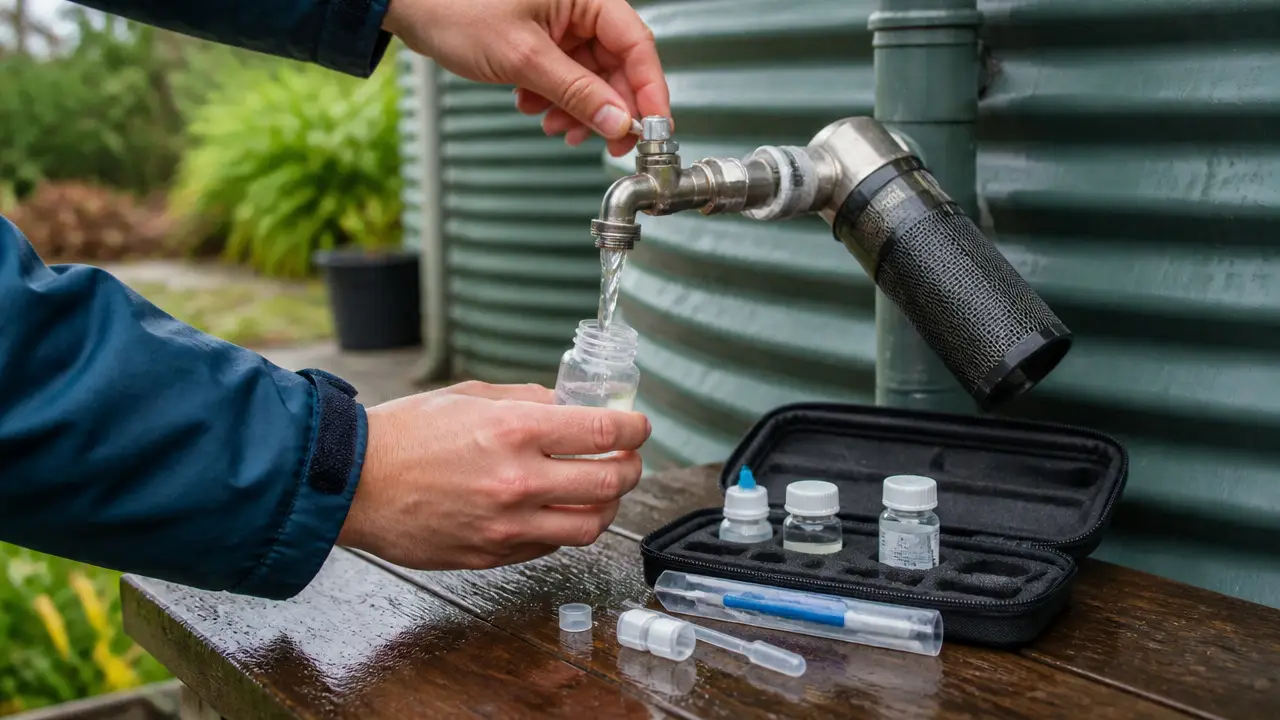
How to Avoid Contaminating the Sample
Wash Your Hands
Handle the sample container and test materials with clean hands. Do not touch the inside of the test vial or cap.
Sample From the Right Point
Choose the location that answers your question. Tank water tells you about storage. A kitchen faucet tells you about the water after it has passed through downstream plumbing and treatment.
Let the Faucet or Outlet Run as Directed
Some testing methods require a specific sampling procedure. Follow the kit instructions rather than inventing a rinse time.
Close the Test Immediately
Once the sample is in the container, seal it as directed. Leaving the vial open invites contamination from hands, dust, and the surrounding air.
Respect the Incubation Window
Do not call a test negative too early. Some positive samples develop later in the allowed time range.
What a Positive Home Bacteria Test Means
A positive result means the water deserves attention. Stop using the result as if it were normal, review the system for contamination pathways, and use an appropriate confirmatory test when the intended water use makes the result important.
Possible system issues include contaminated gutters, tank entry points, biofilm, poorly maintained treatment equipment, plumbing work, or outside contamination. The home test does not tell you which source caused the result.
Do not simply add treatment and assume the problem is solved. Correct the contamination pathway, follow appropriate cleaning or disinfection procedures, and retest.
Test coverage matters when buying a home water quality test kit because different kits screen for different contaminants.
What a Negative Test Does Not Mean
A negative bacteria screen does not mean the water is free of all microorganisms. It also says nothing about lead, pesticides, PFAS, roof-treatment chemicals, smoke residues, or other substances outside the test scope.
For drinking-water use, the full chain matters: collection surface, first flush, storage, filtration, disinfection, plumbing materials, and current testing. No single home vial can replace that system-level assessment.
Frequently Asked Questions
What bacteria should I test for in rainwater?
Coliform bacteria and E. coli are common screening targets because they can indicate sanitary contamination. The right laboratory panel may include additional organisms depending on intended use and local guidance.
How long do home bacteria water tests take?
It varies. Some tests can show positive changes within hours, while final interpretation may require 48 to 72 hours. Follow the complete time window for the exact kit.
Can a bacteria test kit tell me rainwater is safe to drink?
No. It answers only the microbiological questions included in that test. Drinking-water use also requires suitable treatment and current testing for chemical and other relevant hazards.
What should I do if a bacteria test is positive?
Treat the result as a reason to stop normal use for sensitive purposes, investigate the system, correct contamination sources, and use appropriate confirmatory testing before returning the water to that use.
Can a home bacteria test give a false negative?
Yes. Sampling, incubation conditions, test sensitivity, contamination level, and kit condition can all affect the result. Laboratory testing is more appropriate when the decision is high stakes.
Should I test the tank or the faucet?
Test the point that matches the question. Tank sampling checks stored water, while a faucet sample includes the effects of downstream treatment and plumbing.
For broader chemistry and bacteria screening together, rainwater test kits compare multi-parameter options. A pH meter for rainwater helps track acidity changes but does not detect bacteria. TDS meters for rainwater can track dissolved-ion changes without identifying pathogens. If cloudiness is changing, turbidity meters for rainwater measure suspended-particle effects rather than microbial safety.