
As an affiliate, we may earn a commission from qualifying purchases. We get commissions for purchases made through links on this website from Amazon and other third parties.
Best Overall
Best High-Flow
Best Basic UV Chamber
UV treatment can be a strong final microbial-control stage in a rainwater system, but it is unusually dependent on everything that comes before it. Ultraviolet light must pass through the water and reach microorganisms at the required dose. Sediment, cloudiness, color, scale on the quartz sleeve, excessive flow, or a weak lamp can all reduce that exposure.
That means a UV chamber is not a substitute for inlet screening, sediment filtration, appropriate carbon or other treatment, or water testing. It also does not physically remove sediment, metals, salts, pesticides, or other dissolved contaminants. Its job is microbial inactivation when the system is correctly sized, powered, maintained, and supplied with water of suitable UV transmittance.
The five systems here are point-of-entry UV units with different flow roles, connection sizes, controls, and maintenance features. For rainwater, those differences matter more than a generic claim that a lamp is “UV.”
UV Water Purifiers at a Glance
| Product | Best For | Key Strength | Main Tradeoff |
|---|---|---|---|
| iSpring UVF55FS | Best overall residential setup | 12 GPM design, 1-inch MNPT ports, flow-sensor control | Thread/seal installation needs care |
| VIQUA VH410 | Higher-flow homes | 18 GPM class with lamp-life controller and broad input-voltage listing | Replacement electronics can be costly and sleeve handling is delicate |
| HQUA-OWS-12 | Basic stainless UV stage | Simple 120V, 40W chamber with 3/4-inch MNPT ports and spare lamp | Ballast, sleeve, and chamber longevity need monitoring |
| VIQUA VH410M | Monitoring-focused installation | UV intensity monitoring and solenoid-ready control path | More sensors add setup and maintenance complexity |
| Bluonics 12 GPM 55W | Spare-lamp-ready kit | 12 GPM class, LED/alarm, 3/4-inch NPT, extra lamps | Long chamber and connection/ballast complaints require planning |
Best Overall: iSpring UVF55FS
1 / 5
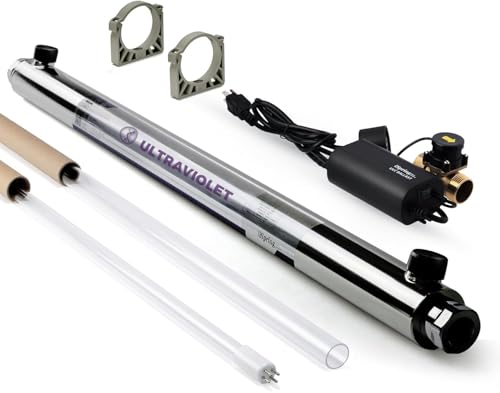
iSpring UVF55FS Whole House UV Water Filter
Flow Claim
12 GPM
Connections
1 in MNPT
Lamp
55 W UV
The iSpring UVF55FS offers the best balance of flow, connection size, controls, and maintenance guidance for a residential rainwater treatment train. It is designed around a 12 GPM flow rate with one-inch male NPT inlet and outlet connections, which is a useful size for a point-of-entry installation serving several fixtures.
Its 55-watt ballast includes a flow-sensor switch. The sensor is designed to energize treatment when flow reaches about 0.66 gallon per minute. That reduces unnecessary lamp operation during no-flow periods and addresses the hot stagnant-water issue that can occur when a continuously operating UV chamber warms water sitting inside it.
The system still depends on proper hydraulic and water-quality conditions. A 12 GPM equipment rating is not permission to push any cloudy rainwater through it at 12 GPM. Pretreatment should reduce sediment and turbidity before the UV chamber, and the installation should preserve the manufacturer’s required flow and pressure conditions.
Maintenance is explicit: the UV lamp is a consumable, and the quartz sleeve needs periodic cleaning. iSpring recommends annual lamp replacement and sleeve cleaning every six to twelve months. In rainwater systems with mineral scale or residual sediment, sleeve inspection may need to happen more often.
Why It Works
- The 12 GPM flow class suits many residential point-of-entry systems.
- One-inch MNPT ports reduce the need to neck a larger main line down to small fittings.
- The flow-sensor control helps avoid unnecessary heating and runtime during no-flow periods.
- The stainless chamber, lamp, quartz sleeve, ballast, and O-rings form a complete UV treatment stage.
What To Keep In Mind
- Product-specific installation includes leaks and a cracked fitting, so do not over-tighten threaded connections.
- The lamp and quartz sleeve are routine maintenance items, not lifetime components.
- Clear, properly prefiltered feed water is essential for reliable UV exposure.
- UV treatment does not remove dissolved chemicals, metals, sediment, or salts.
Best High-Flow: VIQUA VH410
2 / 5
VIQUA VH410 Whole-Home UV Water System

Flow Class
18 GPM
Connections
3/4-1 in NPT
Lamp Life Claim
About 9,000 hr
The VIQUA VH410 is the strongest choice here when the treatment train needs more flow headroom. The product is sold as an 18 GPM whole-home UV system with 3/4- to one-inch NPT connection options and broad 100-240V input compatibility.
The controller provides more useful maintenance feedback than a simple on/off ballast. It shows power status, remaining lamp life, lamp failure, and a replacement reminder. That matters because a UV lamp can still glow after its germicidal output has declined below the intended treatment level. Visible light alone is not a reliable maintenance indicator.
VIQUA calls for annual lamp replacement at roughly 9,000 operating hours and recommends periodic quartz-sleeve cleaning. The prepared product material mentions sleeve cleaning as often as every three months. For rainwater, the right interval depends on how well upstream filtration and water chemistry keep the sleeve free of scale and fouling.
Product-specific use includes long service histories when installation and maintenance are handled correctly, but there are also reports of ballast failures. The quartz sleeve is fragile and should be handled carefully during maintenance.
Why It Works
- The 18 GPM class provides more flow capacity than the 12 GPM systems in this roundup.
- The lamp-life controller makes maintenance status easier to track.
- Broad input-voltage compatibility can simplify some installations.
- High-output lamp design keeps the reactor more compact than older long-chamber approaches.
What To Keep In Mind
- Controller and ballast replacement can become a significant ownership cost.
- Quartz sleeves are fragile and need careful handling during cleaning or lamp changes.
- Flow capacity is only meaningful when water clarity and UV transmittance meet treatment requirements.
- Continue microbiological testing rather than assuming an illuminated lamp proves finished-water quality.
Best Basic UV Chamber: HQUA-OWS-12
3 / 5
HQUA-OWS-12 UV Water Purifier

Power
120 V / 40 W
Connections
3/4 in MNPT
Chamber
304 stainless steel
The HQUA-OWS-12 is the simplest dedicated UV unit in this group. It uses a 120-volt, 40-watt lamp in a stainless-steel reactor with 3/4-inch MNPT inlet and outlet connections. The package includes the ballast, quartz sleeve, lamp, mounting hardware, gloves, instructions, and an extra UV bulb.
That straightforward layout suits a rainwater system where the owner already has proper prefiltration and wants a basic final UV stage without more elaborate flow or intensity sensing. The tradeoff is that a simpler controller gives you fewer ways to detect declining UV performance automatically.
Long-term product-specific use is mixed. Some units have operated for years before ballast failure, while others experienced early ballast failure, cracked quartz, corrosion, or pinhole leaks after extended use. Those are reminders that a UV chamber is a maintained appliance installed under pressure, not a fit-and-forget pipe section.
Stagnant water in the chamber can also warm while the lamp runs continuously. In installations where that matters, hydraulic layout or an appropriate flow-control strategy may be needed.
Why It Works
- Simple 120V operation fits common residential electrical service.
- 3/4-inch MNPT ports suit many smaller point-of-entry plumbing layouts.
- The stainless reactor and quartz sleeve are standard, serviceable UV components.
- An extra lamp is included for scheduled replacement planning.
What To Keep In Mind
- A basic ballast offers less treatment-status information than monitored systems.
- Inspect the chamber for corrosion or leakage as it ages.
- Keep a spare quartz sleeve as well as a spare lamp if system downtime matters.
- Pretreatment and post-installation water testing remain necessary.
Best Monitoring-Focused System: VIQUA VH410M
4 / 5
VIQUA VH410M UV Water Treatment System

Flow Claim
Up to 18 GPM
Monitoring
UV intensity alarm
Control
Solenoid-ready
The VH410M builds on the higher-flow VIQUA platform with an added monitoring role. It is designed for up to 18 GPM and includes UV intensity monitoring rather than relying only on lamp-on status and an annual timer.
That can be valuable in a rainwater installation because actual UV delivery depends on more than lamp age. A dirty sleeve, water color, low UV transmittance, or a sensor problem can change what the controller sees. The system is also solenoid-ready, allowing integration with a normally closed valve so water can be shut off during certain system faults when the installation is designed for that function.
Extra monitoring is not automatically simpler. Product-specific experience includes sensor alarms, temperature-compensation troubleshooting, and seal leaks after quartz-sleeve servicing. If you choose a monitored system, plan for sensor maintenance and understand what each alarm means before relying on automatic shutdown behavior.
Dimensions vary across references, so this guide does not use an exact chamber footprint for the VH410M. Measure the current unit before laying out the mechanical room.
Why It Works
- UV intensity monitoring provides more treatment feedback than lamp-on status alone.
- The 18 GPM flow class suits larger residential demand.
- Solenoid-ready design can support fail-closed system planning.
- Annual lamp reminders support scheduled maintenance.
What To Keep In Mind
- Exact dimensions are omitted because the prepared product fields conflict.
- Sensors and controls add diagnostic complexity.
- Sleeve seals need careful reassembly after maintenance.
- A UV alarm system complements, but does not replace, finished-water testing.
Best Spare-Lamp-Ready Kit: Bluonics 12 GPM 55W UV System
5 / 5
Bluonics Whole House UV Water Filter System

Flow Claim
12 GPM
Lamp
55 W
Connections
3/4 in NPT
The Bluonics system is useful when you want a conventional 12 GPM UV chamber with spare lamps included from the start. The kit uses a 55-watt lamp in a stainless-steel chamber, 3/4-inch NPT connections, an LED indicator, and an audible alarm. The package includes the chamber, ballast, quartz sleeve, O-rings, mounting hardware, and three lamps total according to the prepared product material.
Its main installation constraint is physical length. The prepared dimensions list the assembly at about 46 inches long, so it needs substantially more straight wall space than a compact high-output reactor. Leave room not only for the chamber but also for lamp and sleeve removal during service.
Product-specific use raises two practical concerns: thread sealing and ballast behavior. Some installations needed extra attention to stop leaks, and some power supplies developed chirping or failure symptoms. Stagnant-water heating is also mentioned, making a flow-switch-equipped control strategy attractive where cold-line temperature rise matters.
Why It Works
- The 12 GPM class fits many residential rainwater systems.
- The kit includes spare lamps, which reduces the chance of waiting for a lamp at replacement time.
- LED and audible status indicators provide basic fault awareness.
- Standard 3/4-inch NPT connections are familiar to residential plumbing installers.
What To Keep In Mind
- The long chamber needs enough wall space plus service clearance.
- Threaded connections and seals need careful leak testing.
- A surge protector and appropriate electrical installation are sensible around sensitive ballast electronics.
- Additional flow control may be worth considering if stagnant-water heating is a concern.
What UV Treatment Does—and Does Not Do
UV exposes microorganisms to germicidal ultraviolet energy as water passes through the reactor. When the correct dose reaches the target organisms, it disrupts their ability to reproduce. The process adds no disinfectant residual to the water.
That last point matters. UV does not continue protecting downstream plumbing if contamination is introduced after the chamber. Keep treated piping clean, avoid cross-connections, and place the UV stage appropriately in the treatment train.
UV also does not strain out dirt or remove dissolved contaminants. Iron, manganese, hardness scale, tannins, sediment, and other constituents can interfere with treatment or require separate equipment.
Pretreatment Requirements for Rainwater
Remove Sediment First
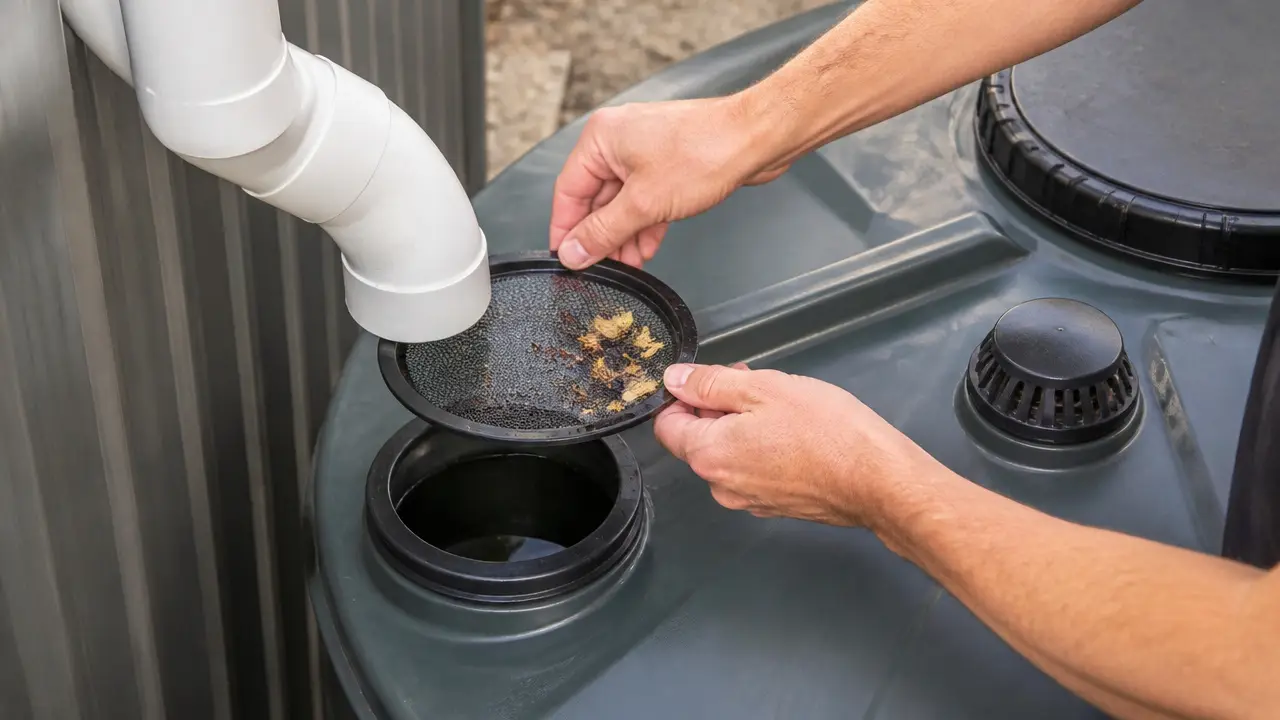
Roof grit, dust, insects, organic debris, and tank sediment should be removed before UV. Fine sediment can shield microorganisms from light and foul the quartz sleeve.
A rainwater system may use multiple stages: roof screens, first-flush diversion, tank settling, a spin-down prefilter, and finer cartridge filtration before UV.
Control Turbidity and Color
Water can look mostly clear and still have poor UV transmittance. Tannins, color, dissolved iron, and very fine particles can absorb or scatter ultraviolet energy.
If the system is being used for drinking water, test the source and finished water rather than using visual clarity as the only standard.
Match Flow to the UV Dose
UV reactors are rated for a certain flow under defined treatment conditions. Higher flow means less exposure time in the chamber. Do not oversize the pump and assume the UV unit will compensate.
Use a flow restriction, correctly sized pump, or system design that keeps maximum demand within the UV unit’s supported treatment flow.
Installation Considerations
Leave Service Clearance
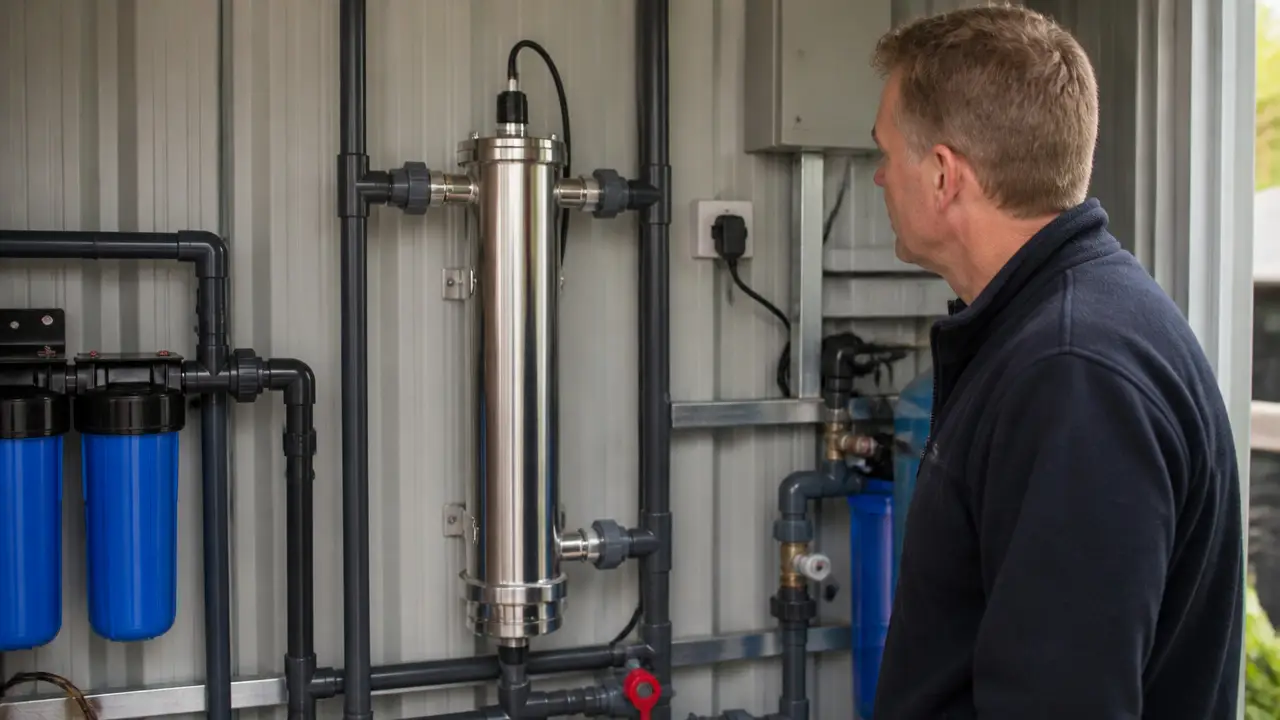
The lamp and quartz sleeve are long components that must slide out of the chamber. A reactor can physically fit on a wall but still be impossible to service if a ceiling, pipe, tank, or wall blocks removal.
Plan clearance before mounting the chamber.
Use Isolation and Bypass Valves
Service valves make lamp, sleeve, O-ring, and chamber maintenance much easier. A planned bypass can keep non-potable system functions available during service, but it should not accidentally allow untreated water into plumbing intended to receive UV-treated water.
Protect the Electronics
Ballasts and controllers need a dry, suitable electrical location. Follow grounding, outlet, GFCI, surge-protection, and environmental requirements in the current manufacturer instructions and local electrical code.
Leak-Test After Sleeve Service
Quartz-sleeve replacement often involves O-rings and compression seals. Reassemble exactly as directed, restore pressure slowly, and inspect for leaks before leaving the system unattended.
UV Maintenance Schedule
Replace the Lamp on Time
A UV lamp can still appear bright after germicidal output has declined. Follow the specified operating-hour or annual replacement interval instead of waiting for the lamp to go dark.
Clean the Quartz Sleeve
Mineral film or fouling reduces UV transmission. Inspect and clean the sleeve on the recommended schedule and more often when the source water leaves deposits.
Replace O-Rings When Needed
Repeated service can flatten, nick, or age seals. Keep correct replacement O-rings available rather than forcing a questionable seal back into service.
Continue Water Testing
UV system status lights do not measure every possible water-quality problem. For drinking-water use, maintain a testing schedule appropriate to the rainwater source, treatment train, local requirements, and household risk.
Final Recommendations
The iSpring UVF55FS is the best overall choice here for a typical residential rainwater treatment train because its 12 GPM class, one-inch connections, and flow-sensor control balance capacity and usability. The VIQUA VH410 is the stronger fit for higher flow demand and adds a useful lamp-life controller.
Choose the HQUA-OWS-12 when you want a simpler basic UV chamber, the VIQUA VH410M when UV intensity monitoring and solenoid integration are priorities, or the Bluonics 12 GPM system when included spare lamps and a conventional 3/4-inch setup fit your installation.
Whichever unit you choose, UV performance starts upstream. Keep the rainwater clear, control maximum flow, maintain the lamp and quartz sleeve, and assess finished-water quality with appropriate current testing.
Frequently Asked Questions
Is UV enough to make rainwater safe to drink?
Not by itself. UV can be an important microbial treatment stage, but rainwater may also contain sediment, chemicals, metals, and other contaminants that need separate treatment. Drinking-water use should be based on the complete treatment system and current water testing.
Where should a UV purifier go in a rainwater system?
Usually after sediment and other pretreatment stages, near the final point-of-entry or point-of-use delivery line. The water should be clear enough for effective UV transmission before it enters the reactor.
Does UV remove bacteria from the water?
UV is an inactivation process rather than a physical removal filter. Microorganisms pass through the chamber but are exposed to germicidal ultraviolet energy when the system is operating under the required conditions.
Does UV remove chemicals, metals, or TDS?
No. UV does not remove dissolved salts, metals, pesticides, sediment, or total dissolved solids. Use treatment designed for those contaminants when testing shows they are a concern.
How often should a UV lamp be replaced?
Many residential UV systems call for replacement around 9,000 operating hours or approximately once per year. Follow the specific current instructions for your model.
Why does the quartz sleeve need cleaning?
The sleeve separates the lamp from the water. Scale, iron, sediment, or film on the sleeve can block UV energy and reduce treatment performance.
What happens during a power outage?
A conventional UV system cannot provide active UV treatment without power. If safe drinking-water continuity is required, include an outage plan such as backup power, stored treated water, or another validated treatment approach.