As an affiliate, we may earn a commission from qualifying purchases. We get commissions for purchases made through links on this website from Amazon and other third parties.
Water quality is not defined by one number. For a household rainwater system, five useful indicators are turbidity, pH, total dissolved solids or conductivity, microbial contamination, and specific chemical contaminants.
Each tells you something different. Clear water can still contain harmful germs or chemicals, so these indicators should be used together. If rainwater may be used for drinking, testing is only one part of a larger safety plan that includes suitable collection, treatment, maintenance, and local requirements. The World Health Organization recommends managing drinking-water risks from the water source through treatment, storage, and final use rather than relying on a single test.
1. Turbidity
Turbidity describes how cloudy water is because of tiny suspended particles.
These particles may include:
- Dust and dirt
- Roof debris
- Organic matter
- Rust
- Sediment
- Algae
- Very fine clay or other solids
A turbidity test does not identify exactly what the particles are. Instead, it tells you how much material is suspended in the water.
This matters in a rainwater system because sudden cloudiness can point to a collection or maintenance problem. A dirty roof, clogged screen, disturbed tank sediment, or failed prefilter can all raise turbidity.
High turbidity can also make water treatment harder. WHO notes that turbidity is useful for checking particle-removal treatment and that high turbidity can interfere with some disinfection processes.
What to check in a rainwater system
If stored rainwater becomes noticeably cloudier, check:
- Gutters and roof valleys
- Leaf screens
- Downspout filters
- The first-flush system
- Tank sediment
- Tank covers and insect screens
- Filters downstream of the tank
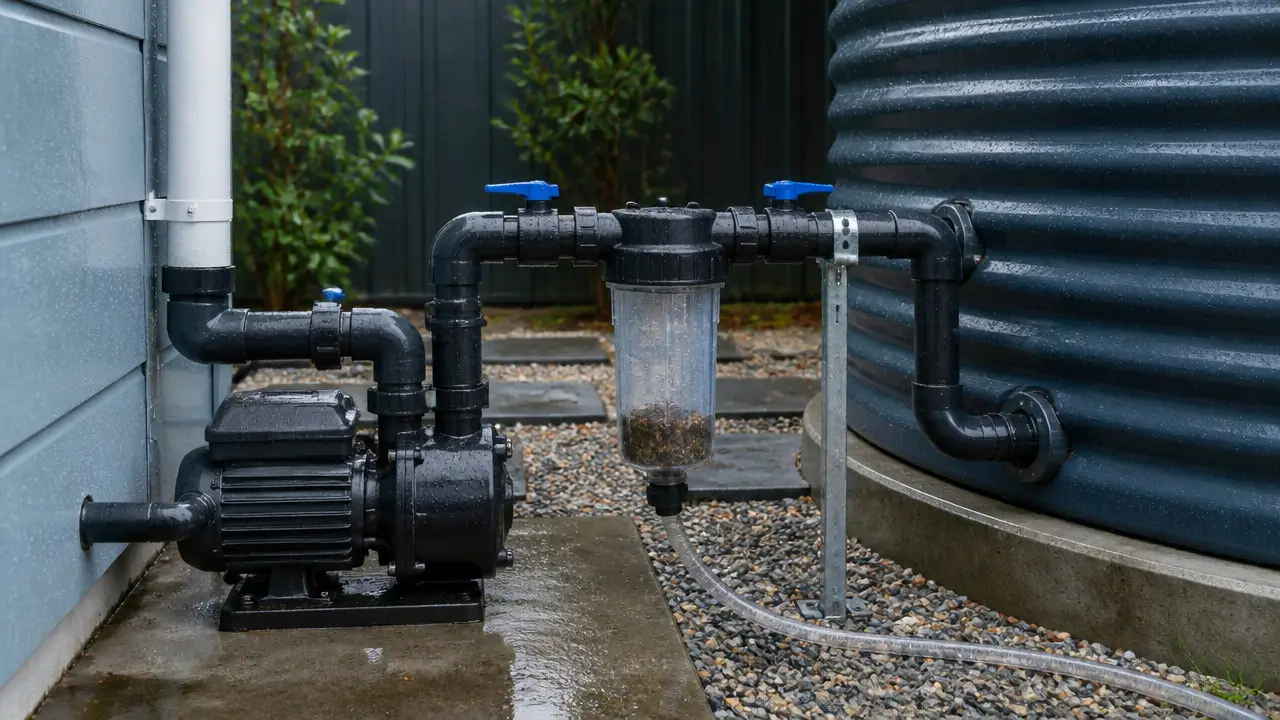
A first-flush diverter sends the first portion of roof runoff away from the tank. That early runoff often carries a heavier load of dust, pollen, bird droppings, and other roof debris.
Do not assume that clear water is safe to drink. Many microorganisms and dissolved chemicals do not make water cloudy.
2. pH
pH tells you how acidic or alkaline the water is.
The scale runs from acidic at the low end to alkaline at the high end, with 7 being neutral.
pH matters because it can affect:
- Pipe corrosion
- Metal fittings
- Tank materials
- Taste
- Treatment performance
- How easily some metals enter the water
Rainwater can have a different pH from well water or municipal water. Its pH may also change after contact with the roof, concrete tanks, pipes, treatment media, or stored sediment.
WHO notes that pH can affect treatment processes, including chlorination, and that contact with storage and plumbing materials may change pH.
For U.S. public water systems, EPA lists pH of 6.5 to 8.5 as a secondary drinking-water guideline. Secondary standards mainly address issues such as taste, appearance, staining, and corrosion rather than serving as a complete measure of health safety.
A pH reading outside an expected range deserves investigation, but correcting pH does not remove bacteria, viruses, pesticides, lead, or other contaminants.
3. Total Dissolved Solids and Conductivity
Total dissolved solids, usually shortened to TDS, means the dissolved minerals, salts, and other charged substances present in the water.
Common dissolved substances can include calcium, magnesium, sodium, chloride, sulfate, and other ions.
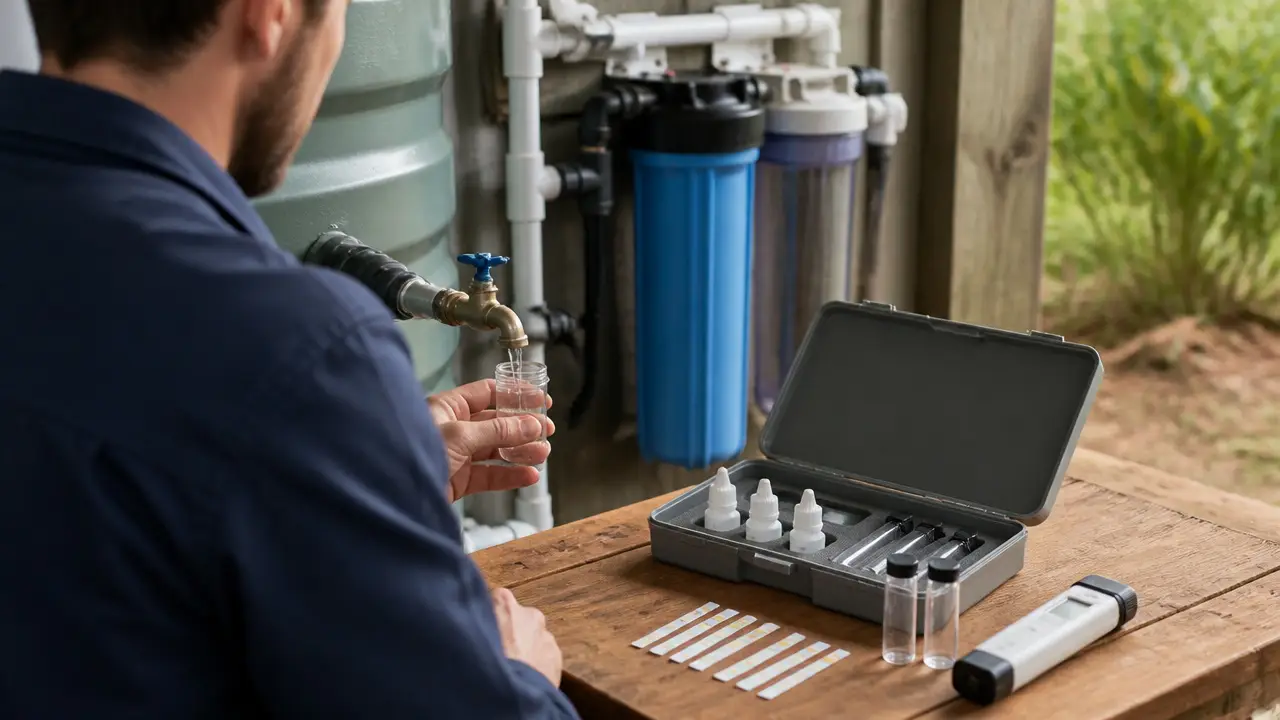
A conductivity meter measures how easily electricity passes through the water. Because dissolved ions increase conductivity, many handheld TDS meters estimate TDS from a conductivity reading.
This makes TDS or conductivity useful for spotting changes.
For example, a stored rainwater supply that normally produces similar readings may deserve attention if the number suddenly rises after:
- Roof repairs
- A new plumbing connection
- Contamination entering the tank
- Mixing with another water source
- Treatment-media failure
However, TDS is a broad indicator rather than a contamination detector.
A normal-looking TDS reading does not prove that water is free from:
- E. coli
- Viruses
- Parasites
- Lead
- Pesticides
- Fuel chemicals
- Many other health hazards
CDC includes TDS among useful routine indicators for private water supplies but explains that water-quality indicators do not necessarily reveal the specific harmful contaminant that may be present.
EPA lists 500 mg/L for TDS as a secondary standard for public drinking water. Again, this value mainly relates to aesthetic and operational concerns and should not be treated as a universal "safe to drink" cutoff.
4. Microbial Contamination
For water that people may drink, cook with, or otherwise consume, microbial quality is one of the most important concerns.
Roof runoff can pick up microorganisms from:
- Bird and animal droppings
- Leaves
- Insects
- Dust
- Gutters
- Standing water
- Dirty collection surfaces
Stored water can also become contaminated if insects, animals, floodwater, dirty hoses, or poorly sealed fittings enter the system.
Laboratories often use organisms such as total coliform bacteria and E. coli as indicators.
Total coliforms are a broad group of bacteria found in the environment. Finding them can point to problems with water-system cleanliness or contamination pathways.
E. coli is more closely associated with fecal contamination. A positive result deserves serious attention because fecal contamination can also introduce disease-causing organisms.
CDC explains that indicator bacteria are useful partly because testing every possible pathogen would be impractical. A positive indicator result does not tell you exactly which pathogens are present, while a limited home test cannot rule out every microbial hazard.
This is also why simply looking at the water is not enough. CDC notes that harmful germs and chemicals may be present even when water looks, smells, and tastes normal.
5. Specific Chemical Contaminants
The fifth indicator is not one universal meter reading. It is testing for chemicals that could reasonably occur in your particular water system.
Possible chemicals depend on the collection surface, surrounding environment, plumbing, storage system, and intended use.
Alongside identifying whether rain is acidic, verify maintenance timing based on a meaningful change in performance.
Tests may include substances such as:
- Nitrate
- Lead
- Copper
- Arsenic
- Pesticides
- Volatile organic compounds
- Other locally important contaminants
For rainwater, the relevant list may differ from the list for a groundwater well.
For example, roof and plumbing materials may influence which metals deserve attention. Nearby industrial activity, wildfire ash, agricultural spraying, or other local conditions can also change what should be tested.
This is one reason a general-purpose home water test cannot provide a complete drinking-water safety assessment.
CDC recommends testing private water supplies based on local contamination risks and using an appropriate certified laboratory when drinking-water safety is being evaluated.
What the Five Indicators Tell You
| Indicator | What it helps reveal | What it cannot prove |
|---|---|---|
| Turbidity | Suspended particles and changes in filtration or source water | Whether water is free of germs or dissolved chemicals |
| pH | Acidity or alkalinity and possible corrosion or treatment issues | Overall drinking-water safety |
| TDS/conductivity | Changes in dissolved mineral and salt content | Absence of pathogens or specific toxic chemicals |
| Microbial tests | Evidence of bacterial or fecal contamination | Absence of every possible pathogen |
| Chemical testing | Presence of specific chemicals included in the test | Absence of chemicals that were not tested |
The key point is that each measurement has a limited job.
A TDS meter cannot replace a bacterial test. A pH strip cannot find lead. A clear tank does not prove there is no E. coli. A negative bacteria test does not prove there are no harmful chemicals.
Which Indicators Matter for Rainwater Used in the Garden?
For simple non-potable irrigation, the testing plan is often different from one used for drinking water.
Non-potable means water that is not intended for drinking.
For garden use, you may be most interested in:
- pH
- Salinity or conductivity
- Sediment
- Unusual contamination from the roof
- Water characteristics that may clog drip irrigation
Water with a heavy sediment load, for example, may repeatedly block small emitters even if plant health is not the main concern.
The type of plants also matters. Some plants tolerate mineral salts better than others.
Edible crops can require more care because irrigation water may contact food that will later be eaten. Local agricultural or public-health guidance should be followed where applicable.
What Should Be Tested If Rainwater Is Intended for Drinking?
Drinking-water use needs a more complete approach.
Do not decide that collected rainwater is potable simply because five basic readings appear normal. Potable means suitable for drinking.
CDC specifically advises people using rainwater collection systems to test the water for harmful germs and chemicals, including routine testing and additional testing when color, taste, or smell changes.
A drinking-water plan may need to consider:
- Roof and gutter suitability
- Animal and environmental contamination
- First-flush diversion
- Prefiltration
- Storage-tank sanitation
- Sediment management
- Appropriate treatment stages
- Microbial testing
- Relevant chemical testing
- Maintenance records
- Current local drinking-water requirements
Treatment also has to match the hazard. A sediment filter may remove particles but not dissolved chemicals. UV disinfection can address certain microorganisms when correctly designed and maintained, but it does not remove metals or salts.
No single filter, purifier, UV unit, meter, test strip, or chemical treatment should be treated as proof that roof runoff is safe to drink.
WHO's current drinking-water guidance, updated in June 2026, uses a whole-system approach that manages hazards from the water source through treatment and final consumption.
When Water Should Be Tested Again
Water quality can change even when the system itself has not been intentionally modified.
Additional testing may make sense after:
- Flooding
- Major storms or unusual contamination events
- Roof replacement
- New roofing or gutter materials
- Tank cleaning
- Plumbing changes
- Treatment-system repairs
- Long periods of stagnation
- A major change in taste, odor, color, or turbidity
- A known local contamination event
For water intended for drinking, use current guidance from your local health or environmental authority to determine the required contaminants and testing schedule.
Frequently Asked Questions
What are the five main indicators of water quality?
For a household rainwater system, five practical indicators are turbidity, pH, total dissolved solids or conductivity, microbial contamination, and specific chemical contaminants. Together, they give a much better picture than any single measurement.
Can a TDS meter tell if rainwater is safe to drink?
No. A TDS meter mainly estimates dissolved ions in water. It cannot reliably detect harmful bacteria, viruses, parasites, lead, pesticides, or many other contaminants.
Is clear rainwater good-quality water?
Not necessarily. Low turbidity means the water contains fewer visible suspended particles, but clear water can still contain microorganisms or dissolved chemicals.
What does pH tell you about water quality?
pH tells you whether water is acidic or alkaline. It can help identify possible corrosion, taste, material-compatibility, and treatment problems, but pH alone does not determine whether water is safe to drink.
What is the most important test for rainwater used as drinking water?
There is no single test that establishes drinking-water safety. Microbial testing is especially important, but appropriate chemical testing and assessment of the complete collection, storage, treatment, and plumbing system are also needed.
How often should stored rainwater be tested?
The correct schedule depends on how the water will be used and local requirements. Water intended for drinking needs regular laboratory testing and should also be retested after contamination events, major system changes, or unexpected changes in the water.
Can home water-quality test strips replace laboratory testing?
No. Home tests can be useful for routine checks of certain parameters, but they only measure the substances they are designed to detect. If rainwater is intended for drinking, use appropriate laboratory testing and follow current local health guidance.