As an affiliate, we may earn a commission from qualifying purchases. We get commissions for purchases made through links on this website from Amazon and other third parties.
Water-test results do not have one universal set of “accepted limits.” The right limit depends on what the water will be used for and which rules apply where you live.
For drinking water in the United States, a useful starting point is the U.S. Environmental Protection Agency’s drinking-water standards. EPA primary standards are health-based requirements for public water systems. EPA secondary standards mainly address taste, odor, color, staining, corrosion, and similar problems. Private wells and household rainwater systems are generally not regulated under the federal public-water rules, so local health requirements may differ.
For collected rainwater, passing a few common tests does not prove that the water is safe to drink. Roof runoff can pick up bacteria, animal waste, metals, chemicals, dust, and material from roofs, gutters, pipes, and tanks. Drinking-water use should be based on suitable collection, treatment, laboratory testing, maintenance, and local requirements.
Common Accepted Limits for Drinking-Water Tests
The following table gives useful U.S. reference values as of August 2026.
| Test | EPA reference value | What it means |
|---|---|---|
| E. coli | Should not be detected | Detection points to fecal contamination and requires attention |
| Total coliform | Ideally not detected in a household source | A positive result is an indicator that contamination may be entering the system |
| pH | 6.5–8.5 | Secondary guideline; mainly affects corrosion, taste, and treatment |
| Total dissolved solids (TDS) | 500 mg/L | Secondary guideline; high levels may affect taste and cause deposits |
| Nitrate, as nitrogen | 10 mg/L maximum | Health-based limit |
| Nitrite, as nitrogen | 1 mg/L maximum | Health-based limit |
| Arsenic | 0.010 mg/L maximum | Health-based limit |
| Lead | Health goal: zero; EPA action level 0.010 mg/L | There is no EPA health goal above zero for lead |
| Copper | Action level 1.3 mg/L | Primarily managed through corrosion-control requirements |
| Fluoride | 4.0 mg/L maximum | Primary health-based standard |
| Iron | 0.3 mg/L | Secondary guideline for staining, taste, and color |
| Manganese | 0.05 mg/L | Secondary guideline; should not be treated as a complete health-safety threshold |
| Chloride | 250 mg/L | Secondary guideline, mainly for taste |
| Sulfate | 250 mg/L | Secondary guideline |
| Zinc | 5 mg/L | Secondary guideline, mainly for taste |
| Aluminum | 0.05–0.2 mg/L | Secondary guideline |
EPA's current primary standards list arsenic at 0.010 mg/L, nitrate at 10 mg/L as nitrogen, nitrite at 1 mg/L as nitrogen, fluoride at 4 mg/L, and copper at an action level of 1.3 mg/L. EPA lists a lead health goal of zero and a current action level of 0.010 mg/L.
EPA's secondary guidelines include pH of 6.5–8.5, TDS of 500 mg/L, iron of 0.3 mg/L, manganese of 0.05 mg/L, chloride and sulfate of 250 mg/L, and zinc of 5 mg/L. These secondary values generally address appearance, taste, corrosion, staining, or equipment problems rather than serving as simple health-safety limits.
What Does mg/L Mean?
mg/L means milligrams per liter. For many substances in water, 1 mg/L is approximately equal to one part per million, or ppm.
Very low contaminant levels may instead be reported in:
- µg/L, or micrograms per liter
- ppb, or parts per billion
For example, an arsenic result of 0.010 mg/L is the same as 10 µg/L.
Bacteria Results Need Special Attention
Microbial testing is especially important when water comes from a rainwater tank, cistern, or other private source.
A laboratory may report coliform or E. coli results as present/absent, detected/not detected, or as a bacterial count.
A positive E. coli result is not something to correct by simply comparing it with pH, TDS, or another reading. E. coli indicates that fecal contamination has probably entered the water. CDC advises contacting the appropriate health or environmental department when harmful germs or chemicals are found in a private water supply.
EPA's public-water coliform regulations are more complicated than a single bacterial concentration. They involve sampling and treatment requirements for regulated water systems. For a household rainwater or private well test, a state-certified laboratory and local health department can provide the correct interpretation.
pH Is Important, but It Does Not Tell You Whether Water Is Safe
A pH test measures how acidic or alkaline the water is.
EPA's secondary range is 6.5 to 8.5.
Water below this range may be more corrosive. That matters in a rainwater system because rainwater tends to contain few dissolved minerals and may interact with metal roofing, flashing, fittings, pipes, or storage components.
Water above the range can contribute to deposits and treatment problems.
But a pH of 7 does not mean water is clean. Water can have a normal pH while still containing bacteria, lead, pesticides, or other contaminants.
TDS Is Not a Drinking-Water Safety Test
Total dissolved solids, or TDS, measures the combined amount of dissolved material in water. This can include minerals and salts.
EPA's secondary guideline is 500 mg/L.
A low TDS reading does not prove water is safe.
This is especially important with rainwater. Rainwater often has relatively little dissolved mineral matter, so a TDS meter can show a very low number even when the water contains microorganisms or other contaminants that the meter cannot identify.
A handheld TDS meter therefore cannot replace microbiological and chemical laboratory testing.
Nitrate and Nitrite Have Health-Based Limits
For drinking water, EPA's maximum contaminant levels are:
- Nitrate as nitrogen: 10 mg/L
- Nitrite as nitrogen: 1 mg/L
These limits are particularly important for infants.
Be careful when reading a laboratory report because nitrate can be reported in different ways. A result labeled nitrate as nitrogen should not be compared directly with a limit expressed as total nitrate unless the units have been converted correctly.
Use the reference value stated by the laboratory or health authority for the exact test method shown on your report.
Lead Has No Health-Based “Safe” Target Above Zero
Lead is different from many contaminants.
EPA lists the maximum contaminant level goal for lead as zero. The current regulatory action level for public water systems is 0.010 mg/L.
An action level is not the same as saying that every concentration below that number is harmless.
In a rainwater system, possible sources can include old flashing, solder, fittings, roofing materials, or other components in contact with the water. CDC notes that rainwater can pick up lead, copper, asbestos, and other substances from roofing, gutters, piping, and storage materials.
If rainwater is being considered for drinking or cooking and lead is detected, discuss the result with the laboratory or local health department rather than relying only on a handheld test kit.
Iron and Manganese Limits Are Different From Health Standards
Iron and manganese often cause confusion because their commonly quoted EPA values are secondary standards.
EPA's secondary values are:
- Iron: 0.3 mg/L
- Manganese: 0.05 mg/L
These values can help identify water that may cause staining, discoloration, metallic tastes, or other problems.
They should not be interpreted as proof that water containing less than those amounts is automatically suitable for drinking.
What About Hardness?
There is no federal EPA maximum contaminant level for normal water hardness.
Look closely at routine rainwater measurements available from home kits to verify whether the selected fittings work together.
Hardness is mainly caused by calcium and magnesium. It matters because hard water can:
- Form scale in pipes and equipment
- Affect soap performance
- Change how some treatment equipment operates
Rainwater is normally much softer than groundwater because it contains fewer dissolved minerals.
A hardness result is therefore useful for system planning, but it is not a general pass-or-fail drinking-water test.
Turbidity Is Also Not a Complete Safety Test
Turbidity measures how cloudy water is due to suspended particles.
Clear water generally makes filtration and disinfection easier, while cloudy water can interfere with some treatment processes. However, there is no single turbidity reading that can be applied to every private rainwater system as proof that the water is potable.
EPA uses turbidity requirements together with treatment requirements for regulated public systems rather than treating turbidity as a stand-alone home drinking-water test.
Very clear water can still contain bacteria or dissolved chemicals.
Which Tests Matter for Collected Rainwater?
The testing plan should match the intended use and the possible sources of contamination.
For water that will only irrigate ornamental plants, drinking-water standards may be unnecessarily strict. Other factors, such as salinity or contaminants that could harm soil or plants, may be more important.
For water used for drinking, cooking, or bathing, the testing needs are much more demanding.
CDC recommends regularly testing collected rainwater for germs and chemicals when it is used for drinking, cooking, or bathing. CDC also recommends getting advice from the local health department about which contaminants should be included.
A drinking-water laboratory panel may need to consider:
- Total coliform and E. coli
- Nitrate and nitrite
- Lead and other relevant metals
- pH
- TDS
- Contaminants associated with local air pollution
- Chemicals associated with the roof, flashing, gutters, pipes, or tank
- Contaminants associated with nearby agricultural or industrial activity
The appropriate list can change from one property to another.
For example, a roof containing questionable metal flashing creates a different testing concern from a clean roof in an area affected by agricultural runoff or wildfire smoke.
Do Not Use One Good Test Result as Proof of Potability
A water sample can pass a bacteria test yet contain an untested chemical. It can also pass a metals test and later become contaminated with bacteria.
Similarly:
- A normal pH does not prove microbiological safety.
- Low TDS does not prove purity.
- Clear water does not prove safety.
- A home test strip cannot screen for every contaminant.
- A sediment or carbon filter does not automatically make roof runoff potable.
- UV treatment does not remove dissolved metals or chemicals.
For rainwater intended for drinking, think of testing as one part of the entire system. Collection surfaces, first-flush diversion, storage, prefiltration, treatment, plumbing, maintenance, and laboratory verification all matter.
A first-flush diverter sends the first portion of roof runoff away from the storage tank. This first runoff can carry a higher load of dirt, animal waste, and other material from the roof. CDC recommends considering first-flush diversion as one way to improve collected rainwater quality.
How Often Should Water Be Tested?
There is no schedule that fits every rainwater system.
CDC recommends that people with a well or rainwater collection system used for drinking test the water at least once each year for harmful germs and chemicals. Additional testing makes sense when water quality may have changed.
Testing should also be considered after events such as:
- Repairs or major changes to the system
- Suspected contamination
- Changes in taste, smell, or appearance
- Changes to roofing or storage materials
- Conditions that could introduce new contaminants
For a private well, CDC specifically recommends annual testing for total coliform bacteria, nitrate, TDS, and pH, plus contaminants of local concern.
A rainwater system may need a different panel because its contamination sources are different.
Use a Certified Laboratory for Drinking-Water Decisions
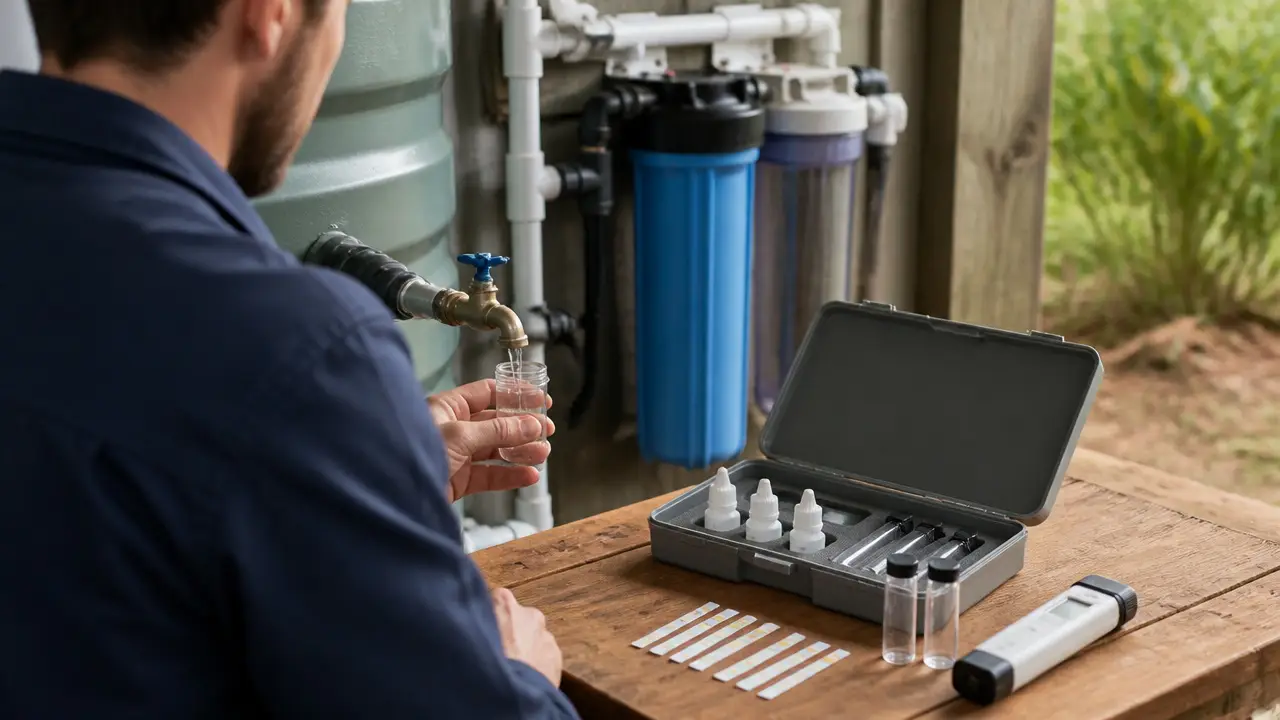
Home meters and strips can be useful for checking certain operating conditions. They are not a complete drinking-water assessment.
If the result will determine whether water is used for drinking, cooking, or other household uses where people may swallow it, use an appropriately certified drinking-water laboratory.
The laboratory can also help with an easily missed issue: sampling technique. A poor sample can give a misleading result, especially for bacteria, metals, and disinfectant testing.
Compare the report with the drinking-water requirements set by your state or local authority. EPA's federal standards are a useful reference, but private rainwater and well systems can be subject to different local requirements.
Frequently Asked Questions
What pH is acceptable for drinking water?
EPA's secondary drinking-water guideline is pH 6.5 to 8.5. This range mainly relates to corrosion, taste, and water-system performance. A normal pH does not by itself prove that water is safe to drink.
What TDS level is acceptable?
EPA's secondary guideline for total dissolved solids is 500 mg/L. TDS mainly affects taste, deposits, and other water characteristics. A low TDS result does not prove that the water is free of bacteria or dangerous chemicals.
What is the acceptable E. coli level in drinking water?
E. coli should not be detected in household drinking water. A positive result indicates probable fecal contamination and should be taken seriously. For regulated public systems, EPA uses specific microbiological monitoring and treatment rules rather than a simple household concentration limit.
What is the maximum nitrate level in drinking water?
EPA's maximum contaminant level for nitrate is 10 mg/L when measured as nitrogen. Nitrite has a separate maximum of 1 mg/L as nitrogen.
Is water safe if all the numbers on a home test strip are normal?
Not necessarily. Test strips only measure the substances they are designed to detect. They may not test for E. coli, viruses, lead, arsenic, pesticides, or other contaminants that could matter for your particular water source.
Can a TDS meter tell whether rainwater is safe to drink?
No. A TDS meter measures dissolved solids rather than overall water safety. Rainwater can have a low TDS reading while still containing microorganisms or chemicals.
Should collected rainwater meet drinking-water limits if it is only used for the garden?
Not necessarily. Water quality requirements depend on how the water is used. Rainwater used for drinking requires much higher water quality than water used on ornamental plants. The crop, soil, irrigation method, local conditions, and contaminants present can also affect whether irrigation water is suitable. CDC recommends limiting rainwater uses that could lead to swallowing the water when its safety has not been established.