As an affiliate, we may earn a commission from qualifying purchases. We get commissions for purchases made through links on this website from Amazon and other third parties.
For most household water, a pH above 8.5 is considered high. That does not automatically mean the water is unsafe to drink. It means the water is more alkaline than the range commonly used for acceptable drinking-water quality.
The U.S. Environmental Protection Agency lists pH 6.5 to 8.5 as a secondary drinking-water standard. Secondary standards mainly address taste, deposits, staining, corrosion, and other nuisance problems rather than setting a health-based safety limit. At high pH, water may have a slippery feel, an unusual soda-like taste, or leave mineral deposits.
For rainwater, well water, or stored water, an unexpected reading above 8.5 is a good reason to retest the water and find out why the pH is high.
What Does a High Water pH Mean?
The pH scale describes how acidic or alkaline water is.
- A pH of 7 is neutral.
- A pH below 7 is acidic.
- A pH above 7 is alkaline, also called basic.
The scale runs roughly from 0 to 14. Each whole pH number represents a large chemical change, so water at pH 9 is meaningfully different from water at pH 8.
For everyday household water, these ranges are a useful starting point:
| Water pH | Practical interpretation |
|---|---|
| Below 6.5 | Relatively acidic; corrosion may become a concern |
| 6.5-8.5 | Common target range for household drinking-water acceptability |
| Above 8.5 | High; investigate the cause if unexpected |
| Around 9 or higher | Clearly alkaline and worth closer evaluation |
These ranges do not tell you whether water is safe to drink. Water with a pH of 7 can still contain harmful microbes, metals, chemicals, or other contaminants.
Likewise, water above pH 8.5 is not automatically dangerous simply because of its pH.
Is a pH Above 8.5 Unsafe to Drink?
Not necessarily.
The EPA's 6.5-to-8.5 pH range is a secondary standard rather than a federal health-based maximum contaminant level. High-pH water can cause taste, feel, and deposit problems, but a pH reading by itself does not provide a complete drinking-water safety assessment.
The World Health Organization also treats safe drinking water as a whole-system issue. Its current drinking-water guidance emphasizes identifying and managing microbial, chemical, physical, and other risks from the water source through the point of use.
This distinction is especially important for collected rainwater. A normal pH reading cannot show whether roof runoff contains:
- Bacteria or other microorganisms
- Bird or animal waste contamination
- Metals from roofing or plumbing
- Agricultural or industrial pollutants
- Chemicals washed from roof materials
- Sediment and organic debris
If rainwater will be used for drinking, cooking, or other potable uses, pH should be only one part of a suitable collection, treatment, maintenance, and current laboratory-testing plan. Potable means suitable for drinking.
What Problems Can High-pH Water Cause?
Moderately high pH is often more of an operating problem than a direct health indicator.
Mineral deposits
Alkaline water may be associated with conditions that encourage mineral scale. Scale can build up on fixtures, heating elements, pipes, irrigation emitters, or other equipment.
However, pH alone does not tell you how much scale will form. Water hardness and alkalinity also matter.
Alkalinity is the water's ability to resist changes in pH. It is different from pH itself.
Unusual taste or feel
The EPA notes that high-pH water can develop a slippery feel or soda-like taste.
A noticeable change in taste is useful as a warning that something has changed, but taste should never be used as a drinking-water safety test.
Treatment problems
pH affects many water-treatment processes. Chemical disinfection, corrosion control, filtration systems, and other treatment stages may work differently depending on the water chemistry.
If your system includes chemical dosing or specialized treatment equipment, use the operating pH range specified for that process rather than assuming 6.5 to 8.5 is suitable for every treatment stage.
Irrigation concerns
For irrigation, high pH is also a reason to look more closely at the water rather than judging it by pH alone.
Food and Agriculture Organization guidance describes 6.5 to 8.4 as a normal pH range for irrigation water. A reading outside that range can indicate that further water-quality evaluation is needed. The actual crop or soil problem may come from bicarbonate, salts, sodium, or another part of the water chemistry rather than pH itself.
Soil also buffers changes in pH. Watering a garden once with pH 8.6 water does not normally make the soil instantly reach pH 8.6.
Why Would Rainwater Have a High pH?
Rainwater is not guaranteed to stay at the same pH from the sky to the storage tank.
Its chemistry can change as it moves across the roof, through gutters and pipes, and into storage.
Possible causes of unexpectedly high pH include:
Concrete or cement-based materials
New concrete, mortar, or some cement-based tank surfaces can affect water chemistry. Water stored against these materials may become more alkaline, particularly before the material has aged.
Limestone or alkaline minerals
Contact with limestone, certain rocks, mineral media, or alkaline dust can raise pH or alkalinity.
Treatment chemicals
A previous attempt to correct acidic water can push pH too high if chemicals or treatment equipment are not properly controlled.
This is one reason chemical pH adjustment should not be done by guessing at a dose.
Contaminants entering the collection system
Dust, construction debris, ash, or other material deposited on a roof can alter water chemistry after it washes into the tank.
Good roof cleaning, gutter maintenance, screening, and first-flush management can reduce some debris entering storage.
A first flush is the initial portion of roof runoff that is diverted away from the storage tank so it can carry away some accumulated dirt and debris.
Biological activity
Strong biological growth can sometimes cause pH to change over the course of the day. If stored water is exposed to light and has heavy algae growth, both the biological problem and the reason light is reaching the water should be addressed.
What Should You Do If Your Water Tests Above pH 8.5?
Start by confirming that the reading is real.
1. Test the water again
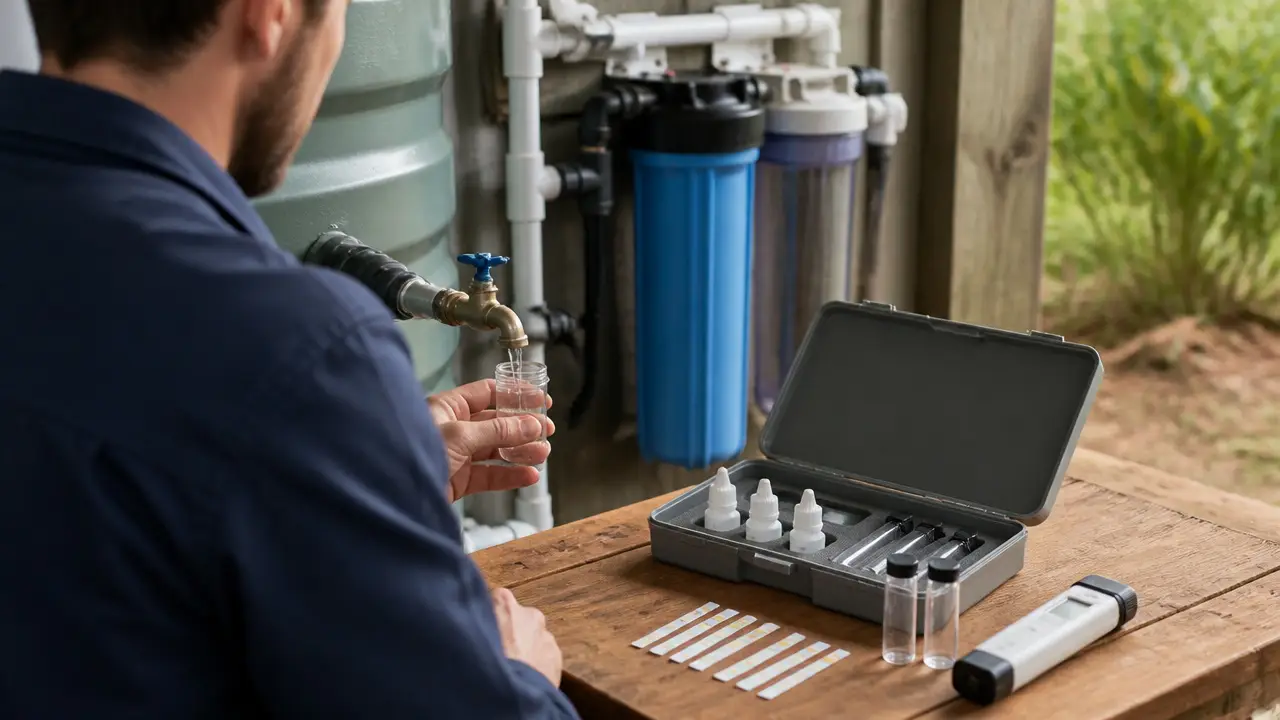
pH strips can provide a rough screening result, but their color ranges can be difficult to interpret.
Planning around accepted ranges for common water-quality tests helps evaluate long-term maintenance priorities for the installation.
A properly calibrated digital pH meter usually gives a more useful measurement when you need to troubleshoot a system. Follow the meter's calibration and storage instructions because a poorly maintained meter can give misleading readings.
If you receive a surprising value such as 9 or higher, repeat the test before changing the system.
2. Test water at more than one point
If possible, compare water from:
- The incoming water source
- The rainwater tank
- The outlet from the tank
- Water after treatment equipment
This can help identify where the pH changes.
For example, normal-pH water entering a tank but high-pH water leaving it suggests that something inside the storage or treatment system deserves attention.
3. Look for recent system changes
Consider whether you recently:
- Installed a concrete tank
- Added new plumbing or treatment media
- Cleaned the tank with chemicals
- Adjusted water-treatment equipment
- Changed the source water
- Had construction or unusual dust around the roof
- Mixed water from two different sources
A sudden pH change often has a system-related cause.
4. Consider more than pH
If the reading stays high, other water tests may help explain it.
Depending on the source and intended use, useful measurements may include alkalinity, hardness, electrical conductivity, or total dissolved solids.
Total dissolved solids, or TDS, is an estimate of the dissolved minerals and salts in water. A TDS meter does not tell you which substances are present or whether water is safe to drink.
5. Match the response to how the water will be used
Water for toilet flushing does not require the same evaluation as water intended for drinking.
For garden irrigation, the crop, soil, salinity, sodium, bicarbonate, and long-term watering pattern may matter more than a small pH difference.
For drinking water, do not simply adjust the pH until the meter shows a preferred number. Determine why it is high and evaluate the complete water quality.
Should You Lower High Water pH Yourself?
Minor troubleshooting can usually be done safely. Chemical correction deserves more caution.
Do not pour vinegar, acid, or another chemical into a drinking-water tank simply to make a pH meter show a lower number.
The amount needed depends on the water's alkalinity, not just its starting pH. Two tanks with the same pH can require very different amounts of acid to change that pH.
Poorly controlled chemical treatment can:
- Push the pH too far in the opposite direction
- Damage pumps, fittings, tanks, or plumbing
- Create unsafe chemical-handling risks
- Interfere with other treatment stages
- Change the chemistry again as new rainwater enters the tank
Larger water systems may use controlled chemical feed equipment or other treatment methods to manage pH. Drinking-water systems should be designed around measured water chemistry, suitable equipment, ongoing monitoring, and local requirements.
High pH Does Not Mean High TDS
pH and TDS meters measure different things.
A pH meter indicates how acidic or alkaline the water is.
A TDS meter estimates the amount of electrically conductive dissolved material in the water. It cannot identify individual contaminants.
You can therefore have:
- High pH with relatively low TDS
- Normal pH with high TDS
- Normal readings for both while other contaminants are still present
Neither meter establishes that collected rainwater is potable.
When High pH Needs More Attention
An isolated reading slightly above 8.5 usually calls for confirmation and investigation rather than panic.
Take the result more seriously when:
- The pH has changed suddenly
- Repeated tests show a much higher value
- Water taste, odor, appearance, or feel has changed
- Scale has suddenly increased
- Treatment chemicals are being used
- The water will be used for drinking
- A new tank or construction material may be affecting the water
- Plants are showing problems and irrigation water chemistry is suspect
For drinking-water use, a qualified water-treatment professional or accredited laboratory can help determine what testing is appropriate. Current local drinking-water, plumbing, or rainwater-use requirements may also apply.
As of August 2026, the EPA continues to list pH 6.5 to 8.5 under its secondary drinking-water standards, while WHO's current guidance emphasizes managing drinking-water safety through assessment of the complete water supply rather than relying on pH alone.
Frequently Asked Questions
Is 8.5 pH too high for water?
A pH of 8.5 is at the upper end of the EPA's secondary range for drinking water. A reading slightly above 8.5 is considered high enough to investigate, but it does not automatically mean the water is unsafe.
Is pH 9 water safe to drink?
A pH of 9 is clearly alkaline and outside the EPA's secondary 6.5-to-8.5 range. The pH reading alone cannot determine whether the water is safe to drink. If drinking water repeatedly measures around pH 9, confirm the measurement and investigate the water chemistry and source.
Can high-pH water damage pipes?
High-pH water can contribute to deposits under some water-chemistry conditions, but pH is only one factor. Hardness, alkalinity, temperature, and dissolved minerals also affect scale formation.
What pH is too high for watering plants?
FAO guidance describes pH 6.5 to 8.4 as a normal range for irrigation water. Water outside that range should be evaluated further, but pH alone does not predict plant damage. Soil conditions, salts, sodium, bicarbonate, and crop sensitivity also matter.
Why is the pH in my rainwater tank high?
Possible causes include contact with concrete or alkaline materials, roof dust, treatment chemicals, mixed water sources, or biological activity. Compare the pH of incoming rainwater with the stored water to help locate where the change occurs.
Does a high pH mean water is hard?
No. Hardness and pH are different measurements. Hard water often contains higher levels of calcium and magnesium, while pH measures acidity or alkalinity. Water can have a high pH without being especially hard.
Can I lower tank-water pH with vinegar?
Adding vinegar or another acid by guesswork is not a good way to treat stored drinking water. The required treatment depends heavily on alkalinity and the rest of the water chemistry. Improper dosing can overshoot the desired pH or interfere with other treatment processes.
Does a normal pH mean rainwater is safe to drink?
No. Normal pH does not rule out microorganisms, metals, chemicals, or other contaminants. Drinking-water use requires suitable collection and treatment, proper maintenance, current laboratory testing, and compliance with applicable local requirements.