As an affiliate, we may earn a commission from qualifying purchases. We get commissions for purchases made through links on this website from Amazon and other third parties.
A rainwater tank overflows when water enters faster than the tank can store or release it. The safest fix is usually to install a properly sized overflow outlet and route excess water away from the tank, buildings, and foundations.
Do not simply block the inlet when the tank fills. Rain still has to go somewhere. A good rainwater system gives excess water a controlled path during heavy storms.
Why Rainwater Tanks Overflow
Some overflow is normal. Once a tank reaches its full storage level, any additional rainwater must leave through an overflow.
Problems start when the overflow system cannot handle the incoming flow.
Common causes include:
- No dedicated overflow outlet
- An overflow pipe that is too small
- A blocked overflow screen or pipe
- Poor pipe slope
- An outlet installed too high
- A downspout feeding the tank faster than water can leave
- Several downspouts feeding one small overflow
- Leaves, insects, sediment, or roots blocking drainage
- An undersized tank that fills during nearly every storm
- An overflow outlet that sends water back toward the tank or house
The goal is not always to prevent water from leaving the tank. It is to make sure excess water leaves in a safe and predictable way.
Install a Proper Tank Overflow
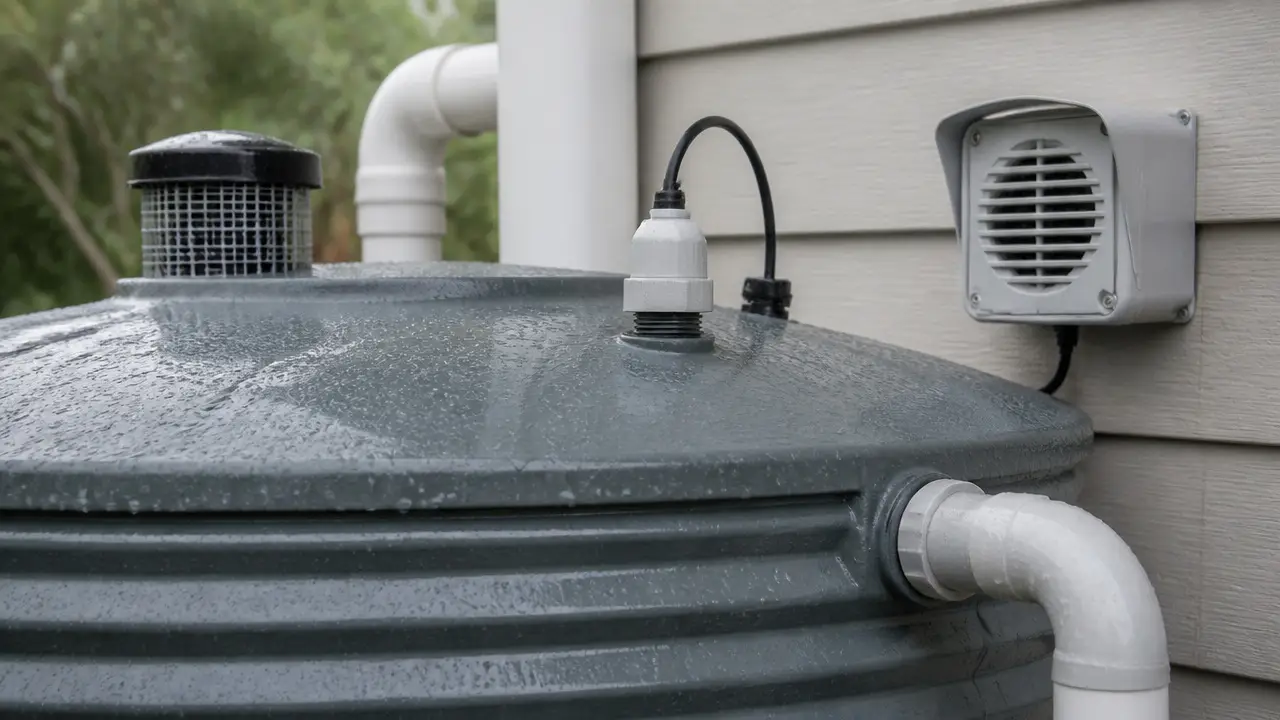
A rainwater tank should have a dedicated outlet near its normal full-water level.
When the water reaches that level, excess water flows through the outlet instead of rising into the tank lid, inlet, or other fittings.
The overflow should lead to a suitable discharge point, such as:
- A stormwater system where allowed
- A drainage swale
- A rain garden
- An infiltration area
- Another storage tank
- A safe part of the yard that can accept the flow
Do not discharge large amounts of overflow beside a house foundation, retaining wall, septic system, or area that already drains poorly.
Local drainage rules can affect where tank overflow may be discharged.
Make Sure the Overflow Is Large Enough
A small overflow opening may work during light rain but fail during a strong storm.
The overflow system must be able to release water about as quickly as the collection system can deliver it once the tank is full.
For example, a tank connected to several large roof areas may receive a much higher flow than a single rain barrel connected to one downspout.
Important factors include:
- Roof collection area
- Rain intensity
- Number of downspouts feeding the tank
- Inlet pipe size
- Overflow pipe size
- Number of bends
- Pipe slope
- Screens or fittings that restrict flow
Avoid reducing a large overflow outlet into a much smaller pipe unless the downstream system has been properly sized for the expected flow.
If the tank repeatedly backs up during storms even though the overflow is clear, the overflow capacity may be too low.
Keep the Overflow Pipe Flowing Downhill
Gravity drainage works best when the overflow pipe continuously slopes toward its discharge point.
Low spots can hold water, sediment, and debris. They can also reduce the amount of air moving through the pipe and make drainage less reliable.
Check for:
- Sagging flexible pipe
- Sections that slope back toward the tank
- Crushed pipe
- Tight bends
- Partially closed valves
- Mud or roots around the outlet
Whenever possible, use a simple route with a steady downward slope.
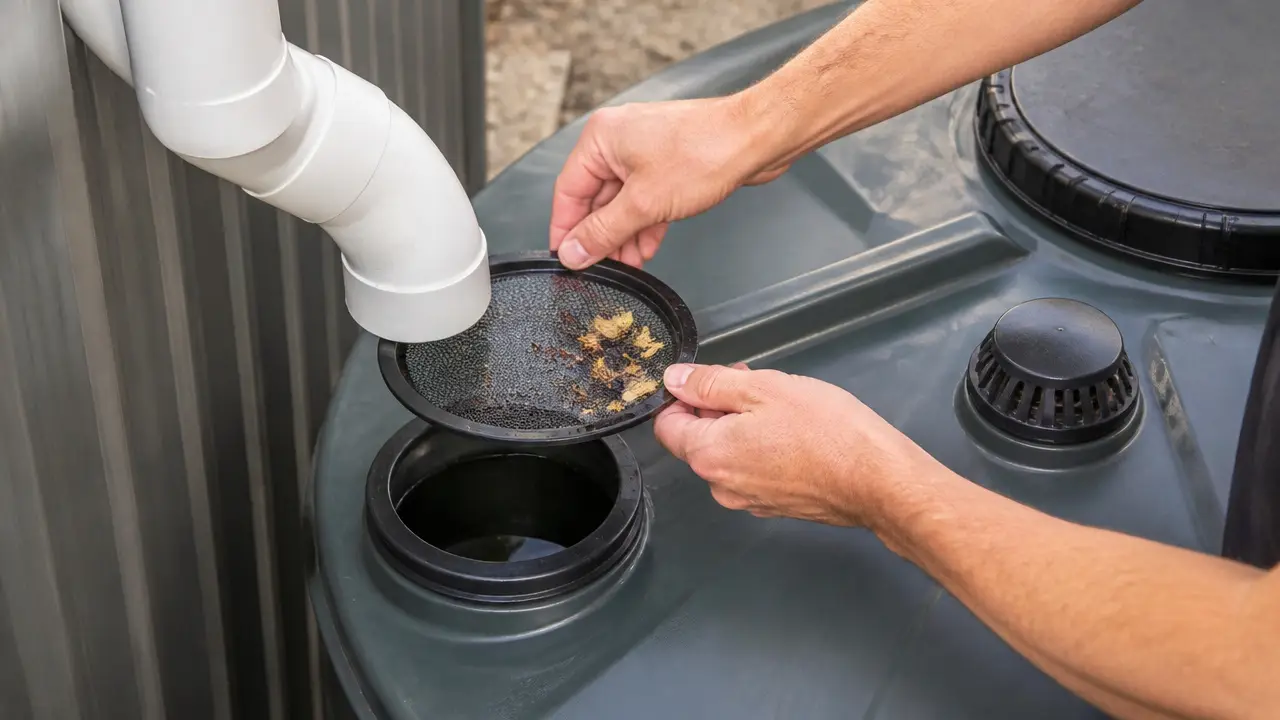
Clean the Overflow Screen
Rainwater tank overflow openings are often screened to keep mosquitoes, insects, rodents, and debris from entering the tank.
The screen still has to pass enough water.
Fine debris can collect against it and sharply reduce flow during a storm.
Inspect the screen periodically and clean away:
- Leaves
- Roof grit
- Pollen
- Algae
- Insect nests
- Organic debris
Do not permanently remove insect screening just to improve water flow. If a properly maintained screen causes frequent backup, the overflow assembly may need to be larger or redesigned.
Check the Tank Inlet
Sometimes the problem looks like a tank overflow problem but actually starts at the inlet.
If the inlet pipe extends too far into the tank or is poorly vented, water may back up through the downspout before the normal overflow begins working properly.
Look for:
- Water backing up from the inlet
- Downspouts spilling at joints
- Gutters overflowing near the tank connection
- Air-locking or surging sounds
- Inlet screens clogged with leaves
The tank inlet and overflow need to work together. Water entering the tank displaces air, and that air needs a path out.
Use a High-Level Bypass When Appropriate
Some rainwater collection systems divert additional roof runoff away from the tank once storage is full.
This can reduce the amount of water passing through the tank overflow.
Depending on the system, excess water may be redirected to:
- The original downspout drain
- A stormwater line
- A secondary tank
- A drainage area
A bypass is useful when a tank is small compared with the connected roof area.
However, it should fail safely. A blocked or malfunctioning diverter should not cause water to back up beneath roofing, enter the building, or flood the tank area.
Connect a Second Tank
If the first tank regularly fills long before rainfall ends, adding storage may reduce how often water is discharged.
Two tanks can be connected in several ways.
One common arrangement allows the first tank's overflow to feed the second tank. Another balances water levels between tanks through properly designed lower connections.
Tank connections need to match the intended flow and tank design.
A bulkhead fitting is a sealed fitting installed through the wall of a tank so a pipe can connect without leaking.
Avoid drilling extra holes into a tank unless the tank manufacturer allows it and the location will not weaken the tank.
Adding another tank does not eliminate the need for a final overflow. The last tank still needs somewhere safe to send excess water.
Consider Whether the Tank Is Too Small
A tank that overflows often may simply have too little storage for the connected roof.
The amount of rainwater potentially collected depends mainly on:
- Roof area
- Rainfall depth
- Collection losses
- Available tank capacity
Consider the effects when the tank is too full to assess tank size based on expected use between rain events.
In U.S. units, one inch of rain falling on one square foot of roof is about 0.623 gallon before losses.
A simple estimate is:
Potential collection in gallons = roof area in square feet × rainfall in inches × 0.623
For example, 1 inch of rain on a 1,000-square-foot roof represents about 623 gallons before allowing for losses.
Actual collection will usually be lower because of first-flush diversion, gutter losses, splashing, evaporation, and other factors.
Increasing tank size can reduce overflow frequency, but even a large tank needs a properly designed overflow for storms that exceed available storage.
Use Stored Water Between Storms
A tank that remains full has little capacity to capture the next rainfall.
Using stored rainwater between storms can create space.
Depending on water quality, system design, and local requirements, non-potable uses may include:
- Garden irrigation
- Drip irrigation
- Landscape watering
- Outdoor cleaning
- Other approved non-potable uses
Non-potable means water that is not intended for drinking.
Do not deliberately empty a tank simply to prevent overflow unless you have a useful and suitable place for the water. Large releases can create erosion or drainage problems.
Do Not Seal the Tank Completely
A rainwater tank should not become a sealed pressure vessel.
Water entering and leaving the tank changes the volume of air inside it. The tank needs suitable ventilation according to its design.
Never block overflow or vent openings to stop water from escaping.
Doing so can cause:
- Tank deformation
- Water backing up through the inlet
- Gutter overflow
- Leaks around fittings
- Damage to connected pipes
If water is escaping from the wrong opening, fix the overflow path rather than sealing the tank.
Protect the Area Around the Tank
Even a properly designed overflow can release a large amount of water during heavy rain.
Make sure the discharge does not undermine the tank base.
Watch for:
- Soil washing away
- Gravel being displaced
- Water pooling under the tank
- Erosion around concrete pads
- Saturated soil near tank supports
Large water tanks are very heavy when full. The base must remain stable and suitable for the tank.
If erosion has already affected a large tank foundation, avoid moving or modifying the tank while it is full. A qualified installer may need to assess the base.
Prevent Mosquitoes From Entering Through the Overflow
An overflow pipe is also a possible insect entry point.
Use suitable screening or another insect-resistant design while keeping enough open area for strong water flow.
Check screens regularly because debris can turn a correctly sized overflow into a restricted one.
Other openings, including inlets and vents, should also be protected where mosquito control is needed.
What to Check During the Next Heavy Rain
Watching the system during rainfall can help show where the restriction is.
From a safe location, look for this sequence:
- Water should enter through the normal tank inlet.
- The water level should rise normally.
- When the tank reaches its full level, water should begin leaving through the overflow.
- The overflow should continue draining without the tank spilling from its lid or inlet.
- Water should reach its discharge point without backing up toward the tank.
Do not climb onto roofs, ladders, tanks, or wet structures during a storm.
If the overflow works during light rain but fails during heavy rain, its capacity or downstream drainage is likely inadequate.
When to Call a Professional
Simple cleaning and visible pipe checks are reasonable DIY tasks for many systems.
Professional help is a better choice when:
- A large cistern is overflowing near a building
- The overflow connects to buried drainage
- Excavation is required
- Structural support around the tank is damaged
- The system connects to household plumbing
- Pumps or electrical equipment are involved
- Several tanks have complicated balancing connections
- Overflow repeatedly floods neighboring property
- Local drainage or plumbing requirements are unclear
Do not enter a rainwater tank or cistern to clear a blockage. Tanks can be confined spaces with serious atmospheric and access hazards.
Frequently Asked Questions
Is it normal for a rainwater tank to overflow?
Yes. A full rainwater tank must release additional water somewhere. A properly working overflow safely carries that water away. The problem is uncontrolled overflow from the lid, inlet, fittings, or tank base.
Can I plug the overflow so the tank holds more water?
No. Blocking the overflow can make water back up through the inlet or other openings and may damage the tank or collection system. If you need more storage, use a larger tank or additional tank designed for the system.
Why does my tank overflow even though it has an overflow pipe?
The pipe may be blocked, undersized, poorly sloped, crushed, or restricted by a dirty screen. The discharge point may also be submerged or unable to drain quickly enough.
Can I send the overflow into another rainwater tank?
Yes, if the tanks and connections are designed for it. The second tank also needs a final overflow that safely handles water when both tanks are full.
Should the overflow pipe be the same size as the inlet?
There is no single pipe size that works for every system. Overflow capacity should be based on the amount of water the roof and inlet system can deliver during heavy rain, along with pipe slope and restrictions.
Why is water coming out of the tank lid?
The normal overflow may be blocked or unable to discharge water quickly enough. Check the overflow screen, pipe, fittings, and downstream drainage. Water should normally leave through the designed overflow before reaching the lid.
Can tank overflow damage the foundation?
Yes. Repeated discharge beside a building or tank base can saturate soil and cause erosion or drainage problems. Route overflow to a suitable discharge location away from vulnerable foundations and supports.