
As an affiliate, we may earn a commission from qualifying purchases. We get commissions for purchases made through links on this website from Amazon and other third parties.
Best Overall
Best with Local Console
Best for Local Data Export
A smart rain gauge becomes more useful than a simple digital display when you want rainfall records to follow you instead of staying on a console. App access, alerts, historical graphs, and exported data can help a rainwater-harvesting owner compare storms with tank refill, track dry periods, and build a clearer picture of whether storage capacity matches local rainfall patterns.
The tradeoff is dependence on software. A manual gauge can keep working for years with no account, network, or cloud service. A smart station adds Wi-Fi, hubs, apps, firmware, and integrations. Those features are valuable only when you will actually use the history or remote access.
Quick Smart-Gauge Checklist
- Choose the data you actually need. Rainfall history may be enough; wind, UV, lightning, and forecast features are secondary for many rainwater systems.
- Check the network requirements. Some stations use Wi-Fi for app access but a separate RF link between outdoor sensor and console.
- Keep a local fallback. A console or manual gauge provides a comparison when an app or cloud service is unavailable.
- Plan data ownership. If long-term records matter, favor systems that support export or local storage.
- Review alert limits. Some subscriptions or service tiers affect SMS history or alert access.
- Mount the outdoor array correctly. Smart processing cannot compensate for poor rainfall exposure.
Smart Rain Gauges at a Glance
| Product | Best For | Key Smart Feature | Tradeoff |
|---|---|---|---|
| WeatherFlow Tempest | Simple smart outdoor hardware | App history, long-range wireless, solar power, no conventional moving rain bucket | Most dependent on app ecosystem |
| Ambient Weather WS-2902 | Smart monitoring with local console | Wi-Fi plus local color display and Ambient Weather Network access | Conventional sensor array needs cleaning and stable Wi-Fi setup |
| Ambient Weather WS-2000 | Local archiving and export | Historical console data with optional SD-card export | More setup and a higher-complexity console |
| Ambient Weather WS-2902 with AWN+ | Alerts and extended network history | AWN+ history and customizable SMS alerts | Added service features may matter less if local rainfall is the only goal |
Best Overall: WeatherFlow Tempest Weather Station
1 / 4
WeatherFlow Tempest Weather Station
Outdoor Power
Solar
Wireless
Up to 1,000+ ft claimed
Measures
Rain, wind, temperature, UV, lightning
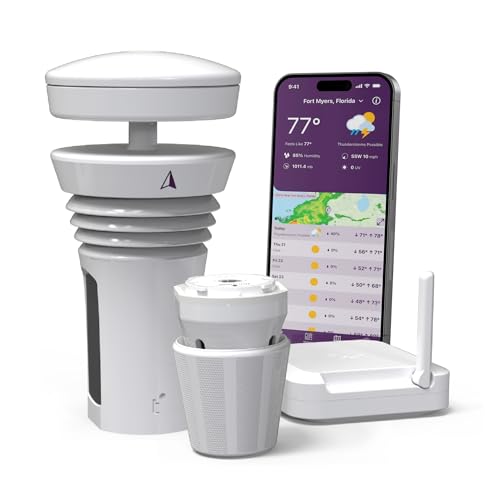
Tempest is the cleanest smart-first design in this group. The outdoor sensor is solar powered, communicates wirelessly, and has no conventional tipping bucket or cup anemometer. That removes two moving assemblies that commonly need cleaning or eventually wear.
For rainwater use, its strongest feature is local history. Instead of relying on a regional weather app, you get precipitation data from your own property and can view graphs over time. Customer evidence is positive about local weather tracking and app history, especially when nearby official stations do not match what is happening at the property.
The manufacturer documents outdoor wireless range over 1,000 feet under suitable conditions. That can make it easier to mount the sensor in a clear location even when the rainwater tank itself is sheltered beside a building.
The main caution is ecosystem dependence. Integrations and advanced connections can involve separate services or changing support. Buy Tempest because its core station and app meet your needs, not because one third-party integration is guaranteed to remain unchanged forever.
Why It Works
- Solar-powered outdoor sensing reduces routine battery work.
- No conventional rain bucket means fewer moving parts to clog.
- Long wireless range supports better sensor placement on larger properties.
- Historical graphs make seasonal rainfall patterns easier to compare with tank use.
What To Keep In Mind
- App and cloud services are part of the experience.
- Third-party integrations can have separate requirements or costs.
- No-moving-parts design still requires correct siting and occasional inspection.
Best with Local Console: Ambient Weather WS-2902
2 / 4
Ambient Weather WS-2902
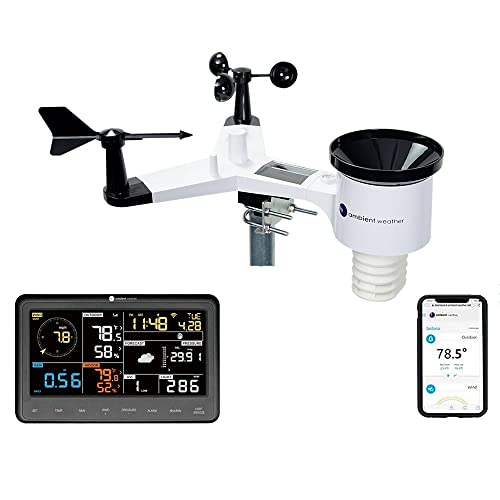
Sensor Link
915 MHz RF
Open-Air Range
Up to 330 ft claimed
Connectivity
Wi-Fi
The Ambient Weather WS-2902 gives you both a conventional local console and smart-network access. The outdoor array sends measurements to the console over RF, while Wi-Fi connects the station to online services. That separation is useful because normal at-home viewing does not have to depend entirely on a phone.
The sensor array tracks rain rate along with humidity, pressure, temperature, and wind. For a rainwater system, rainfall and rain rate are the main values; the rest become useful when the stored water also supports landscape irrigation.
The outdoor array is solar powered with battery backup, and the manufacturer documents up to 330 feet line of sight, with shorter range expected under ordinary building conditions. Customer evidence shows both long-lived successful stations and Wi-Fi setup problems, so network compatibility deserves attention before installation.
Why It Works
- Local console keeps current readings visible without opening an app.
- Wi-Fi adds remote history and network access.
- RF link separates outdoor-sensor communication from the home's Wi-Fi signal.
- Solar sensor power reduces battery dependence.
What To Keep In Mind
- Wi-Fi configuration can be sensitive to network setup.
- Conventional rain-measuring hardware still needs cleaning.
- Customer evidence includes mixed reports about rain-measurement accuracy, so a manual reference gauge is useful during setup.
Best for Local Data Export: Ambient Weather WS-2000
3 / 4
Ambient Weather WS-2000
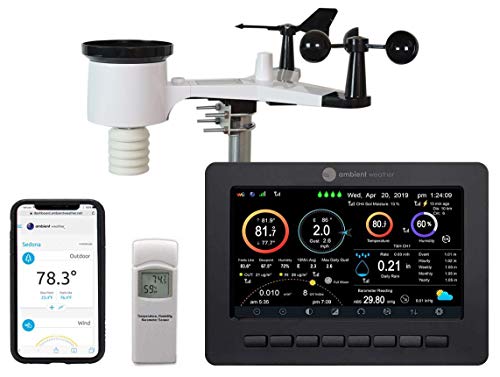
Sensor Link
915 MHz RF
Console
Color tablet
Export
Optional SD card
The WS-2000 is the best fit when you want smart monitoring but also value a path to local historical data. Its console stores minimum and maximum conditions with timestamps and can export archived data to an optional SD card.
That matters for rainwater planning because rainfall records become much more valuable when you can compare them with your own tank or irrigation logs. Local export reduces the need to depend entirely on a cloud dashboard for every long-term analysis.
The outdoor sensor uses the same general solar-plus-battery approach and RF connection to the console. Setup takes more time than a simple gauge, and the customer notes reflect that: users report accurate operation once configured, but app connection and initial setup can be frustrating.
Why It Works
- Local historical data can be retained and exported.
- A dedicated console gives at-home access even when a phone is inconvenient.
- Multiple weather measurements support broader irrigation analysis.
What To Keep In Mind
- Optional SD storage is an added component rather than automatic cloud independence.
- Initial setup is more involved than with a dedicated rain gauge.
- The station still uses a conventional outdoor sensor array that needs maintenance.
Best for Alerts and Network History: Ambient Weather WS-2902 with AWN+
4 / 4
Ambient Weather WS-2902 with AWN+

Included Service
1 year AWN+
History
Up to 3 years through AWN+ claim
Alerts
Customizable SMS
This WS-2902 package uses the familiar Ambient Weather sensor-and-console layout but adds a year of AWN+ service. The supplied evidence highlights extended history, customizable SMS alerts, and forecast features through that service.
For rainwater harvesting, the alerts are most useful when tied to specific weather thresholds you actually act on. A rainfall notification can remind you to check a first-flush device, inspect tank overflow, or postpone irrigation. Alerts that do not lead to an action quickly become noise.
The underlying hardware remains a conventional smart weather station, so the same installation rules apply: mount the array in representative exposure, keep the rain collector clear, and test the console-to-sensor RF link before relying on the online service.
Why It Works
- Added network history can support multi-season rainfall comparison.
- SMS alerts can provide a second notification path beyond the app.
- Local console remains available for normal on-site viewing.
What To Keep In Mind
- AWN+ is an added service layer, not a requirement for basic rainfall measurement.
- Narrow console viewing angles appear in the customer evidence.
- Decide whether extended smart features justify the added account and service complexity.
What Smart Rainfall Data Can Tell You
Smart rainfall history is most useful when paired with another system measurement. Record tank level before and after representative storms, or measure water moving through a known fill or irrigation line. Over time, you can compare what fell with what was captured and used.
That comparison can expose several problems. High rainfall with little tank gain suggests collection losses, blockage, diversion, or overflow. Frequent tank overflow during moderate rain suggests storage may be small relative to roof yield. Long dry periods combined with rapid tank drawdown point toward demand rather than collection as the constraint.
Smart-Gauge Failure Modes to Expect
The App Works but Rainfall Looks Wrong
Inspect the outdoor sensor. Cloud connectivity does not prove the rain-measuring element is clean, level, or correctly calibrated.
The Console Works but the App Does Not
Separate local weather measurement from the network problem. Check Wi-Fi credentials, router compatibility, cloud status, and account settings before resetting the outdoor sensor.
Long-Term History Disappears
If historical data matters, export or back it up periodically when the platform allows. A cloud archive should not be treated as your only permanent copy of multi-year rainwater records.
Alerts Become Noise
Use thresholds tied to specific actions. More alerts do not automatically produce better rainwater management.
Frequently Asked Questions
What makes a rain gauge “smart”?
A smart rain gauge typically adds app access, network connectivity, alerts, cloud or local historical records, and sometimes integrations with other devices or services.
Do smart rain gauges require a subscription?
Core rainfall measurement may not, but some platforms offer paid service tiers for extended history, alerts, or integrations. Check which features depend on ongoing service before buying.
Can a smart rain gauge control irrigation automatically?
Some weather platforms can integrate with compatible irrigation systems, but compatibility and service requirements vary. Check the specific integration requirements rather than assuming any smart rain gauge can control any timer.
Is a smart rain gauge better for sizing a rainwater tank?
Long-term local rainfall records can improve planning, but sizing still requires roof catchment area, runoff assumptions, storage goals, and water demand. The gauge supplies one important input, not the entire calculation.
Should I keep a manual rain gauge too?
A simple manual gauge is useful for occasional cross-checking. If a smart station suddenly reports an implausible total, a nearby correctly placed manual reference can help identify whether the problem is the sensor or the storm data.
How long should I keep rainfall history?
At least one full wet and dry cycle is useful, while multiple years are better for seasonal planning. Longer history helps separate unusual weather from normal local patterns.
For smart features that are less important than simple remote sensor reception, compare best wireless rain gauges. For a non-electronic reference that can verify suspicious readings, best rain gauges covers straightforward manual gauges.