As an affiliate, we may earn a commission from qualifying purchases. We get commissions for purchases made through links on this website from Amazon and other third parties.
One inch of rain means enough rain fell to cover a flat surface with 1 inch of water, assuming none ran off, soaked in, or evaporated.
For rainwater harvesting, the useful conversion is:
1 inch of rain on 1 square foot = about 0.623 gallons of water.
Catchment impact depends on duration and roof area, which helps explain whether one inch of rain is a lot for a single event.
That means 1 inch of rain falling on a 1,000-square-foot roof represents about 623 gallons of water before collection losses.
How Much Water Is 1 Inch of Rain?
The amount of water depends on the area receiving the rain.
| Collection area | Water from 1 inch of rain |
|---|---|
| 1 sq. ft. | 0.623 gallons |
| 10 sq. ft. | 6.23 gallons |
| 100 sq. ft. | 62.3 gallons |
| 500 sq. ft. | 311.5 gallons |
| 1,000 sq. ft. | 623 gallons |
| 1,500 sq. ft. | 934.5 gallons |
| 2,000 sq. ft. | 1,246 gallons |
These are theoretical amounts. A rainwater collection system normally captures less because some water is lost before reaching the tank.
How to Calculate Rainwater From Your Roof
For a roof measured in square feet, use:
Gallons = roof area × rainfall in inches × 0.623
For example, suppose your usable roof collection area is 1,200 square feet and you receive 1 inch of rain:
1,200 × 1 × 0.623 = 747.6 gallons
So that rainfall represents about 748 gallons of water on the collection area.
If only half an inch falls:
1,200 × 0.5 × 0.623 = 373.8 gallons
If 2 inches fall:
1,200 × 2 × 0.623 = 1,495.2 gallons
This makes the formula useful for estimating both rain barrel and larger cistern systems.
Why You Will Not Collect Every Gallon
The formula tells you how much rain lands on the collection area. It does not guarantee that the same amount reaches your tank.
Water can be lost through:
- Gutters that overflow
- Splashing and wind
- Wet roof surfaces
- Gutter and downspout leaks
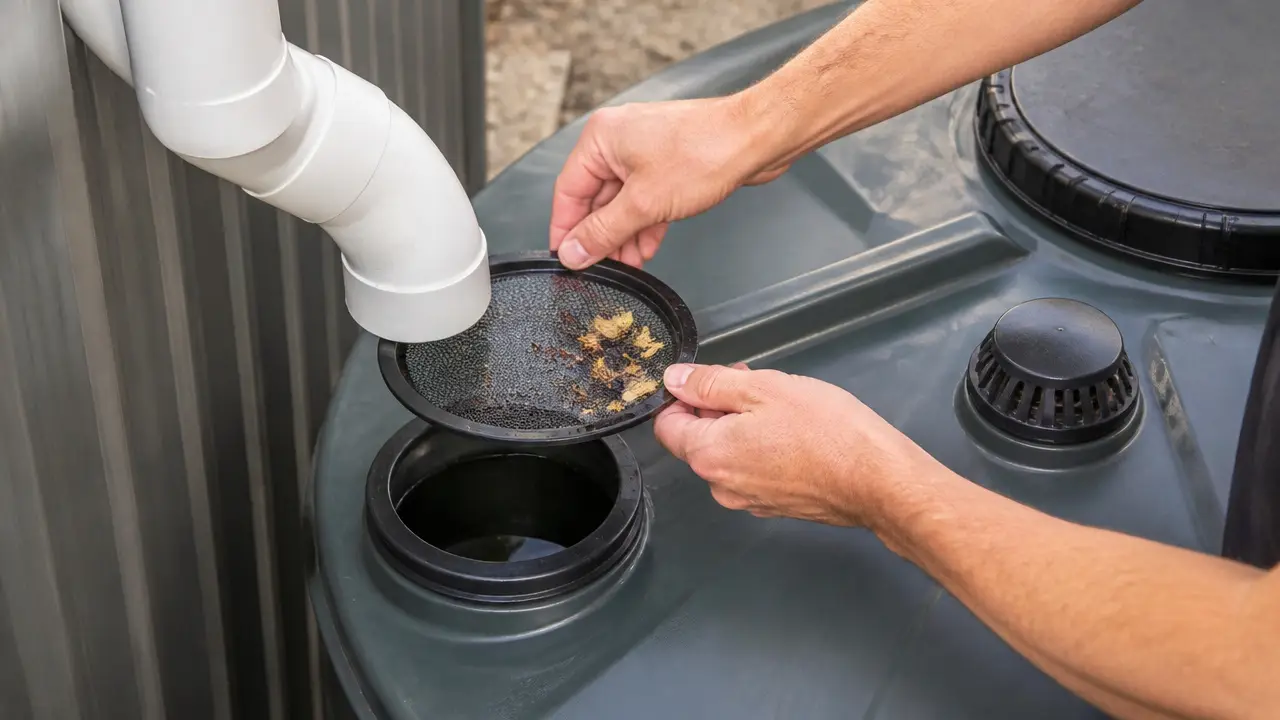
- Screens and prefilters
- A first-flush diverter
- Tank overflow
A first-flush diverter sends the first portion of roof runoff away from storage. This can help remove some of the dust, leaves, bird droppings, and other debris washed from the roof.
When planning tank capacity, treat the calculated number as the maximum available rainfall rather than guaranteed stored water.
What Does 1 Inch of Rain Actually Mean?
Rainfall is measured as a depth, not as a total volume.
If a straight-sided container were sitting outside during a storm and collected exactly 1 inch of water, the storm produced 1 inch of rain.
The same rainfall depth applies whether it falls on a small shed or an entire property. What changes is the total volume.
One inch is also equal to 25.4 millimeters.
That is why a seemingly small rainfall amount can produce hundreds or thousands of gallons when it falls across a large roof.
How Much Is 1 Inch of Rain on an Acre?
One acre contains 43,560 square feet.
Using the same conversion:
43,560 × 0.623 = about 27,150 gallons
So 1 inch of rain over one acre represents roughly 27,150 gallons of water.
Most of that water will not be practically collectable unless the acre is an actual collection surface designed to direct runoff somewhere.
For a rainwater system, use the area of the roof or other suitable collection surface feeding your gutters rather than the total size of your property.
Which Roof Area Should You Measure?
For most roof rainwater calculations, use the roof's horizontal footprint, sometimes called its projected area.
You usually do not need to measure the sloped surface along the shingles or metal roofing. Rainfall is measured vertically, so the horizontal area is what matters.
For a simple rectangular building that is 30 feet wide and 40 feet long:
30 × 40 = 1,200 square feet
If the entire roof drains into your storage system, that is approximately the collection area to use.
Account for rainfall gallons per square foot to coordinate the conveyance path from the roof surface into the tank.
If only one side or one section feeds the tank, calculate only the portion that actually drains into it.
Complex roofs may need to be divided into several rectangles or other simple shapes.
How Much Rain Does It Take to Fill a Rain Barrel?
You can rearrange the formula to estimate how much rain is needed:
Rainfall needed = tank capacity ÷ (roof area × 0.623)
For example, consider a 55-gallon rain barrel connected to 500 square feet of roof:
55 ÷ (500 × 0.623) = about 0.18 inch
In theory, less than one-quarter inch of rain could provide enough runoff to fill that barrel if it starts empty.
Actual collection will be lower because of system losses, and the barrel may fill even sooner if it already contains water.
This is one reason small rain barrels can overflow quickly when connected to a large roof.
Tank Capacity Matters as Much as Rainfall
Knowing rainfall yield helps you see whether your storage capacity matches your roof.
A 1,000-square-foot collection area can receive about 623 gallons from only 1 inch of rain. A small barrel can store only a fraction of that.
When planning a system, consider:
- Usable roof collection area
- Typical rainfall patterns
- Tank capacity
- How quickly you use stored water
- Where overflow will safely go
- Gutter and downspout capacity
- Seasonal freezing conditions
- Intended water use
A larger tank does not create more water. It simply gives you more room to store runoff when rain is available.
Likewise, a large roof does not help much if the tank is already full when the next storm arrives.
Rainfall Amount Is Not the Same as Rainfall Intensity
Two storms can each produce 1 inch of rain but behave very differently.
One storm might deliver that inch slowly over many hours. Another could deliver it very quickly.
This matters because gutters, downspouts, screens, filters, and overflow pipes must handle the flow rate, meaning how much water moves through the system over a certain amount of time.
A tank may have enough total capacity for the storm but still lose water if the inlet system cannot handle a heavy burst of rain.
For system planning, therefore, total rainfall tells you how much water may be available, while rainfall intensity helps determine whether the plumbing can move it effectively.
A Simple Rule to Remember
For U.S. measurements, the easiest rainwater harvesting rule is:
Every inch of rain provides about 0.623 gallons per square foot of collection area.
Or, for a quick mental estimate:
About 623 gallons per 1,000 square feet of roof per inch of rain.
Then allow for real-world collection losses when deciding how much water will actually reach storage.
Frequently Asked Questions
Is 1 inch of rain a lot?
It can be a substantial amount of water. Although 1 inch does not sound like much, it represents about 623 gallons falling on every 1,000 square feet of horizontal area.
How many gallons is 1 inch of rain on 100 square feet?
One inch of rain on 100 square feet represents about 62.3 gallons of water before collection losses.
How many gallons is 1 inch of rain on a 2,000-square-foot roof?
If the full 2,000 square feet drains into the collection system, the theoretical amount is about 1,246 gallons.
How much is half an inch of rain on a 1,000-square-foot roof?
Half an inch represents about 311.5 gallons on 1,000 square feet. Your tank will normally receive somewhat less because of collection losses.
Does roof slope increase the amount of rainwater I can collect?
Not simply because the roof is steeper. Rainfall yield is normally calculated using the roof's horizontal projected area, not the total sloped surface area.
How many gallons are in 1 inch of rain per acre?
One inch of rain over one acre represents roughly 27,150 gallons of water.
Can I drink collected rainwater?
Do not assume roof runoff is safe to drink. Drinking-water use requires suitable collection surfaces, appropriate prefiltration and treatment, ongoing maintenance, current laboratory testing, and compliance with applicable local requirements. A single filter or treatment device does not by itself establish that collected rainwater is potable, meaning safe for drinking.