As an affiliate, we may earn a commission from qualifying purchases. We get commissions for purchases made through links on this website from Amazon and other third parties.
A pump is not always required for drip irrigation. If your water source already provides enough pressure and flow, the system can run without one.
A pump is more likely to be needed when you are feeding drip irrigation from a rain barrel, IBC tote, or cistern at low elevation. Standard household water pressure is usually much higher than gravity pressure from a storage tank.
The key question is not simply whether you have a tank. It is whether the water reaching the drip system has enough pressure and flow for the emitters you plan to use.
When Drip Irrigation Does Not Need a Pump
You may not need a pump when the irrigation system connects to:
- A pressurized household water line
- A well system with an existing pressure pump
- An elevated tank feeding a low-pressure drip system
- A gravity-fed system designed specifically for very low pressure
In these cases, the available pressure may already be enough.
If you are connecting drip irrigation to household plumbing, a pressure regulator is often more important than adding a pump. Drip tubing and emitters are generally designed for much lower pressure than typical household plumbing provides.
Why Rain Barrels Often Have Too Little Pressure
A rain barrel sitting on the ground has very little water pressure.
Gravity creates pressure according to the height difference between the water surface and the irrigation outlet. This difference is sometimes called head height.
As a general rule, about 2.31 feet of vertical water height produces 1 psi of pressure.
For example:
| Water height above drip line | Approximate pressure |
|---|---|
| 2 feet | 0.9 psi |
| 5 feet | 2.2 psi |
| 10 feet | 4.3 psi |
| 20 feet | 8.7 psi |
The important measurement is the height of the water surface, not simply the bottom of the barrel.
Pressure also drops as the barrel empties.
A barrel that works reasonably well when full may deliver noticeably less pressure when the water level gets low.
Can Drip Irrigation Run From a Rain Barrel Without a Pump?
Yes, but the system needs to be designed for gravity operation.
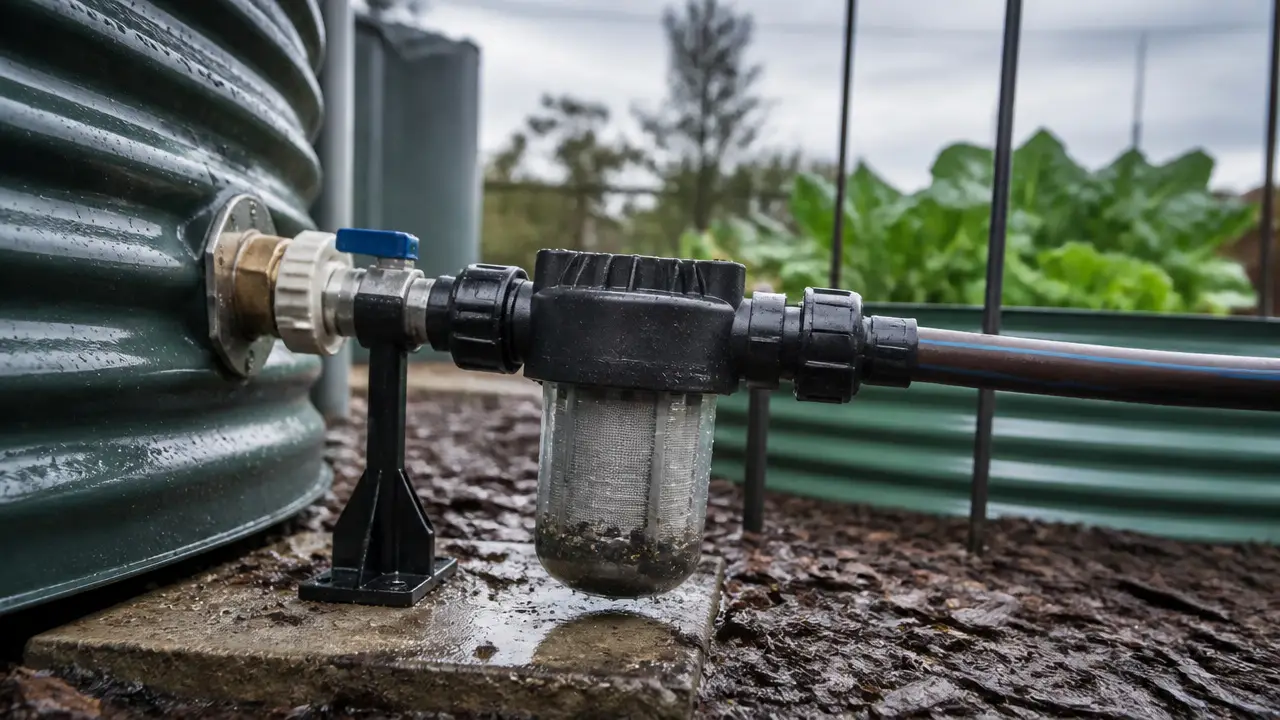
A simple arrangement might include:
- Rain barrel or storage tank
- Outlet or bulkhead fitting
- Shutoff valve
- Filter
- Main supply tubing
- Low-pressure drip tubing or emitters
A bulkhead fitting is a watertight fitting installed through the wall of a tank so tubing or pipe can connect to it.
The main limitation is pressure.
Many drip irrigation products are intended for pressurized systems. Standard pressure-compensating emitters, long tubing runs, or complex irrigation layouts may not work correctly at the very low pressure produced by a barrel.
Look for irrigation parts specifically described by their manufacturer as suitable for gravity-fed or low-pressure systems.
When a Pump Is Usually Needed
A pump becomes useful when gravity cannot provide the pressure or flow the irrigation system requires.
Common situations include:
The tank is at ground level
An IBC tote or cistern sitting beside the garden may have only a few feet of head height.
That may be enough for certain gravity drip systems, but not enough for ordinary drip equipment.
The irrigation area is large
A few containers beside a rain barrel require much less water than several long garden rows.
As the number of emitters increases, the system needs more total flow.
The tubing runs are long
Pressure is lost as water travels through tubing, fittings, filters, valves, and emitters.
Small tubing and long runs increase these losses.
The garden is uphill from the tank
A pump may be necessary if water must travel upward.
The vertical distance a pump must raise water is called lift or static head.
A storage tank below the garden has to overcome this elevation before useful pressure is available at the emitters.
You use pressure-compensating emitters
Pressure-compensating emitters are designed to deliver a fairly consistent amount of water within a specified operating pressure range.
They can be useful on longer or uneven irrigation lines, but they usually require more pressure than a simple gravity system provides.
Always check the operating pressure specified for the actual emitters.
You want automatic irrigation
Timers, valves, filters, regulators, and other components can create additional resistance.
Some irrigation timers also require minimum water pressure to operate correctly.
A pump may therefore be necessary even if water can flow through the drip tubing without one.
Pressure and Flow Are Different
A pump must provide both enough pressure and enough flow.
Pressure is the force pushing the water through the irrigation system.
Flow rate is the amount of water moving through the system over time, commonly measured in gallons per minute.
Suppose you have 100 emitters rated to deliver 0.5 gallon per hour each under their specified operating conditions.
Their theoretical combined demand would be:
100 × 0.5 = 50 gallons per hour
That equals about:
50 ÷ 60 = 0.83 gallons per minute
The actual system still needs enough pressure for those emitters to operate as intended.
Selecting a pump based only on its maximum gallons-per-minute rating can therefore lead to poor performance.
Do Not Size a Pump From Its Maximum Rating Alone
Pump specifications often include both maximum flow and maximum head.
These numbers usually occur under different operating conditions.
A pump that can move a large amount of water with almost no resistance will move less water when it has to:
- Raise water uphill
- Push through small tubing
- Pass through filters
- Supply long irrigation lines
- Maintain useful pressure
Evaluate pressure regulators suited to drip irrigation to understand usable flow where the water will be consumed.
The useful number is the pump's performance at the total head your irrigation system creates.
For a simple garden system, consider:
- Vertical lift from the lowest expected water level
- Required pressure at the drip system
- Tubing length and diameter
- Filter and valve restrictions
- Required total flow
- Pump inlet and outlet sizes
For complicated systems, use the pump manufacturer's performance curve rather than relying on the maximum-flow number printed on the box.
A Pressure Regulator May Still Be Required
Adding a pump does not mean you should send full pump pressure directly into drip tubing.
Too much pressure can cause:
- Fittings to separate
- Tubing to leak
- Emitters to deliver too much water
- Uneven irrigation
- Premature component failure
A suitable pressure regulator can reduce pump pressure to the range required by the irrigation equipment.
Match the regulator to the manufacturer's requirements for the tubing and emitters you are using.
Do You Need a Pressure Tank?
Not necessarily.
A pressure tank is commonly used with pumps that cycle on and off according to water demand. It stores a small amount of pressurized water and can reduce frequent pump starts.
A basic irrigation pump that runs continuously for an entire watering zone may use a different control arrangement.
Whether you need a pressure tank depends on the pump, controls, and irrigation setup rather than drip irrigation itself.
Follow the pump manufacturer's installation requirements.
Protect the Pump From Running Dry
Rainwater tanks eventually run low.
A pump that continues operating without enough water can be damaged unless it is designed for dry-running conditions.
Possible protection includes:
- Low-water cutoff
- Float switch
- Pump controller with dry-run protection
- Properly positioned intake
A float switch senses water level and can switch equipment on or off when the water rises or falls.
Do not assume a pump has dry-run protection unless its documentation specifically says so.
Filtration Matters With Rainwater Drip Systems
Collected rainwater can contain:
- Roof debris
- Grit
- Organic material
- Insects
- Sediment from the tank
Drip emitters have very small passages that can clog.
A filter should normally be installed before the drip lines. The correct filter depends on the emitter manufacturer's requirements.
Filters also need cleaning. A clogged filter can reduce flow enough to make a system appear as though the pump or tank is too small.
Roof screens, inlet screens, tank maintenance, and suitable prefiltration can reduce the amount of debris reaching the irrigation filter.
Gravity-Fed or Pumped Drip Irrigation?
Neither method is automatically better.
Gravity-fed systems make sense when:
- The garden is close to the tank
- The irrigation area is small
- The tank can be elevated safely
- The emitters are designed for low pressure
- Simple operation is more important than high performance
They can be quiet and use no electricity.
Their main disadvantage is low and changing pressure.
Pumped systems make sense when:
- The tank cannot be elevated enough
- The garden is uphill
- Irrigation lines are long
- Several zones need water
- The emitters require higher pressure
- More consistent watering is important
The tradeoff is greater system complexity. Pumps need power, controls, freeze protection where appropriate, and maintenance.
Be Careful About Raising Heavy Water Tanks
Raising a rain barrel can improve gravity pressure, but water is extremely heavy.
One US gallon of water weighs about 8.34 pounds.
A 55-gallon barrel can therefore contain roughly 459 pounds of water, before counting the barrel and supporting structure.
An IBC tote can weigh several thousand pounds when full.
Do not place large water tanks on makeshift stands just to gain pressure. The support must safely handle the full tank weight and remain stable on its foundation.
For large elevated tanks, structural design may need professional attention.
A Simple Way to Decide
Start with the irrigation equipment rather than the pump.
Find out:
- What pressure do the emitters require?
- How much total flow will all emitters need?
- How high is the water source above or below the garden?
- How long are the irrigation lines?
- Does the timer or valve require minimum pressure?
- Does pressure remain adequate when the tank is nearly empty?
If your existing water source meets those requirements, you do not need another pump.
If it does not, either redesign the irrigation system for lower-pressure gravity operation or add a pump sized for the actual pressure and flow requirements.
For a small rain-barrel garden, designing around gravity can be the simplest approach. For a larger cistern-fed irrigation system, a properly sized pump usually gives more predictable results.
Frequently Asked Questions
How high does a rain barrel need to be for drip irrigation?
There is no single required height because drip products have different pressure requirements. About 2.31 feet of water height creates 1 psi of pressure. Check the minimum operating pressure of your emitters and remember that pressure falls as the barrel empties.
Can I connect drip irrigation directly to a rain barrel?
Yes, if the drip system is designed to work at the low pressure available from the barrel. A filter is normally important because small drip emitters can clog with sediment and debris.
Will raising a rain barrel improve drip irrigation pressure?
Yes. Increasing the vertical distance between the water surface and the drip line increases gravity pressure. However, a full barrel is very heavy, so it must only be placed on a support designed for the full load.
Can I use a small pump for drip irrigation?
Possibly. Pump size depends on required flow, required pressure, vertical lift, tubing losses, and the pump's performance curve. The smallest pump that meets those actual operating conditions is usually more appropriate than choosing one by maximum flow alone.
Does a drip irrigation pump need a pressure regulator?
It may. If the pump produces more pressure than the drip equipment is designed to handle, use a compatible pressure regulator or other control method specified by the irrigation manufacturer.
Can drip irrigation work from an IBC tote without a pump?
Yes, especially with a small gravity-fed system designed for low pressure. An IBC tote at ground level may not provide enough pressure for standard drip components, long runs, or an uphill garden.
What happens when a rainwater irrigation pump runs out of water?
Some pumps can overheat or suffer damage when operated dry. Use appropriate low-water or dry-run protection unless the pump is specifically designed to tolerate those conditions.