As an affiliate, we may earn a commission from qualifying purchases. We get commissions for purchases made through links on this website from Amazon and other third parties.
For most garden irrigation systems fed from a rainwater tank, the best pump is one that can supply the required flow and pressure without exceeding the tank, pipe, or irrigation system limits.
A submersible pressure pump is often the simplest choice for a dedicated rainwater tank. It sits inside the tank, runs quietly, and can supply drip irrigation or sprinklers when sized correctly. A surface-mounted garden pump can also work well when the tank is easy to reach and the pump can be installed close to the water source.
The right choice depends less on the pump name and more on four things:
- How much water the irrigation system needs
- How much pressure it requires
- How far and how high the pump must move the water
- Whether you are running drip lines, sprinklers, or both
Match the Pump to the Irrigation System
Start with the irrigation equipment rather than the pump.
A pump that works well with a few drip lines may not supply enough water for several lawn sprinklers. A large sprinkler pump, on the other hand, may provide far more pressure than a small drip system can safely use.
Drip Irrigation
Drip irrigation normally needs relatively low pressure.
The pump still has to move enough water for all the emitters operating at the same time, but excessive pressure is usually controlled with a pressure regulator.
A typical setup may look like:
Tank → pump → filter → pressure regulator → drip tubing
The pump does not need to operate at the exact pressure required by the emitters. It needs to supply enough pressure so that the regulator can provide stable pressure downstream.
Small drip systems can sometimes create another problem: their flow demand may be too low for a large automatic pump.
The pump may switch on, quickly reach its shutoff pressure, switch off, and then restart a few seconds later. This repeated starting and stopping is called short cycling.
A pressure tank, pump controller, appropriately sized pump, or irrigation layout with larger operating zones can help prevent this.
Sprinkler Irrigation
Sprinklers generally require more flow and pressure than drip emitters.
The pump must provide enough water for every sprinkler running within one irrigation zone.
For example, if four sprinklers operate together, add their required flow rates. The pump must be able to supply that combined flow while still maintaining the pressure the sprinklers need.
Do not size a pump using its advertised maximum flow alone. Pump flow falls as the pump works against greater pressure and elevation.
The pump's performance curve is more useful.
Mixed Drip and Sprinkler Systems
If the garden has both sprinklers and drip irrigation, size the pump for the most demanding irrigation zone.
Then use suitable pressure regulation on the lower-pressure drip zones.
Separate valves or irrigation zones often make mixed systems easier to manage.
Submersible Pumps Are Often Best for Rainwater Tanks
A submersible pump operates while underwater inside the tank or cistern.
For many home rainwater irrigation systems, this is a practical arrangement.
Advantages include:
- Quiet operation
- No need to prime the pump under normal conditions
- Less exposed equipment around the tank
- Good performance for tanks located some distance from the garden
- Easier suction conditions because the pump pushes water rather than pulling it
Submersible pumps can work with drip irrigation, hose outlets, and sprinkler systems if their flow and pressure are suitable.
The main disadvantage is access. You may need to remove the pump from the tank for inspection or repair.
Use a pump intended for the type of water and installation involved. Rainwater tanks can contain fine sediment even when gutters, screens, and tank inlets are well maintained.
A floating intake can also help in some systems by drawing water from below the surface while staying above settled sediment.
Surface Pumps Are Easier to Access
A surface pump stays outside the rainwater tank.
Water travels through a suction pipe from the tank to the pump. The pump then sends it toward the irrigation system.
Surface pumps can be a good choice when:
- The tank outlet is easy to reach
- The pump can sit close to the tank
- You want easy access for servicing
- The installation provides reliable pump priming
Their main limitation is suction.
Surface pumps pull water toward themselves. Long suction pipes, air leaks, excessive vertical lift, clogged strainers, and poorly sealed fittings can all reduce performance.
Keeping the pump close to the tank generally makes the suction side easier to manage.
Check the pump manufacturer's maximum suction conditions rather than assuming the pump can lift water from any tank location.
Transfer Pumps Are Better for Moving Water Than Running Irrigation
A transfer pump is designed mainly to move water from one place to another.
For example, it might move water:
- From one tank to another
- From a temporary container to a storage tank
- From a tank to a garden reservoir
Some transfer pumps can operate irrigation equipment, but many are not designed to maintain the steady pressure needed for automatic sprinklers or household-style pressure systems.
If the goal is direct irrigation, choose a pump designed to deliver the required pressure as well as flow.
Understand Flow Rate
Flow rate tells you how much water a pump can deliver over a period of time. It is commonly shown in gallons per minute or liters per minute.
Your irrigation zone determines how much flow you need.
If five devices operate at once, add their individual water demands.
The pump should provide at least that amount of flow at the pressure and head your system requires.
The words at the pressure and head your system requires are important.
A pump may have a high maximum flow when there is almost no resistance. That does not mean it will provide the same flow through long pipes and sprinklers.
Understand Head Height
Head height, usually called simply head, describes how much resistance the pump must overcome.
It includes more than vertical height.
The pump must overcome:
- Elevation between the tank and irrigation area
- Pressure required by the sprinklers or emitters
- Friction inside pipes
- Resistance from filters
- Resistance from valves and fittings
A garden located uphill from the rainwater tank requires more pump head than one located at roughly the same elevation.
Long, narrow pipes also create more resistance.
This is why two gardens using the same sprinklers may need different pumps.
Pipe Size Matters More Than Many People Expect
A powerful pump cannot completely make up for undersized irrigation pipe.
Water loses pressure as it moves through pipes. Long runs, small pipe diameters, elbows, valves, and filters increase those losses.
If a pump appears strong near the tank but sprinklers perform poorly at the far end of the garden, the problem may be the pipe layout rather than the pump itself.
Using suitably sized main irrigation pipe can:
- Reduce pressure loss
- Improve sprinkler consistency
- Reduce unnecessary pump load
- Make future irrigation expansion easier
Connection size also matters.
Check the pump inlet, outlet, tank fitting, irrigation pipe, valves, and adapters before buying equipment. Avoid creating unnecessary restrictions immediately before or after the pump.
Automatic Pump Control Makes Irrigation Easier
Many garden pumps can be paired with an automatic pressure controller.
The controller starts the pump when irrigation begins and stops it when water demand ends.
This arrangement works well with:
- Irrigation timers
- Solenoid valves
- Hose outlets
- Automatic sprinkler zones
However, controllers have minimum operating conditions.
Very small drip systems may not draw enough water to keep some automatic pump controls operating properly.
A pressure tank can sometimes improve operation by storing a small amount of pressurized water and reducing pump cycling.
Check the pump and controller requirements together rather than treating them as unrelated parts.
Dry-Run Protection Is Valuable
Evaluate a suitable pump for a rainwater tank to compare duty-cycle limits for prolonged water delivery.
A rainwater tank will eventually run low if irrigation demand exceeds incoming rainfall.
Running some pumps without water can damage them.
A pump with dry-run protection can shut down when it detects that water is no longer available.
Other systems may use a tank level switch or float switch.
Dry-run protection is especially useful when:
- Irrigation operates automatically
- Nobody regularly checks the tank level
- The tank has limited storage
- Dry weather may continue for several weeks
Do not assume every automatic pump controller provides reliable low-water protection. Check its intended function.
Keep Debris Away From the Pump
Rainwater used for garden irrigation does not normally require drinking-water treatment, but keeping debris out of the irrigation system still matters.
Leaves, insects, roof debris, sediment, and organic material can clog:
- Pump intakes
- Filters
- Drip emitters
- Small valves
- Sprinkler nozzles
A basic rainwater system may use several stages of debris control before water reaches irrigation equipment.
These can include:
- Gutter guards or leaf screens
- An inlet screen
- A first-flush device where appropriate
- Tank screening
- A pump intake screen
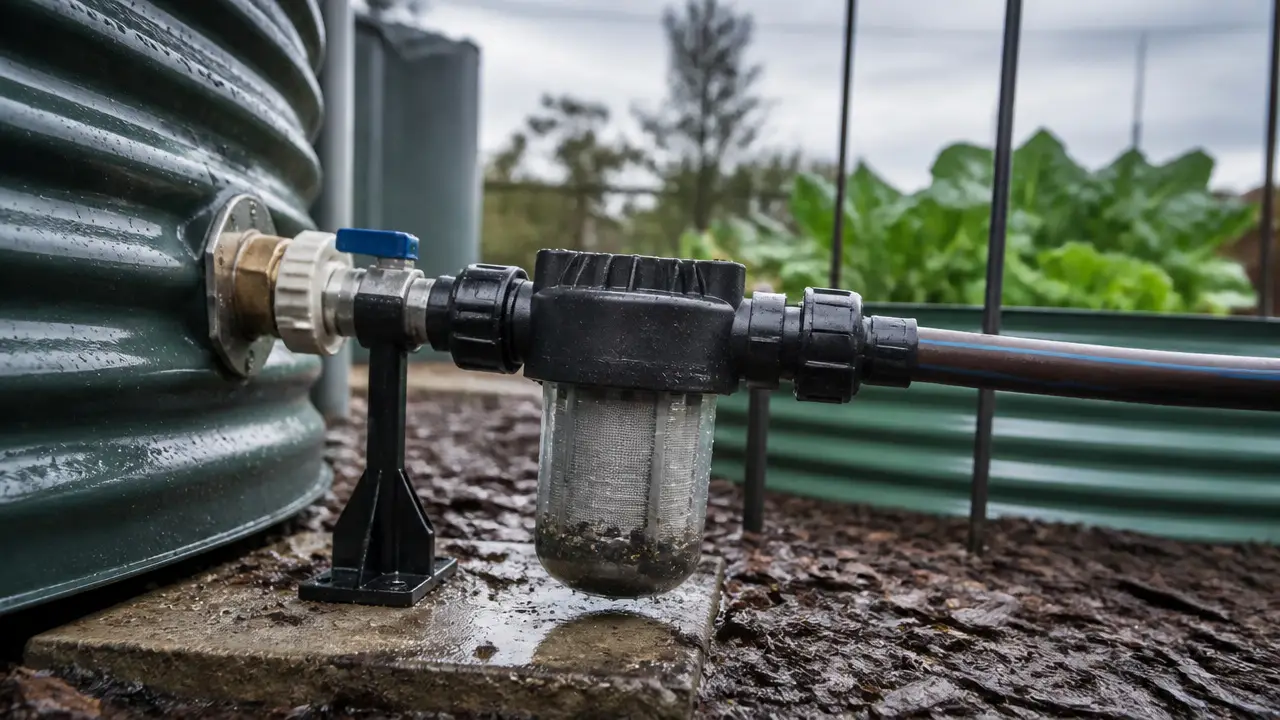
- An irrigation filter
A first-flush device diverts some of the initial roof runoff away from the tank. That early runoff may carry more roof debris and contamination.
It is not a substitute for tank maintenance or water treatment.
For drip irrigation, filtration is particularly important because emitter openings are small. Select the filter based on the irrigation manufacturer's requirements.
Consider Pump Location and Weather
A surface pump needs protection from weather and freezing conditions.
Keep electrical equipment in a suitable location and follow the manufacturer's installation instructions.
Do not place electrical connections where flooding, tank overflow, irrigation spray, or condensation could create a hazard.
In freezing climates, exposed pumps, pipes, filters, and valves can be damaged by trapped water.
Winter preparation may require draining or isolating parts of the irrigation system. The correct method depends on the pump and plumbing design.
Submersible pumps may be less exposed to outdoor temperature swings, but pipes leaving the tank can still freeze.
How Large Should the Pump Be?
Bigger is not automatically better.
An oversized pump can cause:
- Excessive pressure
- Frequent cycling
- Noisy pipework
- Unnecessary electricity use
- Stress on fittings and irrigation equipment
An undersized pump can cause:
- Weak sprinklers
- Poor coverage
- Uneven irrigation
- Low pressure at distant garden areas
- Difficulty running multiple outlets
A better way to size the pump is to identify:
- The flow required by the largest irrigation zone.
- The pressure required by that zone.
- The elevation change between the tank and garden.
- The approximate pipe length and diameter.
- Losses from filters, valves, and fittings.
- Any additional pressure requirements from controllers or irrigation equipment.
Then compare those requirements with the pump's performance curve.
Choose a pump that operates comfortably within its normal working range rather than at its absolute maximum limit.
Do You Need a Pressure Tank?
Not every irrigation pump requires a pressure tank.
A simple sprinkler system controlled by a timer may run the pump continuously for the entire watering cycle. In that case, cycling may not be a major problem.
A pressure tank becomes more useful when water demand changes frequently.
It can help when:
- A hose is opened and closed often
- Small drip zones operate
- Irrigation valves create varying flow
- The pump starts and stops too frequently
The pressure tank stores water under pressure. Small water demands can then be supplied without starting the pump immediately.
It does not create additional water or increase the pump's basic pumping capacity.
What About Solar Irrigation Pumps?
Solar-powered pumps can work well for some garden irrigation systems, especially where utility power is unavailable.
They are easiest to use when irrigation demand can follow available solar energy or when water can first be pumped into a higher storage tank.
A complete solar pumping system may involve:
- Solar panels
- Pump controller
- Pump
- Wiring
- Tank controls
- Storage
- Irrigation equipment
Battery systems add another level of complexity.
For a small garden far from electrical service, solar pumping may be practical. For a pressurized sprinkler system that must run on a fixed schedule regardless of sunlight, system design becomes more demanding.
Electrical and solar equipment should be installed according to manufacturer instructions and applicable electrical requirements. Get qualified help where the installation goes beyond safe DIY work.
A Practical Pump Choice for Most Gardens
For a typical garden supplied from a rainwater tank, a good starting point is a submersible automatic pressure pump sized for the largest irrigation zone.
It should provide:
- Enough flow for the irrigation zone
- Enough pressure after elevation and pipe losses
- Suitable connections for the plumbing
- Automatic control if required
- Dry-run protection or compatible low-water control
- Operating limits suitable for the tank and irrigation system
A surface pressure pump is also a good option when easy servicing is important and suction conditions are favorable.
For drip irrigation, pay particular attention to filtration, pressure regulation, and minimum pump flow.
For sprinklers, pay particular attention to flow, pressure, pipe size, and head height.
The best pump is therefore not simply the one with the highest flow or pressure rating. It is the pump whose operating range matches the irrigation system you actually plan to run.
Frequently Asked Questions
Can I use a rain barrel pump for garden irrigation?
Yes, if the pump can provide the flow and pressure your irrigation equipment requires. A small rain barrel pump may work well for gentle watering or a small drip system but may not provide enough pressure for several sprinklers.
Check the irrigation demand against the pump's performance curve.
Is a submersible or external pump better?
A submersible pump is often simpler, quieter, and less affected by suction problems. An external pump is easier to reach for maintenance.
Either type can work well when correctly sized and installed.
How much pressure does a garden irrigation pump need?
It depends on the irrigation equipment. Drip systems usually operate at lower pressure than many sprinklers and commonly use a pressure regulator.
Use the pressure requirement provided by the sprinkler, emitter, or irrigation equipment manufacturer, then allow for pipe, filter, and elevation losses.
Can a pump be too powerful for irrigation?
Yes.
Too much pressure can damage irrigation components or cause poor operation. An oversized automatic pump may also start and stop frequently when the irrigation system uses only a small amount of water.
Pressure regulators and properly designed irrigation zones can help, but correct pump sizing is preferable.
Do I need a filter between my rainwater tank and irrigation system?
Filtration is especially important for drip irrigation because small emitters can clog easily.
Sprinkler systems may also benefit from filtration when rainwater contains sediment or debris. Follow the irrigation equipment manufacturer's filtration requirements.
Why does my irrigation pump keep turning on and off?
Frequent cycling can occur when the irrigation system uses less water than the pump can comfortably supply.
Other possible causes include pressure-control problems, leaks, blocked filters, incorrect pressure tank settings, or unsuitable pump sizing.
Persistent cycling should be corrected because frequent starting can shorten pump and control-system life.
Can I run sprinklers directly from an IBC tote?
It is possible, but the tote's natural gravity pressure is usually limited unless the water surface is well above the sprinklers.
A pump is commonly used when normal sprinkler pressure is needed. Make sure the tote, outlet fitting, pump connection, and supporting structure are suitable for the installation.
What happens if the rainwater tank runs empty?
A pump that continues operating without water may overheat or suffer internal damage, depending on its design.
Use dry-run protection, a low-water float switch, or another pump protection method recommended by the manufacturer when the tank can run empty.