As an affiliate, we may earn a commission from qualifying purchases. We get commissions for purchases made through links on this website from Amazon and other third parties.
If you mean the largest and most widely recognized global drip irrigation company, the clearest answer is Netafim, part of Orbia’s Precision Agriculture business.
There is no independent organization that publishes an official yearly ranking called the “world’s number one drip irrigation company.” Still, current Orbia information describes Netafim as the world’s largest irrigation company, and Orbia specifically describes it as the largest drip irrigation company in the world.
That makes Netafim the strongest answer when “number one” means global scale, market position, and presence in drip and precision irrigation.
Why Netafim Is Often Considered Number One
Netafim has been closely tied to modern drip irrigation since the technology began developing commercially.
The company was founded in Israel in 1965 and helped pioneer the use of controlled drip irrigation in agriculture. Today, it operates as Orbia Precision Agriculture and supplies irrigation systems in more than 100 countries. Orbia reports that Netafim has thousands of employees and a worldwide manufacturing network.
Orbia also currently calls Netafim the world's leader in drip irrigation.
An older Orbia investor presentation gives useful context for the scale involved. For 2021, Orbia estimated that Netafim held about 30% of the global precision-irrigation market, putting it first by global market share at that time. Because this figure was a company estimate and is several years old, it should not be treated as a current exact market-share figure.
What Does a Drip Irrigation Company Actually Make?
Drip irrigation delivers water slowly near plant roots instead of spraying an entire area.
A complete system can include:
- Main irrigation pipe
- Smaller distribution tubing
- Dripline or drip tape
- Emitters or drippers
- Filters
- Pressure regulators
- Valves
- Fertilizer injection equipment
- Controllers and sensors
An emitter, sometimes called a dripper, is the small part that controls how quickly water leaves the irrigation line.
Large agricultural systems can become much more complicated. They may include pumps, automated valves, monitoring equipment, filtration stations, and fertigation systems.
Fertigation means adding fertilizer to irrigation water so nutrients are delivered through the irrigation system.
Netafim's business covers this broader type of precision irrigation rather than only individual pieces of drip tubing.
Is Netafim the Only Major Global Drip Irrigation Company?
No.
Several companies operate internationally in drip and micro-irrigation. One of Netafim's largest competitors is Rivulis.
In 2023, Jain Irrigation completed the combination of much of its international irrigation business with Rivulis. Jain described the resulting company as the second-largest irrigation company in the world at the time.
Rivulis has continued expanding. In November 2025, it announced the opening of what it describes as the world's largest manufacturing facility dedicated to drippers and sprinklers.
That does not necessarily make Rivulis the largest irrigation company overall. It does show why simply asking which company is “best” or “number one” can be misleading. A company might lead in total sales, manufacturing capacity, geographic coverage, a particular type of emitter, or a certain agricultural market.
Does the World's Largest Company Make the Best System for Your Property?
Not automatically.
Company size matters much less than whether the irrigation equipment fits your water source and intended use.
For a home garden or rainwater-fed irrigation system, check the system requirements before choosing any drip equipment.
Available pressure
Many drip systems need pressure to operate correctly.
A pump-fed irrigation system may have plenty of pressure. A rain barrel or elevated IBC tote can have much less.
Water pressure from gravity depends mainly on the vertical distance between the water surface and the irrigation outlet. This vertical difference is often called head height.
A drip product designed for pressurized agricultural irrigation may perform poorly when connected directly to a low rain barrel.
Required flow
Flow rate tells you how much water moves through the system during a certain amount of time.
Each emitter uses some water. When dozens or hundreds of emitters operate together, their individual flow rates add up.
Your tank outlet, filter, pipe, valve, and pump must be able to supply that combined demand.
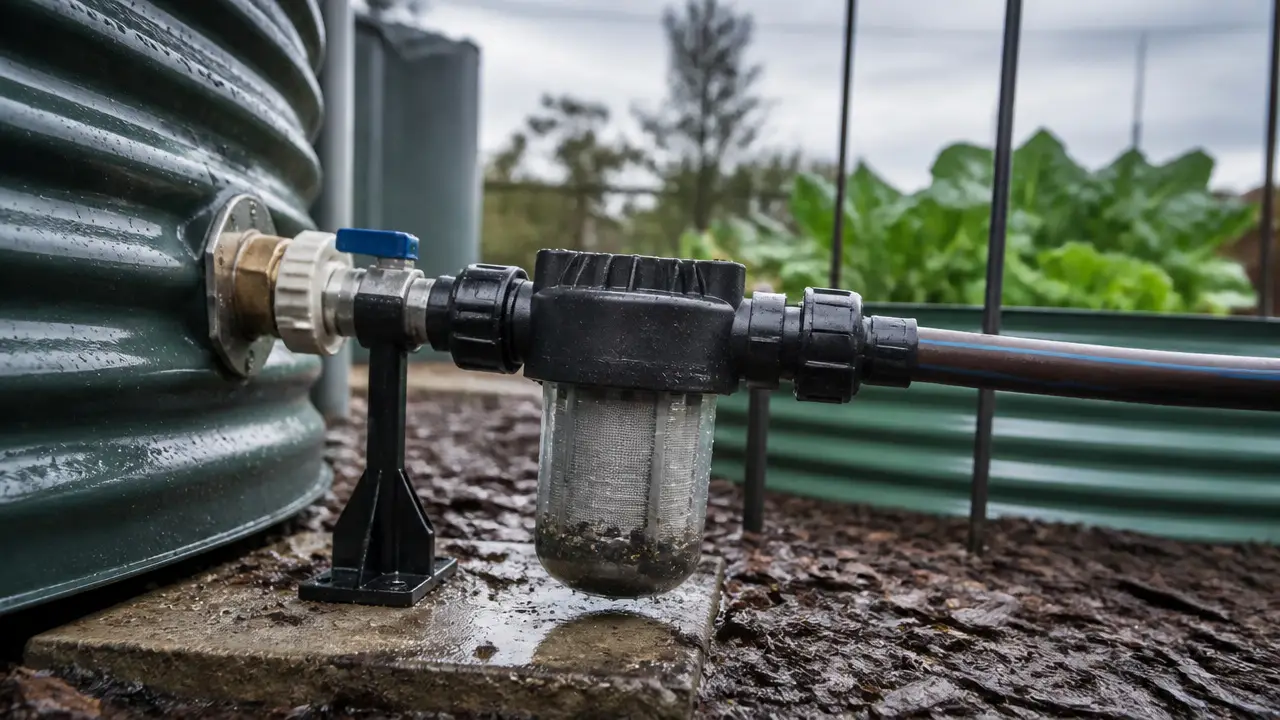
Filtration
Account for practical considerations for a pump required for drip irrigation to assess likely priming faults behind unstable delivery pressure.
Drip emitters contain small passages and can clog.
Stored rainwater can contain sediment, roof debris, algae, insects, or other particles. Suitable filtration before the dripline can therefore be especially important.
The filter must also match the irrigation equipment. A filter that is too restrictive can reduce available flow or pressure.
Connections
Check tubing and fitting sizes before buying parts.
A rain barrel outlet, IBC tote valve, garden hose fitting, irrigation mainline, pressure regulator, and drip tubing do not necessarily use the same connection.
Adapters can solve many problems, but the complete connection path should be planned first.
Water quality
Drip irrigation does not make collected rainwater cleaner or safer.
If roof runoff is being used for irrigation, keep the intended use in mind. Water used around edible crops can require additional precautions, particularly if water may contact the edible parts of the plant.
Drinking-water use requires a much more complete collection, treatment, testing, and maintenance approach. A drip irrigation filter is not a drinking-water treatment system.
What Matters More Than the Brand Name?
For most homeowners and gardeners, start with the system rather than the logo on the tubing.
Ask these questions:
- Where is the water coming from?
- How much pressure is available?
- How much water must the system deliver at one time?
- What filtration does the water need?
- What tubing and fitting sizes must connect?
- How long will each irrigation run be?
- Can the lines be flushed and cleaned?
- Will the equipment face freezing temperatures?
A well-matched smaller system can work better than expensive commercial equipment installed under the wrong conditions.
This matters especially when using rain barrels and tanks. Commercial drip irrigation equipment is often designed around controlled pressure and filtered water. A gravity-fed rainwater system may operate very differently.
Netafim's Position as of 2026
As of August 31, 2026, Netafim remains the most defensible answer to the question of which company is number one globally in drip irrigation.
Orbia currently identifies Netafim as both a global leader in precision agriculture and the world's largest irrigation company. Orbia also specifically describes it as the world's largest drip irrigation company.
That is different from saying every Netafim product is better than every competing product. There is no useful universal ranking at the individual-product level.
For a homeowner, garden, farm, greenhouse, or rainwater system, compatibility with the available pressure, flow, filtration, connections, and maintenance needs should come before company size.
Frequently Asked Questions
What is the world's number one drip irrigation company?
Netafim is the strongest current answer if “number one” means the largest global drip irrigation or precision-irrigation company. Its parent company, Orbia, describes Netafim as the world's largest irrigation company and the world's largest drip irrigation company.
Who invented modern drip irrigation?
Modern drip irrigation developed through several earlier ideas and inventions rather than one single event. Netafim, founded in Israel in 1965, was one of the companies that pioneered the commercial development and worldwide adoption of modern drip irrigation.
Who is Netafim's biggest competitor?
Rivulis is one of Netafim's major global competitors. After combining with Jain Irrigation's international irrigation business, the merged Rivulis operation was described in 2023 as the world's second-largest irrigation company.
Is Netafim suitable for a home garden?
Netafim makes irrigation equipment that can be used in many settings, but suitability depends on the individual system. Check pressure, flow, filtration, tubing size, emitter requirements, and connections rather than choosing equipment based only on the company name.
Can drip irrigation run directly from a rain barrel?
Sometimes, but not every drip system works well at the low pressure produced by a rain barrel. Check the pressure requirements of the emitters and other components. Long lines, fine filters, small fittings, and elevation changes can reduce available flow further.
Does drip irrigation need a filter?
Usually, filtration is important because small emitter passages can clog. It becomes especially important when using stored rainwater that may contain sediment and organic debris. The filter should be selected to match both the water quality and the irrigation equipment.
Is the largest drip irrigation company always the best choice?
No. Global size does not guarantee that a particular product will fit your system. For home and rainwater irrigation, pressure requirements, flow rate, filtration, connection sizes, serviceability, climate, and replacement-part availability are often more important.