
As an affiliate, we may earn a commission from qualifying purchases. We get commissions for purchases made through links on this website from Amazon and other third parties.
Best Overall
Best 3/4-Inch Pair
Best 1-Inch Threaded Pair
A bulkhead fitting is the part that turns a drilled hole in a rain barrel into a usable plumbing connection. When it fits correctly, the flange and gasket compress against the barrel wall and give you a threaded opening for a valve, hose adapter, overflow, or linking line. When it does not fit, the problem usually shows up as a leak, a loose nut, or a thread that will not accept the next fitting.
The five choices here range from 3/4-inch and 1-inch PVC-style fittings to a heavier metal connector. Some arrive as simple pairs. Others include the hole saw and plugs needed to create a new outlet from scratch. The most important details are the required hole size, the thread you need on the wet and dry sides, and whether the barrel wall is thin and curved enough for the gasket to seal.
Do not drill until the actual fitting is in hand. Nominal pipe size does not tell you the outside diameter of the bulkhead body, and different 1-inch fittings can require different wall holes.
Rain Barrel Bulkhead Fittings at a Glance
| Product | Best For | Key Strength | Tradeoff |
|---|---|---|---|
| Two-Piece 1-Inch Kit | First-time DIY drilling | Two bulkheads, plugs, and matching hole saw | Exact secondary dimensions conflict |
| Outus 3/4-Inch Pair | Smaller threaded barrel outlets | Two 3/4-inch fittings with thick sealing gasket | Material and dimensions conflict; fit can be larger than expected |
| Outus 1-Inch Pair | 1-inch threaded plumbing | Two 1-inch NPT fittings | Material and dimensions conflict; thread quality can vary |
| Qitdathn Four-Piece Kit | Building several barrels at once | Four fittings plus plugs and hole saw | Size and material details conflict; measure before drilling |
| Hooshing Threaded Bulkhead | Specialized male/female pipe-thread connection | Threaded connector on both sides | Material and dimensions conflict; washer and thread fit are inconsistent |
The Nominal Pipe Size Is Not the Hole Size
A 1-inch bulkhead fitting does not go through a 1-inch hole. The nominal size describes the plumbing connection, while the body and flange need a larger opening through the barrel wall. That difference is one of the easiest ways to ruin a DIY barrel.
The best approach is to use the hole requirement for the exact fitting. Kits that include a matching hole saw reduce guesswork. When a kit does not include one, measure the body or follow the current installation specification rather than copying the hole size from another brand.
Plastic barrel walls are forgiving enough to drill, but they are not forgiving of an oversized opening. A hole that is too large leaves less wall under the gasket and may never seal reliably.
A Complete Two-Bulkhead Kit With the Hole Saw Included
1 / 5
Two-Piece 1-Inch Bulkhead Kit With Hole Saw

Bulkhead Size
1 in
Pack
2 fittings
Included
Hole saw and plugs
This two-piece kit is the easiest place to start when you are drilling a new rain barrel rather than replacing an existing fitting. It includes two 1-inch bulkhead adapters, two plugs, and a hole saw sized for the installation. It uses a 48 mm opening and a thick silicone-style gasket to seal against the container wall.
The kit format reduces one of the most common DIY mistakes: buying a fitting first and then guessing at the cutter. The fitting can seal without leaks when the hole and gasket sit correctly, and the included cutter is adequate for ordinary plastic-barrel work when used carefully.
The hole saw is still a consumable tool rather than a shop-grade cutter. It can wear or fail after repeated barrel drilling. Exact secondary dimensions conflict, so those are not used in this guide. The strong reason to choose the kit is the matched drilling tool, two fittings, and simple gasketed connection.
Why It Works
- The matching hole saw simplifies a first-time barrel installation.
- Two bulkheads let you create an outlet plus overflow or connector point.
- Plugs are included when one port needs to remain closed.
- The gasket can make a clean seal when the hole is cut and fitted correctly.
What To Keep In Mind
- The exact secondary dimensions are uncertain.
- The included hole saw may not last through a large multi-barrel project.
- Check which side of the fitting carries the thread you need before drilling the final location.
A Two-Pack for 3/4-Inch Barrel Plumbing
2 / 5
Outus 3/4-Inch Bulkhead Fittings
Nominal Thread
3/4 in
Pack
2 fittings
Seal
Thick gasket
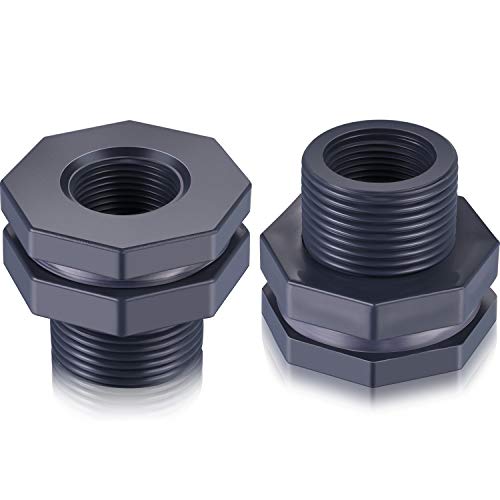
The Outus 3/4-inch pair is useful when the rest of the rain-barrel plumbing is built around a smaller 3/4-inch connection. Two fittings give you enough hardware for a basic barrel outlet and another through-wall connection, or for matching ports on two containers.
The fitting uses a thick sealing gasket intended to conform to a curved barrel wall. That can help on plastic containers where the surface is not perfectly flat. The locking nut uses a reverse-thread arrangement, so pay attention to the direction rather than assuming it tightens like ordinary right-hand hardware.
The product information gives conflicting body dimensions and plastic details. Fit is the main concern: the body can be larger than expected for a standard 3/4-inch bulkhead opening. Measure the fitting itself before cutting the barrel.
Why It Works
- The 3/4-inch nominal size suits common rain-barrel outlets and adapters.
- Two fittings give useful flexibility in a DIY system.
- A thick gasket helps seal against curved plastic walls.
What To Keep In Mind
- The exact material and body dimensions are uncertain.
- The body can be larger than another brand's 3/4-inch fitting.
- The reverse-thread nut can be confusing during installation.
- Inspect the gasket before use because a damaged seal can make the fitting unusable.
A One-Inch Pair for Larger Threaded Connections
3 / 5
Outus 1-Inch Bulkhead Fittings
Nominal Thread
1 in NPT
Pack
2 fittings
Seal
Thick gasket
The 1-inch Outus pair gives a larger nominal plumbing connection than the 3/4-inch version. The clean specification is a 1-inch NPT connection, making it a better fit when the downstream valve, pipe, or adapter already uses that thread standard.
A larger nominal size does not mean every external surface uses a standard pipe thread. The side that accepts additional pipe is easy to confuse with the reverse-thread locking nut. Treat the inside plumbing thread and the outer retaining thread as separate parts with different jobs.
The product information gives conflicting material and body dimensions. The fitting can seal well when the wall hole is correctly sized, but thread quality and fit vary. Test the mating fitting before permanently mounting the bulkhead if the downstream plumbing is critical.
Why It Works
- A 1-inch NPT connection suits larger rain-barrel plumbing than the 3/4-inch pair.
- Two fittings are useful for linked or multi-port barrel builds.
- The thick gasket can seal on a properly drilled curved wall.
What To Keep In Mind
- The exact material and body dimensions are uncertain.
- Do not assume the retaining nut thread is a usable pipe connection.
- Thread quality can vary, so dry-fit the intended adapter before final installation.
A Four-Piece Kit for Building Several Barrels
4 / 5
Qitdathn Four-Piece Bulkhead Kit

Nominal Size
1 in
Pack
4 fittings
Included
Hole saw and plugs
The Qitdathn kit is aimed at larger DIY projects. Four nominal 1-inch bulkhead fittings, four plugs, and a hole saw let you create matching ports across several rain barrels without buying each fitting separately.
The package is convenient, but its size and material details conflict. The nominal thread size is also easy to confuse with the actual body and hole dimensions. That makes careful measurement more important here than with a single-purpose replacement fitting.
The kit still has a clear role when you need several matching through-wall connections and want one cutter for the whole batch. Use the first barrel as a test installation, check for leaks, and only then drill the remaining containers.
Why It Works
- Four fittings suit multi-barrel systems and repeated DIY builds.
- A hole saw and plugs are included.
- Matching fittings can make a linked-barrel project more consistent.
What To Keep In Mind
- The exact material and secondary dimensions are uncertain.
- Nominal size labels can be confusing; measure the real body before drilling.
- Test one installation before cutting every barrel in the project.
A Threaded Metal-Style Connector for Specialized Plumbing
5 / 5
Hooshing Threaded Bulkhead Fitting

Thread Layout
Male and female pipe threads
Seal
Rubber ring
Use
Tank wall connector
The Hooshing fitting is different from the PVC-style bulkheads above because it provides a threaded connector on both sides of the tank wall. That can be useful in a specialized setup where pipe-thread plumbing needs to continue through a container or enclosure.
The product information gives conflicting material and dimensions. Shipped fittings have also differed from the expected size, and their threads do not always mate with ordinary hose hardware. The seal washers can be too small for some installations.
This is therefore the most cautious pick in the group. It can work when the actual fitting in hand matches the planned male and female pipe-thread connections, but it is not the first choice for a simple rain-barrel hose outlet. Dry-fit every downstream part before drilling the tank.
Why It Works
- Male and female pipe-thread sides can solve a specialized pass-through connection.
- The fitting provides a compact through-wall plumbing point.
- It can work in low-pressure water-system applications when the thread match is correct.
What To Keep In Mind
- The exact material and dimensions are uncertain.
- Received size and thread fit have been inconsistent.
- Washer sizing and deep-cut threads can lead to leaks.
- Do not assume garden-hose compatibility from a pipe-thread label.
How to Install a Bulkhead Fitting in a Rain Barrel
Pick a Flat, Accessible Wall Area
Avoid molded ribs, seams, corners, and sharply curved areas. The gasket needs enough flat contact to seal. Also leave room for the nut, valve, or elbow you plan to attach later.
Drill the Correct Hole
Use the cutter supplied with the kit when available. If you supply your own hole saw, use the fitting's actual required opening. Drill slowly enough to control the cut and wear eye protection.
After drilling, remove loose burrs without sanding the opening into a larger oval. The fitting should pass through cleanly but should not rattle in the hole.
Place the Gasket in the Intended Position
Follow the fitting's assembly order. Different bulkheads place the gasket on different sides. A gasket installed on the wrong side may still look tight while leaking once the barrel fills.
Tighten Without Distorting the Wall
Hand-tight plus a controlled final snug is usually better than forcing the nut until the barrel wall bows. Overtightening can squeeze the gasket out or damage the fitting threads.
Test Before Adding Permanent Plumbing
Fill above the bulkhead and inspect the seal before attaching a complicated valve or hose system. Correcting a wall leak is easier while the fitting is still fully accessible.
NPT, NPS, and Garden-Hose Threads Are Not the Same Thing
Thread labels matter. NPT uses a tapered pipe-thread form designed to tighten as the male and female threads engage. NPS is straight pipe thread. Garden-hose thread uses a different form and normally seals with a washer rather than by wedging tapered threads together.
Do not force a hose fitting onto a pipe-thread bulkhead because both are labeled 3/4 inch. Nominal sizes can match while the thread systems do not.
Use a proper adapter when moving from a bulkhead's pipe thread to a garden hose, valve, or other connection type.
Common Bulkhead Fitting Problems
The Fitting Spins but Never Gets Tight
The retaining thread may be damaged, the nut may be on the wrong direction, or the hole may be too large. Stop before the gasket is torn or the barrel wall is damaged.
Water Seeps Around the Gasket
Check for burrs, a twisted seal, a curved wall, or overtightening. Drain the barrel below the fitting before disassembly.
The Next Adapter Will Not Thread In
The thread standard may be wrong even if the nominal size looks correct. Identify NPT, NPS, GHT, or other thread types before adding tape or force.
The Hole Saw Wanders
Use a sharp pilot bit, drill at controlled speed, and support the plastic wall. A wandering cutter can create an oval hole the gasket cannot cover.
The Barrel Wall Flexes Around the Fitting
The selected area may be too thin, curved, or unsupported. A broad flange and gasket can help, but the wall still needs enough structure to hold the connection.
Frequently Asked Questions
What size hole do I need for a 1-inch bulkhead fitting?
There is no universal hole size for every 1-inch bulkhead. The nominal pipe connection is smaller than the body that passes through the wall, so use the hole requirement for the exact product.
Which side of a bulkhead fitting does the gasket go on?
Follow the fitting manufacturer's assembly order. Different designs place seals differently, and copying another brand's layout can cause leaks.
Can I use a bulkhead fitting on a curved rain barrel?
Yes when the flange and gasket can conform to the wall without large gaps. Choose the flattest practical area and avoid ribs or sharp curves.
Can a bulkhead fitting connect directly to a garden hose?
Only if it has a compatible garden-hose thread. Pipe threads such as NPT are different and normally need the correct adapter.
How tight should a rain barrel bulkhead fitting be?
Tight enough to compress the gasket evenly without distorting the barrel wall or squeezing the seal out. More force is not automatically a better seal.
Can I install a bulkhead fitting without reaching inside the barrel?
Some specialized designs can be installed from one side, but many common bulkheads require access to the inside nut or fitting body. Check the installation method before drilling a closed-top barrel.
For the faucet that attaches to the wall connection, rain barrel spigots compare quarter-turn and hose-ready outlets. If the bulkhead will link storage containers, rain barrel linking kits cover the hose side of that connection. For moving excess storm water from a full barrel, rain barrel overflow kits focus on higher-capacity drainage. If your container is larger than a barrel, bulkhead fittings for water tanks compare fittings for broader tank plumbing jobs.