
As an affiliate, we may earn a commission from qualifying purchases. We get commissions for purchases made through links on this website from Amazon and other third parties.
Best Overall
Best 1-Inch Pair
Best 3/4-Inch Pair
A water tank bulkhead fitting has to do more than fill a hole. It creates the permanent pass-through between the tank wall and the rest of the plumbing, so thread type, flange size, gasket contact, and wall thickness all matter. A fitting can be labeled 1 inch and still require a very different wall opening from another 1-inch model.
The four options here are useful for small and medium water tanks, DIY storage containers, troughs, and similar low-pressure setups. They include 3/4-inch and 1-inch bulkheads, plus a threaded metal-style connector for more specialized plumbing. Some products have conflicting material or dimension details, so treat those specifications as uncertain.
For rainwater storage, choose the bulkhead from the pipe or valve you need to connect next. A tank outlet that seals perfectly but has the wrong thread for your valve, hose adapter, or pump line only moves the problem one step downstream.
Water Tank Bulkhead Fittings at a Glance
| Product | Best For | Key Strength | Tradeoff |
|---|---|---|---|
| Two-Piece 1-Inch Kit | New tank openings | Hole saw, plugs, and two bulkheads in one package | Exact secondary dimensions conflict |
| Outus 1-Inch Pair | Larger threaded tank outlets | Two 1-inch NPT fittings with sealing gaskets | Thread and hole fit can vary from expectations |
| Outus 3/4-Inch Pair | Smaller tank drains and hose adapters | Two compact nominal 3/4-inch fittings | Exact body dimensions and material details conflict |
| Hooshing Threaded Bulkhead | Specialized male/female pipe pass-throughs | Threaded connection on both sides | Size, material, washer, and thread consistency are the main concerns |
Match the Bulkhead to the Plumbing After the Tank
A tank outlet is rarely the final component. It may feed a ball valve, hose adapter, pump suction line, filter housing, drain, or linking hose. The bulkhead should therefore be selected as part of that connection chain.
Start with the required pipe size and thread standard. A 1-inch NPT fitting is useful when the next component is also 1-inch NPT. A 3/4-inch bulkhead can be a better match for a garden-hose adapter or small drain system. Do not choose a larger bulkhead simply because the tank itself is large.
Then check the wall. The flange and gasket need enough flat surface around the drilled hole. Ribbed or sharply curved tank sections are harder to seal. Thin polyethylene walls can work well, but the fitting should not be used to support the weight of a long pipe or heavy valve without proper support.
A Complete One-Inch Kit for a New Tank Opening
1 / 4
Two-Piece 1-Inch Tank Bulkhead Kit

Nominal Size
1 in
Pack
2 bulkheads
Included
Hole saw and plugs
This kit is the easiest of the four to use when the tank does not already have an outlet hole. It includes two nominal 1-inch bulkhead adapters, two plugs, and a hole saw. It uses a 48 mm opening and a thick sealing gasket around the through-wall connection.
The matched cutter is the main advantage. Bulkhead sizing can be confusing because the nominal pipe size is not the same as the hole through the tank. Starting with the fitting and hole saw from one kit reduces the risk of cutting an opening based on the wrong brand's dimensions.
The fitting can make a clean seal on a properly drilled water tank. Its exact overall dimensions conflict, and the included cutter has a practical limit: it can handle a few plastic-tank holes without being the right tool for a large production job.
Why It Works
- The hole saw is paired with the intended bulkhead opening.
- Two fittings support a tank with more than one port or a two-tank project.
- Plugs let you close an unused bulkhead.
- The gasketed design works well when the tank wall is clean and properly drilled.
What To Keep In Mind
- The exact secondary dimensions are uncertain.
- The included hole saw can wear during repeated drilling.
- Check which internal thread accepts the next valve or adapter before installing the bulkhead permanently.
A One-Inch Pair for Larger Tank Plumbing
2 / 4
Outus 1-Inch Tank Bulkhead Fittings
Thread Size
1 in
Thread Type
NPT
Pack
2 fittings
The Outus 1-inch pair makes sense when the tank outlet needs to feed larger threaded plumbing. The clean specification is a nominal 1-inch NPT connection, and two fittings give you enough hardware for separate drain and supply ports or for matching connections across two tanks.
The seal uses a thick gasket intended to conform to a container wall. Installation can be leak-free when the drilled opening matches the fitting, but the required hole can differ from another 1-inch bulkhead. That is why the fitting itself should be the drilling reference.
The product information gives conflicting material and overall dimensions. Thread quality can also vary. Dry-fit the exact valve, nipple, or elbow you plan to attach before the tank is full and difficult to work around.
Why It Works
- A 1-inch NPT connection suits many tank drains and supply lines.
- Two fittings support multi-port or multi-tank installations.
- A broad gasket gives the seal useful contact on a suitable tank wall.
What To Keep In Mind
- The exact material and body dimensions are uncertain.
- The wall hole should be based on the actual fitting, not another brand's 1-inch specification.
- Retaining threads and plumbing threads can have different purposes; do not force an adapter onto the wrong side.
A Smaller Pair for Three-Quarter-Inch Connections
3 / 4
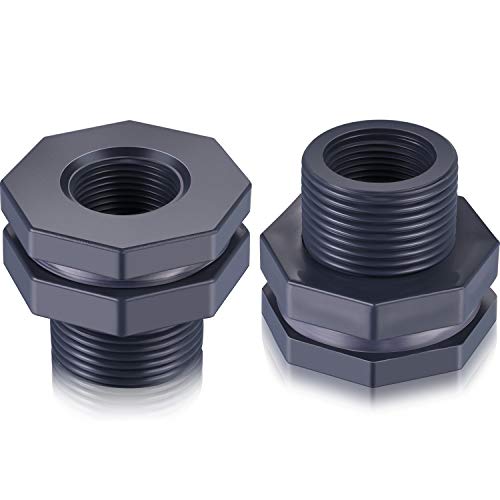
Outus 3/4-Inch Tank Bulkhead Fittings
Thread Size
3/4 in
Pack
2 fittings
Seal
Thick gasket
The 3/4-inch Outus pair is a better match for a tank that only needs a modest drain, hose connection, or small plumbing line. The smaller nominal connection can keep the outlet assembly compact and reduce the amount of wall removed compared with a larger plumbing port.
The fitting uses a reverse-thread locking nut and a thick gasket. That arrangement can work well on rounded tanks, but it is easy to mistake the retaining thread for an ordinary pipe thread. The tank side and downstream plumbing side need to be identified before assembly.
The product information gives conflicting material and exact dimensions. The fitting works in rainwater and tank installations when properly matched, but its body does not always fit an existing nominal 3/4-inch opening. Replacement work therefore needs actual measurement rather than size-name matching.
Why It Works
- The 3/4-inch nominal connection suits smaller tank outlets.
- Two fittings are useful for paired containers or separate tank ports.
- A thick gasket can conform to mildly curved plastic walls.
What To Keep In Mind
- The exact material and body dimensions are uncertain.
- A nominal 3/4-inch fitting may not fit an opening left by another manufacturer's bulkhead.
- Inspect the gasket before installation and replace it if it is deformed or damaged.
A Specialized Male/Female Threaded Pass-Through
4 / 4
Hooshing Threaded Tank Bulkhead

Thread Style
Male/female pipe connection
Thread Type
NPS
Use
Tank wall pass-through
The Hooshing fitting is most useful when the plumbing plan calls for a threaded connection on both sides of the tank wall. It uses an NPS-style thread designation and is intended to provide male and female pipe-thread surfaces across the container wall.
That specialized layout is also why it requires the most care. The product information gives conflicting size and material details. Shipped fittings have differed from expected dimensions, washers have been too small for some installations, and the threads do not always mate with common hose hardware.
Treat this fitting as a part that must be matched in hand before drilling. If the male and female threads connect cleanly to the exact pipe components in the project, it can solve a compact pass-through problem. If the plan simply needs a rainwater-tank outlet and valve, one of the more predictable gasketed bulkheads above is easier to work with.
Why It Works
- Male and female pipe-thread surfaces can solve specialized plumbing layouts.
- The pass-through design keeps the wall connection compact.
- It can work in low-pressure tank systems when every thread and washer matches.
What To Keep In Mind
- The exact material and dimensions are uncertain.
- Received size and thread compatibility can be inconsistent.
- The supplied washer arrangement may not suit every tank wall.
- Pipe thread is not the same as garden-hose thread.
How to Size a Bulkhead for a Water Tank
Start With Flow, Not Tank Capacity
A large water tank does not automatically need a large outlet. The required flow depends on what the tank feeds. A small garden hose can work through a smaller fitting. A pump suction line or high-flow drain may need a larger port to avoid unnecessary restriction.
Use the pump, valve, filter, hose, or downstream pipe size as part of the decision. Avoid shrinking and expanding through multiple adapters unless there is a clear reason.
Check the Tank Wall Thickness
Bulkheads have a limited amount of threaded body available for the flange, gasket, wall, and nut. A fitting that works on a thin barrel may not have enough thread for a thick molded tank wall.
Measure the wall when possible. Also account for curved sections and reinforcing ribs, which can make the effective sealing area worse than the raw thickness suggests.
Leave Space for the Outside Plumbing
The bulkhead may fit the tank while the attached valve does not. Leave enough space to turn a valve handle, thread on an elbow, remove a filter, or disconnect a hose later.
A fitting installed too close to the tank base or a frame member can make simple maintenance unnecessarily difficult.
Bulkhead Threads: What to Check
NPT is a tapered pipe thread. NPS is straight pipe thread. Garden-hose thread uses a different sealing method. Nominal sizes can look similar without being interchangeable.
A bulkhead's large external retaining thread may also look like pipe thread even though it is only there for the locking nut. Do not assume that every visible thread is a usable plumbing connection.
Dry-fit the next component before filling the tank. If an adapter only turns a fraction of a rotation or runs all the way down without sealing, stop and identify the thread standard.
Installing a Bulkhead in a Larger Tank
Mark the hole on a smooth wall area with enough room around it for both the inner and outer flange. Drain and clean the tank before drilling. If the tank is used for rainwater, keep plastic chips and debris out of the storage area.
Use the correct hole saw at controlled speed. Deburr the opening gently. Install the gasket in the position required by the specific fitting and tighten the nut gradually.
Do not hang a heavy valve, filter, or long pipe from the bulkhead without support. The tank wall and seal should not become a bracket for the rest of the plumbing.
Fill the tank above the fitting and inspect it under static water head before relying on the outlet for regular service.
Common Water Tank Bulkhead Problems
A Replacement Fitting Will Not Fit the Old Hole
Nominal size does not define the body diameter. Measure the old hole and the new fitting before assuming they are compatible.
The Gasket Leaks on a Curved Wall
The flange may not have enough flat contact. Move the fitting to a better area when possible rather than trying to solve a geometry problem with excessive tightening.
The Valve Will Not Thread Into the Bulkhead
The connection may use NPT, NPS, or another thread form. Identify both thread forms and use a proper adapter.
The Tank Wall Bows When the Plumbing Is Attached
The external pipe or valve is too heavy or poorly supported. Add independent pipe support so the bulkhead only seals the wall opening.
The Fitting Cracks or Starts Seeping
Drain below the port and replace the damaged fitting. Do not rely on sealant to hold together a cracked structural connector.
Frequently Asked Questions
What size bulkhead fitting do I need for a water tank?
Choose the bulkhead from the flow and plumbing connection you need, not from tank capacity alone. Match the downstream valve, pipe, hose, or pump line.
Is a 1-inch bulkhead fitting actually 1 inch wide?
No. The nominal size describes the plumbing connection. The body and wall hole are larger, and different brands can require different openings.
Can I use a bulkhead fitting for a pump suction line?
Yes when the fitting size, tank wall, thread, and pump inlet are suitable for the planned flow. Support the external plumbing so the pump line does not load the tank wall.
Should the gasket go inside or outside a water tank?
Use the assembly order specified for the exact fitting. Bulkhead designs differ, so there is no safe universal rule based only on appearance.
Can I install a bulkhead fitting in a curved polyethylene tank?
Yes if the selected area gives the flange and gasket enough even contact. Avoid ribs and the tightest curves when a flatter location is available.
Can I connect a garden hose to a water tank bulkhead?
Yes with a compatible garden-hose-thread outlet or the correct adapter. Do not force a hose fitting onto NPT or NPS pipe threads.
For smaller barrel-focused options, bulkhead fittings for rain barrels cover compact DIY connections. If the tank needs a complete mix of outlet hardware, water tank fitting kits compare multi-part packages. For isolating the outlet, ball valves for rainwater tanks cover quarter-turn shutoff choices. If you need fast removable hose connections, camlock fittings for water tanks explain that connection style.